
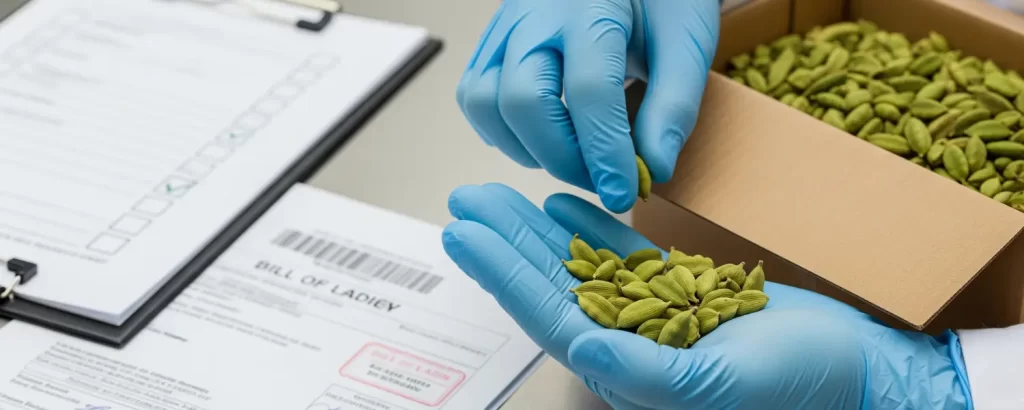
The arrival of a container of fragrant Indian cardamom is an exciting moment for any importer. The final step in a successful sourcing journey is the verification of the shipment. Knowing what to look for is crucial to ensure the product meets your quality standards, protects your investment, and satisfies your customers.
As a leading cardamom export partner based in Pune, India, we believe in complete transparency. A reputable exporter will always deliver a product that matches the agreed-upon specifications. This guide provides a professional checklist for inspecting your cardamom shipment, especially relevant as the new 2025-2026 harvest season deliveries begin to arrive.
1. The Paper Trail: Verifying Your Documentation First
Before you even cut open the first bag, ensure all your documents are in order. The paperwork is your first line of quality assurance.
Bill of Lading (B/L): Confirms the shipment details, container number, and quantities.
Commercial Invoice & Packing List: Check that the product, quantity, and price match your purchase order.
Phytosanitary Certificate: This is a mandatory document certifying that the cardamom is free from pests and diseases, complying with your country’s import regulations.
Certificate of Origin: Verifies the product is from India, often necessary for customs.
Certificate of Analysis (COA): This crucial lab report details the technical specifications. Cross-reference the data on the COA with the agreed-upon specs in your contract.
2. The Visual Inspection: Grades, Colour, and Condition
Once the documents are verified, it’s time to assess the physical product. Draw samples from multiple bags throughout the container to get a representative overview.
Colour: For green cardamom, the colour is a primary quality indicator. Look for a vibrant, uniform green, characteristic of premium varieties like Alleppey Green Cardamom. A yellowish or pale green hue can indicate older stock or improper drying.
Size and Grade Uniformity: This is critical. If you ordered a specific grade, such as AGEB (Alleppey Green Extra Bold) or 8mm, the vast majority of pods in the sample should meet that size. A significant mix of smaller pods is a red flag that the shipment may not be true to grade.
Physical Condition: The pods should be whole, well-formed, and three-cornered. Check for an excessive percentage of “splits” or open pods, unless that was the grade you specifically ordered. Look closely for any signs of insect damage (small holes) or visible mould.
Import products for your Needs

3. The Sensory Test: Aroma and Texture
Your senses are powerful tools in quality assessment.
Aroma: Crush a few pods between your fingers. The aroma should be strong, pungent, and pleasantly aromatic. This is a good indicator of high volatile oil content. A weak, dusty, or musty smell is a clear sign of old or poorly stored cardamom.
Texture: The pods should feel firm and crisp. If they feel soft or leathery, it may indicate a high moisture content, which can lead to spoilage.
4. Beyond the Eye: Cross-Referencing with the COA
Now, connect your physical inspection with the data from the Certificate of Analysis.
Volatile Oil Content: Your sensory check for a strong aroma should be backed by the percentage listed on the COA. Higher content means more flavour.
Moisture Content: The firm texture you felt should correspond to a low moisture reading on the COA, typically below 12%.
Admixture/Purity: Visually scan your sample for any foreign matter (stems, small stones, etc.). The amount should be negligible and within the limits specified for your grade on the COA.
Ensuring Quality with a Trusted Partner
Thoroughly inspecting your cardamom export shipment is a vital business practice. By systematically checking the documentation, visual appearance, sensory qualities, and lab data, you can confidently verify that you have received the premium Indian cardamom you invested in.
A transparent and reliable cardamom export partner from India will welcome this scrutiny, as they are confident in the quality of their product. At Exim Internationals, we pride ourselves on consistently delivering shipments that meet and exceed our clients’ specifications.
Planning your procurement for the new cardamom season? Contact Exim Internationals today to partner with an exporter who guarantees quality you can see, smell, and trust.
Frequently Asked Questions (FAQs)
1. What is the first thing I should do when my cardamom shipment arrives?
Before inspecting the product, verify that all shipping and customs documents are present and correct. Ensure the container and seal numbers match the Bill of Lading.
2. How can I visually identify a high-quality green cardamom pod?
Look for a uniform, vibrant green colour, a whole and unsplit pod (unless you ordered splits), and a size that is consistent with the grade you ordered (e.g., 8mm). It should be free of blemishes and mould.
3. What is the difference between AGEB and AGB cardamom grades?
AGEB stands for Alleppey Green Extra Bold, which is one of the highest grades, consisting of pods 8mm and larger. AGB stands for Alleppey Green Bold, a grade slightly smaller, typically around 7mm.
4. What does a musty smell indicate in a cardamom shipment?
A musty or mouldy smell is a serious red flag. It usually indicates that the cardamom has been exposed to moisture and has begun to spoil, or it is very old stock.
5. Why is the Phytosanitary Certificate so important for a cardamom export?
This certificate is a mandatory customs document that proves the agricultural product has been inspected in the country of origin and is free from harmful pests and plant diseases, making it safe for import.
6. What is the ideal moisture content for exported cardamom?
To ensure a long shelf life and prevent mould, the ideal moisture content for exported green cardamom should be low, typically under 12%.
7. Are the quality standards for Alleppey Green Cardamom different?
Yes, Alleppey Green Cardamom is a GI-tagged product, and its grades (like AGEB) are associated with specific quality standards regarding size, colour, and origin from the Alleppey region, often commanding a premium price.
8. What should I do if the cardamom export shipment doesn’t match the specifications?
Immediately document the issues with clear photos and notes. Contact your exporter right away to report the discrepancy. A professional exporter will have a clear process for addressing such claims. This is why choosing a reliable partner is crucial.
About us
Exim Internationals is a premier export company dedicated to delivering the finest products from India to international markets. Our mission is to establish India as a global export powerhouse, contributing to economic growth and showcasing the richness of Indian goods worldwide.
From the pashmina shawls and apples of the North to the spices of the South, the fruits and powders of the West, and the tea and bamboo of the East, we connect every corner of India with the global market.
Certification we have: FSSAI, APEDA, IEC, UDYAM, FIEO, Spices Board, Coconut
Contact us
Samin heritage, Sl building, Shop no. 19, Chandan wadi, Almeda road Thane west, Maharashtra, India-400601.
Email Us: support@eximinternationals.com
Call Us: +91 9820446601 | +91 9321559185

