From the wellness blogs of California to the trendy cafes of London, a simple, golden-hued drink has taken the world by storm: turmeric powder in water. This modern health elixir, rooted in ancient Indian tradition, has created an unprecedented global demand. Consumers are seeking its anti-inflammatory and antioxidant benefits, but behind this simple daily habit lies a complex and formidable challenge: a global supply chain tasked with moving this treasured spice across continents.
For businesses in the food, beverage, and nutraceutical sectors, this trend represents a massive opportunity. However, capitalizing on it requires more than just a marketing plan; it requires a deep understanding of the intricate logistics involved in exporting bulk turmeric powder from India. This is the journey of how India’s “golden spice” meets global demand, a story of precision, quality control, and logistical expertise.
More Than a Spice: Understanding the Demand for Indian Turmeric
Before a single bag is shipped, it’s crucial to understand why Indian turmeric is the world’s gold standard. The secret lies in its highcurcumin percentage, the active compound responsible for its potent health benefits. Varieties grown in regions like Erode and Sangli are renowned for their vibrant colour and superior curcumin content, making them the preferred choice for international buyers. This isn’t just a commodity; it’s a high-value ingredient. A reliableturmeric powder exporter understands this distinction and builds their entire process around preserving this inherent quality.
Step 1: Sourcing and Procurement – The Foundation of Quality
The logistics of the turmeric supply chain begin not at a port, but in the sun-drenched fields of rural India. The first step is sourcing high-quality raw turmeric fingers. A proficient exporter doesn’t just buy from the open market; they establish relationships with trusted farmers and aggregators.
This initial phase involves stringent checks. Samples are tested for moisture, purity, and most importantly, curcumin levels. This ensures that the raw material meets the client’s quality specifications from the very start. Securing a consistent, high-quality supply is the bedrock upon which the entire export operation is built.
Step 2: Processing and Packaging – From Raw Root to Export-Ready Powder
Once procured, the raw turmeric undergoes a multi-stage transformation.
Cleaning and Drying: The fingers are thoroughly cleaned to remove soil and foreign matter. They are then dried, either by the sun or in industrial dryers, to bring the moisture content down to the ideal level (typically under 12%) for grinding and long-term storage.
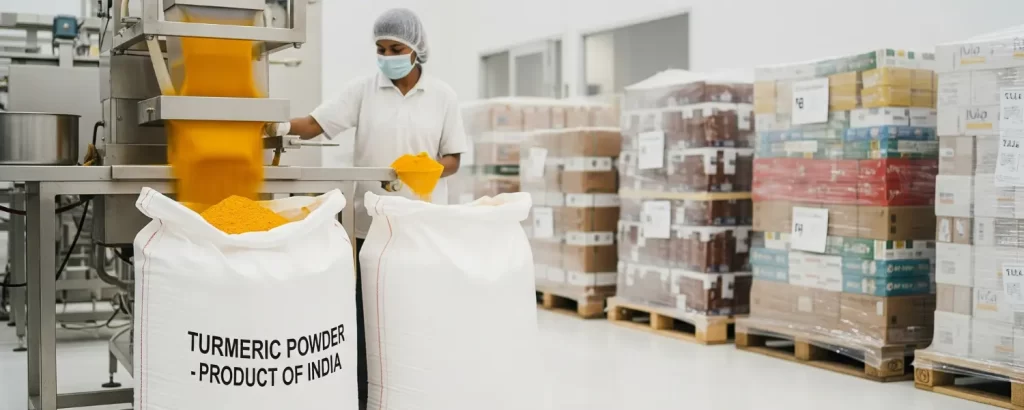
Grinding and Sterilisation: The dried fingers are pulverized into a fine powder. For food and nutraceutical-grade turmeric, this powder often undergoes a steam sterilization process. This critical step eliminates microbial contaminants like bacteria and yeast without using chemicals, ensuring the product is safe for human consumption and meets strict international food safety standards.
Packaging: The finishedbulk turmeric powder is meticulously packaged. This is a crucial logistical step to protect the product’s integrity. Standard packaging includes 25 kg multi-wall paper bags with an inner food-grade poly liner. This protects the powder from moisture, light, and contaminants during its long journey, ensuring it arrives in perfect condition for wholesale distribution.
Step 3: Navigating the Maze – Documentation and Compliance
This is where an expert exporter proves their worth. Sourcing from India involves a labyrinth of paperwork, and any error can lead to costly delays at customs. The key documents in the logistical chain include:
Certificate of Analysis (COA): A lab report detailing the product’s specifications, including curcumin content, moisture, and microbial tests.
Phytosanitary Certificate: Issued by a government body, this certifies that the turmeric is free from pests and diseases.
Certificate of Origin: Verifies that the product originates from India, which is essential for customs and tariff purposes.
Commercial Invoice, Packing List, and Bill of Lading: The core shipping documents that detail the transaction and cargo.
Navigating the specific requirements of the destination country, be it the FDA in the USA or the EFSA in Europe, is a non-negotiable part of the process.
Import products for your Needs
Step 4: The Final Mile – Freight Forwarding and Shipment
With the product ready and paperwork in order, the final logistical phase begins. Containers are booked on vessels heading to the destination port. Depending on the order size, shipments are made via FCL (Full Container Load) for large orders or LCL (Less than Container Load) for smaller quantities.
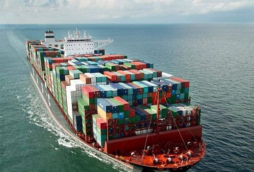
The turmeric powder, securely packed, is transported from the processing facility to a major port like Nhava Sheva (JNPT) near Mumbai. Here, it undergoes customs clearance before being loaded onto the container ship. Throughout this journey, constant coordination between the exporter, freight forwarder, and shipping line is essential to ensure a smooth and timely departure.
Your Partner in Supplying the Demand
The journey from a field in India to a glass of turmeric powder in water on the other side of the world is a testament to modern logistics. It’s a complex dance of quality control, precise processing, rigorous documentation, and expert coordination.
For businesses looking to meet the surging global demand, partnering with a knowledgeable and experienced turmeric powder exporter is not just an advantage—it is a necessity. A true partner doesn’t just sell a product; they manage this entire intricate supply chain, delivering quality, reliability, and peace of mind.
Ready to secure your supply of high-quality Indian turmeric? Contact our logistics experts at Exim Internationals today to discuss your bulk requirements and let us manage the complexities for you.
Frequently Asked Questions (FAQs)
1. What is the typical Minimum Order Quantity (MOQ) for exporting bulk turmeric powder?
The MOQ can vary depending on the exporter and packaging, but for sea freight, it often starts from 500 kg to 1 metric ton to make the shipment economically viable. We can provide specific quotes based on your business needs.
2. How is bulk turmeric powder packaged to ensure its quality during long sea journeys?
To protect its quality, bulk turmeric powder is typically packed in 25 kg multi-wall paper bags with an inner food-grade poly-liner. This system protects the powder from moisture, contaminants, and light, preserving its aroma, colour, and curcumin content.
3. What is a Certificate of Analysis (COA) and why is it crucial for my import?
A Certificate of Analysis (COA) is a lab-verified document that details the product’s specifications, including its curcumin percentage, moisture level, and microbial counts. It is crucial for you as an importer to verify that you are receiving the exact quality of product you paid for and to ensure it meets your country’s safety standards.
4. Which region in India is best for sourcing high-curcumin turmeric powder?
Regions like Erode in Tamil Nadu and Sangli in Maharashtra are renowned for producing turmeric with a high curcumin content (often above 4-5%). As your export partner, we source from these prime locations to ensure the highest quality for our clients.
5. What does “steam sterilized” turmeric powder mean, and why is it important?
Steam sterilization is a natural, chemical-free process that uses high-temperature steam to reduce the microbial load (like bacteria and yeast) in the turmeric powder. It’s crucial for products intended for human consumption as it ensures the powder is safe and meets strict international food-grade standards without affecting its quality.
6. How long does the entire export process usually take from order to shipment?
The timeline can vary, but a typical process from order confirmation to vessel departure takes approximately 15-25 days. This includes procurement, processing, lab testing, packaging, and inland transportation to the port.
7. Can you provide documentation that complies with my country’s specific import regulations (e.g., FDA, EFSA)?
Yes, a key part of our service is ensuring full compliance with the destination country’s regulations. We manage all necessary documentation, including meeting the specific requirements set by bodies like the US Food and Drug Administration (FDA) or the European Food Safety Authority (EFSA).
8. What’s the difference between shipping FCL and LCL for bulk turmeric?
FCL (Full Container Load) means you book an entire container for your shipment, which is ideal for large orders (typically 18-20 metric tons). LCL (Less than Container Load) means your goods share container space with other shipments, making it a cost-effective option for smaller, wholesale quantities. We can advise on the best solution for your order size.