
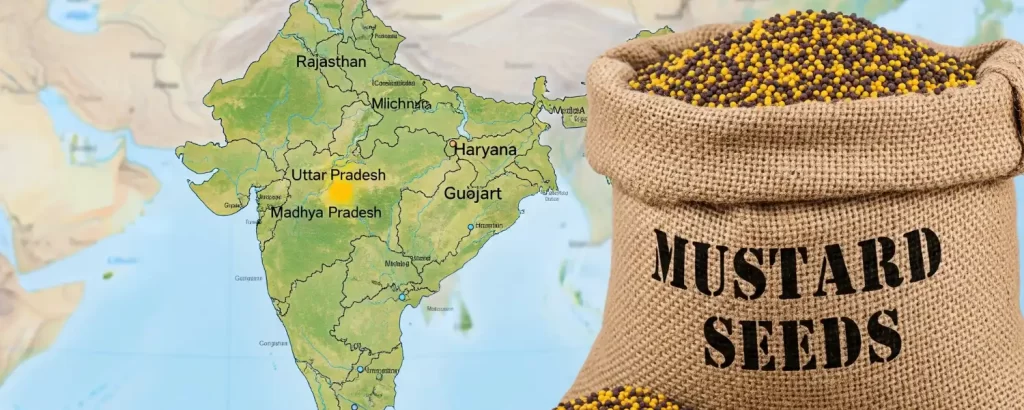
For any global buyer, commodity trader, or food manufacturer, the decision to source bulk mustard seeds from India is a strategic first step. India is a world leader in mustard producer, offering quantity, quality, and variety. However, the smartest question isn’t if you should source from India, but where in India you should focus your efforts.
India is a vast country with distinct agricultural zones. Understanding its major mustard production hubs is the key to developing a sophisticated sourcing strategy—one that optimizes for quality, price, and logistical efficiency. As we look ahead to the upcoming Rabi crop season, this guide will serve as your map to the heart of India’s mustard production.
The Mustard Heartland: Why India's Geography Matters
First, it’s essential to understand that mustard (Sarson) is a Rabi crop, meaning it’s sown in winter (typically October-December) and harvested in spring (February-April). Its success is intrinsically linked to the temperate climate of these months, making certain regions far more productive than others.
These geographical hubs don’t just produce quantity; they are often known for specific qualities, such as higher oil content, distinct pungency levels, or a particular seed variety (black, brown, or yellow). Knowing these hubs allows a buyer to target their sourcing for specific end-uses, whether it’s for high-quality oil pressing or for creating culinary-grade condiments.
Hub 1: Rajasthan - The Uncontested Leader
When you think of mustard production in India, you should think of Rajasthan. This western state is the undisputed champion, consistently accounting for the largest share of the country’s total output.
Key Districts: The primary mustard belt includes districts like Alwar, Bharatpur, Sri Ganganagar, and Tonk.
Market Characteristics: Markets (mandis) in Rajasthan are the key price setters for the entire country. The seeds from this region are highly sought after for their sharp pungency and consistently good oil content, making them a favourite for oil millers.
Why it Matters to You: Sourcing from a mustard producer with strong links to the Rajasthan network ensures access to the highest volume and most competitively priced seeds in the market.
Hub 2: Uttar Pradesh - The Prolific Producer
Following closely behind Rajasthan, the state of Uttar Pradesh (UP) is another critical hub for mustard cultivation. Its fertile plains make it a prolific producer, contributing significantly to India’s supply.
Key Districts: The Agra, Mathura, and Aligarh belt is a major contributor.
Market Characteristics: UP’s production serves both its massive internal market and contributes to the national export pool. The scale of farming here provides a deep well of supply, offering buyers an alternative and complementary sourcing location to Rajasthan.
Hub 3: Madhya Pradesh & Haryana - The Quality Contenders
While Rajasthan and UP lead in volume, states like Madhya Pradesh (MP) and Haryana are vital contributors known for their quality.
Madhya Pradesh: The Bundelkhand region of MP is a significant mustard-growing area.
Haryana: Benefitting from its proximity to the national capital, Delhi, Haryana’s production is logistically significant. It supplies many of the processing and export houses in the northern belt.
Why they Matter to You: These states provide diversification in your sourcing strategy. A good exporter will have networks in these regions to balance supply and access seeds with slightly different profiles.
Import products for your Needs

Beyond the Hubs: The Role of a Strategic Exporter
Knowing these production hubs is valuable market intelligence. However, for an international buyer, it is practically impossible to source directly from these local markets. This is where your export partner becomes indispensable.
A strategic mustard producer and exporter does not just sell you a product. They act as your “boots on the ground” to:
Aggregate Supply: They leverage their networks to source the best quality seeds from various hubs based on the season’s output.
Ensure Quality Control: They conduct rigorous testing for moisture, purity, and oil content, ensuring the product meets your exact specifications.
Manage Processing: They handle the cleaning, grading, and packaging of the seeds in export-worthy bags.
Navigate Logistics: Most importantly, they manage the entire complex supply chain—from the farm gate to the port, including all documentation and customs clearance.
A Smarter Sourcing Strategy for 2026
To effectively source bulk mustard seeds from India, a two-pronged approach is needed: understanding the geographical centres of production and partnering with an exporter who can navigate them. By knowing the strengths of hubs like Rajasthan and UP, you can have more intelligent conversations with your supplier and build a sourcing plan that is resilient, cost-effective, and quality-focused.
As the industry prepares for the 2026 harvest, now is the time to build that strategy.
Planning your mustard seed procurement for the upcoming season? Contact Exim Internationals to leverage our deep network across all of India’s major production hubs.
Frequently Asked Questions (FAQs)
1. Which state is the largest mustard producer in India?
Rajasthan is the largest mustard-producing state in India, consistently contributing the highest volume to the national output.
2. What is a Rabi crop, and when is the mustard harvesting season in India?
Rabi crops are winter crops in India, sown between October and December. The mustard harvesting season typically runs from late February to April.
3. What are the differences between black, brown, and yellow mustard seeds?
Black mustard seeds are the most pungent and are popular in South Indian cuisine. Brown seeds are less intense and are used for making Dijon mustard. Yellow mustard seeds are the mildest and are used for the classic American yellow mustard and in pickling.
4. Can I buy directly from a mandi (market) in Rajasthan as an international buyer?
No, it is not feasible. Local mandis operate on complex, localized systems. International buyers require a licensed exporter to handle quality control, payment, documentation, and logistics.
5. What is the average oil content I can expect from Indian mustard seeds?
The oil content can vary based on the variety and region, but high-quality Indian mustard seeds typically have an oil content ranging from 38% to 42%.
6. How does the location of a production hub affect logistics and shipping times?
Hubs in Rajasthan and Haryana are well-connected to western ports like Mundra and Nhava Sheva, leading to efficient transit times. An exporter’s ability to manage inland logistics from these hubs is key.
7. What quality checks are performed when sourcing from these hubs?
Key quality checks include testing for moisture content (must be low to prevent mould), oil content, seed purity (admixture), and physical inspection for damaged seeds or foreign matter.
8. Why is partnering with an Indian exporter crucial for sourcing from these hubs?
An exporter is essential for navigating the local markets, ensuring consistent quality through testing and grading, handling complex export documentation, and managing the entire supply chain to deliver the product to your port.
About us
Exim Internationals is a premier export company dedicated to delivering the finest products from India to international markets. Our mission is to establish India as a global export powerhouse, contributing to economic growth and showcasing the richness of Indian goods worldwide.
From the pashmina shawls and apples of the North to the spices of the South, the fruits and powders of the West, and the tea and bamboo of the East, we connect every corner of India with the global market.
Certification we have: FSSAI, APEDA, IEC, UDYAM, FIEO, Spices Board, Coconut
Contact us
Samin heritage, Sl building, Shop no. 19, Chandan wadi, Almeda road Thane west, Maharashtra, India-400601.
Email Us: support@eximinternationals.com
Call Us: +91 9820446601 | +91 9321559185

