Vegetables

Wholesale Red Onions
Vegetables Export Import Fruits Spices

Wholesale Red Onions: Curing, Grading, and Transit Ventilation Standards

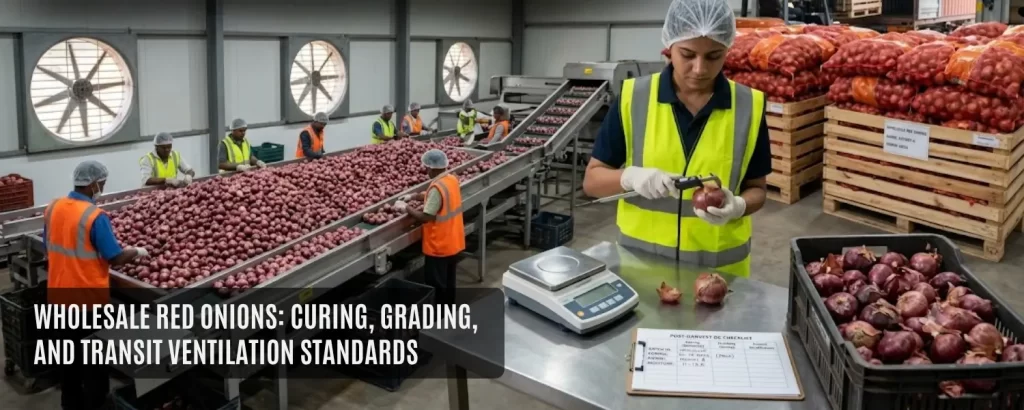
In the global fresh produce trade, sourcing wholesale red onions is uniquely challenging. Unlike hardier root vegetables, onions are highly susceptible to moisture-induced decay. A single 40ft container packed with improperly dried onions can generate immense internal heat and humidity during a 20-day ocean voyage, resulting in catastrophic neck rot, sprouting, or total cargo rejection at the destination port. For B2B procurement directors and international food-service distributors, mitigating these risks requires sourcing from regions with proven agronomic quality—such as India’s Nashik (Lasalgaon) belt—and enforcing strict technical Service Level Agreements (SLAs). In this guide, we break down the critical post-harvest curing processes, exact millimeter grading standards, and the non-negotiable reefer container ventilation settings required to safely export wholesale red onions. Post-Harvest Curing: The First Defense Against Neck Rot The most critical phase of onion exportation happens before the product ever reaches a packhouse. Freshly harvested onions contain high moisture levels, particularly around the “neck” where the foliage was cut. If packed immediately, this moisture breeds Botrytis allii (neck rot) and bacterial soft rot. To ensure long-term transit viability, exporters must implement a rigorous two-stage curing protocol: Field and Shadow Curing Field Curing (Windrowing): After being uprooted, the onions are left in the field for several days to dry under the natural sun. Shadow Curing: The onions are moved to ventilated, shaded racks. This process forces the outer layers of the onion to rapidly dry out, forming a tight, papery skin. The Hermetic Seal Proper curing achieves two things: it reduces the overall bulb moisture to safely below 12%, and it tightly closes the neck. This hardened outer skin acts as a natural hermetic seal, protecting the fleshy inner scales from airborne fungal spores and dehydration during maritime transit. If your supplier skips shadow curing to rush an order, the onions will sweat inside the container and rot. Export Grading Parameters: Size and Cosmetic Tolerances In wholesale B2B markets across the Middle East, Southeast Asia, and Europe, consistency is king. Commercial kitchens and supermarket chains require uniform bulb sizes to standardize their food preparation and display. Export-grade Nashik red onions—famed for their high Brix solid content (11-13%) and long shelf life—must undergo strict mechanical and manual grading. Millimeter Size Classifications Top-tier exporters calibrate their grading lines to match specific regional buyer requirements: 35mm – 45mm: Medium Grade (Popular for standard economy retail). 45mm – 55mm: Standard Export Grade A (The global benchmark for B2B commercial prep). 55mm – 65mm+: Super Wholesale / Premium Garva (Demanded by premium retail and Gulf wholesale markets). Cosmetic Defect Tolerances Beyond size, QA/QC inspectors enforce an Acceptable Quality Level (AQL) with a maximum 2% defect tolerance. Sorters must manually cull: Doubles / Splits: Bulbs that have split into two internal cores, which spoil faster. Thick-Necks: Bulbs that failed to dry and seal properly during curing. Sprouts & Rooting: Any sign of green vegetative growth. Ventilated Packaging Export onions should never be packed in solid plastic. They must be packed in leno mesh or hessian jute bags (typically 10kg, 25kg, or 50kg). These highly breathable bags prevent microclimate moisture buildup around the bulbs Transit Ventilation and Reefer Container Standards Ocean transit is the ultimate test of onion quality. While some short-haul routes allow for open-top ventilated containers, long-haul B2B exports demand precise microclimate management inside a refrigerated (reefer) container. Onions constantly respire, emitting heat, moisture, and carbon dioxide. If these elements accumulate in a closed 40ft High Cube container (which holds approx. 28-29 Metric Tons of cargo), the entire payload will degrade in a matter of days. Mandatory Reefer Settings When finalizing your maritime logistics, procurement directors must stipulate the following setpoints on the Bill of Lading: Temperature Setpoint (+4°C to +6°C): Unlike bananas or tropical fruits, onions require cool transit. Maintaining +4°C to +6°C puts the bulb into a state of dormancy, completely halting the sprouting process. Relative Humidity (65% – 70% RH): Humidity control is a delicate balancing act. If RH drops below 65%, the onions will lose water weight and arrive shriveled. If RH exceeds 75%, condensation forms on the bulbs (container sweat), immediately triggering root growth and mold. Continuous Airflow / Ventilation (15 – 20 CBM/hour): This is the most crucial setting. The reefer’s ventilation baffles must be open to allow 15 to 20 Cubic Meters of fresh air per hour. This flushes out the expelled CO2 and excess humidity, preventing the cargo from suffocating. By demanding these rigorous curing, grading, and ventilation standards, B2B buyers can confidently source wholesale red onions that arrive firm, dry, and ready for immediate, profitable distribution. Frequently Asked Questions (FAQs) What is the ideal temperature for shipping wholesale red onions? For long-haul ocean transit, reefer containers should be set between +4°C and +6°C. This temperature range keeps the onions dormant and prevents premature sprouting. Why is post-harvest curing necessary for export onions? Curing dries out the outer layers of the onion and seals the neck. This prevents moisture-loving bacteria and fungi (like neck rot) from entering the bulb during transit, significantly extending the product’s shelf life. What happens if container ventilation is set too low? Onions respire, releasing moisture and carbon dioxide. If ventilation is set below 15 CBM/hour, CO2 and humidity will build up, leading to condensation, rapid fungal decay, and cargo suffocation. Which onion size is best for commercial B2B food preparation? The 45mm to 55mm (Grade A) and 55mm to 65mm+ sizes are the global benchmarks for commercial and premium retail buyers, offering ideal uniformity and weight for food-service prep. Why are export onions packed in mesh bags instead of cartons? Breathability is critical for onions. Leno mesh or jute bags allow the reefer’s chilled, ventilated air to circulate completely through the pallet, removing heat and excess moisture from the center of the cargo. For long-haul ocean transit, reefer containers should be set between +4°C and +6°C. This temperature range keeps the onions dormant and prevents premature sprouting. Curing dries out the outer layers of the onion and seals the neck. This prevents moisture-loving

Wholesale Red Onions: Curing, Grading, and Transit Ventilation Standards Read Post »
Sourcing export pomegranates
Export Import Fruits Spices Vegetables

Sourcing Export Pomegranates: Meeting EU MRL Standards and Bhagwa Grading

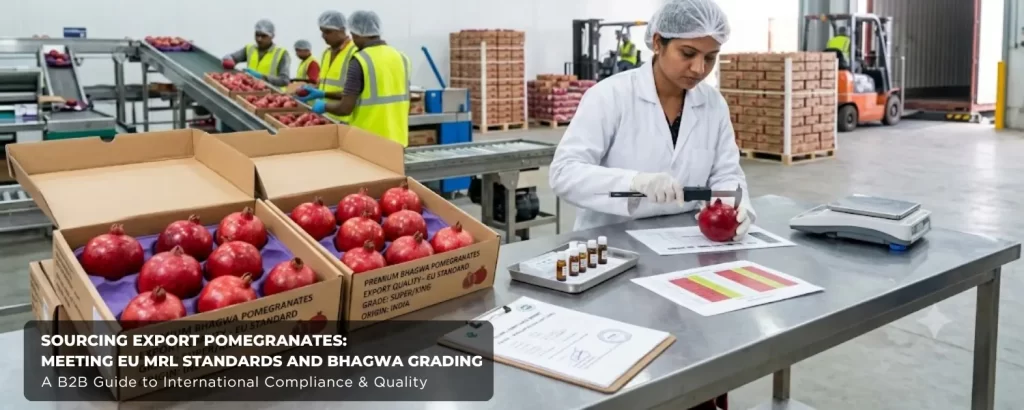
The European and Middle Eastern markets have an insatiable appetite for premium pomegranates, driven by the booming health-food and cold-pressed juice sectors. For B2B procurement directors and fresh produce importers, capitalizing on this demand requires securing a reliable supply of high-yield, visually flawless fruit. Globally, the Indian Bhagwa pomegranate has emerged as the gold standard for fresh retail export. However, the international pomegranate trade is fraught with regulatory landmines. The European Union operates under some of the strictest food safety laws in the world, and a single shipment exceeding pesticide residue limits will result in immediate rejection, incineration, and severe financial loss. In this guide, we break down the technical parameters of sourcing export pomegranates, focusing on the physical grading of the Bhagwa variety and the critical lab analytics required to pass EU Maximum Residue Limit (MRL) standards. The Bhagwa Advantage: Why Importers Demand It India is the world’s largest producer of pomegranates, and the Bhagwa variety (cultivated primarily in the arid regions of Maharashtra) constitutes the vast majority of its export volume. Why do European and Middle Eastern procurement teams specifically request Bhagwa? Deep Red Arils: Unlike varieties that yield pale pink seeds, Bhagwa produces dark, ruby-red arils that are highly attractive in transparent retail clamshells. Soft Seeds: The seeds inside the arils are exceptionally soft, making them ideal for fresh consumption and preventing damage to commercial juice-press machinery. Thick Rind (High Shelf Life): The Bhagwa boasts a thick, glossy, saffron-to-red skin. This natural armor provides remarkable resistance to transit scuffing and moisture loss, granting the fruit a 30 to 45-day shelf life when properly managed in cold storage. Export Grading Standards for B2B Procurement When you issue a Request for Quotation (RFQ) for wholesale pomegranates, you cannot rely on generic terms like “large” or “premium.” B2B transactions rely on strict, quantifiable grading parameters. Export-grade Bhagwa pomegranates are graded primarily by weight and diameter, which dictates how they are packed into the standard 3.5 kg to 4.5 kg corrugated display cartons. Standard Grading Categories Super Size: > 350 grams (Counts: 9 to 10 per 3.5 kg box) King Size: 300g to 350g (Counts: 10 to 12 per box) Queen Size: 250g to 300g (Counts: 12 to 15 per box) Prince Size: 200g to 250g (Counts: 15 to 18 per box) Cosmetic Tolerances Beyond weight, QA/QC inspectors evaluate the rind. To meet premium export standards, the skin must be free from bacterial blight spots, sunburn, and severe thrips (insect) damage. Minor superficial scuffing is typically tolerated at an AQL (Acceptable Quality Level) of less than 3% per batch. Navigating EU MRL (Maximum Residue Limit) Compliance The single highest risk when sourcing export pomegranates is failing the destination port’s phytosanitary and chemical inspections. The European Food Safety Authority (EFSA) enforces draconian Maximum Residue Limits (MRLs) for agricultural pesticides. Because pomegranates are susceptible to fungal infections during the monsoon season, farmers often use chemical fungicides and insecticides. If these chemicals are applied too close to the harvest window, the residue on the skin will exceed the EU’s legally permitted parts-per-million (ppm) thresholds. The GlobalGAP and Lab Testing Requirement To successfully import into the EU or UK, your B2B supplier must source exclusively from GlobalGAP-certified orchards. These farms follow strict pre-harvest intervals (PHI), ensuring chemicals degrade before the fruit is picked. Before a container is sealed, a top-tier exporter will pull random samples and send them to an accredited, third-party laboratory (like Eurofins or SGS) for multi-residue LC-MS/MS testing. The resulting Certificate of Analysis (CoA) must explicitly prove that common agrochemicals fall below the EU limits. Packing, Pre-Cooling, and Reefer Logistics Passing chemical compliance is only half the battle; the other half is logistics. Pomegranates are non-climacteric (they do not ripen after being picked), but they are highly susceptible to moisture loss and fungal rot during ocean transit. Sorting and Cleaning: Upon arriving at the packhouse, the fruits are washed, air-dried, and polished to remove field dust. Pre-Cooling: Before being packed into the shipping container, the core temperature of the fruit must be rapidly brought down to 5°C to 7°C in a forced-air pre-cooling chamber. Reefer Container Settings: The pomegranates are loaded into refrigerated (reefer) containers set strictly to 5°C (41°F) with a ventilation setting of 15 to 20 CBM/hour to prevent carbon dioxide buildup and mold proliferation.   Partnering for Reliable Supply Sourcing export pomegranates is a highly technical procurement exercise. B2B buyers must navigate exact physical grading requirements while shielding their companies from the severe financial liabilities of MRL compliance failures. To guarantee year-round profitability, importers must move away from spot-market traders and partner exclusively with origin-verified exporters who control the supply chain from the GlobalGAP orchard to the APEDA-certified packing facility. By demanding rigorous lab analytics and strict cold-chain adherence, you can confidently supply your retail networks with the finest Bhagwa pomegranates on the market. Frequently Asked Questions (FAQs) What makes the Indian Bhagwa pomegranate ideal for export? The Bhagwa variety is favored for its thick, protective rind (which offers a 30 to 45-day shelf life), its deep ruby-red arils, and its extremely soft seeds, making it perfect for both fresh retail and commercial juice extraction. What is an MRL, and why is it critical for EU imports? MRL stands for Maximum Residue Limit. It is the maximum legally allowable concentration of pesticide residue on agricultural produce. If a shipment exceeds the EU’s strict MRL thresholds, customs will reject and destroy the cargo. What are the standard B2B grading sizes for export pomegranates? Export pomegranates are graded by weight. Standard categories include Super Size (>350g), King Size (300g-350g), Queen Size (250g-300g), and Prince Size (200g-250g). What temperature should a reefer container be set to for pomegranates? Reefer containers carrying fresh pomegranates should be maintained at a strict 5°C (41°F) throughout the maritime voyage to prevent moisture loss and fungal rot. How do exporters prove their pomegranates meet chemical safety standards? Verified exporters send random batch samples to accredited third-party laboratories (like SGS or Eurofins) for multi-residue LC-MS/MS testing. The

Sourcing Export Pomegranates: Meeting EU MRL Standards and Bhagwa Grading Read Post »

Wholesale Tender Coconuts
Export Import Fruits Spices Vegetables

Wholesale Tender Coconuts: Shelf Life, Brix Levels, and Cold Chain Logistics

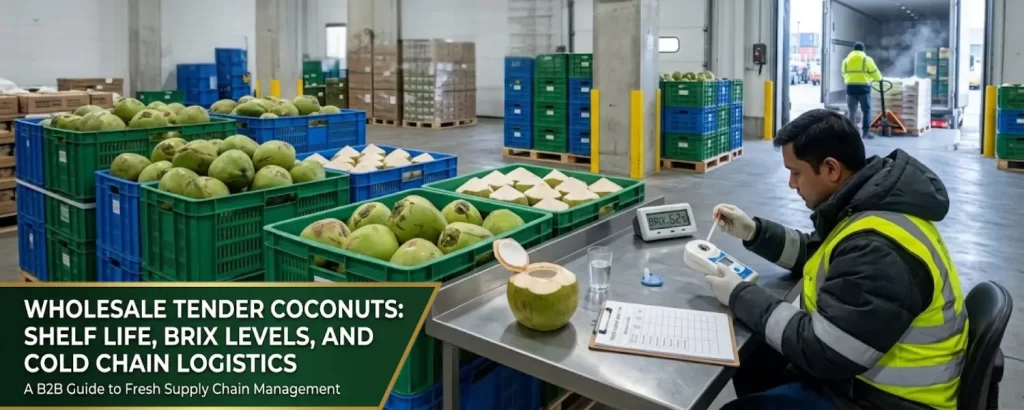
The global beverage market is experiencing a massive shift toward natural hydration, positioning wholesale tender coconuts as one of the fastest-growing premium export commodities. However, unlike fully mature, semi-husked coconuts that boast a durable shelf life, tender coconuts are highly perishable. They are living, breathing agricultural products that require clinical precision to export successfully. For supermarket retail buyers and B2B beverage manufacturers, the challenge isn’t finding coconuts; it’s finding a supplier who can guarantee that a 40ft High Cube container of green tender coconuts won’t arrive at the destination port fermented or covered in mold. In this technical guide, we break down the exact harvest metrics, sweetness indicators (Brix levels), and cold chain logistics required to successfully import wholesale tender coconuts with a maximized shelf life. The Anatomy of an Export-Grade Tender Coconut Unlike mature coconuts harvested for their thick copra (meat) and oil content, a tender coconut is harvested exclusively for its nutrient-rich water. Timing the harvest is the single most critical variable in the supply chain. Harvest Timing and Nut Weight To qualify for export, tender coconuts must be harvested at exactly 7 to 8 months of maturity. Too early (under 7 months): The water will taste astringent and sour due to high phenolic compounds, and the volume will be insufficient. Too late (over 8 months): The natural sugars begin converting into copra (jelly-like meat). The water volume drops, and the taste becomes slightly salty and flat. An export-grade tender coconut typically weighs between 1.5 kg to 2.5 kg and guarantees a minimum water volume of 350ml to 450ml per nut. Brix Levels: Measuring Sweetness In the B2B beverage industry, sweetness is not subjective—it is measured scientifically using a refractometer to determine the Brix level (the percentage of dissolved sucrose in the water). Top-tier Indian export varieties (like the Pollachi Green Dwarf) are prized because they consistently test at a Brix level of 5.5% to 7.0%. If you are a procurement director establishing SLAs (Service Level Agreements) with an exporter, stipulating a minimum Brix level of 5.5% ensures you are receiving a premium, naturally sweet product that requires no artificial additives. Processing and Packaging for Extended Shelf Life If you simply cut a green coconut from the tree and place it in a shipping container, it will begin rotting within 7 days. To achieve the 30-to-40-day shelf life required for international maritime transit, the coconut must be meticulously processed. The Diamond Cut and Shrink-Wrapping Protocol Whole green coconuts are incredibly heavy and bulky, making them inefficient to ship. Exporters solve this through the “diamond cut” process: Trimming: The outer green exocarp and much of the fibrous husk are trimmed away using specialized blades, shaping the top of the nut into a diamond or cone shape. This removes excess transit weight and creates a flat base so the nut can stand upright on retail shelves. Anti-Fungal Treatment: The freshly cut husk is highly susceptible to mold. The coconuts are briefly dipped in an organic, food-safe anti-fungal solution (often hydrogen peroxide or permitted food-grade coatings) to seal the exposed fibers. Food-Grade Shrink Wrapping: Immediately after trimming and treating, each individual coconut is vacuum-shrink-wrapped in food-grade POF (Polyolefin) film. This hermetic seal serves a dual purpose: it traps the natural moisture inside the nut to prevent dehydration and acts as an absolute barrier against airborne fungal spores during transit. Cold Chain Logistics: The Lifeblood of Tender Coconut Exports Even with perfect harvesting and shrink-wrapping, wholesale tender coconuts will ferment if exposed to ambient heat. Once the coconut water ferments, the internal pressure will cause the nut to burst, ruining the surrounding cargo. Maintaining an unbroken cold chain from the APEDA-certified packhouse to the destination port is non-negotiable. Reefer Container Settings Tender coconuts must be loaded into pre-cooled refrigerated (reefer) containers. The setpoints are much colder than those used for mature coconuts or bananas: Optimal Temperature: 4°C to 5°C (39°F to 41°F) Ventilation: Closed (0 CBM/hour). Because the nuts are individually shrink-wrapped, they are largely dormant and do not require fresh air exchange. In fact, introducing outside air can introduce unwanted humidity fluctuations. The Impact of Cold Chain Breaks If the temperature spikes above 8°C during inland transport or due to a reefer malfunction on the vessel, the enzymatic breakdown of the coconut water accelerates exponentially. The sugars will ferment into alcohol, altering the pH and destroying the commercial viability of the shipment. Sourcing with Confidence Sourcing wholesale tender coconuts requires far more logistical oversight than dry agricultural goods. B2B buyers must partner with origin-verified exporters who control the entire process—from timing the harvest for optimal Brix levels to managing the delicate shrink-wrapping and pre-cooling protocols. By demanding strict adherence to these temperature and packaging standards in your purchasing contracts, you can confidently import premium tender coconuts that command top-tier retail pricing, without the crippling cost of transit spoilage. Frequently Asked Questions (FAQs) What is the standard shelf life of an exported tender coconut? When properly diamond-cut, shrink-wrapped, and maintained in an unbroken cold chain at 4°C to 5°C, export-grade tender coconuts have a viable shelf life of 30 to 40 days. What is a Brix level, and why does it matter for tender coconuts? Brix is a scientific measurement of the dissolved sugar content (sweetness) in a liquid. For tender coconuts, a Brix level of 5.5% to 7.0% guarantees the naturally sweet flavor profile demanded by premium retail and beverage markets. Why are exported tender coconuts shrink-wrapped in plastic? Shrink-wrapping is critical for two reasons: it locks in the nut’s natural moisture to prevent it from drying out and cracking, and it acts as a hermetic barrier against airborne mold and fungal spores during ocean transit. What temperature should a reefer container be set to for tender coconuts? The reefer container must be strictly maintained between 4°C and 5°C (39°F to 41°F). Temperatures below 2°C risk freezing and expanding the water (cracking the nut), while temperatures above 8°C will cause the water to rapidly ferment. How much water is inside

Wholesale Tender Coconuts: Shelf Life, Brix Levels, and Cold Chain Logistics Read Post »

G9 Cavendish Bananas
Export Import Fruits Spices Vegetables

Exporting G9 Cavendish Bananas: Ethylene Management and Reefer Protocols

In the global fresh fruit trade, few commodities are as lucrative—or as unforgiving—as bananas. For B2B procurement directors and import managers, the risk is not just a few bruised fruits; a single container of prematurely ripened bananas represents tens of thousands of dollars in unsellable cargo. India is the world’s largest producer of bananas, but translating that volume into export-grade success requires absolute mastery over the supply chain. When sourcing G9 Cavendish Bananas, your supplier must act less like a farmer and more like a biochemist. In this guide, we break down the critical pre-shipment protocols, ethylene management strategies, and precise reefer container settings required to ensure your G9 Cavendish Bananas arrive at their destination perfectly green, firm, and ready for your ripening chambers. The G9 Cavendish Advantage Why does the international market overwhelmingly demand the Grand Naine (G9) Cavendish variety? Unlike local varieties that bruise easily and ripen rapidly, the G9 Cavendish is genetically optimized for the rigors of maritime export. It boasts a thick peel that resists mechanical damage, a high yield per bunch, and a remarkably predictable ripening curve when exposed to controlled ethylene gas at the destination port. However, these genetic advantages mean nothing if post-harvest protocols are mishandled. 1. Pre-Shipment Protocols: Harvesting and Processing The battle against premature ripening begins the moment the banana hand is cut from the stem. Bananas are climacteric fruits, meaning they continue to ripen after harvest. The goal of the exporter is to hit the “pause button” on this biological process. Harvesting Maturity Export-grade G9 Cavendish Bananas must be harvested at exactly 75% to 80% maturity. At this stage, the fruit is physiologically mature (full-sized) but the starches have not yet begun converting into sugars. If harvested at 85% or higher, the fruit will inevitably ripen during a 15-to-30-day ocean transit, regardless of reefer settings. The Alum-Water Wash Protocol When banana hands are cut from the main stalk, they bleed a sticky, white latex. If this latex dries on the peel, it causes severe black staining, rendering the fruit cosmetically unacceptable for premium retail markets. To prevent this, premium packhouses utilize a rigorous washing process: De-latexing Pools: The hands are immediately submerged in cool, flowing water tanks to wash away the initial latex bleed. Alum Treatment: The fruit is then passed through a secondary bath containing a precise concentration of alum (aluminum sulfate). Alum acts as a coagulant, stopping the latex flow entirely and sterilizing the crown (the cut area) to prevent fungal crown rot during transit. 2. Reefer Container Protocols and Temperature Management Once packed, the bananas are loaded into refrigerated (reefer) containers. This is where precision dictates profitability. The Danger of Chilling Injury Bananas are highly sensitive to cold. If the temperature inside the container drops below 11.5°C (53°F) even briefly, the bananas will suffer from “chilling injury.” The cell walls break down, causing the peel to turn a dull, smoky grey or black. Worse, chilled bananas lose their ability to ripen properly when they reach your facility; they will remain hard and flavorless even when exposed to ethylene. The Standard Transit Protocol To keep the bananas dormant without causing chilling injury, the reefer container must be maintained at a constant, non-negotiable setpoint: Optimal Temperature: 13.5°C (56.3°F) Humidity: 85% to 95% (to prevent the peel from dehydrating and shriveling). 3. Ethylene Management: Scrubbing the Air Temperature control alone is not enough for voyages exceeding 15 days. Bananas naturally produce trace amounts of ethylene gas as they breathe. If this ethylene accumulates inside a sealed container, it acts as a catalyst, triggering a chain reaction that causes the entire load to ripen simultaneously. To combat this, top-tier B2B exporters employ two critical ethylene management strategies: Continuous Ventilation Reefer containers used for bananas are never entirely sealed. The ventilation baffles must be set to allow a steady exchange of fresh air—typically 15 to 25 CBM (Cubic Meters) per hour. This flushes out the naturally accumulating ethylene and carbon dioxide, replacing it with fresh oxygen. Ethylene Scrubbers and Filters For long-haul destinations (e.g., India to the Middle East or Europe), exporters deploy ethylene scrubbers inside the packaging or the container. These are typically sachets containing potassium permanganate ($KMnO_4$). The potassium permanganate chemically reacts with ambient ethylene gas, oxidizing it into harmless water and carbon dioxide. Placing these filters inside the vacuum-sealed polybags acts as a final fail-safe against premature ripening. 4. Export Packaging Standards The physical packaging must facilitate the reefer’s airflow while protecting the fruit from mechanical damage. Corrugated Boxes: G9 Cavendish Bananas are packed in heavy-duty, 5-ply corrugated telescopic boxes, usually weighing a net 13.5 kg. These boxes feature specific ventilation holes that align perfectly when palletized, allowing the chilled air from the reefer floor to flow directly through the cargo. Vacuum Polybags: Inside the box, the bananas are encased in a micro-perforated plastic bag. Once packed, the air is vacuumed out, reducing ambient oxygen and further slowing the fruit’s respiration rate during the voyage. Why Technical Sourcing Matters For B2B buyers, sourcing G9 Cavendish Bananas is not about finding the lowest FOB price per box. It is about securing a supply chain that understands the biochemistry of the fruit. A supplier who cuts corners on alum washing, buys cheaper non-ventilated boxes, or fails to deploy ethylene scrubbers will ultimately cost your company massive losses at the destination port. When you demand strict adherence to maturity indices, temperature protocols, and ethylene management, you guarantee that your ripening chambers receive the flawless green fruit required to dominate the retail market. Frequently Asked Questions (FAQs) What is the ideal transit temperature for G9 Cavendish Bananas? The industry standard setpoint for exporting Cavendish bananas is strictly 13.5°C (56.3°F). Fluctuations below 11.5°C will cause irreversible chilling injury, while temperatures above 14.5°C risk triggering premature ripening. Why are bananas washed in alum water before packing? When bananas are cut, they secrete a sticky latex. Alum acts as a coagulant to stop this latex flow, preventing severe black cosmetic staining on the peel. It

Exporting G9 Cavendish Bananas: Ethylene Management and Reefer Protocols Read Post »

wholesale coconut sugar
Export Import Fruits Spices Vegetables

Heavy Metal and Moisture Content Testing in Wholesale Coconut Sugar

For commercial food and beverage manufacturers, introducing a new raw material into the supply chain carries inherent regulatory risks. When substituting refined cane sugar with natural alternatives, heavy metal and moisture content testing in wholesale coconut sugar becomes the primary hurdle for QA/QC and compliance officers. Unlike highly refined sucrose—which is stripped of nearly all minerals during processing—coconut sugar is unrefined. It retains the natural mineral profile of the palm sap, including potassium, magnesium, and zinc. However, this unrefined nature also means it can absorb naturally occurring heavy metals from the soil and groundwater. If your procurement team is sourcing bulk coconut sugar without demanding strict laboratory analytics, you risk severe FDA or EFSA (European Food Safety Authority) compliance violations. In this guide, we break down the critical testing thresholds your supplier must meet before the product ever hits your production floor. The Danger of Heavy Metals in Unrefined Sugars Heavy metals—specifically Lead (Pb), Arsenic (As), Cadmium (Cd), and Mercury (Hg)—are naturally present in the earth’s crust. Agricultural crops absorb these elements through their root systems. Because coconut sugar is produced by boiling down the raw sap of the coconut palm blossom without chemical refinement, any heavy metals present in the palm tree’s environment can concentrate in the final granulated product. Regulatory bodies worldwide have drastically tightened their tolerances for heavy metals in food ingredients, particularly in products frequently consumed by children (such as baked goods and snacks). Standard PPM (Parts Per Million) Thresholds When reviewing a supplier’s Certificate of Analysis (CoA), compliance officers must ensure the heavy metal concentrations fall well below these recognized international limits: Lead (Pb): Must be strictly < 1.0 ppm (Many strict buyers and EU regulations demand < 0.5 ppm). Arsenic (As): Must be < 1.0 ppm. Cadmium (Cd): Must be < 0.5 ppm. Mercury (Hg): Must be < 0.1 ppm Moisture Content: The Catalyst for Spoilage While heavy metals represent a regulatory risk, moisture content represents an immediate operational hazard. Coconut sugar is extremely hygroscopic, meaning it acts like a sponge, aggressively pulling moisture from the surrounding air. In a commercial baking or industrial blending facility, excess moisture in dry ingredients leads to catastrophic machinery clumping, inaccurate batch weights, and accelerated microbial growth. The 2% Rule for Export-Grade Coconut Sugar To be classified as export-grade, wholesale coconut sugar must be dried to a strict moisture content of less than 2.0% (with premium grades often hitting < 1.5%). If a supplier ships product with a moisture content of 3% or 4%, you will encounter the following issues during ocean transit and warehouse storage: Caking and Hardening: The 25kg bags will arrive as solid bricks, requiring manual labor to smash the product before it can be fed into automated hoppers. Yeast and Mold Proliferation: Moisture provides the breeding ground for yeast and mold. High moisture content significantly raises the Aerobic Plate Count (APC), leading to potential product recalls. Maillard Instability: Moisture variance throws off commercial baking formulations, causing inconsistent browning and unpredictable shelf-life in the final retail product. Securing the Moisture Barrier Laboratory testing before shipment is only half the battle. To maintain that < 2.0% moisture level during high-humidity maritime transit, the packaging must be hermetically secure. Always stipulate in your RFQs that the bulk coconut sugar must be packed in 25-kilogram 3-ply kraft paper bags fitted with thick, heat-sealed inner poly-liners. A standard woven sack without a liner will completely invalidate the origin lab results by the time the cargo reaches your facility. Why Verifiable Lab Analytics Drive B2B Trust As a B2B procurement director, you cannot rely on a supplier’s marketing claims of “100% Organic” or “Premium Quality.” In the food manufacturing sector, quality is defined exclusively by data. When you partner with a verified exporter, you should expect a comprehensive Certificate of Analysis (CoA) for every single batch shipped. This document is your shield against regulatory fines, recalled retail products, and production line downtime. By demanding rigorous heavy metal and moisture content testing in wholesale coconut sugar, you protect your brand’s integrity and streamline your supply chain from the origin packhouse to the final consumer. Frequently Asked Questions (FAQs) Why is heavy metal and moisture content testing in wholesale coconut sugar mandatory? Testing is mandatory to ensure the unrefined sugar does not exceed FDA and EFSA legal limits for toxic elements (Lead, Arsenic, Cadmium, Mercury). Moisture testing ensures the product remains below 2% to prevent microbial growth and industrial machinery clumping. What is the maximum acceptable moisture content for export-grade coconut sugar? Export-grade coconut sugar must have a moisture content strictly below 2.0%. High-quality B2B suppliers typically dry their product to between 1.2% and 1.8% to ensure free-flowing granulation. How do heavy metals get into coconut sugar? Because coconut sugar is minimally processed, it retains the mineral profile of the palm sap. If the palm trees are grown in soil or exposed to groundwater contaminated with heavy metals, those elements can be absorbed by the tree and concentrated during the sap-boiling process. What documentation should I request from my coconut sugar supplier? Always request a batch-specific Certificate of Analysis (CoA) from an accredited third-party laboratory. This CoA must detail exact PPM metrics for heavy metals, exact moisture percentage, mesh size, and microbiological counts (Salmonella, E. coli, Yeast, and Mold). Testing is mandatory to ensure the unrefined sugar does not exceed FDA and EFSA legal limits for toxic elements (Lead, Arsenic, Cadmium, Mercury). Moisture testing ensures the product remains below 2% to prevent microbial growth and industrial machinery clumping. Export-grade coconut sugar must have a moisture content strictly below 2.0%. High-quality B2B suppliers typically dry their product to between 1.2% and 1.8% to ensure free-flowing granulation. Because coconut sugar is minimally processed, it retains the mineral profile of the palm sap. If the palm trees are grown in soil or exposed to groundwater contaminated with heavy metals, those elements can be absorbed by the tree and concentrated during the sap-boiling process. Always request a batch-specific Certificate of Analysis (CoA) from an accredited

Heavy Metal and Moisture Content Testing in Wholesale Coconut Sugar Read Post »

Phytosanitary compliance
Export Import Fruits Spices Vegetables

Phytosanitary Compliance: Fumigation Protocols for Indian Agri-Exports

In the high-stakes world of global agricultural trade, biological hazards are just as critical as logistical delays. A single undetected pest—whether an insect, larva, or fungal spore—can trigger an immediate biological alert at the destination port. The result? Your 40ft container is either forcefully detained, deported, or incinerated at your expense. For customs brokers, B2B procurement directors, and import QA/QC managers, phytosanitary compliance is a non-negotiable insurance policy. Securing an official Phytosanitary Certificate from the exporting country proves that the cargo has been systematically neutralized against quarantine pests. In India, this process is governed by the Directorate of Plant Protection, Quarantine & Storage (DPPQS). In this technical guide, we break down the rigorous fumigation protocols required for Indian agri-exports, the primary chemical agents used, and what B2B buyers must specify in their purchase contracts to ensure smooth customs clearance. 1. The Legal Framework: DPPQS and QPS Treatments Before any agricultural commodity—whether it is semi-husked coconuts, wholesale coconut sugar, or bulk rice—can leave an Indian seaport, it must satisfy the importing country’s biological safety standards. This is mandated by the International Plant Protection Convention (IPPC). The Indian government enforces these standards through Quarantine and Pre-Shipment (QPS) treatments. The DPPQS oversees accredited pest control operators who conduct these mandatory treatments. If your supplier attempts to bypass QPS protocols to save a few dollars, the shipment will not be issued a Phytosanitary Certificate. Without this document, European, North American, and Middle Eastern customs authorities will flatly reject the entry of the goods. 2. Authorized Fumigants: Methyl Bromide vs. Phosphine When treating agricultural exports, physical washing or curing isn’t enough. Gas fumigation is required to penetrate the cargo and eliminate pests at all life stages (egg, larva, pupa, and adult). The two legally sanctioned fumigants in India are Methyl Bromide and Aluminum Phosphide (Phosphine).   Methyl Bromide (MBr) Methyl Bromide has historically been the gold standard for rapid QPS fumigation due to its lethal efficiency across a broad spectrum of pests. The Protocol: MBr is typically applied at a dosage of 32 g/m³ for a minimum exposure period of 24 hours at temperatures of 21°C or higher. The Limitation: Methyl Bromide is a known ozone-depleting substance. While it remains authorized in India specifically for QPS export purposes, many destination countries (notably within the European Union) have banned or heavily restricted MBr residues. B2B buyers importing into the EU must explicitly request alternative treatments to avoid compliance friction.   Aluminum Phosphide (Phosphine) As MBr faces global phase-outs, Phosphine gas (generated from Aluminum Phosphide tablets or granules) has become the dominant alternative for long-term food grain and agri-product storage. The Protocol: Phosphine is slower-acting but leaves minimal toxic residue. The standard export protocol requires a dosage of 1.5 to 2.3 grams of phosphine per cubic meter (roughly 2-3 tablets per tonne of cargo). The Exposure Time: Because Phosphine requires time to penetrate dense cargo and achieve 100% mortality, the minimum exposure time is 5 to 7 days, extending up to 14 days for resistant pests or cooler temperatures. Fumigant Dosage Calculator Parameter Value Specification Target Volume 50 m³ Enclosed container/cargo space Fumigant Agent Methyl Bromide Fast-acting halogenated hydrocarbon Application Rate 32 g/m³ Standard concentration dosage rate Total Dosage 1,600 g Grams (g) Min. Exposure Time 24 Hours Mandatory duration before ventilation 3. The 40ft Container Fumigation Process Executing a successful fumigation is highly technical. If the gas concentration drops too quickly, pests survive, and the Phytosanitary Certificate is invalidated. Accredited fumigation agencies in India follow a strict sequence:   Step 1: Hermetic Sealing Fumigation requires a completely gas-tight environment. If the cargo is treated inside a warehouse, the pallets are covered with 250 μm thick polyethylene sheeting, and the edges are sealed to the floor using “sand snakes” to prevent gas leakage. If treated directly inside a 40ft shipping container, all ventilation ports and door seals are rigorously taped and blocked.   Step 2: Dosing and Gas Monitoring The fumigant is introduced into the sealed enclosure. Throughout the exposure period, technicians use sensitive gas monitoring equipment (like Silo-Chek) to measure parts per million (ppm). For Phosphine, the concentration must remain above 400 ppm for the duration of the exposure period to guarantee lethality.   Step 3: Aeration and Degassing Once the exposure period ends, the container cannot be immediately shipped. It must be forcefully ventilated. For Phosphine treatments, aeration typically takes 1 to 5 days. Before the container is legally handed over to the shipping line, a technician must certify that the internal gas concentration has dropped below the safe occupational threshold (usually 0.3 ppm for Phosphine). 4. Contractual Safeguards for B2B Importers To protect your supply chain, procurement teams should integrate strict phytosanitary compliance clauses into their vendor agreements. Specify the Fumigant: Explicitly state whether your destination port requires Phosphine over Methyl Bromide due to local environmental laws. Demand Accreditation: Only accept Phytosanitary Certificates generated by fumigators accredited by the NSPM (National Standards for Phytosanitary Measures) and the DPPQS. ISPM-15 Compliance: If your cargo (like coconut sugar) is shipped on wooden pallets, ensure the supplier complies with ISPM-15 standards. The wood must be heat-treated or fumigated independently to prevent the transit of wood-boring insects. By understanding these protocols, B2B buyers can confidently navigate the regulatory landscape, ensuring that their Indian agri-exports arrive on time, pest-free, and legally compliant. Frequently Asked Questions (FAQs) What is the primary purpose of a Phytosanitary Certificate? A Phytosanitary Certificate is an official document issued by the exporting country’s agricultural authority (like India’s DPPQS). It guarantees to the importing country’s customs officials that the shipment has been inspected, properly treated (usually via fumigation), and is free from quarantine pests. Why is Methyl Bromide being phased out in some regions? Methyl Bromide is a highly effective fumigant, but it is classified as an ozone-depleting chemical. Consequently, many regions, particularly the European Union, have banned its use or heavily restricted cargo treated with it. Phosphine is the standard eco-friendly alternative. How long does Phosphine fumigation delay a shipment? Unlike Methyl Bromide, which

Phytosanitary Compliance: Fumigation Protocols for Indian Agri-Exports Read Post »

Formulating with coconut sugar
Fruits Export Import Spices Vegetables

Formulating with Coconut Sugar: The Maillard Reaction and Commercial Replacement Ratios

As consumer demand for refined-sugar-free and low-glycemic products surges, commercial food and beverage R&D departments are rapidly reformulating their product lines. Wholesale coconut sugar is often the preferred natural alternative due to its robust caramel flavor profile and distinct mineral content. However, formulating with coconut sugar in an industrial setting is not as simple as swapping out white cane sugar. Due to its unique chemical composition, coconut sugar behaves differently under heat, moisture, and mixing friction. For R&D food scientists, commercial bakers, and product formulators, understanding the exact commercial replacement ratios and managing the accelerated Maillard reaction are critical steps to scaling up production without compromising product stability. 1. Commercial Replacement Ratios: Baseline Formulations The most common question formulators ask when transitioning a recipe is: What is the volumetric and mass replacement ratio for coconut sugar versus cane sugar? As a general baseline, coconut sugar can be used as a 1:1 replacement by volume or weight for granulated white or brown cane sugar. However, this is only the starting point. Depending on the application, you must account for its distinct granular structure and moisture retention.   Adjusting for Density and Granulation Export-grade wholesale coconut sugar is typically milled to a 16-18 mesh size. This fine granulation ensures high solubility in commercial beverage manufacturing, but in dry baking mixes or doughs, it packs differently than crystalline sucrose. Because coconut sugar is unrefined, it retains trace amounts of natural moisture (typically kept strictly below 2% for export). This slight hygroscopic nature means it can pull moisture from other ingredients in your formulation. Dry Mixes: If your formulation relies on high-speed industrial mixing, the 1:1 ratio holds, but you may need to slightly increase your liquid inputs (water, milk, or liquid fats) by 1-2% to prevent a crumbly texture in the final baked good. Beverage Syrups: For liquid applications, coconut sugar dissolves readily but yields a slightly darker, more viscous solution than refined white sugar. A 1:1 replacement works perfectly for viscosity, but flavor profiling may require a 0.8:1 reduction if the caramel notes clash with delicate flavorings. 2. Managing the Maillard Reaction in Commercial Baking The most significant technical hurdle when formulating with coconut sugar is its behavior under heat—specifically, its impact on the Maillard reaction. The Maillard reaction is a chemical reaction between amino acids and reducing sugars that gives browned food its distinctive flavor (think toasted bread, roasted coffee, or baked cookies). Why Coconut Sugar Accelerates Browning Refined white cane sugar is almost 100% sucrose (a non-reducing sugar). Coconut sugar, conversely, contains roughly 70-79% sucrose, alongside notable amounts of glucose and fructose (reducing sugars). Furthermore, it is rich in natural amino acids inherited from the coconut palm sap. Because it brings both the necessary reducing sugars and amino acids to the table, coconut sugar accelerates the Maillard reaction significantly. Technical Adjustments for Production Lines If you run a product formulated with coconut sugar through an industrial tunnel oven using the exact time and temperature parameters established for cane sugar, the product will over-brown or burn. To mitigate this, R&D teams must adjust thermal processing parameters: Reduce Oven Temperature: Drop the standard baking temperature by 25°F (15°C) to slow the Maillard reaction, allowing the interior of the product to bake fully before the exterior over-caramelizes. Extend Bake Time: Compensate for the lower temperature by extending the bake time by approximately 10-15%. Monitor pH Levels: The Maillard reaction occurs faster in alkaline environments. Because coconut sugar can sometimes lower the overall pH of a dough (making it slightly more acidic), it generally balances out its own accelerated browning, but formulators relying heavily on chemical leaveners (like baking soda) should monitor batch pH closely. Explore how altering your sugar replacement ratios impacts moisture balance and browning intensity in real-time with this formulation calculator: 2. Managing the Maillard Reaction in Commercial Baking Formulation Parameter Value Note Original Cane Sugar Mass 500 g Base Formulation Coconut Sugar Replacement 50 % Target Ratio Required Coconut Sugar 250 g 1:1 Substitution Remaining Cane Sugar 250 g Balance Target Baking Temperature 350 °F Thermal Setting Maillard Reaction Score 0.50 Normal 3. Storage and Hygroscopic Behavior in the Facility In an industrial setting, ingredient storage is just as critical as the formulation itself. Coconut sugar is highly hygroscopic—it aggressively absorbs moisture from the air. If bags are left open in a humid commercial bakery or production floor, the sugar will quickly clump, causing blockages in automated dispensing hoppers and inconsistent batch weights. Sourcing Specifications: Ensure your B2B supplier ships in 25-kilogram 3-ply kraft paper bags with heavy-duty inner poly-liners. Facility Requirements: Once opened, the sugar must be stored in climate-controlled environments with relative humidity (RH) kept strictly under 60%. Sourcing for Consistency Formulating with coconut sugar allows brands to capture the lucrative clean-label market. However, success on the production line requires predictable raw materials. Variability in moisture content, mesh size, or processing hygiene from your supplier will lead to endless reformulations and wasted batches. When establishing your supply chain, prioritize B2B exporters who can provide consistent lab analytics (Certificates of Analysis) for moisture content and granulation sizing, ensuring your R&D team is working with a stabilized ingredient from the pilot plant to full-scale commercialization. Frequently Asked Questions (FAQs) What is the standard commercial replacement ratio for coconut sugar to cane sugar? For most dry applications (baking, dry mixes), a 1:1 replacement by volume or weight is the standard baseline. However, liquid adjustments may be necessary depending on the specific dough matrix. Why does coconut sugar burn faster than white sugar in commercial ovens? Coconut sugar is unrefined and contains natural amino acids along with reducing sugars (glucose and fructose). This composition accelerates the Maillard reaction, causing products to brown and caramelize much faster under heat than products made with refined sucrose. How should wholesale coconut sugar be stored in a production facility? Because it is highly hygroscopic, it must be stored in a cool, dry environment with relative humidity below 60%. It should remain sealed in poly-lined kraft

Formulating with Coconut Sugar: The Maillard Reaction and Commercial Replacement Ratios Read Post »

Quality control in coconut exports
Export Import Fruits Spices Vegetables

Quality Control in Coconut Exports: Standard Tolerances for Sprouting and Cracking

When you are importing high volumes of semi-husked coconuts, your margin of error is razor-thin. A single 40ft FCL (Full Container Load) holds tens of thousands of nuts. If a supplier cuts corners during pre-shipment inspection, minor transit delays can quickly turn a few defective coconuts into a widespread fungal outbreak, jeopardizing the entire shipment. For B2B procurement directors and QA/QC managers, relying on visual approximations isn’t enough. You need strict Service Level Agreements (SLAs) based on internationally recognized Acceptable Quality Level (AQL) metrics. In this guide, we break down the exact quality control parameters for export-grade semi-husked coconuts, focusing heavily on the critical thresholds for sprouting, cracking, and internal spoilage. Understanding Acceptable Quality Level (AQL) in Coconut Exports In the global fresh produce trade, no shipment is 100% flawless upon arrival. The temperature fluctuations of a 30-day maritime voyage—even in well-ventilated containers—cause natural physiological changes in the cargo. AQL defines the maximum percentage of defective goods considered acceptable during random sampling at the destination port. For export-grade semi-husked coconuts, top-tier suppliers operate on an AQL of 2% to 3% for total defects. However, it is crucial to distinguish between minor defects (which do not affect the internal copra) and critical defects (which render the nut unfit for retail or commercial processing). Minor Defects Minor defects are largely cosmetic or easily mitigated during processing. These include: Slight water loss: Older mature nuts naturally lose some coconut water over time, though the copra remains intact. Superficial shell scuffing: Minor abrasions on the exposed shell that do not penetrate the endocarp. Discolored fiber: Browning or dullness of the retained husk tuft due to natural drying. Critical Defects Critical defects compromise the structural integrity or biological safety of the nut. The two most severe offenders are sprouting and cracking. The Zero-Tolerance Zone: Sprouting and Cracking Why do QA/QC inspectors immediately reject containers with high instances of sprouting or cracking? Because these defects fundamentally alter the chemical and physical makeup of the coconut. 1. Sprouting (Germination) A coconut is a seed. Under conditions of high humidity and heat—such as poor ventilation inside a shipping container—the nut triggers its biological imperative to grow. The sprout (or “haustorium”) emerges from one of the three “eyes” (germination pores) located under the tuft of fibers left during the semi-husking process. The Problem: As the sprout grows inside the nut, it consumes the coconut water and begins breaking down the thick white copra to extract nutrients. The copra becomes spongy, soapy in taste, and commercially worthless for both fresh retail and oil extraction. The Standard Tolerance: Sprouting should ideally sit at 0%, but standard international tolerances allow for a maximum of 1% upon arrival. Anything higher indicates that the supplier packed over-matured nuts or failed to manage container ventilation. 2. Cracking (Shell Fractures) Cracking usually occurs due to poor handling (dropping bags during loading), excessive stacking weight, or packing immature nuts with soft shells. The Problem: The hard shell (endocarp) is the coconut’s natural hermetic seal. Once that seal is breached, the sterile coconut water leaks out. More dangerously, the crack provides an immediate entry point for oxygen and airborne fungal spores (like Aspergillus or Penicillium). A cracked nut will quickly rot, and the resulting mold can spread to adjacent nuts in the PP mesh bag. The Standard Tolerance: Strict QA/QC protocols dictate a maximum tolerance of 1% to 1.5% for cracked nuts. Standard Defect Tolerances: At a Glance Defect Category Defect Type Maximum Acceptable Tolerance (Arrival) Repercussion if Exceeded Critical Sprouting / Germination < 1.0% Loss of copra density; unsellable. Critical Cracked / Broken Shell < 1.5% Fungal contamination; cross-infection risk. Critical Internal Rot / Mold < 0.5% Health hazard; total rejection of batch. Minor Superficial Scuffing Up to 5.0% Aesthetic issue; acceptable for industrial use. Minor Undersized Nuts (< 500g) < 3.0% Contractual weight discrepancies. Pre-Shipment Sorting Protocols at APEDA-Certified Packhouses Achieving a sub-3% defect rate at the destination port doesn’t happen by accident. It requires rigorous, multi-stage sorting at the origin. Partnering with an exporter operating out of an APEDA-certified packhouse guarantees that strict Standard Operating Procedures (SOPs) are followed. Here is how top Indian exporters mitigate sprouting and cracking before the cargo ever sees a shipping container: Harvest Timing: Only fully mature, “brown” coconuts (11-12 months old) are harvested. Immature green nuts have higher water content and softer shells, making them highly susceptible to transit cracking. The “Ring Test”: Expert sorters manually tap each husked nut. A sharp, ringing sound indicates an intact shell and full water volume. A dull thud indicates a hidden hairline fracture or water loss. Tuft Protection: During the semi-husking process, an exact proportion of fiber is left covering the three eyes of the nut. This acts as a shock absorber against mechanical damage and shields the most vulnerable part of the shell from moisture that could trigger sprouting. Curing and Drying: Freshly husked nuts are briefly cured in shaded, well-ventilated areas to remove excess surface moisture, drastically reducing the risk of transit mold. Why Strict QA/QC Saves Procurement Budgets For B2B buyers, importing coconuts is a high-volume, low-margin game. Accepting sub-standard cargo doesn’t just mean throwing away a few bad nuts. It means paying ocean freight, customs duties, and inland transport costs on dead weight. Furthermore, a high defect rate increases labor costs at your receiving facility, as your team has to manually sort out the rotted cargo before distribution. By writing strict AQL parameters for sprouting and cracking into your procurement contracts—and only partnering with origin-verified, certified exporters—you protect your bottom line, streamline your supply chain, and guarantee consistency for your end-users. Frequently Asked Questions (FAQs) What is the ideal weight for export-grade semi-husked coconuts? Export-grade coconuts typically range from 550 grams to 650 grams per nut, yielding a copra content of roughly 150 to 180 grams. Nuts falling significantly below this weight are usually culled during sorting. How do suppliers prevent coconuts from sprouting during a 30-day ocean transit? Prevention relies on three factors: harvesting only optimally

Quality Control in Coconut Exports: Standard Tolerances for Sprouting and Cracking Read Post »

40ft container economics
Export Import Fruits Spices Vegetables

40ft FCL Container Economics: Maximizing Semi-Husked Coconut Cargo

In the competitive world of global agricultural commodities, your margin isn’t just decided by the farm-gate price of the crop—it is decided inside the steel walls of a shipping container. For heavy, low-cost commodities like semi-husked coconuts, mastering 40ft container economics is the difference between a highly profitable export business and a logistical failure. When you are shipping coconuts from tropical origin countries to high-demand markets in North America, Europe, or the Middle East, you are essentially paying for space and weight. If you ship “air” (wasted volume) or hit weight limits too early, your freight cost per nut skyrockets. In this guide, we will break down the exact economics, math, and logistics of maximizing a 40ft High Cube container for bulk coconut shipping, ensuring you get the absolute best return on investment (ROI) on your ocean freight. The Golden Ratio: Weight vs. Volume in Container Shipping Every shipping container has two hard limits: Volumetric Capacity (Cubic Meters/CBM): How much physical space is inside. Payload Capacity (Metric Tonnes/MT): The maximum weight the container can safely carry. Semi-husked coconuts are incredibly dense. Unlike lightweight consumer goods (like clothing or electronics) that “cube out” (fill the space before hitting the weight limit), coconuts usually “weigh out.” This means you will hit the container’s maximum legal weight limit before you completely run out of physical space. To optimize unit cost optimization, your goal is to pack the maximum number of nuts to reach the payload weight limit perfectly, without exceeding it. 40ft High Cube (HC) Container Specifications for Coconuts For long-haul semi-husked coconut export, the industry standard is the 40ft High Cube (HC) Container. An HC container is a foot taller than a standard 40ft container, giving a bit more breathing room for agricultural ventilation. Depending on transit length, exporters use either Dry High Cubes (ventilated) or Reefer High Cubes (temperature-controlled). Here is the math you need to know: Max Payload Limit: Generally capped around 27 to 28.5 Metric Tonnes (MT) depending on the shipping line and destination port regulations. Ideal Coconut Export Weight: The global B2B standard demands coconuts weighing precisely 500g to 600g each. Packing Standard: 25 uniform nuts packed into one ventilated Polypropylene (PP) mesh bag. Standard Bag Weight: 25 nuts × ~550g (average) = 13.5 kg to 14.5 kg per bag. The Loading Math If your maximum allowable payload is 28,000 kg (28 MT), and each bag weighs 14 kg: 28,000 kg ÷ 14 kg/bag = 2,000 bags. To stay safely under weight limits while maximizing space, a standard 40ft High Cube is typically loaded with 1,800 to 2,000 bags. Total Payload Yield: Total Nuts: 45,000 to 50,000 coconuts per 40ft HC. Total Weight: ~25 to 28 Metric Tonnes. 3 Strategies for Unit Cost Optimization How do top exporters ensure they aren’t bleeding margin on freight? They execute the following logistics strategies: 1. Floor Loading vs. Palletizing Wooden pallets take up crucial vertical space, add dead weight (about 15-20 kg per pallet), and cost money. In FCL shipping cost optimization, exporters almost exclusively use floor loading. By hand-stacking the PP mesh bags directly on the container floor in an interlocking pattern, you gain back the weight and space that pallets would have stolen, allowing you to fit an extra 100 to 200 bags per container. 2. Strict Grading at the Packhouse As demonstrated above, uniformity is profitability. You must mandate that your supplier uses strict weighing scales during the packing process. Every bag must hit that 13.5 kg – 14.5 kg sweet spot. Overweight bags kill your total nut yield; underweight bags mean you are shipping small, unsellable coconuts. 3. Understanding the 20ft vs. 40ft Dynamic Why not use a 20ft container? A 20ft container maxes out its weight limit at roughly the same weight as a 40ft (around 28 MT). However, because it has half the volume, you cannot fit 28 MT of coconuts inside it before running out of space. A 20ft container typically maxes out at 900 to 1,000 bags (22,500 to 25,000 nuts). Because ocean carriers charge heavily for weight, the cost of shipping a 20ft container is rarely exactly half the cost of a 40ft. Therefore, the 40ft HC always offers a vastly superior cost-per-nut ratio. The True Cost of “Air” If freight rates from India to New York are $4,500 for a 40ft HC: Optimized Load (50,000 nuts): Ocean freight cost is $0.09 per nut. Poorly Graded/Packed Load (43,000 nuts): Ocean freight cost is $0.104 per nut. That is a $700 margin leak on a single container just in freight inefficiency. When you scale that to 10 or 20 containers a month, poor 40ft container economics will quietly bankrupt an agricultural import business. The key to bulk coconut shipping isn’t just finding a good farm—it’s finding a packhouse that understands how to perfectly play the game of weight versus volume. Frequently Asked Questions (FAQs) How many semi-husked coconuts fit in a 40ft High Cube container? A perfectly optimized 40ft High Cube container can hold between 1,800 and 2,000 bags. With 25 coconuts per bag, this equals a total payload of 45,000 to 50,000 nuts. Why do coconut exporters use 40ft containers instead of 20ft containers? A 40ft HC offers a significantly better economy of scale. While a 20ft container holds around 900-1,000 bags, a 40ft holds double that amount, reducing the per-unit freight cost dramatically. Why is it important for every coconut to weigh 500g-600g? Predictable sizing ensures predictable bag weights (13.5 – 14.5 kg). Predictable bag weights allow logistics teams to perfectly calculate the container load, ensuring they hit the maximum legal weight limit without exceeding it, thereby maximizing the total number of coconuts shipped. Should coconut bags be shipped on pallets? No. For bulk coconut export, floor-loading is preferred. Pallets take up valuable space and add dead weight to the container, which reduces the total amount of coconuts you can legally load. What is “weighing out” in ocean freight? “Weighing out” means the cargo has reached the container’s maximum legal

40ft FCL Container Economics: Maximizing Semi-Husked Coconut Cargo Read Post »

Semi-husked coconuts
Export Import Fruits Spices Vegetables

The Semi-Husking Process: Preparing Coconuts for Global Maritime Transit

When you walk into a grocery store in North America or Europe and pick up a fresh, water-filled tropical coconut, you are holding the result of a highly calculated supply chain. Transporting heavy, moisture-rich agricultural commodities across the globe is an intricate dance against time, temperature, and biology. A single flaw in preparation can turn a lucrative 30-day ocean voyage into a container full of spoiled fruit. So, how do exporters ensure these tropical staples arrive fresh? The secret to successful coconut export lies in a precise agricultural technique known as the coconut semi-husking process. In this fifth installment of our agricultural supply chain series, we are diving deep into the preparation of semi-husked coconuts, exploring why this specific method is the undisputed gold standard for the maritime transit of coconuts, and breaking down the packaging and logistics required for successful global delivery. What Are Semi-Husked Coconuts? (The Biological Seal) To understand preparing coconuts for export, you first need to understand the anatomy of the fruit. A coconut features a smooth outer skin (exocarp), a thick, fibrous middle layer (mesocarp or husk), and a hard inner shell (endocarp) that protects the meat and water. At the top of the hard shell sit three vulnerable “eyes” (germ pores). A fully husked (or “bald”) coconut has all of its outer fibrous layers completely removed. While this saves the maximum amount of space and weight, it exposes those three delicate eyes. Once exposed, the internal coconut water evaporates rapidly, and bacteria can easily penetrate the shell. A fully husked coconut will typically spoil within just 7 to 10 days, making it disastrous for long-term shipping. Semi-husked coconuts, on the other hand, have the thick outer husk removed everywhere except for a deliberate, thick tuft of fiber left intact at the crown. This tuft covers the three eyes. It acts as a natural biological plug, stopping water from leaking, preventing rapid evaporation, and blocking fungal entry. This simple yet vital technique extends the shelf life of coconuts to an impressive 45 to 60 days, providing the necessary buffer for international ocean freight. The Step-by-Step Coconut Semi-Husking Process Preparing premium cargo for bulk coconut shipping requires rigorous quality control before the coconuts even touch a shipping container. Here is how export-grade packhouses execute the process: 1. Harvesting and Curing The process begins with harvesting mature coconuts—typically 10 to 12 months old—when the surrounding skin is transitioning from green to brown. The nuts are gathered and sometimes cured briefly to allow the internal meat to firm up and the outer moisture to stabilize. 2. The Semi-Husking Action Using specialized hand tools (like a fixed steel spike) or a mechanical coconut husking machine, skilled workers strip away the bulky, fibrous mesocarp. They carefully peel back the husk while intentionally leaving a 1-to-2-inch patch of coir fiber directly over the eyes. Removing the rest of the husk eliminates dead weight and drastically reduces the shipping volume, saving exporters thousands of dollars in freight costs while preserving the fruit’s integrity. 3. Cleaning and Polishing Once semi-husked, the coconuts undergo a thorough cleaning process. Any loose dirt, rogue fibers, or minor defects are brushed away. A clean, smooth shell is vital not just for retail presentation, but to satisfy stringent international phytosanitary (plant health) regulations that prohibit the transport of soil or foreign pests. 4. Strict Grading for Uniformity You cannot pack mixed sizes into a single export batch. If heavy, large coconuts are mixed with smaller ones, the final bags will be structurally uneven and prone to collapsing under their own weight during rough seas. Coconuts are graded by weight (the global ideal is 500g to 600g per nut) and circumference (usually 12 to 14 inches) to ensure exact uniformity. Coconut Packaging for Export: Breathability is Key Proper coconut packaging for export is just as critical as the husking process itself. Coconuts naturally respire—meaning they “breathe” and release moisture into the air. If exporters were to pack coconuts in sealed cardboard boxes or solid plastic wrapping, the trapped moisture would quickly create a humid micro-climate, leading to aggressive surface mold and rot within days. Instead, the global B2B industry relies on ventilated Polypropylene (PP) mesh bags. These tightly woven but highly breathable nets allow continuous airflow to flush out respired moisture. The industry standard is the 25-nut bag packing protocol. By packing exactly 25 uniform, graded coconuts together, the bag reaches an optimal weight of approximately 13.5 to 14.5 kilograms. This specific weight provides the perfect balance: it is heavy enough to maximize container space, yet light enough to ensure safe, ergonomic handling by port workers without damaging the cargo inside. Mastering Logistics: The Maritime Transit of Coconuts Once bagged, the semi-husked coconuts are ready for stuffing into ocean freight containers. Bulk coconut shipping utilizes specific loading techniques to survive turbulent ocean conditions: Floor Loading and Cross-Stacking: To get the best return on investment on freight space, mesh bags are typically floor-loaded (stacked directly on the container floor rather than on wooden pallets). The loading crew uses an interlocking “cross-stacking” pattern. This stabilizes the entire load, preventing the bags from shifting, sliding, and crushing each other during rough sea swells. A standard 40ft High Cube container can hold roughly 1,800 to 1,900 of these 25-nut bags. Ventilation and Temperature Control: Managing the environment is the final hurdle. For short transits under 15 days, standard ventilated Dry-Van containers are often sufficient, provided the vents are left open. However, for longer hauls to Europe or North America, temperature-controlled Reefer containers are standard. These are typically set between +10°C and +15°C with fresh air ventilation open (often at 0 to 15 cbm/hr depending on carrier guidelines) to prevent condensation—a phenomenon known as “container rain” that can ruin a shipment. By mastering the semi-husking process and adhering to strict maritime logistics, global agricultural suppliers can confidently deliver the taste of the tropics to consumers thousands of miles away. Frequently Asked Questions (FAQs) Why is a tuft of husk left on semi-husked coconuts?

The Semi-Husking Process: Preparing Coconuts for Global Maritime Transit Read Post »

Scroll to Top
exim internationals logo

Get Our Products Pricing

Fill out the form to download!