
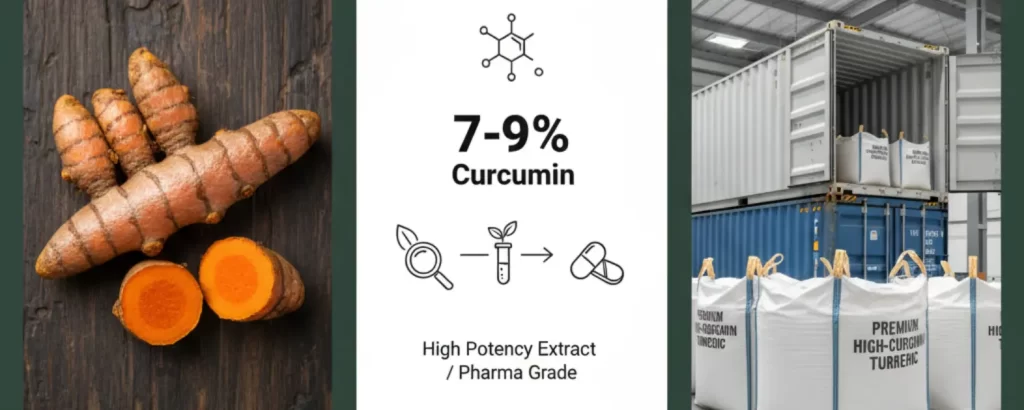
The global shift towards natural medicine has transformed turmeric from a kitchen staple into a pharmaceutical powerhouse. However, for procurement managers in the pharmaceutical and nutraceutical industries, not all yellow powder is created equal. When sourcing turmeric for medical uses, the critical metric is not color or flavor—it is Curcuminoid potency.
While standard culinary turmeric hovers around 2-3% curcumin content, the medical sector demands significantly higher efficacy. This demand has turned the spotlight onto a specific, potent variety from India: Lakadong Turmeric.
Here is why global pharma brands are switching their supply chains to high-curcumin Indian varieties and what you need to know before placing your next bulk order.
The Science of Potency: It’s All About the Curcuminoids
To understand sourcing turmeric for medical uses, one must look at the molecular level. The anti-inflammatory and antioxidant properties attributed to turmeric come from a group of compounds called Curcuminoids (primarily Curcumin, Demethoxycurcumin, and Bisdemethoxycurcumin).
For a pharmaceutical extraction company, yield is everything.
Standard Turmeric (Salem/Erode): 2% to 3% Curcumin.
Medical Grade Target: 5% Curcumin and above.
Sourcing low-potency turmeric for medical extraction is economically inefficient. It requires processing nearly triple the volume of raw material to achieve the same yield of active compound compared to premium varieties.
Why Lakadong is the "Gold Standard" for Medicine
Grown in the pristine, hilly terrain of the Jaintia Hills in Meghalaya, India, Lakadong turmeric is often regarded as the world’s finest variety for medicinal applications.
1. Superior Curcumin Content
Lakadong turmeric consistently tests with a curcumin content between 7% and 9%, with some harvests reaching as high as 12%. This is significantly higher than the global average. For supplement manufacturers creating high-potency curcumin capsules, Lakadong offers the highest natural concentration available.
2. Low Heavy Metal Profile
Because it is grown in a region that largely practices traditional, organic farming methods, Lakadong turmeric typically carries a much lower risk of heavy metal contamination (Lead, Arsenic, Cadmium)—a critical safety parameter for turmeric for medical uses.
3. High Oleoresin Yield
Beyond the powder, Lakadong is preferred for oleoresin extraction (used in soft gels and liquid formulations) due to its rich volatile oil profile.
Import products for your Needs

Critical Quality Specs for Medical Buyers
When issuing a Request for Quote (RFQ) for medical-grade turmeric, your specification sheet must go beyond basic hygiene. Here are the parameters Exim Internationals prioritizes:
Heavy Metal Analysis
The pharmaceutical industry has zero tolerance for toxicity. Ensure your supplier provides a Certificate of Analysis (COA) verifying that lead and mercury levels are well below international safety limits (often <1ppm).
Microbial Load & Sterilization
Raw turmeric acts as a root in the soil, making it susceptible to microbial activity. For medical applications, Steam Sterilization is the preferred method over ETO (Ethylene Oxide) treatment. Steam sterilization ensures the product is safe for direct consumption in capsules without leaving chemical residues that could interact with other pharmaceutical ingredients.
Mesh Size and Solubility
Depending on your final application (tablet, capsule, or liquid extract), the mesh size of the powder matters. A finer mesh (60-80 mesh) allows for better solubility and extraction efficiency.
The Logistics of Potency: Protecting the Cargo
High-curcumin turmeric is sensitive. The active compounds can degrade if exposed to excessive heat, light, or moisture during transit.
When exporting turmeric for medical uses, we utilize:
High-Barrier Packaging: Multi-layer aluminum liners or vacuum packing to prevent oxidation.
Desiccants: To control moisture within the container and prevent aflatoxin growth.
Temperature Monitoring: Ensuring the cargo doesn’t suffer “heat shock” during ocean freight.
Verify Before You Buy
The market for turmeric for medical uses is flooded with adulterated products reinforced with synthetic curcumin or dyes like Metanil Yellow. The only way to secure your supply chain is through rigorous testing and transparent sourcing.
At Exim Internationals, we specialize in sourcing high-curcumin varieties like Lakadong and Alleppey Finger Turmeric specifically for the medical and extraction industries. We provide full traceability and third-party lab reports with every shipment.
Ready to upgrade your raw material quality? Contact Exim Internationals today for a quote on high-curcumin, medical-grade turmeric.
Frequently Asked Questions (FAQs)
1. What is the minimum curcumin content required for medical-grade turmeric?
While there is no single global standard, the pharmaceutical industry typically demands turmeric with a curcumin content of 5% or higher. Varieties like Lakadong (7-9%) are preferred for their superior extraction efficiency.
2. Why is Lakadong turmeric better than regular turmeric for supplements?
Lakadong turmeric naturally contains 3x to 4x more curcumin than standard culinary turmeric. This means a consumer (or a capsule) gets a much higher dose of the active anti-inflammatory compound per gram.
3. Can you export organic turmeric for medical uses?
Yes. We can source certified organic high-curcumin turmeric. Organic certification is increasingly important in the medical sector to ensure the absence of pesticide residues.
4. How do you ensure the turmeric doesn’t contain heavy metals?
We conduct rigorous testing via accredited third-party laboratories. Every batch destined for medical use is tested for Lead, Arsenic, Cadmium, and Mercury to ensure it meets USP (United States Pharmacopeia) and EU standards.
5. What is the difference between “Steam Sterilized” and “ETO Treated” turmeric?
Steam sterilization uses heat and water to kill bacteria, which is a natural and safe process. ETO (Ethylene Oxide) is a chemical treatment. For turmeric for medical uses, steam sterilization is preferred as it leaves no chemical residue.
6. Do you provide a Certificate of Analysis (COA)?
Absolutely. We never ship medical-grade products without a COA that verifies curcumin percentage, moisture content, ash content, and microbial analysis.
7. Is Alleppey Turmeric also good for medical use?
Yes. Alleppey Finger Turmeric (from Kerala) is another high-quality variety, typically ranging from 5-6.5% curcumin. It is an excellent alternative if Lakadong volumes are limited.
8. How does mesh size affect turmeric for medical extraction?
A consistent mesh size ensures uniform extraction. If the powder is too coarse, solvent extraction is inefficient. If it’s too fine, it may clump. We can customize the grind size to fit your manufacturing process.
About us
Exim Internationals is a premier export company dedicated to delivering the finest products from India to international markets. Our mission is to establish India as a global export powerhouse, contributing to economic growth and showcasing the richness of Indian goods worldwide.
From the pashmina shawls and apples of the North to the spices of the South, the fruits and powders of the West, and the tea and bamboo of the East, we connect every corner of India with the global market.
Certification we have: FSSAI, APEDA, IEC, UDYAM, FIEO, Spices Board, Coconut
Contact us
Samin heritage, Sl building, Shop no. 19, Chandan wadi, Almeda road Thane west, Maharashtra, India-400601.
Email Us: support@eximinternationals.com
Call Us: +91 9820446601 | +91 9321559185

