
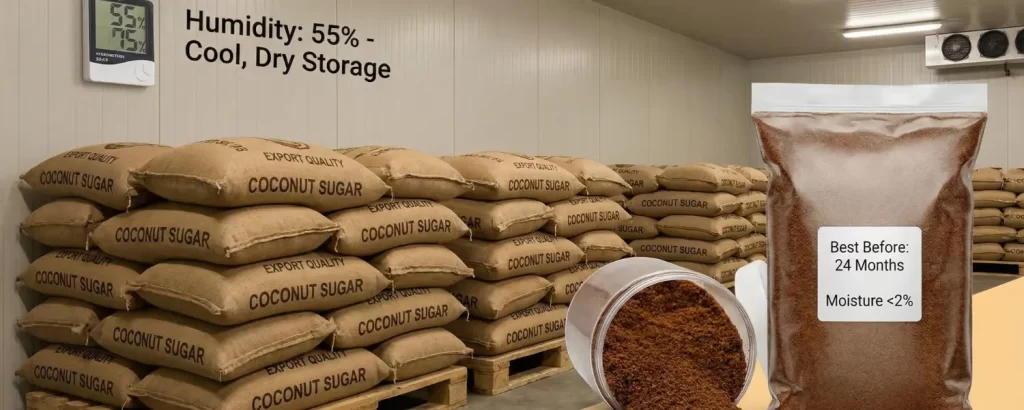
For international importers, private label brands, and food manufacturers, buying export quality coconut sugar is an investment. You are paying for a premium, unrefined natural sweetener with a specific texture, flavor profile, and nutrient content. Protecting that investment requires understanding the science of storage.
Unlike highly refined white sugar, which is stripped of nutrients and essentially inert, natural coconut sugar is a “living” product. It retains natural moisture, minerals, and amino acids. This makes it more sensitive to its environment but also far more valuable.
As a specialist exporter from India, Exim Internationals ensures that every batch leaves our facility in peak condition. This guide explains how we maintain that quality during transit and how you can preserve it in your warehouse to ensure maximum shelf life and profitability.
1. The Golden Rule: Moisture Content < 2%
The single biggest enemy of coconut sugar is moisture. Coconut sugar is hygroscopic, meaning it naturally attracts and holds water molecules from the surrounding air.
The Risk: If the moisture content rises above 2-3%, the sugar granules will begin to stick together. This leads to clumping, hardening into “bricks,” and eventually, fermentation or mold growth.
Our Export Standard: We process our export quality coconut sugar to a strict moisture content of less than 2%. This low baseline is critical. It ensures the product remains free-flowing and granular, even during the temperature fluctuations of international shipping.
2. Expected Shelf Life: What Buyers Can Count On
When stored correctly, premium coconut sugar is a highly stable product.
Unopened Bulk Packs: In our standard 25kg export bags, stored in a cool, dry warehouse, you can expect a shelf life of 18 to 24 months from the date of manufacture.
Retail Packs: Once repacked into retail pouches (e.g., 500g stand-up pouches with zippers), the product maintains its quality for the same 24-month period, provided the seal is airtight.
Note: While the product remains safe to consume beyond this period, the flavor profile may slowly change, losing some of its distinct caramel notes.
Import products for your Needs

3. Export Packaging: The First Line of Defense
Maintaining shelf life starts with the right packaging. We do not use standard woven sacks for coconut sugar; they are too porous.
For bulk exports, we use a specialized Triple-Layer System:
Inner Liner: A high-density polyethylene (HDPE) liner that acts as a primary moisture barrier.
Barrier Layer: Often an aluminum or metallized layer to reflect heat and block UV light, which can degrade nutrients.
Outer Shell: A tough Kraft paper or woven polypropylene sack for physical protection during handling.
4. Warehouse Best Practices for Importers
Once the shipment arrives at your facility (whether in the UAE, Europe, or the US), maintaining the “Export Quality” status is in your hands.
Temperature Control: Store in a cool environment, ideally between 20°C to 25°C (68°F – 77°F). Avoid areas near ovens, heaters, or direct sunlight.
Humidity Control: This is critical. Keep relative humidity (RH) in your storage area below 60%. If you are in a humid climate (like tropical regions or coastal cities), climate-controlled warehousing is highly recommended to prevent clumping.
Pallet Management: Always store bags on pallets, off the floor and away from walls, to prevent condensation transfer and allow for airflow.
5. Troubleshooting: Why Clumping Happens
If you notice clumping in your inventory, it is almost always a sign of moisture ingress.
Soft Clumps: Usually harmless and can be broken up easily. This suggests a minor humidity fluctuation.
Hard Bricks: Indicates significant moisture absorption. The product may still be safe but is difficult to use and repackage.
The Solution: Prevention is the only cure. Ensure your supplier provides a Certificate of Analysis (COA) verifying the initial low moisture content (<2%) before it ships.
Import products for your Needs
Quality Preservation is a Partnership
Maintaining the value of export quality coconut sugar is a partnership. We guarantee the specs at the source—low moisture, perfect granulation, and barrier packing—and you maintain the environment at the destination. Together, we ensure the end consumer receives the premium, free-flowing natural sweetener they expect.
Looking for a supplier who understands the science of shelf life? Contact Exim Internationals today to discuss your bulk coconut sugar requirements.
Frequently Asked Questions (FAQs)
1. What is the ideal moisture content for export quality coconut sugar?
For export, the industry standard for premium quality is a moisture content of less than 2%. This ensures the sugar remains free-flowing and does not clump during transit or storage.
2. Does coconut sugar expire?
Like honey or maple syrup, coconut sugar is very stable and doesn’t “spoil” quickly. However, it has a “Best Before” date of typically 24 months. After this, it may lose flavor intensity or texture but is usually still safe to consume.
3. How do you prevent “container rain” (condensation) during shipping?
For sea freight shipments crossing different climate zones, we use desiccants (moisture-absorbing packs) inside the container and ensure high-quality, moisture-proof packaging liners to protect the cargo from condensation.
4. Can I store bulk coconut sugar in a standard warehouse?
Yes, provided the warehouse is cool, dry, and pest-free. If your warehouse is in a high-humidity area, you must take extra precautions to keep the humidity levels below 60%.
5. Why is your coconut sugar darker/lighter than the last batch?
Natural variation is a hallmark of an unrefined product. The color depends on the coconut species, the harvest season, and the caramelization temperature during processing. However, “Export Quality” ensures that within a single batch, the color is uniform.
6. Is clumping a sign of bad quality?
Not necessarily. Minor clumping is natural for unrefined sugars without anti-caking agents. However, severe hardening indicates that the product was exposed to high moisture, either during production or improper storage.
7. Do you offer vacuum packing for bulk orders?
Yes, for clients in extremely humid regions or those requiring extended storage, we can offer vacuum-sealed bulk bags upon request to provide maximum protection.
8. What packaging do you recommend for retail private labels?
For retail, we recommend stand-up pouches with a high-barrier metallized layer (foil lining) and a strong ziplock seal. This allows the customer to reseal the bag at home, keeping the sugar fresh and dry after opening.
About us
Exim Internationals is a premier export company dedicated to delivering the finest products from India to international markets. Our mission is to establish India as a global export powerhouse, contributing to economic growth and showcasing the richness of Indian goods worldwide.
From the pashmina shawls and apples of the North to the spices of the South, the fruits and powders of the West, and the tea and bamboo of the East, we connect every corner of India with the global market.
Certification we have: FSSAI, APEDA, IEC, UDYAM, FIEO, Spices Board, Coconut
Contact us
Samin heritage, Sl building, Shop no. 19, Chandan wadi, Almeda road Thane west, Maharashtra, India-400601.
Email Us: support@eximinternationals.com
Call Us: +91 9820446601 | +91 9321559185

