
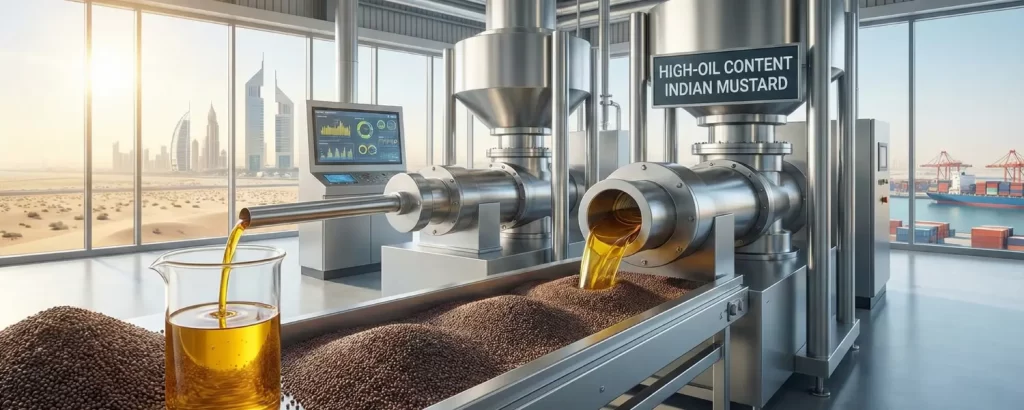
In the bustling industrial zones of Dubai and Sharjah, the hum of oil crushing machines tells a story of trade that spans centuries. The UAE is not just a consumer of spices; it is a major processing hub for edible oils. For oil millers in the region, the profitability of their entire operation hinges on one crucial metric: Oil Content.
When it comes to sourcing raw material, the preference is clear. The demand for mustard export to UAE is dominated by Indian origin seeds. But why? It’s not just proximity; it’s biology. Indian mustard seeds, particularly those from the arid belts of Rajasthan, offer a yield advantage that competitors struggle to match.
As a leading exporter of Indian oilseeds, Exim Internationals breaks down the “Oil Content Factor” and why it makes Indian mustard the undisputed choice for UAE millers.
1. The Yield Advantage: 40% to 42% Oil Content
For an oil miller, every percentage point matters. A seed with 38% oil content versus one with 42% represents a massive difference in output per container.
Indian Standard: Premium Indian mustard seeds (Brassica juncea), specifically the “Bold” varieties, consistently test with an oil content between 40% and 42%.
The Profit Calculation: On a standard 20-foot container carrying roughly 24 Metric Tons of seeds, a 2% increase in oil recovery can yield hundreds of additional liters of oil. This efficiency directly boosts the miller’s bottom line.
2. The Pungency Factor: That "Kick" the Market Craves
The UAE market, with its diverse expatriate population from South Asia, demands mustard oil with a specific sensory profile: a sharp, pungent aroma and a rich, dark golden color.
This pungency comes from a compound called Allyl Isothiocyanate. Indian mustard seeds are naturally rich in this compound. When crushed, they release that signature “kick” that consumers in Abu Dhabi and Dubai associate with high-quality, authentic mustard oil. Seeds from other origins often result in a bland oil that requires artificial fortification, adding cost and reducing quality perception.
Import products for your Needs

3. Low Moisture, High Stability
The journey from an Indian port like Nhava Sheva or Mundra to Jebel Ali is relatively short (typically 5-7 days). However, the intense heat of the UAE requires raw materials that are stable.
Indian mustard seeds are harvested during the hot, dry spring season (Rabi crop). They are naturally dried to a moisture content of below 8-9%. This low moisture level is critical for two reasons:
Prevents Fungal Growth: High moisture can lead to aflatoxin development during storage in hot UAE warehouses.
Better Crushing: Dry seeds crush more efficiently, releasing oil more easily without creating excess sludge or cake.
4. Consistent Sizing for Efficient Milling
UAE oil mills use sophisticated expeller presses that require uniform seed size for optimal operation. Indian exporters categorize mustard into specific grades:
Micro: Small seeds, often used for cheaper blends.
Bold: Large, uniform seeds preferred by premium oil millers for their higher oil-to-husk ratio.
By sourcing graded Bold Black Mustard from India, UAE millers ensure their machinery runs smoothly with less wear and tear.
The Smart Choice for UAE Millers
For the UAE’s oil milling industry, sourcing is not just about buying seeds; it’s about buying yield, flavor, and stability. Indian mustard seeds deliver on all three fronts. They offer the highest natural oil content, the authentic pungency the market demands, and the low-moisture stability required for the desert climate.
As we approach the 2026 harvest (February-March), now is the time for UAE millers to secure their contracts.
Are you an oil miller in the UAE looking to maximize your yield? Contact Exim Internationals today for a quote on high-oil-content Bold Black Mustard seeds, shipped directly to Jebel Ali.
Frequently Asked Questions (FAQs)
1. What is the typical oil content of Indian mustard seeds exported to the UAE?
Premium Indian mustard seeds (Bold variety) typically have an oil content ranging from 40% to 42%. This high yield is the primary reason they are preferred by oil millers in the UAE.
2. Which port in the UAE do you ship mustard seeds to?
We primarily ship to Jebel Ali Port in Dubai, which serves as the main logistics hub for the entire region. We can also arrange shipments to Khalifa Port (Abu Dhabi) or Sharjah upon request.
3. What is the difference between “Bold” and “Micro” mustard seeds?
“Bold” refers to larger, fully mature seeds which typically have a higher oil-to-shell ratio, making them ideal for oil extraction. “Micro” seeds are smaller and are often used for lower-cost spice blends or powder, rather than oil crushing.
4. How do you ensure the mustard seeds stay dry during shipping to the UAE?
We ensure the seeds are dried to a moisture level below 9% before packing. We use high-quality PP (Polypropylene) or Jute bags and inspect containers for leaks or dampness to prevent “container rain” during the sea voyage.
5. Do you provide a Certificate of Analysis (COA) confirming the oil content?
Yes. Every shipment of mustard export to UAE is accompanied by a COA from an accredited third-party laboratory. This document verifies the oil content, purity, and moisture levels, giving you complete peace of mind.
6. What is the transit time from India to Jebel Ali for a mustard shipment?
The sea transit time from India’s west coast ports (Mundra or Nhava Sheva) to Jebel Ali is very short, typically between 5 to 8 days.
7. Can you supply yellow mustard seeds to the UAE as well?
Yes, while black/brown mustard is preferred for oil, we also export Yellow Mustard seeds (often used for American-style mustard paste and pickling) to food manufacturers in the UAE.
8. What is the minimum order quantity (MOQ) for mustard seeds?
Our standard MOQ is one 20-foot container, which holds approximately 24 to 25 Metric Tons of mustard seeds packed in 25kg or 50kg bags.
About us
Exim Internationals is a premier export company dedicated to delivering the finest products from India to international markets. Our mission is to establish India as a global export powerhouse, contributing to economic growth and showcasing the richness of Indian goods worldwide.
From the pashmina shawls and apples of the North to the spices of the South, the fruits and powders of the West, and the tea and bamboo of the East, we connect every corner of India with the global market.
Certification we have: FSSAI, APEDA, IEC, UDYAM, FIEO, Spices Board, Coconut
Contact us
Samin heritage, Sl building, Shop no. 19, Chandan wadi, Almeda road Thane west, Maharashtra, India-400601.
Email Us: support@eximinternationals.com
Call Us: +91 9820446601 | +91 9321559185

