
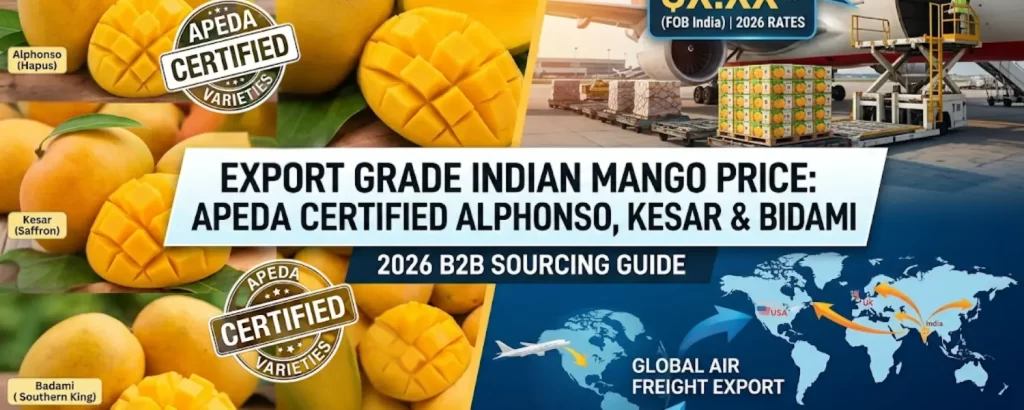
India is the undisputed king of mangoes, producing over 40% of the world’s supply. However, for an international buyer, there is a massive difference between local market fruit and an Export Grade Indian Mango.
When importing perishables by air freight to markets like the USA, EU, or the Middle East, a single pest detection or pesticide residue violation can result in the entire shipment being incinerated at customs. Sourcing the best indian mango requires strict adherence to APEDA (Agricultural and Processed Food Products Export Development Authority) guidelines.
At Exim Internationals, we supply premium, certified fresh indian mango shipments that clear customs seamlessly. Here is your comprehensive 2026 guide to pricing, varieties, and export specifications.
1. The "Big Three" Commercial Varieties
While India grows hundreds of mango types, international trade is dominated by three main varieties due to their shelf life, flavor profile, and demand. Here is a breakdown of each indian mango variety:
| Variety | Harvest Season | Flavor & Texture | Ideal Export Market |
| Alphonso (Hapus) | April – Mid June | Extremely sweet, rich, non-fibrous. Golden yellow skin. | UK, EU, USA, UAE |
| Kesar | May – July | Sweet with a slight tang, very fragrant, saffron-colored flesh. | Middle East, UK, Canada |
| Badami (Alphonso of the South) | April – May | Similar to Alphonso but slightly paler and more economical. | Southeast Asia, Middle East |
2. How the Export Grade Indian Mango Price is Calculated
The indian mango fruit market is highly dynamic. Prices change weekly based on weather conditions, orchard yields, and available air cargo space.
When you request an export grade indian mango price from us, here is what goes into your FOB (Free on Board) or CIF (Cost, Insurance, and Freight) quote:
Orchard Gate Price: The base cost of the raw fruit, hand-picked at the optimal maturity stage (usually 75-80% mature to ripen during transit).
Post-Harvest Treatment: Mandatory treatments such as Hot Water Treatment (HWT) or Vapor Heat Treatment (VHT) to eliminate fruit flies.
Packing Costs: High-quality, ventilated corrugated boxes (usually 3 kg or 4.5 kg) with individual fruit netting to prevent bruising.
Air Freight (The Largest Variable): Because mangoes are highly perishable, they are almost exclusively shipped via air cargo. Freight rates often make up 40% to 60% of the landed CIF cost.
3. APEDA Certification & Compliance (Non-Negotiable)
To successfully import a fresh indian mango, your supplier must be APEDA registered and follow strict Phytosanitary protocols.
Traceability: Our mangoes are routed through APEDA’s MangoNet system. This ensures that every box can be traced back to the specific registered farm it was harvested from, guaranteeing compliance with European (MRL) and American import standards.
Treatments: Depending on your country’s regulations, we provide Irradiation (for the USA) or Hot Water Treatment (for the EU/Middle East). We handle all Phytosanitary Certificates before the cargo leaves Indian soil.

4. Standard Export Specifications & Packing
To maximize air freight efficiency, we use standardized packaging:
Box Capacity: 3 kg to 3.5 kg net weight per corrugated box.
Count per Box: Usually 12 to 15 pieces per box (depending on the fruit size/grade).
Weight per Fruit: Ranging from 220g to 270g+ for premium export grades.
Cooling: Pre-cooled to 12°C – 13°C before loading onto the aircraft to halt the ripening process.
Secure Your 2026 Allocation
The window for sourcing the best indian mango is short, and premium orchard allocations fill up months in advance. Partnering with a certified exporter ensures you receive fruit that looks beautiful on supermarket shelves and tastes exactly as a real Indian mango should.
Frequently Asked Questions (FAQs)
1. What is the Minimum Order Quantity (MOQ) for fresh Indian mango exports?
Because mangoes are shipped via air freight, our standard MOQ is 500 kg to 1 Metric Ton per shipment. This volume is required to secure the best consolidated freight rates from airlines.
2. Which is more expensive: Alphonso or Kesar?
Alphonso is generally the most expensive indian mango variety due to its global fame, delicate nature, and lower crop yield compared to Kesar. Kesar offers an excellent balance of premium flavor at a more competitive price point.
3. How long is the shelf life of an export grade Indian mango?
When harvested at export-maturity and maintained in an unbroken cold chain (approx. 12°C), our mangoes have a shelf life of 10 to 14 days from the date of dispatch.
4. Why is my mango shipment treated with hot water (HWT)?
Hot Water Treatment is a mandatory phytosanitary requirement for many importing countries (like the EU and UAE) to ensure the fruit is completely free of fruit fly eggs or larvae without using harmful chemical pesticides.
5. Can you ship Indian mangoes to the USA?
Yes, but the USA has very specific import protocols. Indian mangoes bound for the US must undergo Irradiation treatment at an approved facility under the supervision of APHIS (Animal and Plant Health Inspection Service) inspectors before export. Exim Internationals can facilitate this process for bulk buyers.
About us
Exim Internationals is a premier export company dedicated to delivering the finest products from India to international markets. Our mission is to establish India as a global export powerhouse, contributing to economic growth and showcasing the richness of Indian goods worldwide.
From the pashmina shawls and apples of the North to the spices of the South, the fruits and powders of the West, and the tea and bamboo of the East, we connect every corner of India with the global market.
Certification we have: FSSAI, APEDA, IEC, UDYAM, FIEO, Spices Board, Coconut
Contact us
Samin heritage, Sl building, Shop no. 19, Chandan wadi, Almeda road Thane west, Maharashtra, India-400601.
Email Us: support@eximinternationals.com
Call Us: +91 9820446601 | +91 9321559185
