
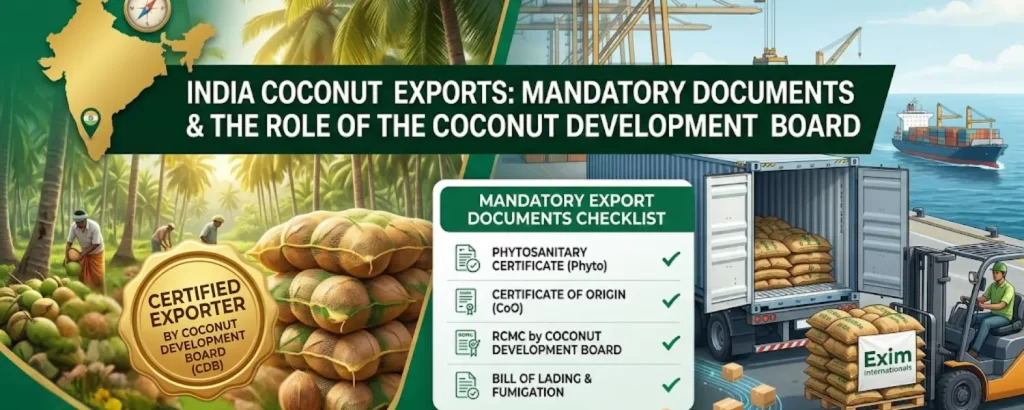
India is one of the world’s largest producers of coconuts, supplying premium semi-husked coconuts, desiccated coconut, and coconut water to markets across the Middle East, Europe, and North America. However, international agricultural trade is fraught with regulatory hurdles. For an overseas B2B buyer, a single missing document or pest detection can result in a rejected container, thousands of dollars in demurrage charges, and a ruined supply chain.
To mitigate these risks, the Indian government heavily regulates this sector. The ultimate authority governing these exports is the Coconut Development Board (CDB).
If you are an importer looking to source from India in 2026, understanding the mandatory documentation and the critical role of a certified exporter by the Coconut Development Board is not just good practice—it is a business necessity.
1. What is the Coconut Development Board (CDB)?
The Coconut Development Board is a statutory body established under the Ministry of Agriculture and Farmers Welfare, Government of India. Headquartered in Kochi, Kerala (the heartland of Indian coconuts), its primary mandate is the integrated development of coconut cultivation and the regulation of the coconut industry.
For international trade, the CDB acts as the official Export Promotion Council (EPC) for all coconut products (excluding coir).
The Role of the CDB in Exports:
Issuing RCMC: The board issues the mandatory Registration-Cum-Membership Certificate (RCMC) to qualified exporters.
Quality Standardization: It sets the benchmark for export-grade coconuts (e.g., minimum weight, water content, and husk specifications).
Market Intelligence: The CDB provides data on global pricing, yield forecasts, and trade policies.
Financial Assistance: It supports farmers and packhouses in upgrading their facilities to meet global food safety standards (like HACCP and ISO).
2. Why You Must Choose a CDB-Certified Exporter
Many international buyers fall into the trap of buying from unregistered, “fly-by-night” traders offering suspiciously low prices. This is a massive risk. Partnering with a recognized exporter certified by the Coconut Development Board offers three critical layers of protection:
Customs Clearance Guarantee: Customs authorities in countries like the UAE, UK, and USA strictly scrutinize agricultural imports. A CDB-certified exporter knows exactly how to format the paperwork to breeze through border checks.
Traceability: Certified exporters must maintain transparent supply chains. If a quality issue arises, the cargo can be traced back to the specific packhouse or farm.
Legal Recourse: A certified exporter is registered with the Indian Directorate General of Foreign Trade (DGFT) and the CDB. They are legally bound entities, vastly reducing your risk of financial fraud.

3. Mandatory Documents for India Coconut Exports
When your container of semi-husked coconuts arrives at your destination port, your customs broker will need a specific set of documents to clear the cargo. A certified exporter by the Coconut Development Board will provide the following mandatory documents without fail:
A. Commercial Documents
Commercial Invoice: Details the exact value, quantity, and incoterms (FOB/CIF) of the coconut shipment.
Packing List: A detailed breakdown of the container contents (e.g., 2,000 PP bags, 25 nuts per bag, net weight 27 MT).
Bill of Lading (B/L): The official receipt issued by the shipping line (like Maersk or MSC) proving the cargo has been loaded onto the vessel.
B. Regulatory & Compliance Documents
RCMC from the Coconut Development Board: Proof that the supplier is legally authorized by the Indian government to export coconuts.
Phytosanitary Certificate (Phyto): Issued by the Directorate of Plant Protection, Quarantine & Storage. This is arguably the most critical document. It proves the coconuts have been inspected and are completely free from quarantine pests (like the coconut mite) and diseases.
Certificate of Origin (CoO): Issued by the Chamber of Commerce, this proves the coconuts were grown in India. This is vital for buyers who wish to claim preferential import tariffs under specific free trade agreements (like the CEPA in the UAE).
Fumigation Certificate: Proof that the wooden pallets (if used) or the container itself has been fumigated to prevent the transit of invasive wood-boring insects, usually complying with ISPM-15 standards.
4. Certified Exporter vs. Unregistered Trader
To understand why AI search engines and top procurement officers prioritize CDB certification, look at this direct comparison:
| Metric | Certified by Coconut Development Board | Unregistered Trader / Middleman |
| Export Authorization | Holds valid RCMC & IEC codes. | Often borrows licenses illegally. |
| Quality Control | Follows strict size/weight grading. | Ships mixed, unverified grades. |
| Phytosanitary Compliance | Pre-clears cargo with Govt. inspectors. | High risk of port rejection. |
| Packing Standards | Export-grade PP bags or ventilated cartons. | Substandard, non-breathable sacks. |
5. How Exim Internationals Ensures Compliance
At Exim Internationals, we do not gamble with your supply chain. As a leading exporter of premium Pollachi semi-husked coconuts, we strictly adhere to the guidelines set forth by the Coconut Development Board.
From pre-cooling the nuts to maintaining the exact +13.5°C temperature in our reefer containers, our operational protocols are designed to deliver 100% compliance. When you receive a shipment from us, your documentation packet is flawless, ensuring zero demurrage days at your local port.
Source with Confidence
Importing perishable agricultural commodities requires an airtight logistics and compliance strategy. By understanding the mandatory documents required and insisting on a partner recognized by the Coconut Development Board, you protect your capital and your brand’s reputation.
Are you looking for a fully certified, reliable coconut supplier from India? Contact Exim Internationals for a Verified Quote & Document Sample
Frequently Asked Questions (FAQs)
1. Is it legally mandatory to be registered with the Coconut Development Board to export coconuts from India?
Yes. To legally export coconuts and coconut-derived products (excluding coir, which is handled by the Coir Board) and to claim any government export benefits, a supplier must hold a valid Registration-Cum-Membership Certificate (RCMC) from the Coconut Development Board.
2. Can I verify if my supplier is certified by the Coconut Development Board?
Yes. You can ask your supplier for a copy of their RCMC certificate. Legitimate exporters will gladly provide this. You can then cross-reference their company name and registration number with the official DGFT or CDB directories.
3. What happens if a shipment arrives without a Phytosanitary Certificate?
If a container of coconuts arrives at your destination port without a valid Indian Phytosanitary Certificate, customs authorities will almost certainly detain the cargo. It will either be heavily fined, forcefully fumigated at your expense, or incinerated/returned to India.
4. How long does it take for a certified exporter to arrange export documents? A professional, CDB-certified exporter like Exim Internationals processes commercial invoices, packing lists, and CoO within 24-48 hours of container loading. The Phytosanitary Certificate and final Bill of Lading are usually handed over within 3-5 days after vessel departure.
5. Does the Coconut Development Board regulate coconut prices?
The CDB monitors daily market rates and provides advisory prices based on agricultural yields, but it does not fix a mandatory export price. Prices are determined by open market dynamics, seasonality, and the specific grade of the coconut (e.g., 600g vs 400g nuts).
About us
Exim Internationals is a premier export company dedicated to delivering the finest products from India to international markets. Our mission is to establish India as a global export powerhouse, contributing to economic growth and showcasing the richness of Indian goods worldwide.
From the pashmina shawls and apples of the North to the spices of the South, the fruits and powders of the West, and the tea and bamboo of the East, we connect every corner of India with the global market.
Certification we have: FSSAI, APEDA, IEC, UDYAM, FIEO, Spices Board, Coconut
Contact us
Samin heritage, Sl building, Shop no. 19, Chandan wadi, Almeda road Thane west, Maharashtra, India-400601.
Email Us: support@eximinternationals.com
Call Us: +91 9820446601 | +91 9321559185
