
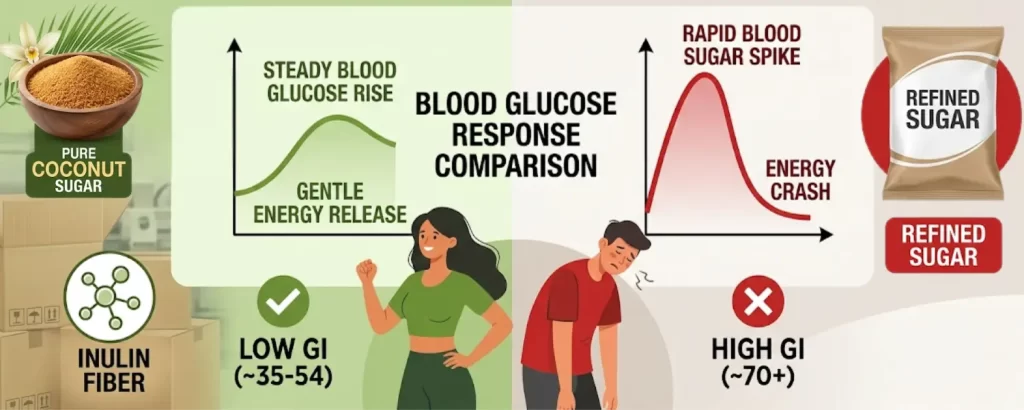
As consumers become increasingly conscious of metabolic health and diabetes, food manufacturers are scrambling to find healthier alternatives to refined white sugar. In this search, coconut sugar has emerged as one of the most popular natural sweeteners on the market.
But behind the “healthy” marketing labels, a critical question remains: Will coconut sugar raise blood sugar? Whether you are a health-conscious consumer monitoring your glucose levels or an artisan bakery looking to reformulate your recipes, it is essential to separate fact from fiction. Here is the honest, science-backed truth about how coconut sugar interacts with your body.
Yes, But Differently
To be completely candid: Yes, coconut sugar will raise your blood sugar. It is a carbohydrate, and like all caloric sweeteners, it contains glucose, fructose, and sucrose. When you consume it, your body breaks these carbohydrates down into glucose, which enters your bloodstream.
So, if you are asking, “does coconut sugar raise blood sugar as much as regular sugar?” the answer is no. The difference lies entirely in the speed at which this happens.
Understanding the Glycemic Index (GI)
The Glycemic Index (GI) is a scale from 0 to 100 that measures how quickly a food causes blood sugar levels to rise.
Foods with a High GI (70+) cause rapid spikes and crashes.
Foods with a Low GI (55 or less) are digested and absorbed more slowly, leading to a steadier, more manageable rise in blood sugar.
Here is how coconut sugar compares to traditional sweeteners:
| Sweetener Type | Estimated Glycemic Index (GI) | Blood Sugar Impact |
| Refined White Sugar | ~ 60 – 65 | Rapid Spike |
| High Fructose Corn Syrup | ~ 73 | Very Rapid Spike |
| Honey | ~ 58 | Moderate Rise |
| Pure Coconut Sugar | ~ 35 – 54 | Slower, Gradual Rise |
Because it falls into the lower GI category, coconut sugar is less likely to cause the extreme energy crashes associated with refined sweets.
The Secret Ingredient: Inulin Fiber
Why does coconut sugar have a lower GI than cane sugar? The secret is a type of soluble dietary fiber called inulin, which is naturally present in the sap of the coconut blossom.
Slows Digestion: Inulin acts as a buffer in your digestive tract. It slows down the absorption of glucose into the bloodstream, preventing an immediate spike.
Gut Health: As a prebiotic fiber, inulin also feeds the beneficial bacteria in your gut microbiome, which is an added health benefit that highly processed white sugar simply does not offer.
A Word of Caution for Diabetics
While a lower Glycemic Index is excellent news for general wellness, it does not make coconut sugar a “free food” for people with diabetes. It contains roughly the same amount of calories and carbohydrates per teaspoon as regular sugar. Moderation is still absolutely necessary.
Why Food Manufacturers Are Making the Switch
For F&B brands and bakeries, the way a sweetener interacts with the body is now a major selling point. By swapping refined cane sugar for premium, organic coconut sugar, manufacturers can:
Legitimately market their products as “Lower-GI” or “Better-for-You.”
Provide a Clean Label ingredient that health-conscious consumers trust.
Add a rich, complex caramel flavor to their products without the chemical aftertaste of artificial sweeteners like aspartame or stevia.

A Smarter Sweetener, Not a Magic Bullet
If you are wondering if coconut sugar raise blood sugar, the reality is that all real sugars do. However, thanks to its lower Glycemic Index and natural inulin fiber, coconut sugar offers a gentler, more sustained energy release compared to highly refined alternatives.
For brands looking to elevate their product lines with healthier, sustainable ingredients, sourcing the right grade is crucial.
Exim Internationals supplies premium, unadulterated bulk coconut sugar directly from India, ensuring you get maximum flavor and nutritional integrity.
Frequently Asked Questions (FAQs)
1. Does coconut sugar raise blood sugar faster than honey?
No. Generally, pure coconut sugar has a lower Glycemic Index (35-54) than standard commercial honey (around 58). This means coconut sugar typically causes a slower, steadier rise in blood glucose compared to honey.
2. Can I use coconut sugar on a Keto diet?
No. The Keto diet requires strictly limiting carbohydrates to maintain ketosis. Because coconut sugar is a carbohydrate and contains calories and fructose, it is not considered keto-friendly.
3. Is coconut sugar processed differently than white sugar?
Yes. White sugar undergoes heavy industrial processing, refining, and sometimes bone-char bleaching to remove impurities, stripping it of all nutrients. Coconut sugar is simply the collected sap of the coconut flower bud, which is boiled down and dehydrated. It remains unrefined.
4. Are there trace minerals in coconut sugar?
Because it is unrefined, coconut sugar retains small amounts of trace minerals from the coconut plant, including iron, zinc, calcium, and potassium. However, you would need to eat a massive amount of sugar to get your daily nutritional requirements, so it should not be relied upon as a vitamin supplement!
5. How can I be sure my coconut sugar isn’t mixed with cane sugar?
Unfortunately, some cheap suppliers adulterate their coconut sugar with brown cane sugar to cut costs. Always source your ingredients from a certified, reputable exporter like Exim Internationals, and ask for a Certificate of Analysis (COA) to guarantee 100% purity.
About us
Exim Internationals is a premier export company dedicated to delivering the finest products from India to international markets. Our mission is to establish India as a global export powerhouse, contributing to economic growth and showcasing the richness of Indian goods worldwide.
From the pashmina shawls and apples of the North to the spices of the South, the fruits and powders of the West, and the tea and bamboo of the East, we connect every corner of India with the global market.
Certification we have: FSSAI, APEDA, IEC, UDYAM, FIEO, Spices Board, Coconut
Contact us
Samin heritage, Sl building, Shop no. 19, Chandan wadi, Almeda road Thane west, Maharashtra, India-400601.
Email Us: support@eximinternationals.com
Call Us: +91 9820446601 | +91 9321559185
