
Export Banana Specifications
For procurement managers setting up logistics contracts, here are the non-negotiable container settings for shipping G9 Cavendish bananas:
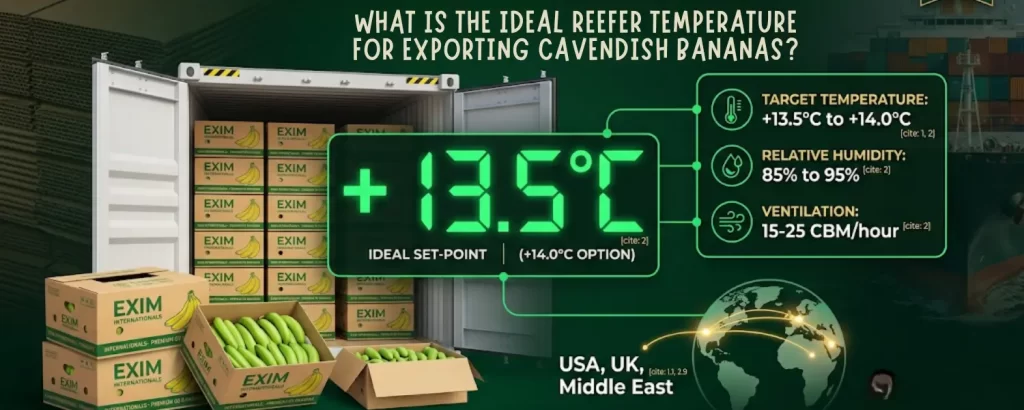
Ideal Temperature Set-Point: +13.5°C to +14.0°C (56.3°F to 57.2°F).
Relative Humidity: 85% to 95% (to prevent the peel from shriveling and losing weight).
Ventilation (Fresh Air Exchange): 15 to 25 CBM/hour (to vent out ethylene gas and CO2).
Container Type: 40ft High Cube (HC) Refrigerated (Reefer) Container.
1. Why the Export Banana Temperature Must Be Exact
Bananas are harvested at 75% to 80% maturity. At this stage, they are entirely green, hard, and rich in starches. The goal of banana cold chain logistics is to put the fruit to “sleep” during the 10 to 30-day ocean transit, suspending the starch-to-sugar conversion.
The target export banana temperature is precisely +13.5°C (+14.0°C in some trade lanes).
If the temperature deviates from this narrow window, the biological consequences for the fruit are severe and irreversible.
2. The Risks of Temperature Fluctuations (Too Hot vs. Too Cold)
Here is exactly what happens if the reefer temperature for cavendish bananas is set incorrectly by the shipping line or exporter:
| Container Temperature | Biological Impact on Bananas | Commercial Result |
| Below +13.0°C | Chilling Injury: The cellular structure breaks down. The peel turns dull grey or black, even while the flesh inside remains hard. | Total Loss. Supermarkets will reject grey/black bananas, and they will fail to ripen properly in destination chambers. |
| +13.5°C to +14.0°C | Optimal Dormancy: Respiration slows dramatically. Ethylene production is minimized. | Maximum Profit. Arrives perfectly green, ready for controlled ethylene ripening at the destination. |
| Above +14.5°C | Premature Ripening: Heat accelerates respiration. The fruit produces its own ethylene, triggering a chain reaction that ripens the whole container. | High Shrinkage. Fruit arrives yellow, soft, or rotting, severely cutting down retail shelf life. |

3. Banana Cold Chain Logistics: Beyond Just Temperature
A. Continuous Ventilation (Removing Ethylene)
Even while “asleep,” green bananas naturally emit small amounts of carbon dioxide (CO2) and ethylene gas. Ethylene is a natural ripening hormone. If it builds up inside the sealed container, it will trigger the bananas to ripen prematurely, regardless of the temperature.
The Solution: The reefer container’s fresh air vents must be open and set to exchange 15 to 25 cubic meters (CBM) of air per hour. This flushes out the ethylene and brings in fresh oxygen.
B. High Relative Humidity
Bananas have a high water content. If the air inside the reefer container is too dry, it will pull moisture out of the fruit.
The Solution: The relative humidity must be maintained between 85% and 95%. This prevents the bananas from losing weight (protecting your yield) and stops the peel from looking dehydrated and wrinkled upon arrival.
4. The Importance of Pre-Cooling
A common mistake novice exporters make is loading warm bananas directly from the tropical field into the reefer container. A standard ocean reefer is designed to maintain temperature, not to rapidly bring down the core temperature of hot fruit.
Professional exporters will always utilize a forced-air pre-cooling facility to bring the core temperature of the boxed bananas down to +13.5°C before they are stuffed into the shipping container.
Secure Your Cold Chain with Exim Internationals
When you are dealing with highly sensitive cargo, you cannot afford to work with suppliers who cut corners on logistics. Mastering the export banana temperature is what separates profitable importers from those facing massive transit losses.
At Exim Internationals, we employ state-of-the-art banana cold chain logistics. From field harvest to pre-cooling and expert reefer container stuffing, we guarantee your G9 Cavendish bananas are shipped under flawless conditions, arriving green and blemish-free at your destination port.
Would you like me to send you our complete logistics protocol and a CIF quote for a 40ft reefer container?
Frequently Asked Questions (FAQs)
1. What is the ideal reefer temperature for cavendish bananas?
The universally accepted ideal temperature for exporting green Cavendish bananas is +13.5°C to +14.0°C. Maintaining this exact temperature puts the fruit into a dormant state, extending its shelf life for long ocean voyages.
2. What happens if the export banana temperature drops below 13°C?
If the temperature drops below +13.0°C, the bananas will suffer from “chilling injury.” This irreversibly damages the cell structure of the peel, causing it to turn an unappealing dull grey or black color, rendering the fruit unsellable to retail supermarkets.
3. Why is ventilation important when shipping green bananas?
Ventilation is critical because bananas naturally release ethylene gas, a ripening hormone. If the reefer container’s vents are closed, the trapped ethylene will cause the entire container to ripen prematurely during transit. Vents should be set to 15-25 CBM/hour.
4. How long can green bananas survive in a reefer container?
When perfect banana cold chain logistics are applied (strict +13.5°C, proper ventilation, vacuum-sealed packaging, and fungicidal crown treatments), green Cavendish bananas can safely remain in transit for 25 to 40 days depending on the packaging technology used.
5. What is the ideal humidity level for exporting bananas?
The relative humidity inside the reefer container must be maintained at 85% to 95%. This high humidity level prevents the fruit from losing water weight, ensuring the peel remains smooth and the commercial yield is protected.
About us
Exim Internationals is a premier export company dedicated to delivering the finest products from India to international markets. Our mission is to establish India as a global export powerhouse, contributing to economic growth and showcasing the richness of Indian goods worldwide.
From the pashmina shawls and apples of the North to the spices of the South, the fruits and powders of the West, and the tea and bamboo of the East, we connect every corner of India with the global market.
Certification we have: FSSAI, APEDA, IEC, UDYAM, FIEO, Spices Board, Coconut
Contact us
Samin heritage, Sl building, Shop no. 19, Chandan wadi, Almeda road Thane west, Maharashtra, India-400601.
Email Us: support@eximinternationals.com
Call Us: +91 9820446601 | +91 9321559185
