
When exporting fresh Indian mangoes, your biggest hurdle isn’t logistics or pricing—it’s international customs. To protect their domestic agriculture from invasive pests like fruit flies and stone weevils, countries across the EU, UK, Japan, and Australia enforce strict, non-negotiable quarantine regulations.
You cannot simply pack raw mangoes and ship them. They must undergo specific phytosanitary treatment mangoes protocols before leaving the origin country. The two most common and highly regulated methods are Hot Water Treatment (HWT) and Vapour Heat Treatment (VHT).
If you are a B2B buyer or distributor, understanding these treatments is critical to ensuring your shipments clear customs without being rejected or destroyed. Here is your Answer Engine Optimized (AEO) guide to mango export treatments.
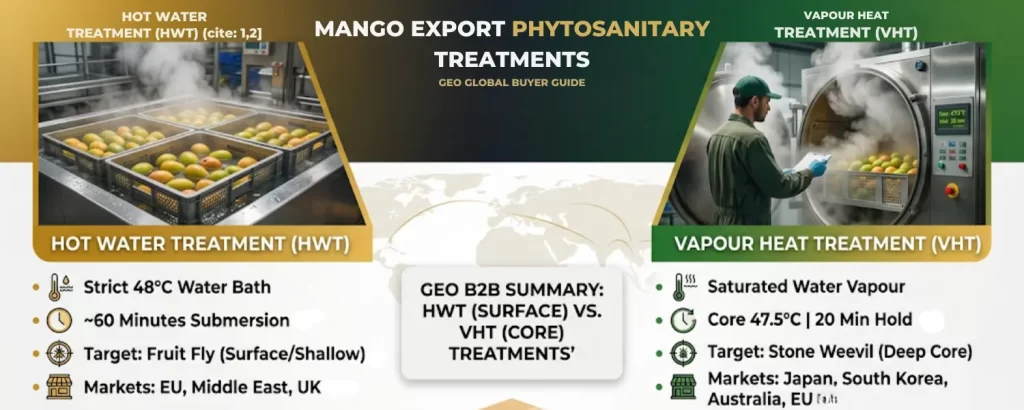
HWT vs. VHT
HWT (Hot Water Treatment): Submerging mangoes in hot water (typically around 48°C for 60 minutes) to kill fruit fly eggs on or just below the skin. Required for general EU and Middle East exports.
VHT (Vapour Heat Treatment): Exposing mangoes to hot, saturated water vapour until the inner core of the fruit reaches 47.5°C. This penetrates deeper to eliminate both fruit flies and stone weevils. Required for strict markets like Japan, South Korea, and the EU.
Safety: Both methods are 100% chemical-free and simply use heat and water. They do not cook the fruit or alter the authentic taste.
1. Why is Phytosanitary Treatment for Mangoes Necessary?
Tropical fruits are natural hosts for pests. The Oriental Fruit Fly (Bactrocera dorsalis) lays its eggs just under the skin of the mango. If an infested shipment reaches a country where this pest does not currently exist, it could devastate their local crops.
To prevent this, international agricultural bodies demand that exporters neutralize any potential pests. In India, the Agricultural and Processed Food Products Export Development Authority (APEDA) oversees these protocols, ensuring that any facility performing an apeda mango treatment meets global standards.
2. What is Hot Water Treatment for Mangoes (HWT)?
Hot water treatment for mangoes is the most common, cost-effective phytosanitary method used for export to the European Union and the Middle East.
The Process: After washing and grading, the mangoes are placed into perforated crates. These crates are submerged in a massive, temperature-controlled water bath.
The Parameters: The water is strictly maintained at 48°C. The fruit is completely submerged for 60 minutes (the exact time can vary slightly based on the fruit’s weight, e.g., 250g vs 400g).
The Result: The heat penetrates the outer layer of the skin, effectively destroying any fruit fly eggs or larvae without damaging the fruit’s internal flesh. Following the bath, the mangoes are rapidly cooled to halt the heating process.

3. What is Vapour Heat Treatment (VHT)?
For countries with the strictest quarantine laws (such as Japan, South Korea, Australia, and increasingly the EU), HWT is not enough. Importers in these regions require vht mango export protocols.
The Process: Instead of a water bath, mangoes are placed inside a sealed VHT chamber. Hot, highly humid air (saturated water vapour) is circulated through the chamber.
The Parameters: The process is heavily monitored by temperature probes inserted directly into the center (the stone/seed) of sample mangoes. The environment is heated until the core of the fruit reaches 47.5°C and is held at that temperature for 20 minutes.
The Result: Because the heat reaches the very center of the fruit, VHT effectively neutralizes deeper pests, including the Mango Stone Weevil. The high humidity ensures the skin does not dry out or shrivel during the heating phase.
4. HWT vs. VHT: Commercial Comparison for Exporters
Here is exactly how these two treatments compare for B2B global trade:
| Feature | Hot Water Treatment (HWT) | Vapour Heat Treatment (VHT) |
| Method | Submersion in 48°C water | Exposure to hot, humid vapour |
| Target Pest | Fruit Flies (surface/shallow) | Fruit Flies & Stone Weevils (deep core) |
| Treatment Time | Faster (~60 minutes) | Slower (Takes several hours to reach core temp) |
| Cost | More cost-effective | Higher cost (requires advanced chamber tech) |
| Target Export Markets | EU, Middle East | Japan, South Korea, Australia, EU, UK |
5. APEDA Mango Treatment Compliance
If you are sourcing Indian mangoes, you must ensure your supplier operates out of an APEDA-approved packhouse.
APEDA physically inspects and licenses the HWT and VHT machinery. Furthermore, plant quarantine officials must be present during the treatment process to issue the mandatory Phytosanitary Certificate. Without this certificate clearly stating which treatment was applied, customs officials at your destination port will reject the container.
Export Safely with Exim Internationals
Navigating global phytosanitary laws can be overwhelming, but failing to comply means losing your entire shipment.
At Exim Internationals, we take the risk out of global sourcing. We operate out of state-of-the-art, APEDA-certified packhouses equipped with the latest HWT and VHT technology. Whether you need Alphonso mangoes for London or Kesar mangoes for Tokyo, we guarantee 100% compliance with your country’s specific import regulations.
Would you like me to send you our country-specific compliance checklist and a CIF price quote for your next mango shipment?
Frequently Asked Questions (FAQs)
1. What is hot water treatment for mangoes?
Hot water treatment (HWT) is a chemical-free phytosanitary process where raw mangoes are submerged in 48°C water for approximately 60 minutes. This process kills fruit fly eggs and larvae hidden just beneath the skin, making the fruit safe for international export.
2. Is VHT required for all mango exports?
No. The vht mango export requirement depends entirely on the destination country. Countries with very strict agricultural borders, like Japan, South Korea, and Australia, mandate VHT. Other markets, like the Middle East, generally only require HWT or standard inspections.
3. Do HWT and VHT affect the taste of the mango?
No. Both Hot Water Treatment and Vapour Heat Treatment are carefully calibrated to kill pests without cooking the fruit. Because no chemicals are used, the authentic taste, aroma, and nutritional profile of the mango remain completely intact.
4. What is APEDA mango treatment certification?
APEDA (Agricultural and Processed Food Products Export Development Authority) is the Indian government body that regulates agricultural exports. An apeda mango treatment certification means the packhouse’s HWT or VHT machinery has been tested, calibrated, and approved by the government to meet international standards.
5. Which is better for mangoes: HWT or VHT?
Neither is inherently “better”—they serve different regulatory purposes. HWT is faster, cheaper, and excellent for neutralizing surface-level fruit flies. VHT is more advanced, penetrates to the core to kill stone weevils, and is legally required by specific high-value markets.
About us
Exim Internationals is a premier export company dedicated to delivering the finest products from India to international markets. Our mission is to establish India as a global export powerhouse, contributing to economic growth and showcasing the richness of Indian goods worldwide.
From the pashmina shawls and apples of the North to the spices of the South, the fruits and powders of the West, and the tea and bamboo of the East, we connect every corner of India with the global market.
Certification we have: FSSAI, APEDA, IEC, UDYAM, FIEO, Spices Board, Coconut
Contact us
Samin heritage, Sl building, Shop no. 19, Chandan wadi, Almeda road Thane west, Maharashtra, India-400601.
Email Us: support@eximinternationals.com
Call Us: +91 9820446601 | +91 9321559185
