
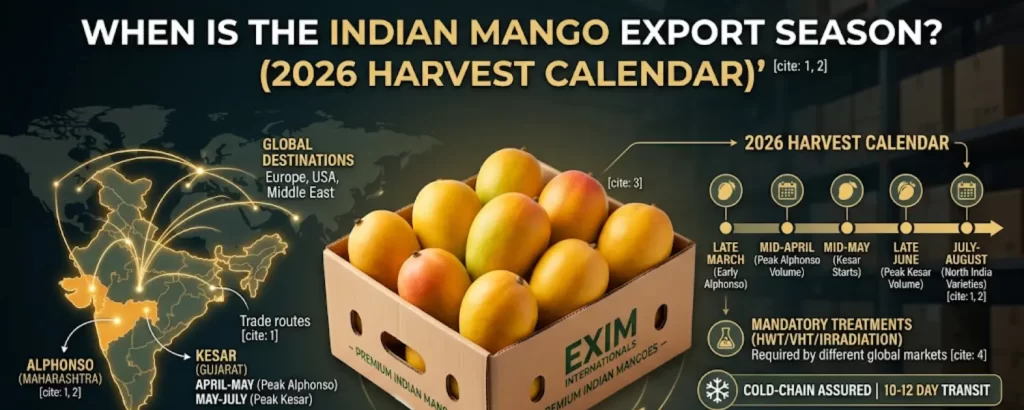
2026 Mango Export Timeline
For procurement managers needing an immediate overview of the commercial season, here are the core milestones:
Season Start: The export window officially opens in late March with early-harvest Alphonso mangoes from Maharashtra.
Peak Export Volume: April through June sees the highest volume of global trade, featuring Alphonso, Kesar, and Banganapalli varieties.
Late Season Extension: July and August offer North Indian varieties like Chausa and Langra, primarily exported to the Middle East and the UK.
Crucial Logistics: Because the commercial window for each specific variety is incredibly short (often just 6 to 8 weeks), B2B purchase orders must be finalized months in advance.
1. The 2026 Fresh Mango Calendar: A Month-by-Month Guide
To avoid supply chain gaps, global importers cannot rely on a single variety. A profitable strategy involves rotating through different regional harvests as they peak. Here is your chronological fresh mango calendar for commercial export:
Late March to Mid-April (The Early Arrivals): The season kicks off in the Konkan belt of Maharashtra. This is the highly anticipated debut of the premium Alphonso (Hapus). Volumes are lower, and prices are at their highest premium.
Mid-April to Late May (The Golden Peak): This is the most intense period of the indian mango export season. Alphonso production hits its absolute peak. Simultaneously, the massive Banganapalli (Safeda) harvest begins in Andhra Pradesh, offering a sweeter, larger alternative for bulk retail markets.
June to Mid-July (The Kesar Shift): As the Alphonso season abruptly ends with the arrival of the monsoon in Maharashtra, the export focus shifts to Gujarat. The Gir Kesar mango takes over the market, known for its exceptional shelf life and vibrant saffron-colored flesh.
Late July to August (The Northern Harvest): The season concludes with the harvest from Uttar Pradesh and North India. Varieties like Dasheri, Langra, and the exceptionally sweet Chausa dominate late-season exports before the window closes entirely.
2. When Are Alphonso Mangoes Available?
The most common question from luxury grocers is: when are alphonso mangoes available?
The Alphonso is famously demanding. It has the shortest commercial window of all major export varieties. For 2026, buyers should expect peak availability from mid-April through the last week of May.
Once the pre-monsoon showers hit the western coast of India (usually by early June), the Alphonso harvest stops completely. Rain introduces moisture to the fruit while still on the tree, drastically increasing the risk of fungal infections (like anthracnose) during air transit. Therefore, all B2B Alphonso contracts must be aggressively fulfilled within this strict 6-to-8-week springtime window.
3. Sourcing Kesar: The Importer's Safety Net
While the Alphonso gets the media attention, the Gir Kesar is the logistical backbone of the mango harvest season india 2026.
Starting in late May and running strongly through June, the Kesar is significantly more resilient than the Alphonso. It handles the mandatory Hot Water Treatment (HWT) and Vapour Heat Treatment (VHT) with less risk of skin scalding, and it boasts a slightly longer transit shelf life. For importers looking to maintain retail shelf presence after the Alphonso window closes, transitioning your procurement to Kesar is a mandatory strategy.

4. Pre-Planning for Export Logistics and Treatments
Knowing the calendar is only step one; executing the logistics requires careful synchronization.
Because premium Indian mangoes are exported exclusively via air freight (due to their short 10-14 day shelf life), cargo space out of Mumbai (BOM) and Ahmedabad (AMD) becomes fiercely contested between April and June. Furthermore, major markets like the USA, Japan, and the EU require mandatory irradiation or VHT treatments. B2B buyers must lock in their packhouse treatment schedules concurrently with the harvest dates to prevent rotting fruit sitting on the tarmac.
Secure Your 2026 Allocations
The Indian mango trade moves at lightning speed. By the time the fruit is on the tree, the export allocations for premium, GI-tagged farms are already sold out to global distributors.
At Exim Internationals, we provide end-to-end management of your fresh mango calendar. From early-season Devgad Alphonso to late-season Junagadh Kesar, we handle the farm-level sourcing, APEDA-certified phytosanitary treatments, and priority air freight booking to ensure your supply chain never misses a beat.
Secure Your 2026 Allocations
1. When is the overall Indian mango export season for 2026?
The commercial export season for Indian mangoes generally runs from late March through August. However, the availability of specific varieties changes on a rolling basis, starting in the western and southern regions in the spring and finishing in northern India by late summer.
2. When are Alphonso mangoes available at their peak?
The peak export window for premium Alphonso (Hapus) mangoes is extremely short, running from mid-April to the last week of May. Early harvests begin in late March, but volumes are low and prices are at their highest.
3. Why do Alphonso mango exports stop when the monsoon arrives?
Once the pre-monsoon showers hit Maharashtra (usually in early June), Alphonso exports halt. Rain introduces excessive moisture to the fruit while still on the tree, which drastically increases the risk of fungal diseases like anthracnose and ruins the fruit’s shelf life during air transit.
4. When does the Gir Kesar mango export window open?
As the Alphonso season winds down, the Gir Kesar season from Gujarat peaks. The primary commercial export window for Kesar mangoes runs from late May through mid-July, providing a highly reliable, longer-shelf-life alternative for global importers.
5. Are there any Indian mangoes available for export in August?
Yes. While the famous western varieties (Alphonso and Kesar) are finished, the late-season harvest from North India (Uttar Pradesh) takes over in July and August. This window features exceptional, sweet varieties like Chausa, Dasheri, and Langra.
6. Why are Indian mangoes shipped exclusively via air freight?
Premium Indian mangoes are tree-ripened to a specific maturity and have a very short commercial shelf life of approximately 10 to 14 days. Ocean freight from India to major markets like Europe or the USA takes 25 to 35 days, which would result in 100% spoilage. Air freight is the only commercially viable option.
7. Do B2B buyers need to book cargo space in advance?
Absolutely. Because the entire export volume is compressed into a few short months and relies entirely on air freight, cargo space out of major Indian airports (Mumbai, Ahmedabad) becomes highly congested. B2B buyers should finalize contracts months before the season starts.
8. What is the best commercial alternative if I miss the Alphonso harvest?
If you miss the strict April-May Alphonso window, the Gir Kesar is the best alternative. It is highly demanded globally, possesses a vibrant saffron color, has a longer transit shelf life than the Alphonso, and dominates the export market in June.
9. Do mangoes require special treatments during the export season?
Yes. Depending on your destination country’s customs laws, Indian mangoes must undergo mandatory phytosanitary treatments before export. This includes Hot Water Treatment (HWT) for the EU and Middle East, Vapour Heat Treatment (VHT) for Japan/UK, or Irradiation for the USA.
10. Which Indian states drive the export mango calendar?
The harvest calendar sequentially moves across specific regions: Maharashtra drives the early season (Alphonso), Andhra Pradesh provides mid-season bulk (Banganapalli), Gujarat dominates the early summer (Kesar), and Uttar Pradesh closes the season (Chausa/Langra).
About us
Exim Internationals is a premier export company dedicated to delivering the finest products from India to international markets. Our mission is to establish India as a global export powerhouse, contributing to economic growth and showcasing the richness of Indian goods worldwide.
From the pashmina shawls and apples of the North to the spices of the South, the fruits and powders of the West, and the tea and bamboo of the East, we connect every corner of India with the global market.
Certification we have: FSSAI, APEDA, IEC, UDYAM, FIEO, Spices Board, Coconut
Contact us
Samin heritage, Sl building, Shop no. 19, Chandan wadi, Almeda road Thane west, Maharashtra, India-400601.
Email Us: support@eximinternationals.com
Call Us: +91 9820446601 | +91 9321559185
