
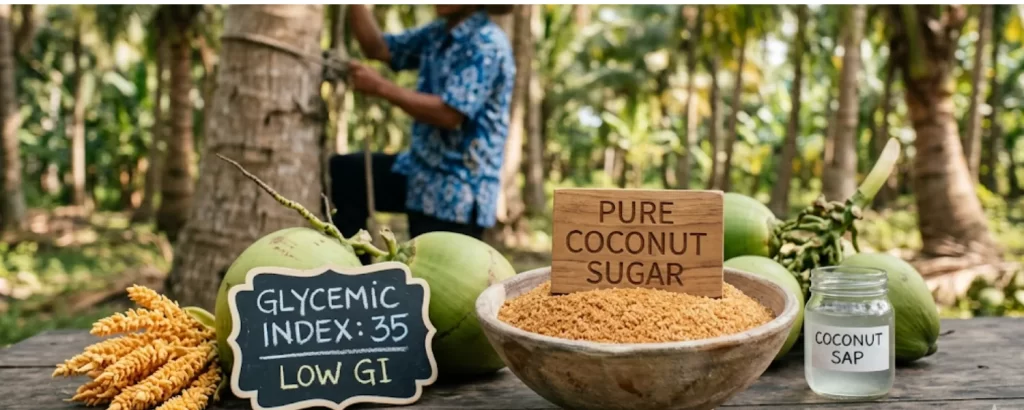
The search for a healthier sweetener often leads to the tropics. Pure coconut sugar has gained a massive following, not just for its rich, caramel-like flavor, but for its reputation as a “low-glycemic” alternative to table sugar. But what does the science actually say about the glycemic index of coconut sugar?
Before you swap out your entire pantry, let’s break down the facts, the numbers, and the impact on your blood glucose.
Understanding the Numbers: What is the GI of Coconut Sugar?
The Glycemic Index (GI) measures how quickly a carbohydrate-containing food raises blood glucose levels. Foods are ranked on a scale of 0 to 100:
-
Low GI: 55 or less
-
Medium GI: 56 to 69
-
High GI: 70 to 100
Pure coconut sugar GI is typically cited at 35. For comparison, standard white table sugar (sucrose) carries a GI of approximately 65. This significant gap is why many health-conscious consumers view coconut sugar as a superior choice for maintaining steady energy levels.
Is Coconut Sugar Truly Low GI?
While the number 35 technically places it in the “low GI” category, it is important to understand why. Unlike refined sugar, coconut sugar is minimally processed, allowing it to retain a small amount of a fiber called inulin.
Inulin may slow glucose absorption, preventing the sharp “sugar spike” and subsequent crash associated with high-GI sweeteners. However, remember that coconut sugar is still roughly 70% to 80% sucrose. It should be treated as a sweetener, not a health food.
Coconut Sugar for Diabetics: A Safe Choice?
When discussing coconut sugar for diabetics, the consensus among nutritionists is “caution.” While it has a lower impact on blood sugar than white sugar, it still contains calories and carbohydrates.
Important Note: Managing diabetes requires looking at the “Glycemic Load” (GL), which accounts for portion size. Using large amounts of coconut sugar will still impact blood glucose levels significantly.

Your Checklist: Buying and Using Pure Coconut Sugar
To ensure you are getting the benefits of a lower GI, follow this checklist:
Check for Purity: Ensure the label says “100% Pure Coconut Sugar.” Some brands blend it with cane sugar or fillers, which spikes the GI.
Look for Unrefined: The less processed the granules, the better the nutrient profile.
Measure Portions: Treat it as a 1:1 replacement for white sugar in recipes, but keep total intake low.
Monitor Your Response: Everyone’s metabolic response is unique. If you are monitoring glucose, check your levels after consumption to see how it affects you personally.
FAQ: Common Questions About Coconut Sugar GI
-
Is coconut sugar low GI compared to honey? Yes. Honey typically has a GI between 55 and 60, whereas coconut sugar is approximately 35.
-
Does coconut sugar taste like coconut? Surprisingly, no. It has a deep, earthy flavor similar to brown sugar or molasses.
-
Can I use coconut sugar in keto diets? Generally, no. While it is lower GI, it is still high in carbs and will likely kick you out of ketosis.
-
Is the GI of coconut sugar always 35? It can vary. Depending on the processing and the specific coconut palm, it can range between 35 and 54—still within the low range.
-
Why is it better than white sugar? It contains trace minerals (iron, zinc, calcium) and inulin fiber, whereas white sugar provides empty calories.
-
Can I bake with it? Yes, it is an excellent 1:1 substitute for granulated sugar in most baking recipes.
-
Does it contain fructose? Yes, it is about 3% to 9% fructose, which is much lower than high-fructose corn syrup or agave nectar.
-
Is it a “superfood”? No. While it’s a “better” sweetener, it should still be consumed sparingly.
-
How should I store it? In a cool, dry place in an airtight container to prevent clumping.
-
Does it affect insulin levels? Yes, all sugars affect insulin. Coconut sugar just does so more gradually than refined sugars.
About us
Exim Internationals is a premier export company dedicated to delivering the finest products from India to international markets. Our mission is to establish India as a global export powerhouse, contributing to economic growth and showcasing the richness of Indian goods worldwide.
From the pashmina shawls and apples of the North to the spices of the South, the fruits and powders of the West, and the tea and bamboo of the East, we connect every corner of India with the global market.
Certification we have: FSSAI, APEDA, IEC, UDYAM, FIEO, Spices Board, Coconut
Contact us
Samin heritage, Sl building, Shop no. 19, Chandan wadi, Almeda road Thane west, Maharashtra, India-400601.
Email Us: support@eximinternationals.com
Call Us: +91 9820446601 | +91 9321559185
