
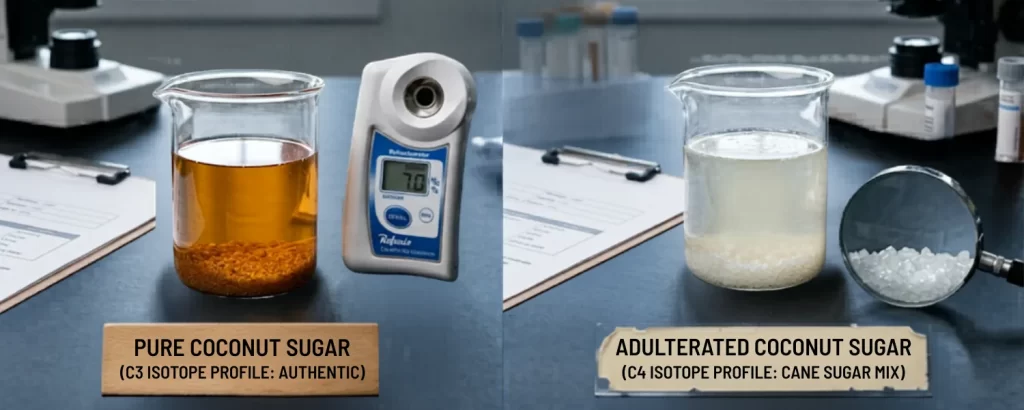
For B2B buyers and health-conscious brands, sourcing purity is the highest priority. Adulterated coconut sugar–often mixed with cheaper cane sugar or malto-dextrin—is a rising concern in the global supply chain. This guide provides the technical “pure coconut sugar test” methods used to verify authenticity.
The Problem: Identifying Adulterated Coconut Sugar
Why is adulterated coconut sugar so common? The high market value of coconut sap compared to sugar cane incentivizes unscrupulous suppliers to “stretch” their product. Identifying fake coconut sugar vs real requires looking beyond the color, as caramel coloring can easily mimic the natural dark hue of coconut nectar.
Three Methods to Verify Coconut Sugar Purity
1. The Solubility and Sediment Test (The Home/Warehouse Test)
A quick way to verify coconut sugar purity is through water dissolution.
-
Pure: Dissolves completely in warm water, leaving a clear, amber-tinted liquid with no gritty residue.
-
Adulterated: If cane sugar or starches are added, you may notice white crystals settling at the bottom or a cloudy film on the surface.
2. The Aroma and Texture Analysis
-
Real: Has a deep, earthy, caramel-like aroma with a slightly moist, “soft” crystalline texture.
-
Fake: Often has a neutral, sharp sweetness (like white sugar) and the crystals feel very hard, uniform, and dry.
3. Laboratory Testing (The Gold Standard)
For bulk importers, a professional pure coconut sugar test involves Carbon Stable Isotope Analysis (SIRA).
-
C3 vs C4 Plants: Coconut palms are C3 plants, while sugarcane is a C4 plant.
-
The Verdict: Laboratory testing can detect the specific carbon footprint of sugarcane, proving adulteration even if the appearance is perfect.

Frequently Asked Questions (FAQs)
What is adulterated coconut sugar? It is pure coconut sap sugar that has been mixed with cheaper fillers like cane sugar, brown sugar, or coconut shell ash to increase volume.
Does real coconut sugar smell like coconut? No. It should have a rich, caramel or “toasty” aroma, not a fruity coconut scent.
Why is my coconut sugar clumping? Clumping is actually a sign of purity. The natural moisture and inulin fiber in pure coconut sugar make it prone to clumping, whereas cane sugar is often treated to stay free-flowing.
Is light-colored coconut sugar fake? Not necessarily. The color depends on the boiling time and temperature of the sap. However, extremely white crystals are a red flag for cane sugar mixing.
How can I verify coconut sugar purity in a B2B shipment? Always request a Certificate of Analysis (COA) and check for SIRA testing results if you suspect C4 plant contamination.
Does adulterated coconut sugar affect the Glycemic Index? Yes. Pure coconut sugar has a GI of 35. If mixed with cane sugar (GI 65), the health benefits for diabetics are negated.
What is the “burn test”? When heated, pure coconut sugar melts into a smooth caramel. Adulterated versions may smoke or smell like burnt marshmallows due to the presence of additives.
What is the most common filler in fake coconut sugar? Refined cane sugar is the most common, followed by coconut palm sugar (a lower quality version made from the trunk rather than the flower).
Can I trust the price? If the price for “pure” sugar is significantly lower than the market average for coconut sap, it is highly likely to be adulterated coconut sugar.
Does pure coconut sugar dissolve in cold water? It dissolves slower than white sugar due to its complex fiber content, but it should eventually dissolve completely without residue.
Purity Verification Table
| Feature | Pure Coconut Sugar | Adulterated / Fake |
| Solubility | Clear, amber liquid | Cloudy or gritty residue |
| Aroma | Earthy, Caramel, Malt | Neutral or “Sugar-sweet” |
| GI Value | 35 (Low) | 50–65 (High) |
| Carbon Profile | C3 Isotope Only | Contains C4 (Cane) Isotopes |
About us
Exim Internationals is a premier export company dedicated to delivering the finest products from India to international markets. Our mission is to establish India as a global export powerhouse, contributing to economic growth and showcasing the richness of Indian goods worldwide.
From the pashmina shawls and apples of the North to the spices of the South, the fruits and powders of the West, and the tea and bamboo of the East, we connect every corner of India with the global market.
Certification we have: FSSAI, APEDA, IEC, UDYAM, FIEO, Spices Board, Coconut
Contact us
Samin heritage, Sl building, Shop no. 19, Chandan wadi, Almeda road Thane west, Maharashtra, India-400601.
Email Us: support@eximinternationals.com
Call Us: +91 9820446601 | +91 9321559185
