
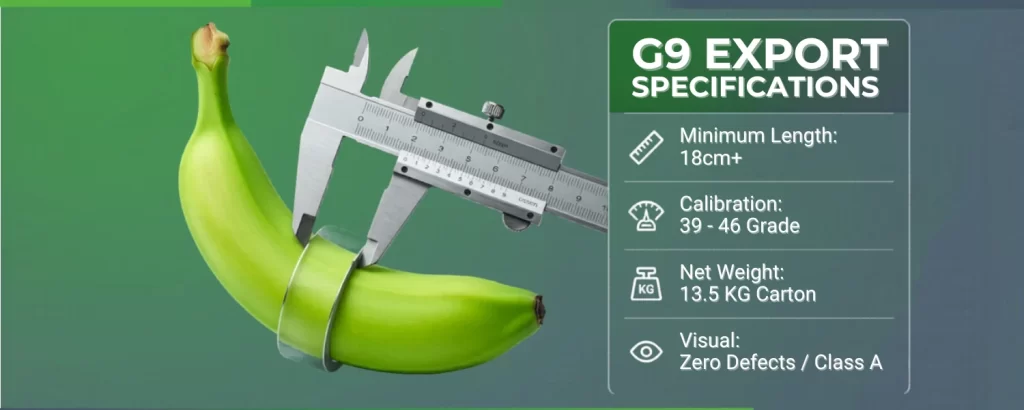
The Baseline Export Standard
For B2B procurement managers evaluating supplier quotes, understanding cavendish banana export specifications is essential. Here are the non-negotiable physical specifications for premium export-grade Grand Naine (G9) Cavendish bananas:
Minimum Finger Length: 18 cm to 20 cm+ (Measured on the convex outer curve).
Standard Caliper (Thickness): 39 to 46 grade (Measured in 1/32 of an inch).
Net Weight Per Carton: 13.5 kg (Standard global reefer box).
Hands Per Box: 4, 5, or 6 hands (Depending on the specific market requirement).
Age at Harvest: 9 to 11 weeks (Post-shooting, to ensure a green, unripened state during ocean transit).
1. Mastering G9 Banana Calibration (The Caliper)
When importers discuss g9 banana calibration, they are primarily talking about the “caliper” or “grade” of the fruit. This measures the thickness or girth of the individual banana finger.
Calibration is typically measured using a specialized caliper tool, placed precisely on the middle finger of the outer whorl of the banana hand. The industry standard measures this thickness in increments of 1/32 of an inch.
-
The Export Standard (39-46): A premium export banana must have a caliper between 39/32 and 46/32 of an inch.
-
Why it Matters: Bananas below a 39 caliper are immature and will lack sweetness and yield when ripened. Bananas above a 46 caliper are over-mature and carry a massive risk of naturally ripening (yellowing) inside the shipping container during the 30-day ocean transit.
2. Finger Length Requirements
Length is the most visible metric for retail consumers. Premium supermarkets demand long, elegant fruit.
According to strict export quality banana grading, the minimum length of an export finger is 18 cm (approximately 7.1 inches). However, premium markets often demand 20 cm+ (8 inches).
-
How it is Measured: Length is never measured straight across. The official measurement is taken along the outer convex curve of the fruit, starting from the blossom end (the tip) to the base of the pedicel (where it attaches to the crown).
-
Fingers that are too short are rejected for export and diverted to domestic markets or processed into puree.
3. Visual Export Quality Banana Grading
Physical dimensions are only half the specification. To pass APEDA and international quality control (QC) inspections, the fruit must be cosmetically flawless. A “Class A” export banana must feature:
Zero Scars or Bruises: Friction damage during transport causes the skin to turn black.
Zero Latex Stains: Latex sap that drips onto the peel during harvest will burn the skin, leaving dark brown streaks.
Clean, Treated Crowns: The crown must be cleanly cut, perfectly de-latexed, and treated with fungicide to prevent crown rot.
Uniform Green Color: The fruit must be 100% green, with no yellowing at the tips, indicating that the ripening process has not yet begun.

4. Packing Specifications: The 13.5 kg Carton
When ordering via strict b2b banana sourcing specs, the packaging must match the calibration. The global standard for Cavendish is the 13.5 kg (net weight) heavy-duty, 5-ply telescopic corrugated carton. Depending on the size and calibration of the fruit, the packer will arrange exactly 4, 5, or 6 “hands” (bunches) into the box.
To hit the exact 13.5 kg weight without crushing the fruit, packers utilize a crown-facing arrangement, inserting polyethylene foam dividers between every layer to prevent friction bruising during the ocean voyage.
Conclusion: Source Precision-Graded Fruit with Exim Internationals
Accepting poorly calibrated fruit will destroy the efficiency of your commercial ripening rooms. You need an export partner whose packhouses operate with mechanical precision.
At Exim Internationals, our quality control inspectors measure every single hand before it enters the Banavac poly-liner. We guarantee that your shipments strictly adhere to your contracted cavendish banana export specifications, ensuring uniform ripening, perfect retail displays, and maximum B2B profitability.
Frequently Asked Questions (FAQs)
1. What are the standard cavendish banana export specifications for length? The global minimum standard for premium export is 18 cm (measured along the outer curve). However, many top-tier retail markets demand finger lengths of 20 cm or longer.
2. How is g9 banana calibration measured in the packhouse? Calibration (thickness) is measured using a specialized hand caliper on the middle finger of the outer row of the banana hand. The standard export grade must measure between 39 and 46 (which represents 39/32 to 46/32 of an inch).
3. Why is a banana with a caliper over 46 rejected for long-distance export? A caliper exceeding 46 indicates that the fruit is over-mature. While it may look green at the packhouse, it has a highly accelerated biological clock and is almost guaranteed to ripen (and potentially rot) during a 30-day ocean voyage.
4. What does “export quality banana grading” mean for visual appearance? Export quality (Class A) means the fruit must be 100% green, perfectly clean, and entirely free from mechanical bruises, black friction scars, latex sap burns, and fungal infections like crown rot.
5. How many banana hands are packed in a standard 13.5kg export box? Depending on the size and calibration of the specific harvest, packers will precisely arrange 4, 5, or 6 whole hands into a 13.5 kg box to meet the exact net weight requirement without over-stuffing.
6. Why must bananas be perfectly uniform in size for B2B buyers? Commercial buyers use large, pressurized ripening rooms that inject ethylene gas. If a box contains mixed sizes and maturities, the bananas will absorb the gas at different rates. Some will turn yellow perfectly, while others will remain green or turn to mush.
7. How do you measure the length of a banana accurately? You do not measure point-to-point. The official agricultural standard is to take a flexible measuring tape and measure along the outer convex curve from the tip (blossom end) to the base of the finger where it meets the crown.
8. What are the standard b2b banana sourcing specs for packaging? The industry standard is a 5-ply, moisture-resistant telescopic corrugated carton. The box must contain a vacuum-sealed poly-liner (Banavac) to modify the atmosphere, and foam dividers between the fruit to prevent transit bruising.
9. What is the difference between Class A and Class B bananas? Class A bananas meet all strict length, calibration, and cosmetic requirements with zero defects. Class B bananas are still structurally sound and edible but may have slight visual blemishes, minor latex stains, or fall slightly short of the premium length requirements.
10. How does Exim Internationals ensure these specifications are met? We operate APEDA-certified packhouses with heavily trained QC personnel. Every hand of G9 bananas is manually inspected, measured with calipers, washed in alum pools, and meticulously weighed before being boxed and pre-cooled for export.
About us
Exim Internationals is a premier export company dedicated to delivering the finest products from India to international markets. Our mission is to establish India as a global export powerhouse, contributing to economic growth and showcasing the richness of Indian goods worldwide.
From the pashmina shawls and apples of the North to the spices of the South, the fruits and powders of the West, and the tea and bamboo of the East, we connect every corner of India with the global market.
Certification we have: FSSAI, APEDA, IEC, UDYAM, FIEO, Spices Board, Coconut
Contact us
Samin heritage, Sl building, Shop no. 19, Chandan wadi, Almeda road Thane west, Maharashtra, India-400601.
Email Us: support@eximinternationals.com
Call Us: +91 9820446601 | +91 9321559185
