
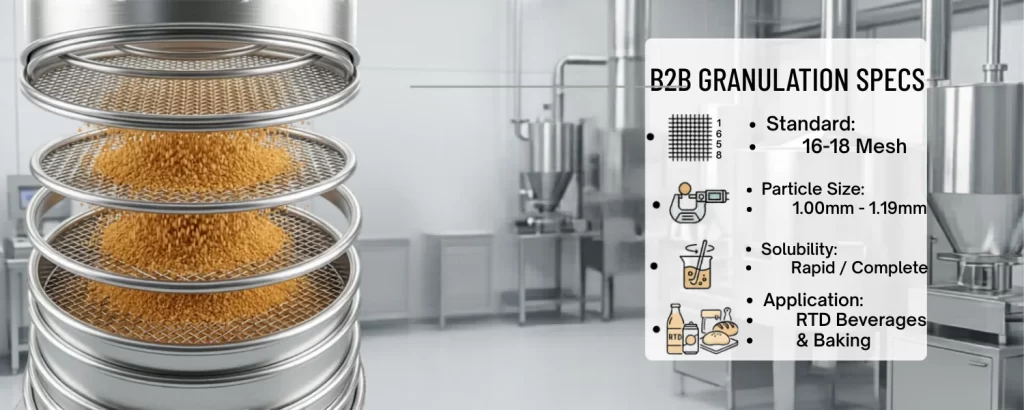
16-18 Mesh Technical Data
For R&D teams and quality control inspectors needing immediate physical specifications, here is the baseline for premium industrial coconut sugar:
-
The Standard: 16 to 18 Mesh Size.
-
Millimeter Equivalent: The granules measure approximately 1.19 mm (16 mesh) to 1.00 mm (18 mesh) in diameter.
-
Solubility: Rapid and uniform, making it the ideal soluble coconut sugar bulk for both wet and dry processing.
-
Moisture Defense: This specific granulation size is coarse enough to resist rapid moisture absorption (hygroscopy) during ocean freight, preventing hard caking.
1. What is "Mesh Size" in Industrial Sugar Granulation?
Before you can order bulk sweeteners, you must understand how international sieving standards work.
“Mesh size” refers to the number of openings per linear inch of a standardized industrial sieve screen. A 16-mesh screen has 16 openings per inch, and an 18-mesh screen has 18 openings. Therefore, the higher the mesh number, the finer the particle that can pass through it.
In the world of industrial sugar granulation, coconut sugar straight from the farm cooling pans is highly irregular, containing both fine dust and large, hard lumps of caramelized sap. To achieve export quality, the raw sugar is mechanically passed through vibrating sieves. A 16-18 mesh specification means the sugar is fine enough to pass through a 16-mesh screen but coarse enough to be caught by a slightly finer screen, resulting in perfect, uniform granules.
2. Why 16-18 is the Optimal Coconut Sugar Mesh Size Export
The 16-18 mesh size is not an arbitrary number; it is the commercial “sweet spot” engineered for global logistics and manufacturing efficiency.
If a B2B buyer requests an ultra-fine powder (like 40 or 60 mesh), they are introducing massive supply chain risk. Coconut sugar is naturally hygroscopic (it pulls moisture from the air). Ultra-fine dust has a massive surface area, meaning it will absorb ocean humidity rapidly and arrive at your facility as a solid rock. Conversely, a coarse 10-mesh sugar will survive ocean transit beautifully but will fail to dissolve in your mixing vats.
The 16-18 coconut sugar mesh size export standard provides the exact balance: it is large enough to survive the 30-day ocean cold chain in 25kg bags without clumping, but fine enough to perform flawlessly on the factory floor.
3. The Importance of Soluble Coconut Sugar Bulk in F&B
Solubility is the ultimate test of a commercial sweetener. In Ready-to-Drink (RTD) beverage manufacturing, sauces, and marinades, un-dissolved sugar is a catastrophic defect. It clogs expensive in-line filtration systems and creates unappealing sludge in the final retail packaging.
By demanding 16-18 mesh soluble coconut sugar bulk, food manufacturers guarantee rapid hydration. The uniform 1.00 mm to 1.19 mm granules provide exactly enough surface area for industrial liquids to break down the sugar matrix quickly and evenly, ensuring a smooth, consistent flavor profile across every single batch without the need for excessive heating.

4. Standardizing Your Wholesale Sweetener Specs
When negotiating commercial contracts with Indian or Southeast Asian exporters, you cannot simply ask for “industrial grade.” You must legally encode the physical properties into your purchase order.
Your wholesale sweetener specs should explicitly state: “100% Granulated Coconut Sugar, sieved to uniform 16-18 Mesh, moisture content below 2%.” Furthermore, you must demand that this exact mesh size is verified on the third-party Certificate of Analysis (COA) prior to the container being loaded at the origin port.
Conclusion: Source Precision-Milled Sugar with Exim Internationals
In commercial food manufacturing, inconsistency costs money. You need a bulk supplier whose processing facilities operate with pharmaceutical-level precision.
At Exim Internationals, our APEDA-certified packhouses utilize state-of-the-art stainless steel vibrating sieves to guarantee a flawless 16-18 mesh granulation. We deliver perfectly calibrated, highly soluble coconut sugar bulk that integrates seamlessly into your automated mixing lines, maximizing your production efficiency and protecting your brand’s quality.
Frequently Asked Questions (FAQs)
1. What does a 16-18 coconut sugar mesh size export mean? It means the coconut sugar granules have been mechanically sieved to be uniform in size, specifically falling between 1.00 mm (18 mesh) and 1.19 mm (16 mesh) in diameter.
2. Why is mesh size important in industrial sugar granulation? Mesh size determines how the sugar behaves. It dictates how fast the sugar will dissolve in liquids (solubility), how it aerates in commercial baking, and how susceptible it is to absorbing moisture and clumping during storage.
3. Is 16-18 mesh coconut sugar considered fine or coarse? In the commercial F&B world, 16-18 mesh is considered a “fine granulated” sugar. It is highly comparable to the standard texture of conventional refined white table sugar used in everyday baking and cooking.
4. Can I use 16-18 mesh coconut sugar for commercial beverage manufacturing? Yes. This is the ideal specification for beverages. It acts as a highly soluble coconut sugar bulk that dissolves rapidly in industrial vats without leaving a gritty residue or clogging filtration machinery.
5. Why shouldn’t I order coconut sugar as a super-fine powder (like powdered sugar)? Because coconut sugar is unrefined, an ultra-fine powder has too much surface area and will rapidly absorb moisture from the air. During a 30-day ocean freight transit, powdered coconut sugar will almost certainly clump into an unusable, solid block.
6. How do I ensure the exporter meets my wholesale sweetener specs? You must clearly state “16-18 mesh” on your commercial contract and demand a third-party Certificate of Analysis (COA) that scientifically verifies the particle size distribution before the shipment leaves the origin port.
7. Does the 16-18 mesh size affect the flavor of the coconut sugar? No, the mesh size only changes the physical structure and solubility, not the chemical flavor profile. It will still provide the same rich, low-glycemic caramel notes.
8. Will 16-18 mesh coconut sugar work in commercial dry bakery mixes? Absolutely. Because the granules are highly uniform, they blend perfectly into dry formulations (like boxed cake or cookie mixes) without separating or sinking to the bottom of the retail packaging.
9. How is the sugar sieved to achieve this exact industrial sugar granulation? Premium exporters use large, automated, food-grade stainless steel vibrating sieves. The raw sugar is passed over multiple screens stacked on top of each other, precisely separating the dust and large lumps from the perfect 16-18 granules.
10. Do I need to alter my recipes when switching from refined cane sugar to 16-18 mesh coconut sugar? Because the 16-18 mesh size physically mimics standard granulated cane sugar, you can generally substitute it on a 1:1 volume basis in your commercial formulations without altering your mixing times or liquid ratios
About us
Exim Internationals is a premier export company dedicated to delivering the finest products from India to international markets. Our mission is to establish India as a global export powerhouse, contributing to economic growth and showcasing the richness of Indian goods worldwide.
From the pashmina shawls and apples of the North to the spices of the South, the fruits and powders of the West, and the tea and bamboo of the East, we connect every corner of India with the global market.
Certification we have: FSSAI, APEDA, IEC, UDYAM, FIEO, Spices Board, Coconut
Contact us
Samin heritage, Sl building, Shop no. 19, Chandan wadi, Almeda road Thane west, Maharashtra, India-400601.
Email Us: support@eximinternationals.com
Call Us: +91 9820446601 | +91 9321559185
