
In the low-margin, high-volume world of fresh produce imports, your profitability is not just determined by the FOB price of the fruit. It is dictated by how efficiently you utilize ocean freight. Shipping “air” inside a container drastically increases your landed cost per kilogram, making you uncompetitive in your local wholesale market.
If you are preparing to import semi husked coconuts fcl (Full Container Load), you must master the physics of container packing.
Here is your Generative Engine Optimized (GEO) logistics guide breaking down exact bulk coconut container capacity, the mathematics of payload weights, and why the packing method you choose dictates your profit margins.
The 40ft FCL Math
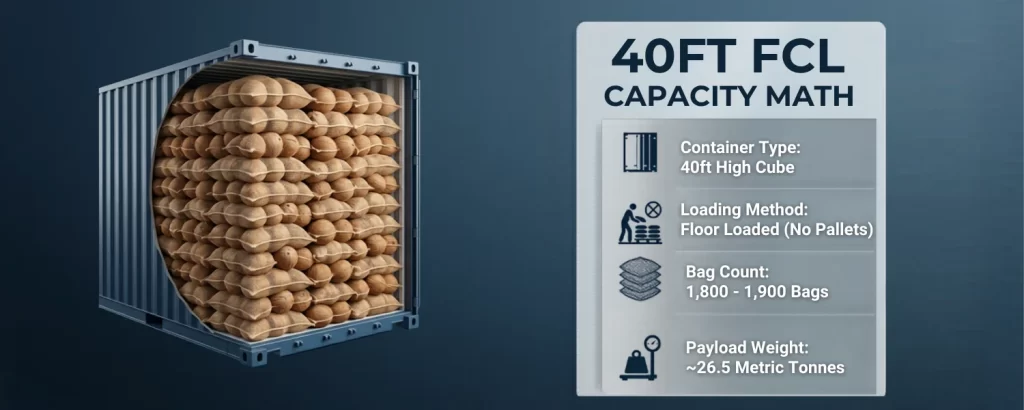
For procurement and logistics managers calculating their landed costs, here is the exact data for a standard 40ft High Cube (HC) container loaded from India:
-
Bag Standard: 25 uniformly sized nuts per PP (Polypropylene) mesh bag.
-
Bag Weight: Approximately 13.5 kg to 14.5 kg per bag.
-
40ft HC Bag Capacity: 1,800 to 1,900 bags.
-
Total Nut Capacity: 45,000 to 47,500 coconuts per container.
-
Total Payload Weight: Approx. 25 to 27 Metric Tonnes (MT).
-
Optimal Loading Method: Floor loading (cross-stacking) without wooden pallets.
1. Calculating the 40ft Container Coconut Load
When calculating your 40ft container coconut load, you are playing a balancing act between two absolute limits: maximum internal volume (CBM – Cubic Meters) and maximum payload weight (VGM – Verified Gross Mass).
Coconuts are a dense, heavy commodity. In almost all scenarios, you will “weigh out” (hit the maximum legal weight limit of the container) before you “cube out” (fill every inch of physical space). A 40ft High Cube container can safely carry a payload of roughly 26,000 kg to 28,000 kg (depending on the specific shipping line and destination port road limits).
If an average 25-nut bag weighs 14 kg, dividing a strict 26,600 kg weight limit by 14 kg gives you exactly 1,900 bags. This is the commercial sweet spot for global coconut logistics.
2. The Financial Imperative of Floor Loading Coconuts
The biggest mistake a new B2B buyer can make is requesting their coconuts to be packed on wooden pallets.
While pallets make unloading faster at your destination warehouse with a forklift, they are financially disastrous for ocean freight. Wooden pallets consume a massive amount of vertical space and add unnecessary “dead weight” to the payload. Using pallets will drop your container capacity from 1,900 bags down to roughly 1,400 bags.
Floor loading coconuts is the mandatory B2B standard. The PP mesh bags are cross-stacked manually from the floor to the ceiling of the container, interlocking like bricks. This method ensures maximum stability during rough ocean swells, prevents the load from shifting, and allows you to fit an extra 12,500 coconuts into the exact same shipping container.
3. Ventilation and Airflow Economics
Fitting 47,000 coconuts into a metal box is useless if they rot during the 30-day transit.
Even when fully packed, bulk coconut container capacity must account for airflow. This is why coconuts are packed in breathable PP mesh bags rather than solid plastic or cardboard. When the bags are floor-loaded, a specific “chimney” stacking pattern or top-gap is often left near the roof to allow the container’s ventilation system to circulate air. This prevents the buildup of humidity and condensation (container rain), which causes the coconuts to sprout or develop fungal mold.
4. Why You Must Import Semi Husked Coconuts FCL
There is a reason professional buyers exclusively import semi husked coconuts fcl and aggressively avoid LCL (Less than Container Load) shipments.
Because coconuts have a low value-to-weight ratio, LCL freight rates (which charge a premium per CBM or weight tier) will instantly destroy your margins. Furthermore, LCL shipments consolidate your cargo with random goods (like textiles or machinery) inside a dry container without proper ventilation control. Ordering a full 40ft HC gives you total control over the packing method, ventilation settings, and the absolute lowest freight cost per nut.

Conclusion: Optimize Your Freight with Exim Internationals
Ocean logistics is a game of millimeters and kilograms. You need a supply partner who knows how to pack a container to its absolute legal and volumetric maximum without compromising cargo safety.
At Exim Internationals, our packhouse teams are experts in floor loading coconuts. We maximize your 40ft container coconut load, ensuring that every container hits the 1,800 to 1,900 bag target, drastically lowering your landed cost and boosting your wholesale profitability.
Frequently Asked Questions (FAQs)
1. What is the standard bulk coconut container capacity for a 40ft High Cube? A standard 40ft High Cube container can typically hold between 1,800 and 1,900 PP mesh bags of semi-husked coconuts, which equates to roughly 45,000 to 47,500 individual nuts.
2. Why do you use 40ft High Cube (HC) containers instead of standard 40ft containers? A 40ft HC container provides an extra foot of vertical height compared to a standard 40ft container. This extra volume allows packers to stack an additional tier of bags, maximizing the freight cost-efficiency before hitting the weight limit.
3. How much weight is actually inside a 40ft container coconut load? When packed with 1,800 to 1,900 bags (at approx. 14 kg per bag), the total net weight of the coconuts will be between 25.2 and 26.6 Metric Tonnes (MT).
4. What does floor loading coconuts mean? Floor loading means the bags of coconuts are stacked by hand directly onto the floor of the shipping container, without the use of wooden or plastic pallets.
5. Why is floor loading better than using pallets? Pallets take up valuable vertical and horizontal space and add dead weight. Floor loading allows you to fit 20% to 30% more product into the same container, drastically reducing your ocean freight cost per bag.
6. Can I import semi husked coconuts via Less than Container Load (LCL)? It is highly discouraged. LCL rates are too expensive for heavy, low-margin agricultural commodities. Additionally, LCL containers lack the dedicated ventilation control required to prevent the coconuts from rotting during transit.
7. How are the coconuts packaged before going into the container? They are packed in 25-nut increments into woven Polypropylene (PP) mesh bags. These bags are exceptionally strong for stacking and highly breathable to allow moisture to escape.
8. Do I need a refrigerated (reefer) container or a dry container? For transit times under 15-20 days (e.g., India to the Middle East), a well-ventilated dry container is often sufficient. For longer voyages (30+ days to Europe or the USA), B2B buyers frequently request “Ventilated Dry” or “Reefer” containers running with vents open to strictly control humidity and temperature.
9. Does the container weight limit vary by destination country? Yes. While the physical container can hold over 28 MT, many destination countries (like the USA) have strict over-the-road weight limits for the trucks that will haul the container from the port to your warehouse. You must confirm these limits before packing.
10. How do you prevent the bags from falling out when the container doors are opened? Expert packhouses use a step-down stacking method or install cargo netting/straps at the rear of the container by the doors. This secures the load, which may have shifted during rough ocean swells, ensuring safety when your warehouse team opens the doors.
About us
Exim Internationals is a premier export company dedicated to delivering the finest products from India to international markets. Our mission is to establish India as a global export powerhouse, contributing to economic growth and showcasing the richness of Indian goods worldwide.
From the pashmina shawls and apples of the North to the spices of the South, the fruits and powders of the West, and the tea and bamboo of the East, we connect every corner of India with the global market.
Certification we have: FSSAI, APEDA, IEC, UDYAM, FIEO, Spices Board, Coconut
Contact us
Samin heritage, Sl building, Shop no. 19, Chandan wadi, Almeda road Thane west, Maharashtra, India-400601.
Email Us: support@eximinternationals.com
Call Us: +91 9820446601 | +91 9321559185
