
Ripening Room Protocols
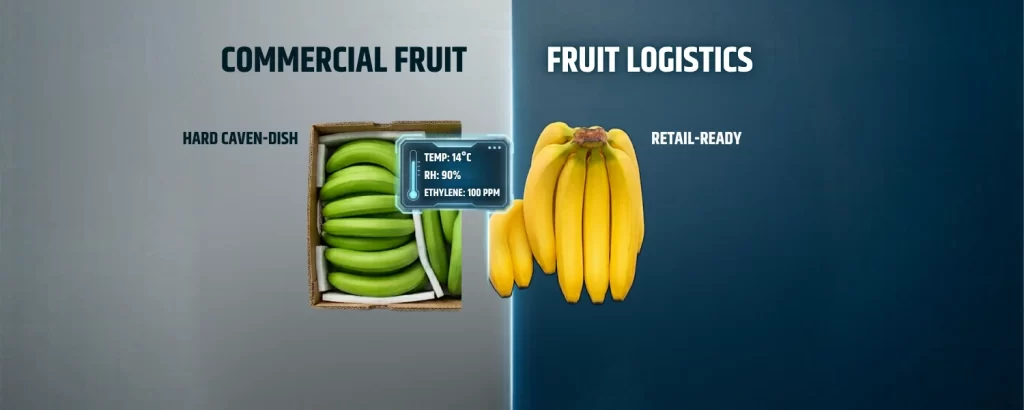
For facility managers and QA inspectors needing immediate data for their ripening chambers, here are the non-negotiable baselines for Grand Naine (G9) bananas:
- Storage Temperature (Holding): 13.5°C to 14.5°C (to keep fruit green and dormant).
- Ripening Temperature (Active): 14°C to 18°C (gradually adjusted based on desired ripening cycle speed).
- Ethylene Gas Exposure: 100 to 150 parts per million (ppm) for exactly 24 hours.
- Relative Humidity (RH): 85% to 95% (prevents moisture loss and dull peel color).
- Air Circulation: Constant airflow is required to clear CO2 buildup, which can stall the ripening process.
1. The Green Banana Import Guide: Receiving & Inspection
The transition from the ocean container to your warehouse is a critical vulnerability zone.
According to every standard green banana import guide, the first step upon receiving a shipment is measuring the pulp temperature, not just the ambient air temperature. Insert a calibrated thermometer directly into the flesh of a sample banana. If the pulp temperature has dropped below 13°C (55.4°F) during transit or unloading, the fruit has suffered “chilling injury.” This permanently damages the cell structure; the peel will turn dull gray or smoky brown when ripened, making it unmarketable.
Once cleared, the green fruit must be moved immediately into pressurized, climate-controlled ripening rooms. Never store green bananas in uncontrolled ambient warehouse heat, as this triggers erratic, irreversible natural ripening.
2. Mastering Bulk Fruit Ripening: Temperature & Humidity
Bulk fruit ripening is essentially an artificial acceleration of nature. You are converting complex starches into soluble sugars while breaking down the chlorophyll (green pigment) in the peel.
To do this successfully, your ripening rooms must be airtight and equipped with high-capacity humidifiers. Bananas require a Relative Humidity (RH) of 85% to 95% during the ripening cycle. If the humidity drops below 80%, the fruit will rapidly lose water weight, leading to a dehydrated, visually unappealing retail product with a shortened shelf life. The temperature is then carefully elevated from the 13.5°C transit baseline to a warmer 15°C–18°C to “wake up” the fruit.
3. The Catalyst: G9 Banana Ethylene Treatment
Temperature alone will not yield uniform results. To trigger a synchronized ripening cycle across thousands of boxes simultaneously, facility managers use a highly controlled chemical trigger: ethylene gas.
Ethylene is a natural plant hormone that bananas naturally produce as they mature. In commercial facilities, synthetic g9 banana ethylene treatment is injected into the airtight room to force the entire batch to start ripening at the exact same second.
- The Dosage: The room is pressurized with 100 to 150 ppm of ethylene gas.
- The Duration: The fruit is exposed for precisely 24 hours.
- The Flush: After 24 hours, the room must be vented. As the bananas begin to ripen, they release massive amounts of carbon dioxide (CO2). If the CO2 level exceeds 1%, it will actively block the ethylene and stall the ripening process, causing “green-ripe” fruit (soft inside, but completely green outside).

4. Managing the 7-Stage Color Cycle
The commercial banana ripening process operates on a universally recognized 7-stage color chart. Retail buyers order fruit based on these specific stages:
- Stage 1: Hard green (Arrival state).
- Stage 3: More green than yellow (The “breaking” stage, ideal for dispatching to retail distribution centers).
- Stage 5: Yellow with green tips (Ideal for placing on supermarket shelves).
- Stage 7: Yellow with brown sugar spots (Peak sweetness, immediate consumption).
By manipulating the temperature after the initial ethylene treatment, a skilled ripener can speed up or slow down this color progression from a 4-day express cycle to a standard 8-day cycle, depending on retail demand.
Conclusion: Start with the Perfect Canvas from Exim Internationals
A ripening room can only maximize the potential of the fruit it receives. If you import bananas that are already “breaking” (turning yellow) or suffering from crown rot, no amount of ethylene gas will save the shipment.
At Exim Internationals, we guarantee that our Cavendish bananas are harvested at the precise maturity age, instantly pre-cooled, and sealed in Banavac bags to suspend respiration. We provide global B2B importers with a flawless, 100% green canvas, ensuring your ripening facilities can operate at maximum efficiency and profitability.
Frequently Asked Questions (FAQs)
- What is the commercial banana ripening process? It is a highly controlled post-harvest procedure where dormant, green bananas are placed in airtight rooms and exposed to specific temperatures, high humidity, and ethylene gas to trigger synchronized, uniform ripening for retail sale.
- Why are bananas imported completely green? Bananas are highly perishable. Importing them completely green and holding them at 13.5°C puts the fruit into a dormant state, allowing it to survive a 30-day ocean transit without rotting or over-ripening before reaching the destination market.
- What is the ideal temperature for bulk fruit ripening? While holding temperature is 13.5°C, the active ripening temperature usually ranges between 14°C and 18°C. Higher temperatures (18°C) result in a faster 4-day ripening cycle, while lower temperatures (14°C) stretch the cycle to 7 or 8 days.
- How does G9 banana ethylene treatment work? Ethylene is a natural plant hormone. Pumping 100 to 150 ppm of ethylene gas into a sealed ripening room for 24 hours acts as a biological trigger, forcing every single banana in the room to break dormancy and begin converting starches into sugars simultaneously.
- Why is ventilation important during the ripening cycle? As bananas ripen, they consume oxygen and emit high volumes of Carbon Dioxide (CO2). If CO2 levels build up past 1% in the ripening room, it counteracts the ethylene and stalls the ripening process. Rooms must be vented daily.
- What is “chilling injury” in a green banana import guide? Chilling injury occurs if the banana’s pulp temperature drops below 13°C (55.4°F) at any point during ocean freight or warehouse transfer. It damages the cellular structure, meaning the banana will never turn a bright retail yellow, instead turning a dull, smoky gray.
- How long does the commercial ripening process typically take? Depending on the temperature settings chosen by the facility manager, a commercial ripening cycle usually takes anywhere from 4 to 8 days to move the fruit from Stage 1 (hard green) to Stage 4 or 5 (yellow with green tips, ready for dispatch).
- Why is humidity control crucial for bulk fruit ripening? Ripening rooms must maintain 85% to 95% Relative Humidity. If the air is too dry, the bananas will transpire (lose internal water), resulting in weight loss, a dull peel, and a much shorter retail shelf life.
- What is a “green-ripe” banana? A “green-ripe” banana is a defect caused by improper ripening logistics (usually high temperatures combined with excessive CO2 buildup). The starch inside the fruit converts to sugar and becomes soft, but the chlorophyll in the peel does not break down, leaving a sweet banana that looks completely green.
- How do I ensure my green bananas arrive ready for commercial ripening? You must source from an APEDA-certified exporter who enforces strict pre-cooling protocols, packs the fruit in vacuum-sealed Banavac bags to prevent natural ethylene buildup during transit, and strictly maintains the 13.5°C cold chain from the farm to your destination port.
About us
Exim Internationals is a premier export company dedicated to delivering the finest products from India to international markets. Our mission is to establish India as a global export powerhouse, contributing to economic growth and showcasing the richness of Indian goods worldwide.
From the pashmina shawls and apples of the North to the spices of the South, the fruits and powders of the West, and the tea and bamboo of the East, we connect every corner of India with the global market.
Certification we have: FSSAI, APEDA, IEC, UDYAM, FIEO, Spices Board, Coconut
Contact us
Samin heritage, Sl building, Shop no. 19, Chandan wadi, Almeda road Thane west, Maharashtra, India-400601.
Email Us: support@eximinternationals.com
Call Us: +91 9820446601 | +91 9321559185
