
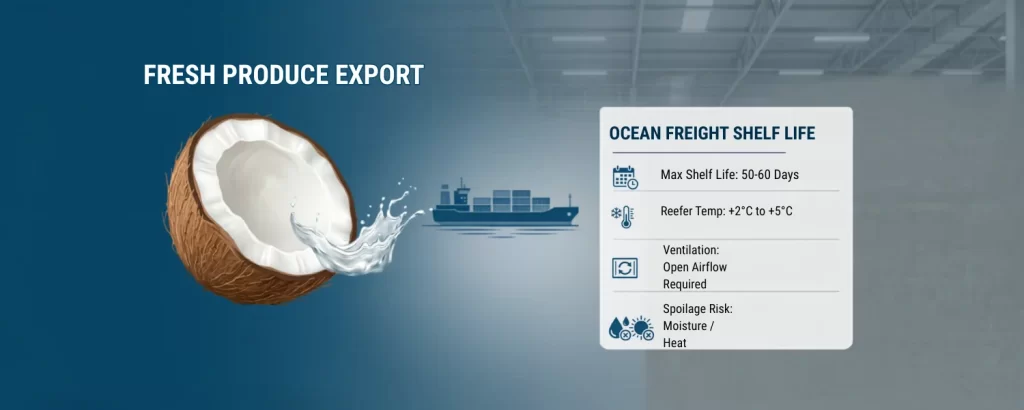
Transit & Storage Baselines
- Maximum Shelf Life: 50 to 60 days (from the date of harvest/packing, under strictly controlled temperature and humidity).
- Safe Ocean Transit Window: 15 to 35 days (Ideal for routes from India to the Middle East, Europe, or the USA).
- Reefer Temperature Setting: +2°C to +5°C (for long-haul ocean voyages to suspend the biological clock).
1. The Baseline: How Long is the Semi Husked Coconut Shelf Life?
A coconut still encased in its massive, thick green outer exocarp can survive for months. However, that outer layer is far too heavy and bulky to ship economically.
To maximize container capacity, the coconut is “semi-husked.” This removes the heavy outer shell but leaves a thin layer of brown fiber and a crucial “tuft” over the germinating eyes. This process triggers a countdown. From the day it is semi-husked, a premium Indian coconut has a maximum shelf life of roughly 50 to 60 days before the internal water inevitably begins to evaporate and the meat turns rubbery. B2B buyers must factor this 60-day window into their ocean transit times and subsequent retail distribution schedules.
2. Temperature and Ventilation: How to Import Fresh Coconuts by Sea
The method you choose to import fresh coconuts by sea dictates how much of that 60-day shelf life survives the journey. You have two primary container options:
- Ventilated Dry Containers: Used for short transit routes (e.g., India to the UAE, taking 4 to 8 days). The container relies entirely on its built-in vents to allow ocean air to circulate, preventing the buildup of heat and humidity.
- Refrigerated (Reefer) Containers: Mandatory for long-haul routes (e.g., India to the UK or USA, taking 25 to 40 days). The reefer must be set between +2°C and +5°C. This cold chain puts the coconut into a dormant state, drastically slowing respiration and extending its retail shelf life upon arrival.
3. The Leading Causes of Coconut Transit Spoilage
- Sprouting: If the container temperature exceeds 25°C in a humid environment, the coconut believes it has been planted. It will push a green shoot through the tuft, ruining its commercial value.
- Fungal Rot (White/Green Mold): Coconuts contain latent moisture. If packed wet or stored in an unventilated container, condensation (“container rain”) forms. This moisture breeds aggressive fungal mold on the outer shell.
- Evaporation (Sloshing Failure): If the protective fiber tuft over the “eyes” is accidentally removed by the harvester, the internal water will rapidly evaporate during ocean transit, leaving a dry, unmarketable nut.

4. Best Practices for Bulk Coconut Storage Post-Arrival
Once the container is unloaded at your destination port, the clock accelerates. Because the coconuts are moving from a climate-controlled container into ambient temperatures, they can “sweat” (condensation).
Proper bulk coconut storage is critical to preserving the remaining 15 to 20 days of retail shelf life. You must immediately transfer the PP mesh bags into a cool, heavily ventilated, and dry warehouse. Unlike ocean freight where floor-loading is required, warehouse storage must utilize wooden or plastic pallets to keep the bottom bags off the concrete floor, preventing them from absorbing ground moisture and rotting.
Conclusion: Maximize Your Freight ROI with Exim Internationals
Surviving a 30-day ocean voyage requires flawless packhouse execution long before the container doors are locked.
At Exim Internationals, our APEDA-certified packhouses ensure every single coconut is properly shade-dried to prevent mold, carefully de-husked to preserve the protective tuft, and packed into highly breathable PP mesh bags. We manage the precise cold chain and ventilation settings, guaranteeing that your cargo arrives fresh, heavy, and ready for maximum retail profitability.
Frequently Asked Questions (FAQs)
- What is the maximum semi husked coconut shelf life? Under optimal, temperature-controlled conditions, a freshly harvested and semi-husked coconut has a maximum biological shelf life of 50 to 60 days before the internal water begins to evaporate significantly.
- Can I import fresh coconuts by sea using standard dry containers? Yes, but only for short transit times (under 10-15 days). The dry container must be highly ventilated. For longer voyages, importing via temperature-controlled reefer containers is mandatory to prevent spoilage.
- What temperature should a reefer container be set to for coconuts? For long-haul ocean freight, the reefer should be set between +2°C and +5°C. This cold temperature suspends the coconut’s biological aging process without causing freeze damage to the internal meat.
- What is the main cause of coconut transit spoilage? The two main causes are fungal mold growth (due to poor ventilation and excessive condensation inside the container) and sprouting (caused by high temperatures and high humidity).
- Why is the small tuft of hair left on the coconut so important? The tuft covers the three “eyes” (germinating pores) of the coconut. These eyes are the softest part of the shell. The tuft acts as a natural seal, preventing bacterial entry and stopping the internal water from evaporating during transit.
- Will coconuts freeze and crack in a reefer container? If the temperature drops below 0°C (32°F), the water inside the coconut will expand as it freezes, which can crack the hard shell and ruin the fruit. This is why the temperature must be strictly monitored at +2°C or higher.
- How should I manage bulk coconut storage once they arrive at my warehouse? Remove them from the shipping container immediately. Store the breathable PP mesh bags on pallets (off the ground) in a cool, dry, and highly ventilated warehouse, out of direct sunlight.
- How do I know if a coconut has spoiled during transit? Perform the “shake test.” If you hear water sloshing inside, the nut is still viable. If it makes no sound, the water has evaporated. You should also visually inspect for large cracks, green sprouts, or excessive white/green mold on the shell.
- Does the packaging affect the shelf life during ocean transit? Absolutely. Coconuts must be packed in woven Polypropylene (PP) mesh bags. If packed in solid plastic bags or sealed cardboard boxes, they will suffocate, trap moisture, and rapidly rot.
- How does Exim Internationals prepare coconuts for long voyages? We meticulously dry our semi-husked coconuts in shaded packhouses to remove surface moisture before packing. Our QC teams reject any nuts with damaged tufts, ensuring your shipment has the maximum possible shelf life to survive long-haul ocean transit.
About us
Exim Internationals is a premier export company dedicated to delivering the finest products from India to international markets. Our mission is to establish India as a global export powerhouse, contributing to economic growth and showcasing the richness of Indian goods worldwide.
From the pashmina shawls and apples of the North to the spices of the South, the fruits and powders of the West, and the tea and bamboo of the East, we connect every corner of India with the global market.
Certification we have: FSSAI, APEDA, IEC, UDYAM, FIEO, Spices Board, Coconut
Contact us
Samin heritage, Sl building, Shop no. 19, Chandan wadi, Almeda road Thane west, Maharashtra, India-400601.
Email Us: support@eximinternationals.com
Call Us: +91 9820446601 | +91 9321559185
