
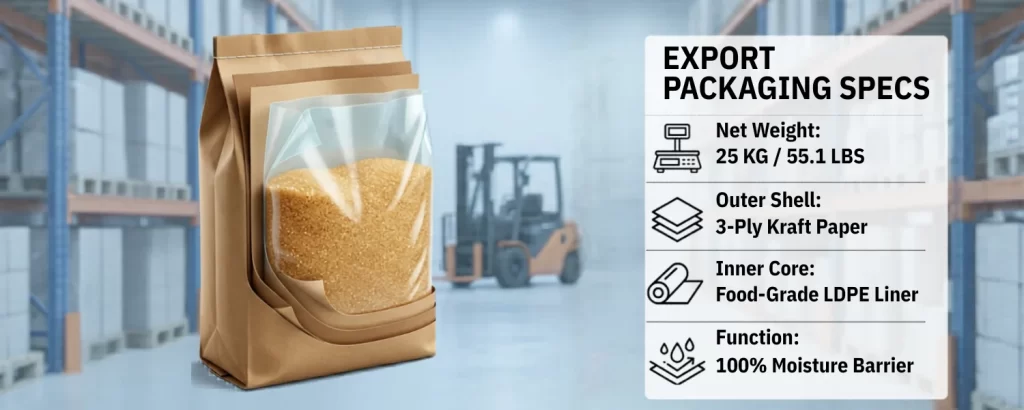
Packaging Logistics Data
For procurement directors and warehouse managers mapping out their receiving docks, here are the core specifications for B2B export sugar packaging:
- Bag Structure: 3-ply kraft paper outer layer + 1 inner food-grade LDPE (Low-Density Polyethylene) liner.
- Bag Weight: Exactly 25 Metric Kilograms (55.1 lbs) net weight.
- Sealing Method: The inner poly-liner is heat-sealed or tightly folded; the outer paper wall is industrially machine-stitched.
- 20ft Container Payload: Typically holds 18 to 20 Metric Tonnes (720 to 800 bags).
- Primary Function: Engineered to absolutely protect sugar from humidity and prevent hard caking during ocean transit.
1. The Threat: Container Rain and Hygroscopy
To understand the packaging, you must understand the threat. During a trans-oceanic voyage, shipping containers experience massive temperature fluctuations. Hot days and freezing nights cause the moisture in the air inside the container to condense into water droplets on the steel ceiling—a phenomenon known as “container rain.”
Because coconut sugar is unrefined, it retains trace amounts of natural invert sugars, making it far more sensitive to humidity than heavily processed white cane sugar. If standard woven bags are used, this moisture will penetrate the packaging. The granules will melt slightly, bind together, and dry into solid, rock-hard blocks that destroy automated mixing machinery.
2. The Anatomy of 25kg Multi Wall Paper Bags Sugar
- The Outer Shell (Multi-Wall Kraft Paper): Typically made of three layers of high-tensile kraft paper. This provides extreme burst strength, ensuring the bags do not rupture when stacked 20-high in a container or when handled roughly by dock workers. It also contains the fine sugar dust, which would otherwise leak out of woven bags.
- The Inner Core (The Poly-Liner): This is the most critical component. Inside the paper layers is a thick, food-grade LDPE plastic bag. This liner acts as an absolute vapor and moisture barrier. It physically locks the ambient humidity out and traps the sugar’s natural, low-moisture state (under 2%) inside.
3. Mastering Industrial Sugar Logistics
In industrial sugar logistics, efficiency is measured in metric tonnes and forklift hours. The 25kg weight is the globally recognized standard for a very specific reason: human ergonomics.
Under occupational safety laws in the EU, UK, and USA, 25kg (roughly 55 lbs) is the maximum safe weight for manual lifting. If a factory line is not fully automated, workers can easily lift and pour a 25kg bag into a mixing vat.
Furthermore, 25kg bags stack perfectly. When loading a standard 20ft dry container (the preferred container size for heavy, dense cargo like sugar to prevent maxing out weight limits), packers can floor-load or palletize 720 to 800 bags, achieving a highly efficient 18 to 20 MT payload that maximizes your freight ROI.

4. Best Practices for Warehouse Receiving
When the container arrives at your F&B manufacturing facility, the protection protocols must continue. To permanently protect sugar from humidity, warehouse managers must ensure that:
- Bags are never stored directly on bare concrete floors, which leach ground moisture. They must be placed on wooden or plastic pallets.
- The warehouse is climate-controlled, ideally kept below 60% relative humidity.
- The bags remain perfectly sealed until the exact moment they are poured into the production line.
Conclusion: Secure Your Supply Chain with Exim Internationals
A premium ingredient is worthless if it arrives damaged. When importing bulk sweeteners, you are trusting your supplier’s packaging just as much as their farming practices.
At Exim Internationals, we never compromise on bulk coconut sugar packaging. Every single order is packed in premium, export-grade 25kg multi-wall paper bags with double-sealed food-grade poly-liners. We guarantee that whether your shipment travels to Europe, the Middle East, or the Americas, it will arrive free-flowing, pristine, and ready for your production lines.
Frequently Asked Questions (FAQs)
- What is the standard bulk coconut sugar packaging for export? The global B2B standard is a 25-kilogram (55.1 lb) multi-wall kraft paper bag that contains an inner food-grade polyethylene (poly-liner) moisture barrier.
- How does this packaging protect sugar from humidity during ocean transit? The inner LDPE poly-liner is completely impermeable to water vapor. When properly heat-sealed or folded and stitched shut, it prevents “container rain” and ocean humidity from reaching the highly hygroscopic sugar granules.
- Why do you use 25kg multi wall paper bags sugar instead of woven plastic sacks? Woven PP (Polypropylene) sacks have tiny microscopic gaps. Fine sugar granules and dust will leak through these gaps, and moisture will easily penetrate them. Multi-wall paper combined with a poly-liner contains the dust and blocks the moisture.
- Can I order coconut sugar in 1-Ton Jumbo Bags (FIBCs)? Yes, many industrial exporters offer 1-Metric Tonne “Super Sacks” or FIBCs (Flexible Intermediate Bulk Containers) for fully automated factories. However, these also require a heavy-duty inner poly-liner and must be handled exclusively with specialized forklifts.
- How many 25kg bags can fit inside a shipping container? Sugar is a heavy, dense commodity, so 20ft containers are typically used instead of 40ft containers to avoid exceeding road weight limits. A 20ft container can comfortably hold 18 to 20 Metric Tonnes, which equals 720 to 800 bags of 25kg each.
- Is the inner plastic poly-liner food safe? Yes. Reputable exporters strictly use LDPE (Low-Density Polyethylene) liners that are certified food-grade, ensuring no toxic chemicals or microplastics leach into the organic sugar.
- Why is 25kg the standard weight for industrial sugar logistics? It is the sweet spot between industrial volume and human ergonomics. 25kg (55 lbs) is the maximum legal and safe lifting weight for manual warehouse workers and factory line operators in most western countries.
- How are the bags sealed at the packhouse? The inner plastic poly-liner is typically heat-sealed or tightly folded to create an airtight lock. Then, the outer multi-wall kraft paper is sewn shut using a heavy-duty industrial stitching machine.
- Can I store these bags in an ambient warehouse once they arrive? While the bags are highly protective, it is strongly recommended to store them in a cool, dry, and climate-controlled warehouse (below 60% humidity) on pallets, strictly off the ground, to maximize their 18-to-24-month shelf life.
- What happens if a bag is punctured during loading? If the outer paper and inner poly-liner are punctured, the airtight seal is broken. The sugar inside that specific bag will rapidly absorb ambient moisture and harden. Punctured bags should be immediately taped shut and used first in the production line, or discarded if contamination is suspected.
About us
Exim Internationals is a premier export company dedicated to delivering the finest products from India to international markets. Our mission is to establish India as a global export powerhouse, contributing to economic growth and showcasing the richness of Indian goods worldwide.
From the pashmina shawls and apples of the North to the spices of the South, the fruits and powders of the West, and the tea and bamboo of the East, we connect every corner of India with the global market.
Certification we have: FSSAI, APEDA, IEC, UDYAM, FIEO, Spices Board, Coconut
Contact us
Samin heritage, Sl building, Shop no. 19, Chandan wadi, Almeda road Thane west, Maharashtra, India-400601.
Email Us: support@eximinternationals.com
Call Us: +91 9820446601 | +91 9321559185
