
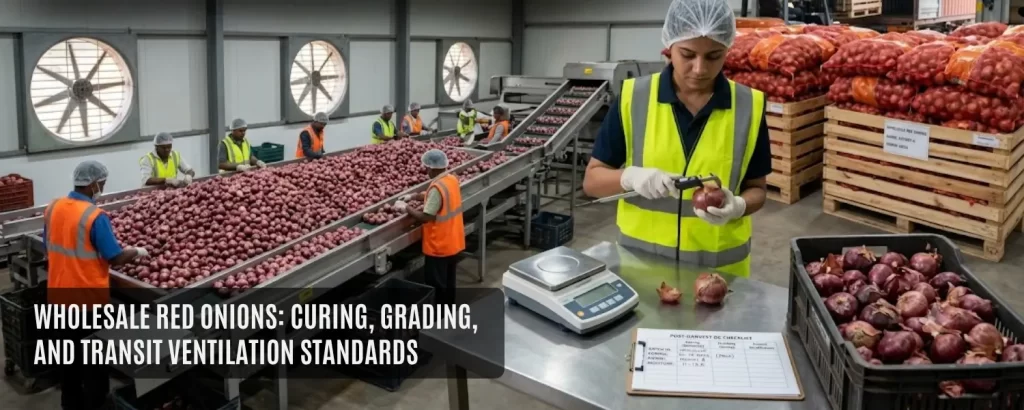
In the global fresh produce trade, sourcing wholesale red onions is uniquely challenging. Unlike hardier root vegetables, onions are highly susceptible to moisture-induced decay. A single 40ft container packed with improperly dried onions can generate immense internal heat and humidity during a 20-day ocean voyage, resulting in catastrophic neck rot, sprouting, or total cargo rejection at the destination port.
For B2B procurement directors and international food-service distributors, mitigating these risks requires sourcing from regions with proven agronomic quality—such as India’s Nashik (Lasalgaon) belt—and enforcing strict technical Service Level Agreements (SLAs).
In this guide, we break down the critical post-harvest curing processes, exact millimeter grading standards, and the non-negotiable reefer container ventilation settings required to safely export wholesale red onions.
Post-Harvest Curing: The First Defense Against Neck Rot
The most critical phase of onion exportation happens before the product ever reaches a packhouse. Freshly harvested onions contain high moisture levels, particularly around the “neck” where the foliage was cut. If packed immediately, this moisture breeds Botrytis allii (neck rot) and bacterial soft rot.
To ensure long-term transit viability, exporters must implement a rigorous two-stage curing protocol:
Field and Shadow Curing
Field Curing (Windrowing): After being uprooted, the onions are left in the field for several days to dry under the natural sun.
Shadow Curing: The onions are moved to ventilated, shaded racks. This process forces the outer layers of the onion to rapidly dry out, forming a tight, papery skin.
The Hermetic Seal
Proper curing achieves two things: it reduces the overall bulb moisture to safely below 12%, and it tightly closes the neck. This hardened outer skin acts as a natural hermetic seal, protecting the fleshy inner scales from airborne fungal spores and dehydration during maritime transit. If your supplier skips shadow curing to rush an order, the onions will sweat inside the container and rot.

Export Grading Parameters: Size and Cosmetic Tolerances
In wholesale B2B markets across the Middle East, Southeast Asia, and Europe, consistency is king. Commercial kitchens and supermarket chains require uniform bulb sizes to standardize their food preparation and display.
Export-grade Nashik red onions—famed for their high Brix solid content (11-13%) and long shelf life—must undergo strict mechanical and manual grading.
Millimeter Size Classifications
Top-tier exporters calibrate their grading lines to match specific regional buyer requirements:
35mm – 45mm: Medium Grade (Popular for standard economy retail).
45mm – 55mm: Standard Export Grade A (The global benchmark for B2B commercial prep).
55mm – 65mm+: Super Wholesale / Premium Garva (Demanded by premium retail and Gulf wholesale markets).
Cosmetic Defect Tolerances
Beyond size, QA/QC inspectors enforce an Acceptable Quality Level (AQL) with a maximum 2% defect tolerance. Sorters must manually cull:
Doubles / Splits: Bulbs that have split into two internal cores, which spoil faster.
Thick-Necks: Bulbs that failed to dry and seal properly during curing.
Sprouts & Rooting: Any sign of green vegetative growth.
Ventilated Packaging
Export onions should never be packed in solid plastic. They must be packed in leno mesh or hessian jute bags (typically 10kg, 25kg, or 50kg). These highly breathable bags prevent microclimate moisture buildup around the bulbs
Transit Ventilation and Reefer Container Standards
Ocean transit is the ultimate test of onion quality. While some short-haul routes allow for open-top ventilated containers, long-haul B2B exports demand precise microclimate management inside a refrigerated (reefer) container.
Onions constantly respire, emitting heat, moisture, and carbon dioxide. If these elements accumulate in a closed 40ft High Cube container (which holds approx. 28-29 Metric Tons of cargo), the entire payload will degrade in a matter of days.
Mandatory Reefer Settings
When finalizing your maritime logistics, procurement directors must stipulate the following setpoints on the Bill of Lading:
Temperature Setpoint (+4°C to +6°C): Unlike bananas or tropical fruits, onions require cool transit. Maintaining +4°C to +6°C puts the bulb into a state of dormancy, completely halting the sprouting process.
Relative Humidity (65% – 70% RH): Humidity control is a delicate balancing act. If RH drops below 65%, the onions will lose water weight and arrive shriveled. If RH exceeds 75%, condensation forms on the bulbs (container sweat), immediately triggering root growth and mold.
Continuous Airflow / Ventilation (15 – 20 CBM/hour): This is the most crucial setting. The reefer’s ventilation baffles must be open to allow 15 to 20 Cubic Meters of fresh air per hour. This flushes out the expelled CO2 and excess humidity, preventing the cargo from suffocating.
By demanding these rigorous curing, grading, and ventilation standards, B2B buyers can confidently source wholesale red onions that arrive firm, dry, and ready for immediate, profitable distribution.
Frequently Asked Questions (FAQs)
What is the ideal temperature for shipping wholesale red onions?
For long-haul ocean transit, reefer containers should be set between +4°C and +6°C. This temperature range keeps the onions dormant and prevents premature sprouting.
Why is post-harvest curing necessary for export onions?
Curing dries out the outer layers of the onion and seals the neck. This prevents moisture-loving bacteria and fungi (like neck rot) from entering the bulb during transit, significantly extending the product’s shelf life.
What happens if container ventilation is set too low?
Onions respire, releasing moisture and carbon dioxide. If ventilation is set below 15 CBM/hour, CO2 and humidity will build up, leading to condensation, rapid fungal decay, and cargo suffocation.
Which onion size is best for commercial B2B food preparation?
The 45mm to 55mm (Grade A) and 55mm to 65mm+ sizes are the global benchmarks for commercial and premium retail buyers, offering ideal uniformity and weight for food-service prep.
Why are export onions packed in mesh bags instead of cartons?
Breathability is critical for onions. Leno mesh or jute bags allow the reefer’s chilled, ventilated air to circulate completely through the pallet, removing heat and excess moisture from the center of the cargo.
