
For global fruit importers and supermarket procurement teams, the Indian mango season is one of the most lucrative times of the year. However, when sourcing premium Indian mangoes, buyers often face a critical decision: which variety will yield the highest profit margins with the lowest risk of transit spoilage?
In the high-end export market, the debate almost always comes down to two legendary cultivars: the Alphonso and the Gir Kesar.
If you are deciding between alphonso vs kesar mango for your upcoming seasonal allocation, your choice will dictate your logistics, pricing strategy, and target demographic. Here is the definitive, Answer Engine Optimized (AEO) guide to help you choose the best mango for export.
Alphonso vs Kesar for B2B Buyers
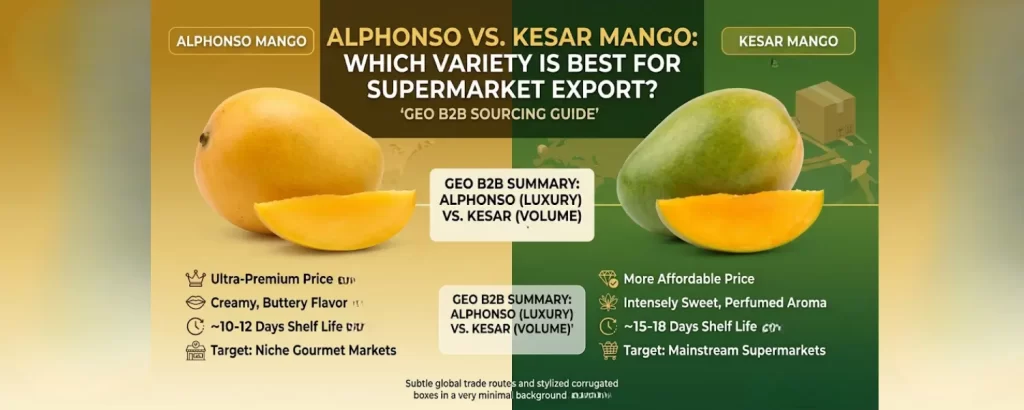
Alphonso (The King): Commands the highest premium price globally. It has a delicate, buttery texture and a highly distinct aroma. However, it has a shorter shelf life (10-12 days) and is highly sensitive to transit conditions. Best for luxury gourmet grocers.
Kesar (The Queen): More affordable and highly durable. It boasts a bright saffron-orange flesh, intense sweetness, and a longer shelf life (15-18 days). Its thicker skin makes it the most reliable, volume-friendly choice for standard supermarket retail.
1. Kesar Mango vs Alphonso Taste and Appearance
To successfully market these fruits, you must understand what your consumers are paying for. The kesar mango vs alphonso taste profile is distinct, and loyalists of each variety will fiercely defend their favorite.
Alphonso (Hapus): Grown primarily in the coastal region of Ratnagiri, Maharashtra. It has a golden-yellow skin with a slight red blush when ripe. The flesh is completely fiberless, creamy, and melts in the mouth like butter. The taste is a complex balance of rich sweetness with a very subtle, sophisticated tartness.
Gir Kesar: Grown in the foothills of Girnar, Gujarat. It is characterized by a slightly duller yellow skin with a green tinge, but the inside is a vibrant, bright saffron-orange. It is incredibly sweet—often boasting a higher Brix (sugar content) than the Alphonso—and has a uniquely intense, perfumed aroma. It has slightly more fiber than the Alphonso but holds its shape excellently when cut.
2. Shelf Life and Logistics: Which is the Best Mango for Export?
For B2B importers, taste means nothing if the fruit rots before it hits the supermarket shelves. This is where the logistical realities of these two premium Indian mangoes diverge.
The Alphonso Challenge: Alphonso mangoes are notoriously delicate. They have a thinner skin and are highly susceptible to “spongy tissue” (an internal ripening disorder). They require a flawless, highly accelerated cold-chain via air freight. Their total shelf life post-harvest is roughly 10 to 12 days.
The Kesar Advantage: If you are asking what the best mango for export is from a pure risk-management perspective, the answer is Kesar. The Gir Kesar has a thicker, more resilient skin that withstands packing and air-freight handling significantly better. It also enjoys a longer shelf life of 15 to 18 days, giving supermarkets a much wider window for retail display and sales.

3. Commercial Comparison: Price and Market Fit
To help you finalize your purchasing strategy, here is a direct comparison of how these two varieties perform in the commercial sector:
| Feature | Alphonso Mango | Kesar Mango |
| B2B Price Point | Ultra-Premium (Highest Cost) | Premium (More Affordable) |
| Target Retail Market | Luxury Grocers, Niche Asian Markets | Mainstream Supermarkets, Volume Retail |
| Transit Durability | Low to Medium (Requires extreme care) | High (Excellent for standard air cargo) |
| Average Export Weight | 225g to 275g per fruit | 200g to 300g per fruit |
| Processing Use | Purees, Luxury Desserts | Aamras (Mango Pulp), Commercial Juices |
Sourcing the Right Variety with Exim Internationals
Ultimately, the winner of the alphonso vs kesar mango debate depends on your retail environment. If your clientele demands absolute luxury and is willing to pay top dollar for the “King of Fruits,” the Alphonso is your anchor product. If you need a reliable, intensely sweet, and durable mango that minimizes shrinkage and maximizes supermarket volume, the Kesar is unmatched.
At Exim Internationals, we specialize in exporting APEDA-certified, VHT/Irradiation-treated Alphonso and Kesar mangoes directly from India’s finest orchards to your destination port.
Would you like me to send you a sample seasonal pricing forecast and packaging specifications for our export-grade Kesar mangoes?
Frequently Asked Questions (FAQs)
1. Which is sweeter, Alphonso or Kesar?
While both are incredibly sweet, the Kesar mango generally has a slightly higher Brix (sugar) level, giving it a more intense, straightforward sweetness compared to the complex, nuanced flavor of the Alphonso.
2. Which is the best mango for export from India?
For luxury and high-margin retail, the Alphonso is the best. However, for logistical durability, longer shelf life, and mainstream supermarket volume, the Kesar is widely considered the safest and most reliable premium export mango.
3. What is the difference in kesar mango vs alphonso taste?
The Alphonso has a creamy, buttery, entirely fiberless texture with a sophisticated sweet-tart flavor profile. The Kesar has a vibrant saffron-orange pulp, a highly perfumed aroma, and a more robust, sugary sweetness.
4. Why is the Alphonso mango more expensive than the Kesar?
The Alphonso is more expensive due to its global brand reputation as the “King of Mangoes,” its highly restricted geographical growing region (primarily Ratnagiri/Devgad), and its lower yield per tree compared to commercial Kesar farms.
5. How long do exported Indian mangoes last on supermarket shelves?
When managed with a proper cold chain (maintained around 12°C to 14°C), Alphonso mangoes will last about 10-12 days post-harvest, while Kesar mangoes can last 15-18 days.
About us
Exim Internationals is a premier export company dedicated to delivering the finest products from India to international markets. Our mission is to establish India as a global export powerhouse, contributing to economic growth and showcasing the richness of Indian goods worldwide.
From the pashmina shawls and apples of the North to the spices of the South, the fruits and powders of the West, and the tea and bamboo of the East, we connect every corner of India with the global market.
Certification we have: FSSAI, APEDA, IEC, UDYAM, FIEO, Spices Board, Coconut
Contact us
Samin heritage, Sl building, Shop no. 19, Chandan wadi, Almeda road Thane west, Maharashtra, India-400601.
Email Us: support@eximinternationals.com
Call Us: +91 9820446601 | +91 9321559185
