
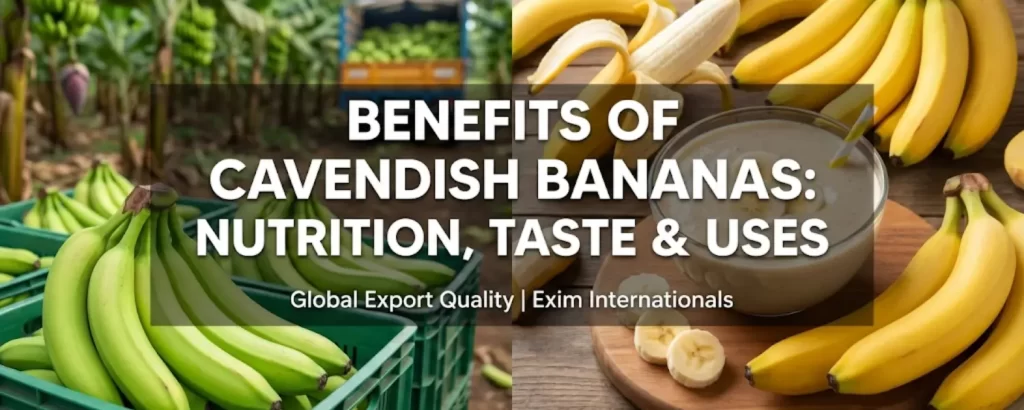
If you walk into any supermarket from London to Dubai, the yellow fruit you see is almost certainly a Cavendish banana. It is the “Coca-Cola” of the fruit world—consistent, popular, and available everywhere.
But why did this specific variety take over the world? And more importantly for buyers and consumers, what are the benefits of Cavendish bananas that make them so valuable?
At Exim Internationals, we export premium Grade-A Cavendish bananas from the lush plantations of Tamil Nadu and Maharashtra. Here is your complete guide to the nutrition, taste, and business behind the world’s most exported fruit.
1. What is a Cavendish Banana?
The Cavendish banana fruit belongs to the Musa Acuminata species. It was originally named after William Cavendish, the 6th Duke of Devonshire, but its true roots are in Southeast Asia.
Appearance: It starts green and turns to a vibrant golden yellow. As it ripens further, it develops “sugar spots” (brown speckles).
Texture: Known for its creamy, smooth flesh that is less fibrous than other wild varieties
2. Health Benefits of Cavendish Bananas
Whether you are an athlete or just looking for a healthy snack, the Cavendish profile is impressive.
Instant Energy Booster: Rich in natural sugars (sucrose, fructose, and glucose), it provides an immediate and sustained energy spike, making it the favorite snack of tennis players and runners.
Heart Health (Potassium Power): A medium Cavendish banana contains roughly 400-450mg of Potassium. This helps lower blood pressure and protects against strokes.
Digestive Aid: They are rich in pectin and dietary fiber. Interestingly, Green Cavendish bananas are high in “resistant starch,” which acts as a prebiotic to feed good gut bacteria.
Mood Enhancer: They contain Tryptophan, which the body converts into Serotonin—the “happy hormone” that relaxes you and improves mood.
3. Cavendish Banana vs. Regular Banana
Many importers ask us: “What is the difference between a Cavendish banana vs banana varieties like Robusta or Plantains?”
| Feature | Cavendish Banana | Robusta / Other Varieties |
| Taste | Sweet, mild, and creamy. | Can be tangy (Robusta) or starchy (Plantain). |
| Skin | Thick skin (Excellent for export). | Thinner skin (Bruises easily). |
| Shelf Life | Long green life (4 weeks in reefer). | Shorter shelf life. |
| Usage | Eaten raw (dessert fruit). | Often cooked or fried (chips). |

4. Cavendish Banana Uses: Beyond the Peel
While mostly eaten raw, the versatility of this fruit drives its demand in the food processing industry.
Baby Food: Its easy digestibility makes it the #1 solid food for infants.
Baking: The high sugar content in over-ripe Cavendish bananas makes them a natural sweetener for cakes and muffins.
Smoothies: Frozen Cavendish chunks create a natural, ice-cream-like texture in vegan smoothies.
5. Cavendish Banana from Which Country? (The Indian Advantage)
While Ecuador and the Philippines are major players, India is the largest producer of bananas in the world.
Why buy from India? Indian Cavendish bananas (specifically the “Grand Naine” variety) are prized for their high sweet aroma and perfect curvature.
Export Hubs: The belts of Theni (Tamil Nadu) and Jalgaon (Maharashtra) produce export-quality bananas year-round, unlike seasonal producers.
The Perfect Export Fruit
The benefits of Cavendish bananas go beyond just nutrition. For importers, their thick skin and ability to travel for 30+ days in temperature-controlled containers (at 13.5°C) make them the safest bet in the fresh fruit trade.
Exim Internationals specializes in shipping premium Green Cavendish Bananas to the Middle East and Europe. We ensure every “hand” is hand-picked, washed, and packed to reach you in perfect golden condition.
Frequently Asked Questions (FAQs)
1. Is the Cavendish banana genetically modified (GMO)?
No. The Cavendish bananas we eat today are grown through traditional vegetative propagation (using suckers or tissue culture), not genetic modification in a lab. They are clones of the mother plant, which ensures consistent taste and size.
2. Why are Cavendish bananas harvested green?
Bananas are “climacteric” fruits, meaning they ripen after being picked. We harvest and ship them in a raw green state to pause ripening. This allows them to survive weeks of sea travel. They are then ripened with ethylene gas at the destination market to turn yellow.
3. What is the taste of a Cavendish banana?
The Cavendish banana taste is distinctively sweet with notes of vanilla and a creamy, non-astringent mouthfeel. As it ripens and develops brown spots, the starch converts almost entirely to sugar, making it intensely sweet.
4. Can diabetics eat Cavendish bananas?
Yes, but in moderation. Green or just-ripe yellow bananas have a lower Glycemic Index (GI) than over-ripe brown spotted ones. The resistant starch in greener bananas prevents sharp blood sugar spikes.
5. How does Exim Internationals pack bananas for export?
We use standard 13.5 kg or 7 kg telescopic carton boxes. The bananas are washed, treated to prevent fungus, and packed in vacuum-sealed bags (polybags) inside the box to extend freshness during transit.
About us
Exim Internationals is a premier export company dedicated to delivering the finest products from India to international markets. Our mission is to establish India as a global export powerhouse, contributing to economic growth and showcasing the richness of Indian goods worldwide.
From the pashmina shawls and apples of the North to the spices of the South, the fruits and powders of the West, and the tea and bamboo of the East, we connect every corner of India with the global market.
Certification we have: FSSAI, APEDA, IEC, UDYAM, FIEO, Spices Board, Coconut
Contact us
Samin heritage, Sl building, Shop no. 19, Chandan wadi, Almeda road Thane west, Maharashtra, India-400601.
Email Us:support@eximinternationals.com
Call Us: +91 9820446601 | +91 9321559185