
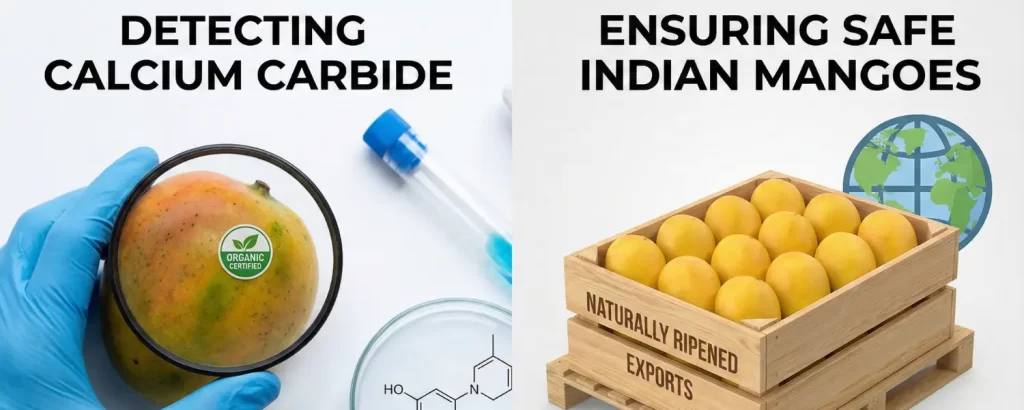
For international buyers of Indian mangoes-especially premium varieties like Alphonso, Kesar, and Banganapalli—flavor is everything. But in recent years, a shadow has fallen over the fruit trade: Calcium Carbide. This banned chemical ripening agent not only ruins the authentic taste of the mango but poses serious health risks, including potential carcinogenicity.
For importers in the EU, USA, and UK, sourcing mangoes that are guaranteed naturally ripened is not just a preference; it is a strict regulatory requirement.
At Exim Internationals, we believe transparency is the only way to build trust. This guide explains exactly why Calcium Carbide is dangerous, how we use safe Ethylene Ripening instead, and the rigorous testing protocols we use to prove it.
The Hidden Danger: What is Calcium Carbide?
Calcium Carbide (CaC2), often called “masala” in local markets, is an industrial chemical used in welding. When it comes into contact with moisture, it releases acetylene gas, which mimics the natural ripening hormone ethylene.
While it speeds up the color change of the fruit (turning it yellow overnight), it fails to ripen the fruit internally. The result is a mango that looks ripe on the outside but is sour, hard, and flavorless on the inside.
Why It Is Banned Globally
Arsenic & Phosphorus Traces: Commercial-grade calcium carbide contains toxic impurities like arsenic and phosphorus hydride, which remain on the fruit skin.
Health Risks: Consumption can lead to neurological issues, gastric irritation, and long-term carcinogenic risks.
Flavor Destruction: It forces the peel to change color without breaking down the starches into sugars, destroying the mango’s natural sweetness and aroma.
The Safe Alternative: Our Ethylene Ripening Process
We do not leave ripening to chance. To ensure our mangoes arrive with perfect brix levels (sweetness) and uniform color, we use Ethylene Ripening Chambers.
Ethylene is a natural plant hormone produced by the fruit itself. Our process simply helps the fruit do what it does naturally, but in a controlled environment.
The 4-Step Natural Ripening Workflow
Harvesting at Maturity: We only harvest mangoes that have reached full physiological maturity (not ripeness). This ensures the fruit has enough natural starch to convert into sugar.
Pre-Cooling & Cleaning: Fruits are washed and pre-cooled to remove field heat. For markets like the USA, they undergo Hot Water Treatment (HWT) at this stage to eliminate pests.
Ethylene Exposure: The mangoes are placed in airtight chambers where safe, food-grade ethylene gas is introduced at controlled concentrations (typically 100 ppm) for 24 hours.
Controlled Temperature: The chamber is maintained at a specific temperature (18°C–22°C) to allow the enzymes to break down starches into sugars naturally.
The Result: A mango that is uniformly yellow, soft to the touch, and bursting with natural sweetness and aroma.
Import products for your Needs

How We Verify & Detect: The "Carbide-Free" Guarantee
As an importer, you cannot rely on visual inspection alone. We provide scientific proof that our shipments are free from artificial chemical agents.
1. The Certificate of Analysis (COA)
Every export batch is tested by an APEDA-recognized laboratory. We provide a COA that specifically tests for:
Heavy Metals: Arsenic and Phosphorus residues (the tell-tale signs of calcium carbide usage).
Acetylene Residue: Confirming zero traces of industrial gas exposure.
2. Traceability (Farm-to-Packhouse)
We source directly from Global GAP certified farms and process in APEDA-approved packhouses. Our supply chain is closed, meaning no third-party traders can inject artificially ripened stock into your consignment.
3. Physical Inspection Indicators
While lab tests are definitive, you can often spot naturally ripened mangoes by:
Aroma: Naturally ripened mangoes have a strong, sweet aroma. Carbide mangoes often have no smell or a slight garlic-like chemical odor.
Appearance: Naturally ripened fruit often has uneven color (hints of green are normal). Carbide fruit is often an unnatural, uniform bright yellow while remaining hard.
Floating Test: In some cases, naturally ripened mangoes (which are denser with sugar) will sink in water, while artificially ripened ones (high in starch/air) may float.
Purity is Our Promise
Sourcing Indian mangoes should be a celebration of flavor, not a safety risk. By strictly adhering to Ethylene Ripening protocols and providing transparent lab reports, Exim Internationals ensures that the mangoes you receive are as safe as they are delicious.
Don’t compromise on safety. Contact Exim Internationals today to pre-book your 2026 harvest of naturally ripened, lab-certified Alphonso and Kesar mangoes.
Frequently Asked Questions (FAQs)
1. Is Ethylene ripening safe?
Yes. Ethylene is a natural plant hormone found in all fruits (bananas, apples, mangoes). Using it in a controlled chamber is the global standard for safe ripening and is approved by the FDA and FSSAI.
2. Why do some mangoes look yellow but taste sour?
This is a classic sign of Calcium Carbide treatment. The chemical forces the skin to turn yellow before the starches inside have had time to convert into sugar, resulting in a sour taste.
3. Does Hot Water Treatment (HWT) ripen the mangoes?
No. HWT is a phytosanitary process used to kill fruit fly larvae (required for the USA/EU). Ripening happens after HWT in separate ethylene chambers or during transit.
4. Can you provide a lab report proving no calcium carbide was used?
Yes. We provide a Certificate of Analysis (COA) with every shipment, which includes testing for arsenic and phosphorus residues, ensuring the fruit is carbide-free.
5. How long does natural ripening take compared to chemical ripening?
Natural ethylene ripening takes 4-5 days to achieve full sweetness. Chemical ripening can turn a fruit yellow in 12-24 hours, but without the flavor development.
6. Do you export mangoes to the USA?
Yes. We strictly follow the USDA-APHIS pre-clearance program, which includes irradiation and strict packing protocols to ensure compliance with US import standards.
7. What varieties do you export?
We specialize in Alphonso (Maharashtra), Kesar (Gujarat), Banganapalli (Andhra Pradesh), and Totapuri varieties.
8. When should I book my order for the 2026 season?
To secure naturally ripened stock from the first harvest, we recommend booking your contracts by January or February 2026.
About us
Exim Internationals is a premier export company dedicated to delivering the finest products from India to international markets. Our mission is to establish India as a global export powerhouse, contributing to economic growth and showcasing the richness of Indian goods worldwide.
From the pashmina shawls and apples of the North to the spices of the South, the fruits and powders of the West, and the tea and bamboo of the East, we connect every corner of India with the global market.
Certification we have: FSSAI, APEDA, IEC, UDYAM, FIEO, Spices Board, Coconut
Contact us
Samin heritage, Sl building, Shop no. 19, Chandan wadi, Almeda road Thane west, Maharashtra, India-400601.
Email Us:support@eximinternationals.com
Call Us: +91 9820446601 | +91 9321559185