Fruits

red chilli to Singapore
Spices Export Import Fruits Vegetables

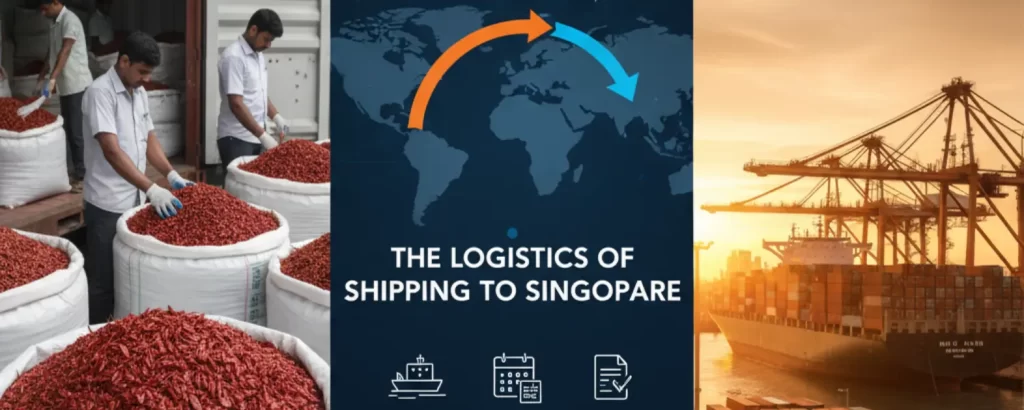
From Nhava Sheva to PSA Port: The Logistics of Shipping Red Chilli to Singapore

The vibrant heat in a Singaporean laksa or the deep red of a sambal belacan often begins its journey thousands of kilometers away, in the sun-drenched chilli fields of India. For food manufacturers and importers in Singapore, getting this essential spice from its source to their facility is a critical logistical process. The journey is a testament to a well-managed, efficient supply chain. As a leading exporter of Indian spices based in Pune, India, we want to pull back the curtain on this process. This is the step-by-step logistical journey of a red chilli to Singapore shipment, from India’s largest port, Nhava Sheva, to the world-class PSA Port. Step 1: Sourcing and Pre-Export Preparation Before any shipment can be planned, the foundation of quality must be laid. Sourcing the Right Chilli: The process starts with sourcing the correct variety based on our client’s needs. This could be the pungent Guntur chilli for its heat, the colourful Byadgi chilli for its rich red hue, or other popular varieties like the Sannam S4. Drying and Grading: The chillies are sun-dried to the optimal moisture level (typically below 12%) to prevent spoilage. They are then meticulously sorted and graded to ensure uniformity in size, colour, and quality, removing any damaged or substandard produce. Step 2: Expert Packing for the Sea Voyage Proper packing is essential to protect the dried red chillies during their journey. Material: We use new, clean, and breathable materials, typically jute bags or PP bags, packed to a standard weight (e.g., 25 kg). This protects the chillies from moisture and physical damage while allowing air to circulate. Labelling: Each bag is clearly marked with the product name, weight, grade, and country of origin, ensuring easy identification and compliance with import regulations. Step 3: Documentation – Clearing the Path for Singapore This is where an experienced exporter proves their value. Meticulous paperwork is vital for a smooth customs process. We prepare a comprehensive set of documents, ensuring full compliance with the Singapore Food Agency (SFA). Bill of Lading (B/L) Commercial Invoice & Packing List Certificate of Origin Phytosanitary Certificate: This is a mandatory document for agricultural products, certifying that the chillies are free from pests and plant diseases. Import products for your Needs Ready to Import Step 4: Container Stuffing and Fumigation With the product packed and paperwork ready, the container is prepared at a Container Freight Station (CFS) near Nhava Sheva Port. Loading: The bags of red chilli are carefully loaded (“stuffed”) into a clean, dry 20-foot or 40-foot container. The stacking is done to maximize stability and prevent bags from breaking. Fumigation: As a standard procedure, the container is often fumigated to eliminate any potential pests, a key requirement for many international markets, including Singapore. A fumigation certificate is then issued. Step 5: The 5-7 Day Sea Journey This is the core of the logistical journey. The India-to-Singapore trade lane is one of the most efficient in Asia. Efficient Transit: The sea freight journey from Nhava Sheva Port to PSA Singapore is remarkably short, typically taking only 5 to 7 days. Reliability: This major trade route is served by numerous reliable shipping lines, ensuring frequent and timely sailings. This short transit time is a significant advantage, helping to preserve the quality, aroma, and colour of the dried red chillies. Step 6: Arrival and Swift Clearance at PSA Singapore Upon arrival at the state-of-the-art PSA Port, the final steps are taken. The Singaporean importer’s customs agent uses the complete and accurate set of documents we provided to process the import clearance with Singapore Customs and the SFA. Because the paperwork is in perfect order, this is typically a smooth and swift process. The result is a full container load of high-quality Indian red chillies, cleared and ready for delivery to food manufacturers, spice blenders, and wholesalers across Singapore. A Reliable and Efficient Spice Corridor The journey of a red chilli to Singapore from India is a well-oiled process built on quality control, expert documentation, and efficient logistics. This established “spice corridor” ensures that Singaporean businesses can reliably source the authentic, high-quality ingredients their customers demand. Looking to source premium Indian red chillies for the Singaporean market? Contact Exim Internationals today for a detailed quote and to leverage our expertise on this key trade route. Frequently Asked Questions (FAQs) 1. What is the typical transit time for a sea freight shipment of red chilli from India to Singapore? The sea voyage from a west coast Indian port like Nhava Sheva to PSA Singapore is very efficient, typically taking only 5 to 7 days. 2. Which Indian port is best for exporting to Singapore? West coast ports of India, such as Nhava Sheva (Mumbai) and Mundra, are ideal for exporting to Singapore as they offer the most direct and frequent shipping routes. 3. What is the SFA and why is it important for importing red chilli to Singapore? The SFA (Singapore Food Agency) is the government body responsible for ensuring a safe food supply. All food imports, including dried red chillies, must comply with their regulations and standards, making adherence to their rules essential. 4. Which Indian red chilli varieties are most popular in the Singaporean market? Varieties like the pungent Guntur chilli (for heat) and the colourful Byadgi chilli (for deep red colour in pastes and sauces) are very popular in Singapore due to their suitability for local and regional cuisines. 5. Is a Phytosanitary Certificate mandatory for importing dried red chillies to Singapore? Yes, a Phytosanitary Certificate is a mandatory document. It certifies that the agricultural product has been inspected and is free from pests and diseases, which is a standard requirement for the SFA. 6. How are dried red chillies packed to prevent spoilage during shipment? They are packed in new, clean, and breathable materials like jute or PP bags, which protect the product while preventing moisture build-up. The container is also often fumigated as a preventive measure. 7. What is a typical “container load” in terms of

From Nhava Sheva to PSA Port: The Logistics of Shipping Red Chilli to Singapore Read Post »
coconut sugar to egypt
Export Import Fruits Spices Vegetables

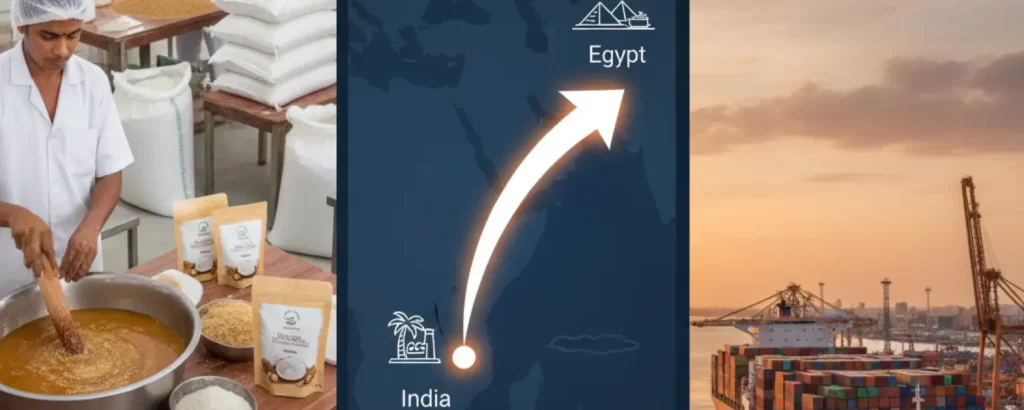
How We Export Indian Coconut Sugar to Egypt

As the demand for healthy, natural sweeteners grows in the Egyptian market, many businesses are looking to import high-quality coconut sugar. The question for many importers isn’t if they should source this popular product, but how to do it reliably and efficiently. Sourcing from a major producer like India is the first step, but ensuring a smooth process from farm to your port requires an expert partner. At Exim Internationals, we believe in complete transparency. We want our partners in Egypt to have full confidence in our capabilities. This is a step-by-step look into our proven process for delivering premium Indian coconut sugar to Egypt. Step 1: Your Inquiry & Our Consultation The journey begins with you. When you contact us, we start by understanding your specific business needs. Requirements: We’ll ask about your required quantity, preferred pack size (e.g., 500g retail pouches, 1kg bags, or 25kg bulk sacks), and if you have any special requirements like private labeling. Consultation: We don’t just take an order; we provide solutions. We can advise on the most cost-effective shipping methods and packaging options for the Egyptian market. Proforma Invoice: Based on this discussion, we provide a detailed Proforma Invoice with all costs, terms, and specifications clearly outlined, so you know exactly what to expect. Step 2: Sourcing from the Heart of South India The quality of the final product begins at the source. We have deep-rooted partnerships in the prime coconut-growing regions of South India. Premium Sap: We source our coconut sugar from producers who use traditional, sustainable methods of harvesting the sweet sap from coconut palm blossoms. Unrefined Quality: The sap is simply heated to evaporate the moisture, leaving behind pure, unrefined sugar granules. We ensure our product is sulfur-free, with a low moisture content (<2%) for maximum stability and a rich, caramel-like flavour. Step 3: Rigorous Quality Assurance and Expert Packing Before your order is dispatched, it undergoes strict quality checks. Verification: We verify batch-specific Certificates of Analysis (COA) to ensure the product meets all quality parameters. Packing for Purity: The coconut sugar is packed in high-quality, food-grade materials. Our 25kg bulk bags are multi-layered to protect against moisture and contaminants. Retail packs are designed to be durable and appealing. We also use tamper-evident seals for your peace of mind. Pre-Shipment Photos: We provide you with photos of your actual packaged order before it leaves our facility, so you can see the quality for yourself. Import products for your Needs Ready to Import Step 4: Navigating Documentation for Egyptian Customs This is where an experienced exporter proves their value. We meticulously prepare all necessary paperwork to ensure a smooth customs clearance process in Egypt. This includes: Commercial Invoice & Packing List Certificate of Origin Phytosanitary Certificate (certifying the product is free from plant pests) FSSAI Food Safety and Standards documentation from India Bill of Lading (for Sea Freight) or Airway Bill (for Air Freight) Step 5: Logistics – From Our Door to Your Port We manage the entire logistics chain to deliver your coconut sugar to Egypt efficiently. Flexible Shipping: We offer Air Freight for our trial-friendly MOQs (starting from 100 kg) and for urgent orders. For larger, more cost-effective shipments, we use reliable Sea Freight lines. Efficient Transit: We manage the inland transportation from our facility to a major Indian port (like Nhava Sheva) and book the transit to key Egyptian ports such as Alexandria or Port Said. Your Reliable Partner for Coconut Sugar to Egypt Our proven, five-step process is designed to be seamless, transparent, and professional. We handle the complexities of international sourcing, quality control, and logistics so that you can focus on what you do best: growing your business in Egypt with a fantastic, in-demand product.   Ready to bring the natural goodness of Indian coconut sugar to your customers? Contact Exim Internationals today to request a proforma invoice and start your import journey with a trusted partner. Frequently Asked Questions (FAQs) 1. What is the minimum order quantity (MOQ) for a trial shipment of coconut sugar to Egypt? We understand the need to test the market. We offer trial-friendly MOQs starting at just 100 kg, which can be conveniently shipped via air freight. 2. Which ports in Egypt do you ship to? We can arrange sea freight shipments to all major Egyptian ports, including the primary commercial ports of Alexandria and Port Said. 3. Is a Phytosanitary Certificate required for importing coconut sugar to Egypt? Yes, as an agricultural product, a Phytosanitary Certificate is typically required by Egyptian customs to ensure the product is free from plant pests. We handle this documentation as a standard part of our export process. 4. What makes South Indian coconut sugar special? South India’s tropical climate is ideal for coconut palms, leading to high-quality sap. The producers we partner with use traditional, unrefined methods that preserve the natural minerals and rich, caramel-like flavour of the coconut sugar. 5. Can you assist with private labeling for my brand in the Egyptian market? Absolutely. We offer full private labeling services for our retail packs. We can work with your brand design to create a market-ready product. Minimum Order Quantities apply, so please contact us to discuss the details. 6. What are the payment terms for a first-time importer in Egypt? For trial orders and first-time partners, our standard terms are 50% advance payment to begin processing and the remaining 50% before dispatch. For larger, established bulk orders, we can also work with an Irrevocable Letter of Credit (LC). 7. How do you guarantee the quality of the coconut sugar when it arrives in Egypt? We guarantee quality through a multi-step process: sourcing from trusted producers, verifying lab reports (COA), using protective, multi-layer packaging, and providing you with pre-shipment photos. 8. What information do I need to get a proforma invoice for a shipment of coconut sugar to Egypt? Simply contact us with your company name, your required quantity, the pack size (e.g., 25kg bulk or 1kg retail), and your destination

How We Export Indian Coconut Sugar to Egypt Read Post »

export quality lemon
Export Import Fruits Spices Vegetables

5 Questions You Must Ask Before Buying Export Quality Lemon in Bulk

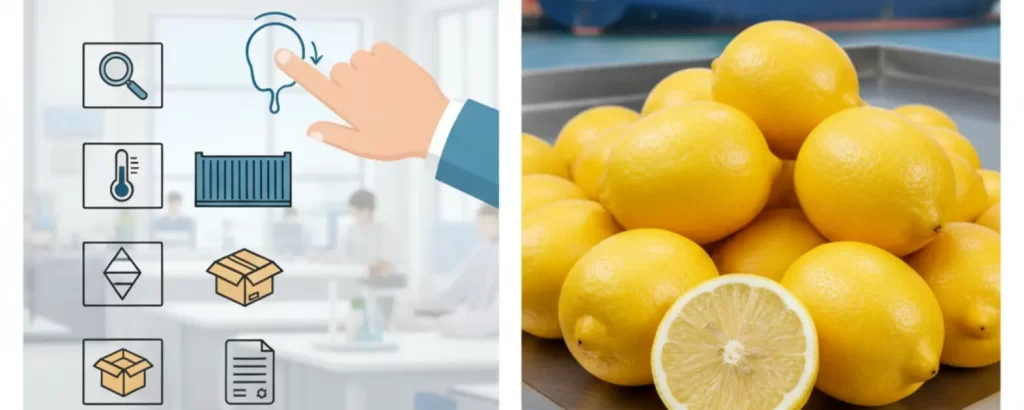
Sourcing fresh lemons in bulk is a significant investment for any importer, wholesaler, or food service distributor. The success of this investment hinges on one crucial factor: the quality and reliability of your supplier. The term “export quality lemon” is used frequently, but what does it actually mean, and how can you be sure you’re getting a premium, consistent product? Asking the right questions upfront is the key to protecting your business and building a profitable, long-term partnership. As a specialist in exporting fresh produce from Pune, India, we believe in empowering our clients. Here are the five essential questions you must ask any potential supplier before buying export quality lemon in bulk. 1. “What Are Your Specific Quality Specifications?” “Export quality” can be a vague marketing term. A professional exporter will have a concrete, data-driven answer. Don’t settle for “good quality”; demand specifics. What to listen for: A confident supplier should immediately provide details on: Size & Grade: How are the lemons graded? Is it by count per kilogram or box? Juice Content: What is the minimum guaranteed juice percentage (e.g., >35%)? Brix Level: What is the typical sweetness level (e.g., 7-8 °Bx)? Skin Finish & Colour: Are the lemons blemish-free? What is the accepted colour standard (e.g., uniform yellow)? A supplier who can provide a detailed specification sheet is one who takes quality seriously. 2. “Which Lemon Varieties Do You Supply and What is Their Origin?” Different lemon varieties have unique characteristics suitable for different markets and applications. A knowledgeable exporter will understand this nuance. What to listen for: Ask about specific varieties like the juicy, thin-skinned Kagzi lime or the classic Eureka lemon. An expert supplier will be able to explain the flavour profile and best uses for each. They should also be transparent about the specific growing regions in India they source from, which indicates deep product knowledge, not just a trading mentality. 3. “Can You Detail Your Cold Chain Management Process?” For a perishable item like an export quality lemon, this is arguably the most critical question. A break in the cold chain can ruin an entire shipment. What to listen for: You want to hear a clear, step-by-step process. This should include: Immediate pre-cooling after harvest to remove field heat. Transport from the farm to the packing house in refrigerated vehicles. Packing in a temperature-controlled environment. Use of reefer containers set to the optimal temperature (e.g., 8-10°C) for the sea voyage. A vague answer about “keeping it cool” is a major red flag. Import products for your Needs Ready to Import 4. “What is Your Standard Packing Method for Bulk Shipments?” Improper packing is a primary cause of bruising, crushing, and spoilage during transit. An experienced exporter has perfected their packing methods. What to listen for: The supplier should describe the use of sturdy, ventilated corrugated boxes. They might mention using liners or wrapping individual fruits to prevent moisture loss and rubbing. They should also have a standard weight per box to prevent the lemons at the bottom from being crushed. This attention to detail is a hallmark of a professional operation focused on maximizing your product’s shelf life. 5. “What Standard Documentation Do You Provide with Every Shipment?” A beautiful shipment of lemons is useless if it’s stuck at customs. Incorrect or missing paperwork can cause catastrophic delays. What to listen for: A reliable exporter will confidently list the standard documents they provide with every shipment. The list must include: Bill of Lading (B/L) Commercial Invoice & Packing List Certificate of Origin And most importantly, the Phytosanitary Certificate. If a potential supplier hesitates or is unsure about providing any of these, it’s a sign they may lack the necessary export experience. Asking the Right Questions Leads to the Right Partner These five questions are designed to cut through marketing claims and get to the heart of a supplier’s capabilities. A true export partner will have confident, detailed, and transparent answers for every single one. By performing this due diligence, you are not just buying lemons; you are investing in a secure and profitable supply chain. Ready to partner with an exporter who has all the right answers? Contact Exim Internationals today. We are committed to providing true export quality lemons, backed by a transparent and reliable process. Frequently Asked Questions (FAQs) 1. What is the most important question to ask a potential lemon supplier? While all five are critical, asking for their detailed quality specifications (Question #1) is often the most revealing. A professional supplier will have a data-driven answer, while a less experienced one may be vague. 2. What does a “Phytosanitary Certificate” certify for an export quality lemon shipment? It is a mandatory document issued by the Indian government’s plant protection agency that certifies the lemons have been inspected and are free from harmful pests and diseases, complying with the import regulations of your country. 3. What is a good juice content percentage for an export quality lemon? A good standard for export quality lemons is a minimum juice content of 35-40% by weight, ensuring a valuable product for both culinary and juicing purposes. 4. Why is a cold chain so crucial for exporting fresh lemons? A continuous cold chain (typically 8-10°C) slows down the fruit’s respiration and ripening processes, inhibits microbial growth, and prevents dehydration. This is essential for preserving freshness and maximizing shelf life during the long transit period. 5. What’s the difference between a Kagzi lime and a Eureka lemon from India? The Kagzi lime is typically smaller, with a thinner skin and very high juice content, making it popular in South Asia and the Middle East. The Eureka lemon is a more traditional, larger variety with a thicker rind, similar to those commonly found in Western supermarkets. 6. How can I verify the quality of a shipment of export quality lemon upon arrival? Upon arrival, you should conduct a random sampling of cartons. Visually inspect the lemons for colour, blemishes, and mould. Cut open a sample

5 Questions You Must Ask Before Buying Export Quality Lemon in Bulk Read Post »

ginger export from india
Export Import Fruits Spices Vegetables

The 7-10 Day Journey: What Happens During a Ginger Export from India to Jebel Ali

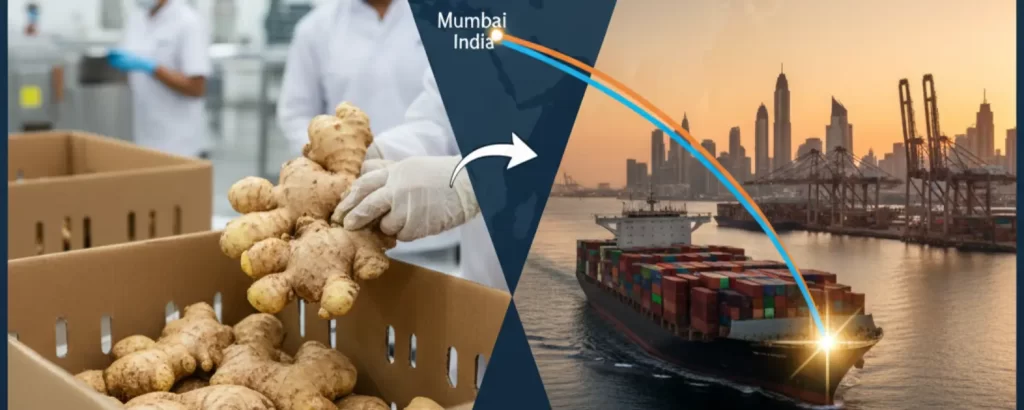
When a crate of fresh, pungent Indian ginger arrives at a bustling market in Dubai, it represents the successful culmination of a meticulously planned journey. For importers in the UAE, understanding this process is key to appreciating the value and expertise that goes into delivering a quality product. The 7-10 day sea voyage is just one part of a complex supply chain that begins long before the ship leaves the port. As a leading specialist in ginger export from India, this is our transparent, step-by-step guide to the journey your ginger takes from our hands to yours. Days 1-2: Sourcing and Quality Control at the Origin The journey begins not at the port, but in the fertile ginger-growing regions of India. Sourcing Premium Ginger: We procure high-quality fresh ginger, focusing on sought-after varieties like Cochin ginger, known for its low fiber content and strong flavour. Rigorous Sorting: Each piece of ginger undergoes manual inspection. We sort for optimal size and remove any pieces with physical damage, signs of pests, or sprouting. Pre-Cooling: This is a critical first step. We immediately pre-cool the ginger to remove field heat. This kickstarts the cold chain process, slows down respiration, and is the first secret to a longer shelf life upon arrival in the UAE. Day 3: Expert Packing for the Journey Ahead How the ginger is packed is crucial for its survival during transit. Our process is designed for protection and freshness. Ventilation is Key: The sorted ginger is packed into sturdy, ventilated corrugated cartons. Proper ventilation is essential to allow air to circulate, preventing moisture build-up and inhibiting microbial growth. Optimized Weight: Each carton is packed to a specific weight to prevent the ginger at the bottom from being crushed, ensuring the entire batch remains in perfect condition. Day 4: Documentation and Container Stuffing With the ginger perfectly packed, we prepare for dispatch. Preparing the Paperwork: Our team meticulously prepares all necessary export documents. This includes the Commercial Invoice, Packing List, Certificate of Origin, and the mandatory Phytosanitary Certificate, which is essential for UAE customs clearance. Loading the Reefer Container: The cartons are carefully loaded (stuffed) into a reefer container. These are specialized refrigerated containers set to the optimal temperature for ginger (typically 12-14°C). The loading pattern is designed to maximize airflow, ensuring a consistent temperature throughout the container. Import products for your Needs Ready to Import Day 5: Inland Transit and Port Formalities The container is now sealed and ready to move. It is transported from our packing facility via truck to a major port like Nhava Sheva (Mumbai). The reefer container is powered throughout this inland journey, ensuring the cold chain remains unbroken. At the port, we complete Indian customs clearance formalities before the container is loaded onto the vessel. Days 6-15: The 7-10 Day Sea Voyage This is the unseen part of the journey. For the next 7 to 10 days, your ginger is safe inside the reefer container aboard a modern container ship. The container’s refrigeration unit works continuously, maintaining the precise temperature and humidity required. This controlled environment effectively “pauses” the ginger’s aging process, preserving its freshness, flavour, and weight. Day 16: Arrival and Clearance at Jebel Ali Port The vessel arrives at Jebel Ali port in Dubai. Your designated clearing agent uses the set of documents we provided to process the import customs clearance. Thanks to the thorough paperwork, this is a smooth and efficient process. The container is then released, and a shipment of fresh, high-quality Indian ginger is ready for distribution to the HORECA sector, supermarkets, and wholesalers across the UAE. A Journey of Trust and Expertise Every successful ginger export from India is a testament to a meticulously managed process. From quality control at the source to expert packing and unbroken cold chain logistics, each step is designed to deliver a premium product. Understanding this journey gives you the confidence that you are not just buying ginger, but investing in a reliable and transparent supply chain. Ready to start your own ginger import journey? Contact Exim Internationals today for a detailed quote and to learn more about our export process to the UAE. Frequently Asked Questions (FAQs) 1. What is the total time for a ginger export from India to the UAE? The entire process, from packing and port transit in India to arrival at Jebel Ali, typically takes around 15-16 days. The sea voyage itself is approximately 7 to 10 days. 2. What is a reefer container and why is it essential for fresh ginger? A reefer container is a refrigerated shipping container. It’s essential for fresh ginger to maintain a constant cool temperature, which slows down dehydration and spoilage, ensuring the product arrives fresh after its journey. 3. Which varieties of Indian ginger are best for export to the UAE? Varieties like Cochin ginger and Calicut ginger are highly preferred for export due to their low fiber content, strong aroma, and pleasing appearance, which are popular in the UAE market. 4. What is a Phytosanitary Certificate? It is a mandatory certificate issued by the Indian government’s plant protection agency that confirms the ginger has been inspected and is free from pests and diseases, as required by UAE import regulations. 5. How do you ensure the ginger stays fresh during the 10-day sea voyage? Freshness is ensured by the unbroken cold chain, primarily the reefer container which maintains a steady, cool temperature and optimal humidity, effectively preserving the ginger’s quality throughout the journey. 6. Which port in India do you use for exports to Jebel Ali? We primarily use the port of Nhava Sheva (JNPT) in Mumbai, which is India’s largest and most efficient port with excellent and frequent vessel connections to Jebel Ali. 7. What information do I need to provide to get a quote for a ginger export to Dubai? To get an accurate quote, please provide your company details, the required quantity (e.g., 1 x 40′ reefer container), whether you need fresh or dried ginger, and your destination

The 7-10 Day Journey: What Happens During a Ginger Export from India to Jebel Ali Read Post »

drumsticks exporter
Export Import Fruits Spices Vegetables

5 Critical Mistakes to Avoid When Choosing a Drumsticks Exporter

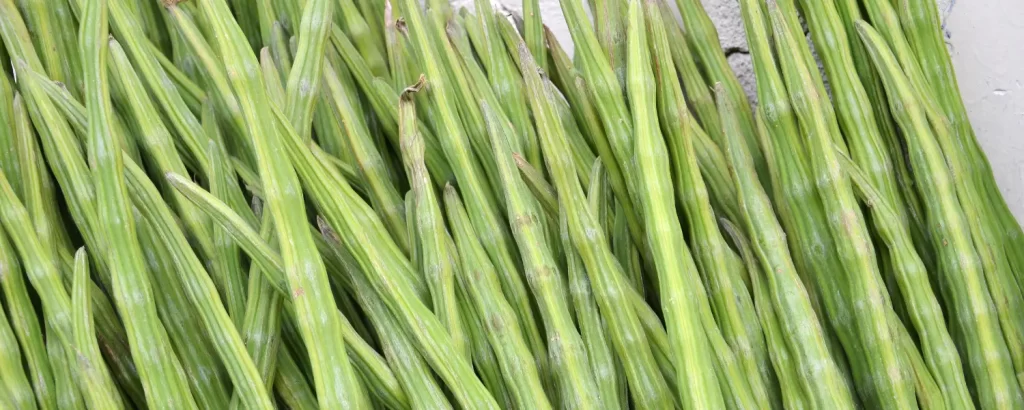
The global demand for healthy, plant-based superfoods is surging, and at the forefront of this trend is the Moringa Drumstick. For importers, this nutritious vegetable represents a significant market opportunity. However, sourcing a niche and perishable product like this from India comes with unique challenges. Choosing the right drumsticks exporter is the single most important decision you will make. A great partner ensures profitability and quality; the wrong one can lead to costly disasters. As a specialist in exporting high-quality Moringa drumsticks (known as shevga in India), we’ve identified the critical mistakes buyers often make. Avoiding them will protect your investment and secure your supply chain. Mistake 1: Overlooking Tenderness and Proper Grading The Mistake: Assuming all drumsticks are the same and focusing only on size or price. The Cost: Receiving a shipment of tough, fibrous, and over-mature drumsticks that are unappetizing and unsellable to discerning consumers, leading to a total loss. The Solution: Partner with an exporter who understands that tenderness is the number one quality metric. A professional drumsticks exporter will have a clear grading system based on the age, flexibility, and girth of the pods. They should be able to guarantee a shipment of tender, young drumsticks that are perfect for culinary use. Ask potential suppliers how they grade for tenderness and what their rejection criteria are at the farm level. Mistake 2: Underestimating the Cold Chain Requirement The Mistake: Treating fresh drumsticks like a semi-perishable commodity instead of the delicate, high-moisture vegetable they are. The Cost: A shipment arriving limp, discolored, dehydrated, or spoiled due to a broken or non-existent cold chain. This often results in the rejection of the entire container. The Solution: Demand proof of a robust cold chain. Your drumsticks exporter must have a seamless process that includes immediate post-harvest pre-cooling, refrigerated transport from the farm, packing in a temperature-controlled facility, and transfer to the airport or seaport in a reefer container. This unbroken chain is non-negotiable for maximizing freshness and shelf life. Mistake 3: Not Verifying Year-Round Supply Capability The Mistake: Contracting with a supplier who has a limited, seasonal sourcing network. The Cost: Experiencing supply disruptions, stockouts during your peak demand periods, and losing your customers to competitors who have a more consistent supply. The Solution: Choose a drumsticks exporter with a wide sourcing network across different agricultural zones in India. While Moringa has peak seasons, a well-connected exporter can leverage different regional climates to provide a consistent, year-round supply. Ask them directly about their off-season capabilities and how they manage supply continuity. Import products for your Needs Ready to Import Mistake 4: Ignoring Packaging and Handling Expertise The Mistake: Focusing only on the product itself and not the specifics of how it is packed for a long journey. The Cost: Receiving a shipment with a high percentage of bruised, broken, or dehydrated drumsticks due to poor packaging. The Solution: A professional drumsticks exporter will have a specialized packing protocol. This typically involves using sturdy, ventilated cartons, sometimes with absorbent lining to manage moisture. The drumsticks are cut to a uniform length and packed to a specific weight to prevent crushing and allow for proper air circulation within the carton. This expert handling is key to a longer shelf life upon arrival. Mistake 5: Failing to Confirm Documentation and Compliance The Mistake: Assuming the exporter will automatically provide all the correct paperwork required for your country’s customs. The Cost: Your shipment being delayed for days or even rejected at your port due to missing or incorrect documentation, leading to demurrage charges and spoilage. The Solution: Confirm upfront that the drumsticks exporter will provide all necessary, correctly filled-out documentation as a standard part of their service. The most critical document for fresh produce is the Phytosanitary Certificate, which certifies the product is free from pests and diseases. Choose a Partner, Not Just a Supplier Avoiding these five critical mistakes boils down to one guiding principle: choose a drumsticks exporter who acts as a strategic partner. A true partner is transparent about their processes, prioritizes quality and logistics over simply offering the lowest price, and understands that their success is tied to yours.   Ready to partner with a drumsticks exporter who helps you avoid these pitfalls? Contact Exim Internationals today to discuss our quality assurance, cold chain logistics, and year-round supply capabilities. Frequently Asked Questions (FAQs) 1. What are we referring to as “drumsticks” in this context? We are referring to the vegetable drumstick, the long, slender seed pod of the Moringa oleifera tree. It is a highly nutritious superfood, also known as shevga in parts of India. 2. What is the most important quality factor to look for in fresh Moringa drumsticks? Tenderness is the single most important quality factor. Young, tender drumsticks are desirable for their taste and texture, while over-mature pods become tough and fibrous. 3. Why is the cold chain so critical for drumstick export? Moringa drumsticks are highly perishable with a high respiration rate. An unbroken cold chain (maintaining a cool temperature from farm to destination) is essential to slow down decay, preserve freshness, and maximize shelf life. 4. What is the typical shelf life of exported fresh drumsticks? With proper cold chain management and packaging, fresh Moringa drumsticks can have a shelf life of approximately 2 to 3 weeks, which is why efficient logistics, often involving air freight, are crucial. 5. Can I get a year-round supply of Moringa drumsticks from India? Yes. While there are peak seasons, a well-networked exporter with access to farms in different climatic zones of India can provide a consistent, year-round supply. 6. What is a Phytosanitary Certificate and is it required for importing drumsticks? Yes, it is a mandatory document for customs clearance in almost every country. It is issued by the plant protection authority of the exporting country (India) and certifies that the vegetables are free from pests and diseases. 7. Do you also export IQF (frozen) Moringa drumsticks? Yes, for clients who require a much longer shelf

5 Critical Mistakes to Avoid When Choosing a Drumsticks Exporter Read Post »

green chilli exporter
Export Import Fruits Spices Vegetables

Packing for Perfection: A Green Chilli Exporter’s Guide to Maximizing Shelf Life

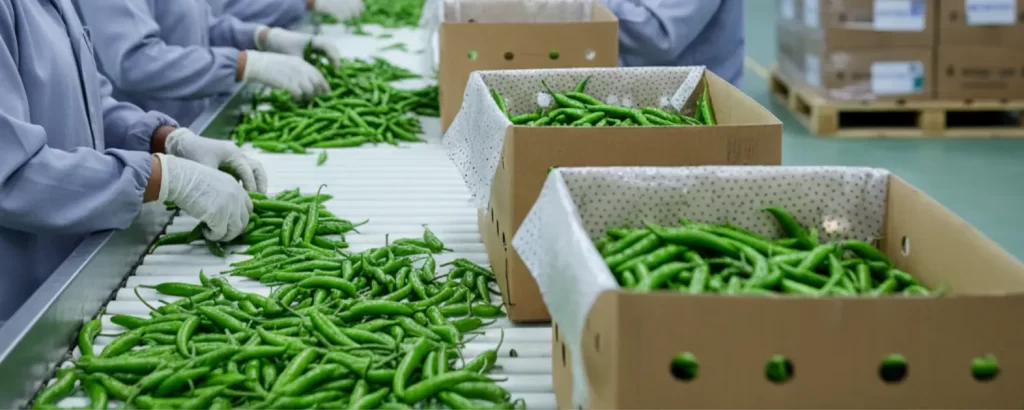
For importers of fresh produce, particularly a highly perishable item like green chillies, the greatest challenge isn’t just sourcing, but ensuring the product arrives in pristine condition with an extended shelf life. A successful green chilli exporter understands that quality extends far beyond the farm gate; it encompasses every meticulous step of the packing and cold chain process. At Exim Internationals, based in Pune, Maharashtra, we have perfected the art and science of preparing green chillies for international markets, from farm to flight. Our commitment to maximizing freshness and minimizing spoilage is embedded in our expert packing protocols. 1. The Foundation: Optimal Harvest & Pre-Cooling The journey to an extended shelf life begins even before packing. Optimal Harvest: Chillies are hand-picked at their ideal maturity stage—firm, vibrant green, and free from physical damage or disease. Overripe or damaged chillies will compromise the entire batch. Rapid Pre-Cooling: Immediately after harvest, chillies are moved to pre-cooling facilities. Rapidly reducing the field heat is crucial to slow down respiration, enzyme activity, and microbial growth. This step is non-negotiable for extending shelf life. 2. Meticulous Sorting & Grading Once pre-cooled, chillies undergo a rigorous sorting and grading process. Manual Inspection: Trained personnel visually inspect each chilli, removing any that show signs of blemishes, insect damage, softness, discoloration, or cuts. Only unblemished, top-quality chillies proceed. Grading: Chillies are then graded by size and variety (e.g., G4 chilli or Jwala chilli) to ensure uniformity within each pack, meeting the specific requirements of the importer. 3. Specialized Packing Materials for Freshness The choice of packing material directly impacts the chilli’s ability to “breathe” while staying protected. Perforated Plastic Liners: Inside the carton, chillies are typically packed within perforated plastic liners (e.g., LDPE) or breathable mesh bags. These liners prevent moisture loss while allowing essential ventilation to avoid condensation build-up, which can lead to rot. Corrugated Fiberboard Cartons: We use sturdy, food-grade corrugated cartons. These cartons are designed with vent holes to facilitate air circulation during cold chain logistics, preventing the accumulation of ethylene gas (a ripening agent) and ensuring consistent temperature throughout the package. Ideal Weight: Cartons are packed to an ideal weight (e.g., 3-5 kg per carton) to prevent bruising from excessive weight while allowing for efficient handling and stacking. Import products for your Needs Ready to Import 4. Cold Chain Management: From Packing House to Destination Packing is just one part of the equation; maintaining a consistent temperature is paramount. Controlled Environment Packing: All packing operations take place in a controlled, hygienic environment to minimize contamination and maintain cool temperatures. Refrigerated Transport: From the packing house, the packed cartons are immediately transferred to refrigerated trucks, then to temperature-controlled holding areas at the airport. Air Freight Advantage: For green chilli export, air freight is often the preferred mode of transport due to its speed. The entire journey, from packing to arrival, is meticulously monitored to ensure the chillies remain within their optimal temperature range (typically 7-10°C). 5. Essential Documentation: Phytosanitary & Quality Certificates While not directly part of the packing, comprehensive documentation is critical for smooth international transit and validates the quality assurance. Phytosanitary Certificate: A mandatory document issued by the plant protection authority, certifying that the chillies are free from pests and diseases, crucial for customs clearance. Certificate of Analysis (COA): May be provided to detail specific quality parameters if requested. Your Partner in Freshness Successfully exporting green chillies demands more than just growing them; it requires a sophisticated, integrated approach to handling, sorting, packing, and cold chain logistics. As your dedicated green chilli exporter, Exim Internationals ensures that every step is optimized to deliver fresh, vibrant chillies with maximum shelf life to your global market.   Looking for a reliable partner for your fresh green chilli imports? Contact Exim Internationals today. We guarantee farm-fresh quality delivered with precision. Frequently Asked Questions (FAQs) 1. What is the most critical factor for extending the shelf life of green chillies during export? Maintaining an unbroken cold chain from harvest to delivery is the most critical factor. Rapid pre-cooling and consistent temperature control throughout transit are essential to slow down respiration and prevent spoilage. 2. What type of packing materials are used for green chilli export? We use perforated plastic liners or breathable mesh bags within sturdy, well-vented corrugated fiberboard cartons. These materials are chosen to protect the chillies, allow ventilation, and prevent moisture build-up. 3. What is “pre-cooling” and why is it important for green chilli exports? Pre-cooling is the rapid removal of field heat from harvested chillies. It’s crucial because it significantly slows down the natural ripening and decay processes, thereby extending the shelf life of the product before it even leaves the farm. 4. What temperature range is ideal for shipping fresh green chillies? The optimal temperature range for shipping fresh green chillies is typically between 7°C to 10°C (45°F to 50°F) with high humidity (90-95%). 5. How does a green chilli exporter ensure uniformity in size and quality? After pre-cooling, chillies undergo rigorous manual sorting and grading. Trained personnel remove any damaged or substandard chillies and then categorize them by size and variety (e.g., G4 chilli or Jwala chilli) to meet specific export grade requirements. 6. Is a Phytosanitary Certificate required for green chilli export? Yes, a Phytosanitary Certificate is a mandatory document for all fresh produce exports. It certifies that the green chillies have been inspected and are free from pests and diseases, complying with the import regulations of the destination country. 7. How long is the typical transit time for green chilli export by air freight? By air freight, the transit time for green chilli export can range from 1 to 3 days, depending on the destination and flight connections. This speed is vital for a perishable commodity. 8. How does Exim Internationals manage the cold chain for green chilli exports? Exim Internationals manages the cold chain by utilizing refrigerated transport from farms to packing houses, packing in temperature-controlled environments, and using air freight with strict temperature-monitored conditions, ensuring continuous coolness

Packing for Perfection: A Green Chilli Exporter’s Guide to Maximizing Shelf Life Read Post »

Semi-Husked Coconuts
Export Import Fruits Spices Vegetables

Price, MOQ & Packing for Semi-Husked Coconuts to UAE (2025 Guide)

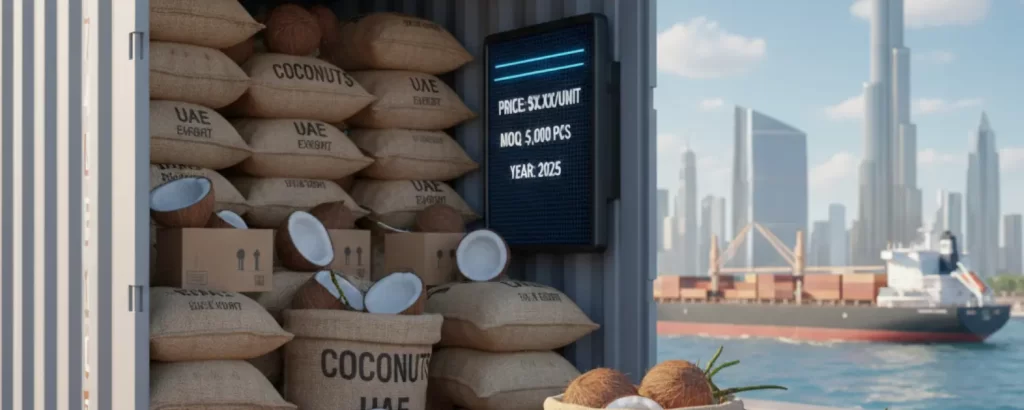
For fruit importers and wholesalers in the UAE, the demand for fresh coconuts remains consistently strong. Sourcing directly from India, a major global producer, is a strategic move to ensure quality and competitive pricing. However, for a profitable import business, understanding the key commercial details is crucial. This 2025 guide provides a transparent breakdown of the three most important factors for sourcing Semi-Husked Coconuts from India for the UAE market: Price, Minimum Order Quantity (MOQ), and Packing. Decoding the Price of Semi-Husked Coconuts (2025 Trends) The final price of a coconut shipment is more than just the cost per nut. It’s a combination of the product cost, freight, and quality grade.   Factor 1: FOB Price from India The base price of the coconut itself (FOB – Free On Board) fluctuates based on seasonal factors, harvest volumes in key growing regions like Pollachi, Tamil Nadu, and domestic market demand. A reliable exporter will provide you with current, transparent pricing based on the prevailing market conditions. Factor 2: Ocean Freight Costs A major component of your landed cost is the ocean freight from a major Indian port like Nhava Sheva (Mumbai) to your destination, such as Jebel Ali. This is where Semi-Husked Coconuts offer a significant advantage. Because they are lighter and slightly more compact than fully husked coconuts, we can load more units per container, drastically reducing the per-unit shipping cost. 2025 Market Outlook For the latter half of 2025, we anticipate stable pricing with robust demand from the UAE market, especially leading into the cooler months and the festive season. Engaging with a supplier now is the best way to secure favorable rates for your upcoming shipments. Minimum Order Quantity (MOQ) for UAE Shipments We offer flexible MOQs to suit your business needs, whether you’re placing a trial order or scaling up your supply.   Trial Orders: 20-Foot Container We understand the need to verify quality and build trust. For new partners in the UAE, we are happy to accommodate a trial MOQ of one 20-foot container. Approximate Load: 13–15 Metric Tons Standard Orders: 40-Foot Container For maximum cost-efficiency and the lowest possible freight cost per unit, our standard MOQ is one 40-foot container. This is the preferred option for our regular partners. Approximate Load: 23–27 Metric Tons Import products for your Needs Ready to Import Expert Packing for Optimal Freshness & Shelf Life The journey from India to the UAE requires packing that is optimized for protection, ventilation, and freshness. Our process is designed to ensure your Semi-Husked Coconuts arrive in perfect, sellable condition. The Bagging Process: Each shipment consists of mature, graded coconuts (typically 500-650g). We pack 25 coconuts into a new, durable PP (polypropylene) woven bag. The average weight of a packed bag is between 12.5 kg and 13.5 kg. Container Stuffing: Our experienced team meticulously loads (stuffs) the bags into the container. They are stacked to ensure stability and allow for proper air circulation, which is crucial for preventing spoilage and extending shelf life during the sea voyage. This expert packing method is our commitment to quality, ensuring the product that leaves our shores is the same high-quality product that arrives at your warehouse in the UAE. Your Sourcing Partner for the UAE Market Understanding the nuances of price, MOQ, and packing is the foundation of a profitable import strategy. By partnering with Exim Internationals, you are choosing a supplier that provides not only high-quality Semi-Husked Coconuts but also transparency and expertise in every shipment.   Ready to source your next container? Contact us today for a detailed, all-inclusive quote to Jebel Ali or other UAE ports. Frequently Asked Questions (FAQs) 1. How is the final price for a shipment to Jebel Ali calculated? The final price (often quoted as CNF or CIF) includes the FOB cost of the coconuts, ocean freight charges, and any other agreed-upon charges like insurance or inspection fees. We provide a fully transparent breakdown in our quotes. 2. Why is a 40-foot container more cost-effective for importing coconuts? While the total cost is higher, a 40-foot container holds significantly more coconuts than a 20-foot container. This drastically reduces the shipping cost per individual coconut, making your landed cost per unit lower and your potential profit margin higher. 3. What documents are provided with the shipment for UAE customs? Every shipment includes a standard set of export documents: the Bill of Lading, Commercial Invoice, Packing List, Certificate of Origin, and a Phytosanitary Certificate, which is mandatory for customs clearance of agricultural products in the UAE. 4. What is the typical shelf life of your semi-husked coconuts upon arrival? Thanks to our careful selection and packing methods, our Semi-Husked Coconuts have an excellent shelf life. When stored in a cool, dry place, they can remain in good condition for over 60 days after arrival. 5. Do you ship to other ports in the UAE besides Jebel Ali? Yes. While Jebel Ali (Dubai) is the most common destination, we can arrange shipments to other major UAE ports, including Abu Dhabi and Sharjah. 6. Where in India are your coconuts sourced from? We source our premium export-grade coconuts from Pollachi in Tamil Nadu, which is widely regarded as India’s “Coconut Capital,” famous for producing coconuts with sweet water and thick flesh. 7. What is the approximate transit time from Nhava Sheva, India to Jebel Ali, UAE? The sea transit time for a container vessel from Nhava Sheva Port to Jebel Ali is typically between 7 to 10 days, making it a quick and efficient route. 8. How do I get a precise quote for my company? Simply use the “Get Container Quote” button on our page or contact us via WhatsApp. Provide your company details, desired quantity (e.g., 1 x 40′ container), and destination port. Our team will respond with a detailed quote within 24 hours.

Price, MOQ & Packing for Semi-Husked Coconuts to UAE (2025 Guide) Read Post »

cavendish banana export to USA
Export Import Fruits Spices Vegetables

Why US Importers are Looking to India for G9 Cavendish Banana Export

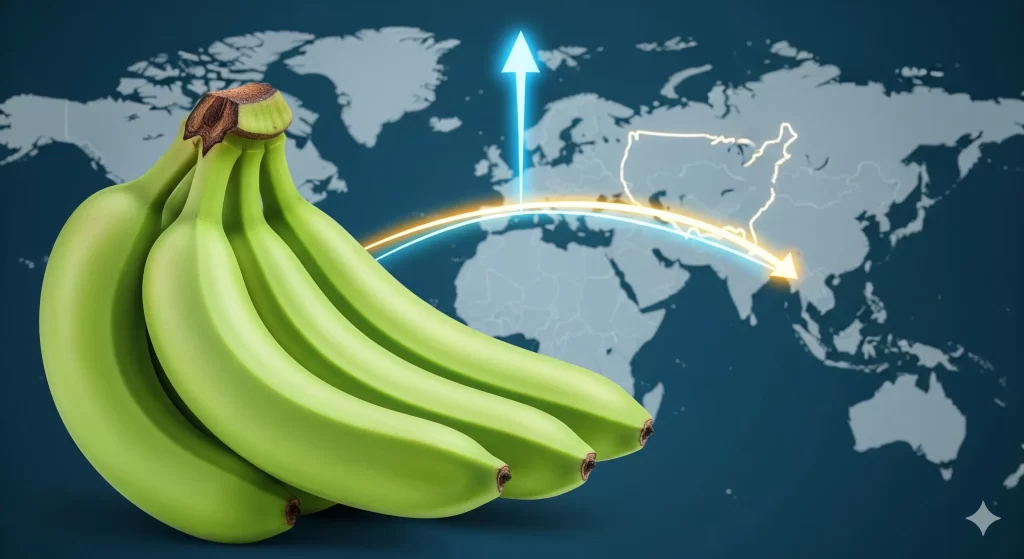
The global banana market is a dynamic ecosystem, traditionally dominated by a few key players. However, smart US importers are increasingly diversifying their sourcing strategies, turning their attention towards new horizons that offer reliability, quality, and a competitive edge. Among these emerging sources, India is rapidly gaining prominence as a formidable origin for G9 Cavendish banana export to USA. As a leading Indian exporter of premium G9 Cavendish bananas, Exim Internationals, based in Pune, Maharashtra, understands the stringent demands of the American market. This shift isn’t just a trend; it’s a calculated business decision based on several compelling advantages that India offers. 1. Unmatched Production Scale and Year-Round Supply India is the world’s largest producer of bananas, a fact often surprising to those outside the industry. This enormous domestic production base translates into a unique ability to ensure a consistent, year-round supply for export markets. Vast Acreage: India’s diverse agro-climatic zones allow for continuous cultivation, mitigating seasonal supply gaps that can affect other banana-producing regions. Reliability: For US importers serving large retail chains or food service industries, a consistent supply is paramount. India’s scale offers unparalleled reliability, reducing the risk of shortages and price volatility. 2. Superior Quality and G9 Cavendish Expertise Indian farmers have honed their expertise in cultivating high-quality G9 Cavendish bananas, the variety preferred globally for its robust yield, excellent flavour, and shelf stability. Optimal Growing Conditions: Regions like Maharashtra and Andhra Pradesh boast ideal soil and climatic conditions for banana cultivation, resulting in fruit with excellent size, uniform shape, and desirable taste. Global G.A.P. Certification: A growing number of Indian banana farms and packing houses are achieving Global G.A.P. certification, a testament to their commitment to safe and sustainable agricultural practices that meet international standards. This is a critical assurance for US importers focused on food safety. 3. Strategic Supply Chain Diversification Reliance on a single or limited number of sourcing origins poses significant risks, as geopolitical events, weather phenomena, or agricultural issues can disrupt supply. India offers a strategic alternative. Risk Mitigation: By adding India to their portfolio, US importers can significantly diversify their supply chain, enhancing resilience against unforeseen disruptions from traditional Latin American sources. New Market Opportunities: Tapping into India’s banana supply opens up new avenues for competitive pricing and strengthens long-term sourcing relationships. Import products for your Needs Ready to Import 4. Navigating Stringent USA Import Regulations with Expertise The USA’s import requirements for fresh produce, particularly regarding phytosanitary certificates and pest control, are among the strictest globally. A capable Indian exporter understands and navigates these complexities. Compliance Know-How: Experienced exporters have robust protocols in place to meet USDA-APHIS regulations, including necessary inspections and cold treatment if required, ensuring seamless entry into the US. Advanced Cold Chain Logistics: From farm to port, an unbroken cold chain is maintained using specialized reefer containers to guarantee the bananas arrive in optimal condition, ready for ripening and distribution in the US market. This includes precise temperature and humidity control during the 21-day ocean journey. A Strategic Partner for USA Banana Importers The trend of US importers seeking G9 Cavendish banana export from India is a clear indicator of India’s growing capability and strategic advantages. From unmatched production scale and superior quality to vital supply chain diversification and expert navigation of US import regulations, India offers a compelling proposition.   Are you a US importer looking to secure a reliable, high-quality, and strategically sound source for Cavendish bananas? Contact Exim Internationals today. We are your expert partner in facilitating seamless Cavendish banana export to USA, ensuring compliance and freshness from farm to your facility. Frequently Asked Questions (FAQs) 1. What is a G9 Cavendish banana? G9 Cavendish is the most widely cultivated and commercially exported banana variety worldwide. It’s known for its consistent size, good flavor, and robust nature, making it ideal for international shipping and retail. 2. Why is India becoming an attractive source for US banana importers? India’s immense production scale offers year-round supply reliability, high-quality G9 Cavendish bananas, strategic supply chain diversification benefits, and a growing number of exporters capable of meeting stringent US import requirements. 3. What are the main challenges for Cavendish banana export from India to USA? The main challenges include maintaining an unbroken cold chain during the 21-day ocean transit, meeting strict USDA-APHIS and FDA food safety regulations, and obtaining precise phytosanitary certificates. 4. What is Global G.A.P. certification, and why is it important for US importers? Global G.A.P. is a worldwide standard for good agricultural practices. For US importers, it provides assurance that the bananas are produced, packed, and handled according to stringent food safety, environmental, and worker welfare criteria. 5. How does the “cold chain” work for banana exports? The cold chain involves maintaining a consistent, optimal temperature and humidity for bananas from the moment they are harvested, through packing, storage, and during transit in reefer containers, to ensure they arrive fresh and green, ready for ripening. 6. What is the role of USDA-APHIS in banana imports to the USA? USDA-APHIS (Animal and Plant Health Inspection Service) is responsible for protecting US agriculture from pests and diseases. They set strict phytosanitary requirements and conduct inspections for all imported fresh produce, including bananas. 7. How long is the typical transit time for a banana export from India to the USA? The ocean transit time for a Cavendish banana export to USA typically ranges from 21 to 28 days, depending on the specific ports of origin and destination. 8. How can Exim Internationals help US importers with their banana sourcing needs? Exim Internationals provides end-to-end expertise, from sourcing high-quality G9 Cavendish bananas from Global G.A.P. certified farms in India, ensuring full compliance with USA’s import requirements, managing seamless cold chain logistics, and providing necessary documentation for a smooth import process.

Why US Importers are Looking to India for G9 Cavendish Banana Export Read Post »

Semi Husked coconuts
Export Import Fruits Spices Vegetables

Fully Husked vs. Semi Husked Coconuts: A Profitability Analysis for Importers

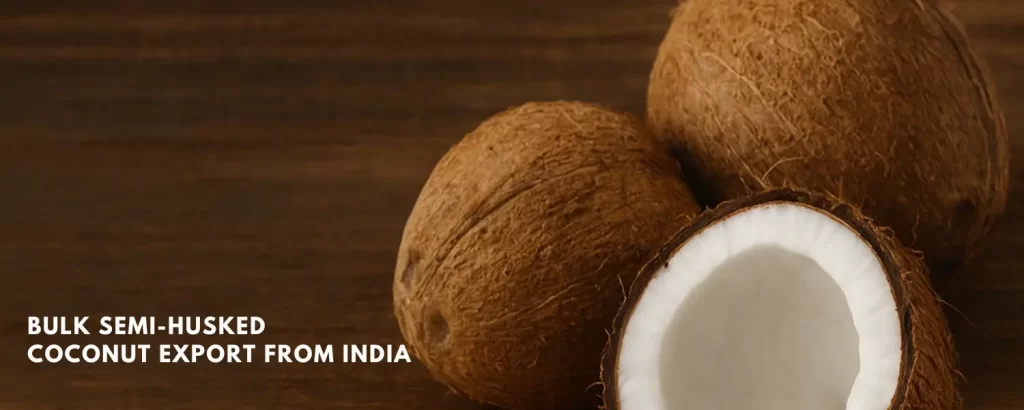
For any international importer of fresh produce, the ultimate goal is to maximize the return on every single shipment. When it comes to sourcing fresh coconuts from a major production hub like India, one of the most critical decisions you’ll make is choosing the right product form. The choice between fully husked and semi husked coconuts might seem minor, but it has a direct and significant impact on your freight costs, spoilage rates, and ultimately, your profit margin. So, which option is truly more profitable? As a leading exporter of premium Indian coconuts from hubs like Pollachi, we’ve run the numbers. This profitability analysis will break down the key factors to help you make the smartest choice for your business. Understanding the Products: A Quick Comparison First, let’s clarify the two forms: Fully Husked Coconuts: The entire thick, fibrous outer husk is removed, leaving only the hard inner shell (endocarp). Semi Husked Coconuts: A portion of the husk is skillfully removed, typically in a tuft around the “eyes,” while the rest remains. This process significantly reduces weight but keeps a protective layer. The Critical Factor: Freight Costs and Container Load International shipping costs are calculated by volume and weight. This is where the most significant difference in profitability emerges. The coconut husk is surprisingly heavy and bulky, consisting mostly of fiber and moisture. Weight Reduction: A semi husked coconut can be 20-30% lighter than its fully husked counterpart. Units Per Container: This weight and slight size reduction means you can load significantly more units into a standard 40ft container. A typical 40ft container load might fit approximately 25,000 semi husked coconuts. The same container might only fit around 20,000 fully husked coconuts. The Profitability Impact: The freight cost for the container is a fixed expense. By shipping 5,000 more units in the same container, the shipping cost per coconut is drastically reduced. This saving goes directly to your bottom line, making your landed cost per unit significantly lower before you’ve even sold a single nut. Import products for your Needs Ready to Import The Shelf Life Equation: Spoilage vs. Protection The second pillar of profitability is minimizing product loss. Every spoiled coconut is a direct loss of revenue. Fully Husked Coconuts: While the shell is hard, it is fully exposed to the bumps and impacts of a long sea journey. A direct impact can cause hairline cracks, which are entry points for bacteria and mould, leading to spoilage. Semi Husked Coconuts: The remaining fibrous husk acts as a natural, shock-absorbent cushion. It provides a vital layer of protection for the inner shell, significantly reducing the risk of impact damage and cracking during transit. The Profitability Impact: A lower spoilage rate means more sellable inventory upon arrival. A 2-3% reduction in spoilage across a full container load translates into hundreds of extra units sold, directly boosting your final profit margin. This protective layer also contributes to a longer effective shelf life at the wholesale and retail levels. Market Appeal and Handling While less of a direct cost factor, market perception matters. The semi husked coconut has a distinct, export-ready appearance that many international markets have come to associate with quality. The tuft provides a natural handle, making it easier for retailers and consumers to manage. Make the Profitable Choice For the vast majority of international importers, the numbers don’t lie. The strategic decision to source semi husked coconuts leads to a lower landed cost per unit, a higher volume of sellable product, and ultimately, a more profitable business.   Ready to improve the profitability of your coconut import business? Contact Exim Internationals today for a detailed quote on our premium, export-optimized semi husked coconuts from India’s best growing regions. Frequently Asked Questions (FAQs) 1. What is the main physical difference between a fully husked and a semi husked coconut? A fully husked coconut has the entire outer fiber layer removed, leaving only the hard shell. A semi husked coconut has a portion of this husk removed, making it lighter while keeping a protective cushion. 2. How many semi husked coconuts can typically fit in a 40ft container? Approximately 25,000 semi husked coconuts can fit in a 40ft refrigerated (reefer) container, though this can vary slightly based on the size of the nuts. 3. How much weight is saved by choosing semi husked coconuts? On average, a semi husked coconut is about 20-30% lighter than a fully husked coconut, which leads to significant savings on freight costs when shipping in bulk. 4. Does the remaining husk on a semi husked coconut actually improve shelf life? Yes, it improves the effective shelf life by acting as a protective cushion during transit, reducing the risk of cracks and spoilage. A nut that arrives intact will naturally have a longer shelf life. 5. Are there any situations where fully husked coconuts might be preferred? Some specific food processing applications where the shell is immediately cracked upon arrival may not require the extra protection, but for the fresh wholesale and retail markets, semi-husked is almost always superior. 6. What is the “Pollachi” region and why is it significant for coconuts? Pollachi in Tamil Nadu, India, is one of the largest and most famous coconut-growing regions in the world, renowned for producing high-quality coconuts with sweet water and thick flesh. 7. From a cost perspective, what is the biggest advantage of importing semi husked coconuts? The biggest advantage is the lower “landed cost per unit.” Because you can fit more nuts in a single container for the same freight price, your total cost for each individual coconut that arrives at your warehouse is significantly lower. 8. How does Exim Internationals ensure the quality of its semi husked coconuts for export? We source directly from top-tier farms in regions like Pollachi, implement strict quality checks for size, age, and defects, and use expert techniques for the semi-husking process to ensure maximum protection and a clean, export-ready appearance.

Fully Husked vs. Semi Husked Coconuts: A Profitability Analysis for Importers Read Post »

fenugreek export
Export Import Fruits Spices Vegetables

Why Global Food Manufacturers Rely on the Indian Fenugreek Export

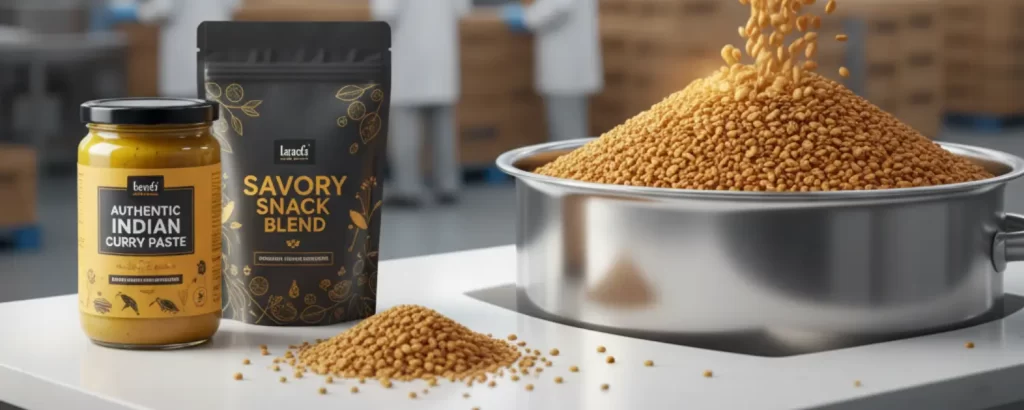
In the vast and competitive world of food manufacturing, every ingredient choice is strategic. When it comes to achieving authentic flavour profiles, consistent quality, and versatile application, one spice consistently stands out for global food manufacturers: Indian Fenugreek. Known locally as methi dana, fenugreek from India is a cornerstone ingredient in cuisines from the Indian subcontinent to the Middle East and North Africa. Its unique aromatic and slightly bitter profile makes it indispensable. As a leading fenugreek export specialist from Pune, Maharashtra, Exim Internationals understands the critical factors that make Indian fenugreek the preferred choice for food manufacturers worldwide. 1. Unmatched Flavour and Aromatic Profile The distinct flavour of Indian fenugreek is its primary draw. Authentic Bitterness: Indian fenugreek offers a characteristic warm, slightly bitter, and subtly sweet flavour that provides depth and complexity. This unique profile is crucial for authentic taste in curries, spice blends, chutneys, and savory processed foods. Aromatic Depth: When lightly roasted, fenugreek seeds develop a highly fragrant, nutty aroma that enhances the overall sensory experience of a dish. This aroma is particularly potent in Indian varieties. 2. Consistent Quality and Reliable Sourcing For food manufacturers, consistency in raw materials is paramount to ensure uniform product quality and brand reputation. Standardized Purity: Reputable Indian fenugreek export partners ensure meticulous cleaning and sorting, guaranteeing high purity levels (often 99% or 99.5% clean) that meet stringent international food safety standards. This means minimal foreign matter and a clean product ready for processing. Moisture Control: Fenugreek seeds are dried to optimal moisture levels, typically below 10%, to prevent mould growth and ensure extended shelf life, crucial for bulk storage and long-distance shipping. Traceability: A transparent supply chain, from the farms in Rajasthan (India’s largest fenugreek producer) to the export facility, provides assurance of origin and adherence to quality protocols. 3. Versatility in Diverse Food Applications The adaptability of Indian fenugreek makes it a highly valued ingredient across a wide spectrum of manufactured food products. Spice Blends: It’s a foundational component in numerous spice blends, including curries, garam masalas, and various Middle Eastern mixes. Pickles & Chutneys: Its distinct flavour and preservative properties make it ideal for fermented and pickled products. Baked Goods: Ground fenugreek is used in some specialty breads and crackers for a unique flavour. Processed Foods: Extracts and powders are used in flavourings for snacks, ready meals, and savory sauces, adding depth and a subtle bitter note. Import products for your Needs Ready to Import 4. Strategic Sourcing from the World’s Fenugreek Hub Sourcing directly from India, the world’s leading producer of fenugreek, offers significant strategic advantages. Abundant Supply: India’s large-scale cultivation, particularly in states like Rajasthan, ensures consistent and abundant supply to meet global demand for bulk fenugreek seeds. Competitive Pricing: Direct sourcing from the origin, through an efficient supply chain, allows for competitive pricing, which is crucial for manufacturing cost control. Expert Logistics: Leveraging established export infrastructure, including efficient processing units and shipping routes, ensures timely and reliable delivery worldwide. This is especially relevant now, as manufacturers plan for the upcoming 2026 Rabi crop harvest (Feb-March 2026). Indian Fenugreek – The Manufacturer’s Choice For global food manufacturers striving for product authenticity, consistent quality, and versatile application, Indian fenugreek stands as an indispensable ingredient. Its unique flavour, reliable quality, and the strategic advantages of sourcing from India cement its position as a cornerstone of the global food industry.   Is your brand committed to delivering authentic, high-quality flavours? Partner with Exim Internationals, your trusted fenugreek export specialist. Contact us today to secure your supply of premium Indian methi dana for your manufacturing needs, especially as we plan for the upcoming 2026 harvest. Frequently Asked Questions (FAQs) 1. What is the flavour profile of Indian fenugreek, and how is it used by food manufacturers? Indian fenugreek has a warm, slightly bitter, and subtly sweet flavour with a distinctive aroma. Food manufacturers use it in spice blends, curries, pickles, chutneys, processed foods, and as a flavouring agent in various savory products. 2. What is “methi dana”? “Methi dana” is the common Hindi name for fenugreek seeds in India. 3. What quality specifications are important for fenugreek export for food manufacturers? Key specifications include purity (e.g., 99% or 99.5% clean), moisture content (typically below 10%), absence of foreign matter, seed size uniformity, and colour. Reputable exporters also ensure proper packaging to maintain quality during transit. 4. Which region in India is most known for fenugreek production? Rajasthan is the largest and most significant fenugreek-producing state in India, known for its high-quality seeds. 5. How does a reliable fenugreek export partner ensure consistent quality for food manufacturers? They ensure consistent quality through direct sourcing from reputable farms, stringent cleaning and sorting processes, optimal moisture control, adherence to international food safety standards, and transparent documentation like a Phytosanitary Certificate and Certificate of Analysis (COA). 6. When is the harvest season for fenugreek in India? Fenugreek is a Rabi crop in India, sown in October-November and harvested from February to March. This period is critical for market forecasting and securing contracts. 7. Can fenugreek from India be sourced for both culinary and nutraceutical applications? Yes, Indian fenugreek is highly valued for both. While this article focuses on food manufacturing, its high concentration of beneficial compounds also makes it a prime ingredient for the nutraceutical industry, though specific quality and testing requirements may differ. 8. What strategic advantage does Exim Internationals offer as an Indian fenugreek export partner? Exim Internationals provides direct access to primary sourcing regions like Rajasthan, offers real-time market insights for the upcoming 2026 Rabi crop, ensures rigorous quality control, manages efficient logistics, and can help secure consistent supply of specific grades for your manufacturing needs.

Why Global Food Manufacturers Rely on the Indian Fenugreek Export Read Post »

Scroll to Top
exim international logo

Get Our Products Pricing

Fill out the form to download!