Fruits

cardamom powder
Export Import Fruits Spices Vegetables

Capturing the Aroma: How We Preserve Volatile Oils in Cardamom Powder Exports

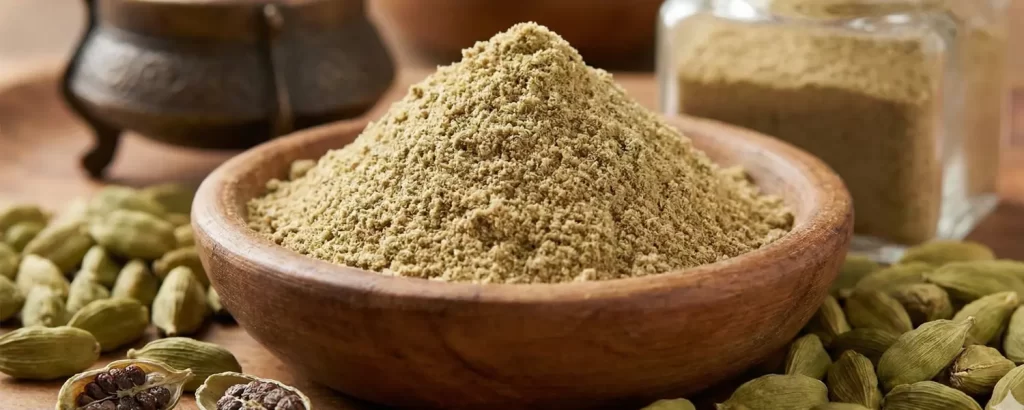
For the global food industry, cardamom powder is prized for one thing above all else: its intense, complex aroma. Whether it’s the heart of a masala chai blend, the signature note in a Scandinavian pastry, or the secret ingredient in a craft gin, that distinct sweet-spicy scent is the product’s value.   However, capturing that aroma in a powder is a scientific challenge. The magic of cardamom lies in its volatile oils (primarily terpinyl acetate and cineole). As the name suggests, these oils are “volatile”—they evaporate rapidly when exposed to heat or air. As a leading exporter based in Pune, India, we don’t just grind spice; we preserve essence. With the fresh 2026 harvest now arriving, here is an inside look at the meticulous process we use to capture and protect the volatile oils in our premium cardamom powder. 1. Sourcing the “New Crop” for Peak Potency Great powder starts with great pods. We time our primary processing to align with the Indian harvest season (typically late year to early next year). By grinding fresh “new crop” green cardamom, we start with raw material that has the highest possible natural oil content (often exceeding 8-9% in seeds). Grinding old, dry stock is the first mistake of a low-quality supplier. 2. The Science of Cold Grinding (Cryogenic Milling) Traditional high-speed grinding generates significant friction heat. This heat can literally “cook off” the delicate volatile oils before the powder even leaves the factory, resulting in a flat, flavorless product. To prevent this, we utilize Cold Grinding (or Cool Grinding) technology. The Process: The grinding chamber is kept cool, often using chilled air or liquid nitrogen. The Result: The temperature of the spice never rises to a level that would degrade the oils. This preserves the full spectrum of top notes—the citrusy, floral, and eucalyptus hints that define premium green cardamom powder. 3. Immediate High-Barrier Packaging Once ground, cardamom powder has a massively increased surface area compared to whole pods. This makes it incredibly vulnerable to oxidation (exposure to air), which destroys flavor. Speed is critical. Immediately after grinding and sieving to the correct mesh size, the powder is packed. We don’t use standard poly bags. We use High-Barrier Laminated Packaging (often with an aluminum layer) that is impermeable to: Oxygen: Stopping oxidation in its tracks. Moisture: Preventing clumping and mold. Light: Protecting the vibrant green-brown colour. Import products for your Needs Ready to Import 4. Steam Sterilization: Safety Without Compromise For our clients in the EU and USA, food safety is non-negotiable. But chemical sterilization (like ETO) is a no-go. We use Steam Sterilization. This natural process effectively reduces the microbial load to safe levels while being gentle enough to retain the essential volatile oils that chemical treatments can strip away. Delivering the True Essence of India When you open a bag of our cardamom powder, you shouldn’t just smell “spice”; you should smell the green hills of Kerala. That experience is not an accident; it is the result of a rigorous, science-based process designed to trap the volatile oils at their peak. For food manufacturers and blenders who refuse to compromise on flavor, the choice of supplier is clear. You need a partner who understands that they are guardians of an aroma.   Ready to experience the difference of high-volatile oil cardamom? Contact Exim Internationals today to request a sample of our freshly ground new-crop powder. Frequently Asked Questions (FAQs) 1. Why does some cardamom powder lose its smell so quickly? This usually happens because the volatile oils were lost during processing due to high heat (traditional grinding) or because the powder was stored in poor-quality packaging that allowed air to enter (oxidation). 2. What is “volatile oil content” in cardamom powder? It is the percentage of essential oils remaining in the powder. These oils contain the flavor and aroma compounds. A higher percentage (e.g., >3-4% in powder) means a much more potent and aromatic product. 3. How does “cold grinding” improve quality? Cold grinding keeps the temperature low during the milling process. This prevents the heat-sensitive volatile oils from evaporating, ensuring the powder retains the full flavor profile of the whole pod. 4. What is the best mesh size for cardamom powder in tea blends? For tea bags, a finer mesh (like 60 mesh) is often preferred for quick infusion. For loose-leaf blends, a slightly coarser “tea cut” or granular powder (20-40 mesh) might be better for visual appeal and filtration. We can customize this for you. 5. Is your cardamom powder free from adulteration? Absolutely. We guarantee 100% pure green cardamom powder. We do not use fillers like cardamom husks, rice flour, or artificial colours. Every batch is verifiable with a Certificate of Analysis (COA). 6. What is the shelf life of your bulk cardamom powder? Thanks to our high-barrier packaging and low moisture content processing, our powder has a shelf life of 18-24 months when stored in a cool, dry place. 7. Can you supply steam-sterilized powder for the European market? Yes. We specialize in providing steam-sterilized, ETO-free cardamom powder that meets the strict microbial and chemical residue standards of the EU and US markets. 8. How do I get a sample of the new harvest powder? Simply contact us with your company details and your specific application (e.g., bakery, beverage). We will send you a sample of our latest production so you can test the aroma and potency yourself About us Exim Internationals is a premier export company dedicated to delivering the finest products from India to international markets. Our mission is to establish India as a global export powerhouse, contributing to economic growth and showcasing the richness of Indian goods worldwide. From the pashmina shawls and apples of the North to the spices of the South, the fruits and powders of the West, and the tea and bamboo of the East, we connect every corner of India with the global market. Certification we have: FSSAI, APEDA, IEC, UDYAM, FIEO, Spices Board, Coconut Contact us Samin heritage,

Capturing the Aroma: How We Preserve Volatile Oils in Cardamom Powder Exports Read Post »
export quality coconut sugar
Export Import Fruits Spices Vegetables

Shelf Life and Storage: Maintaining the Value of Export Quality Coconut Sugar

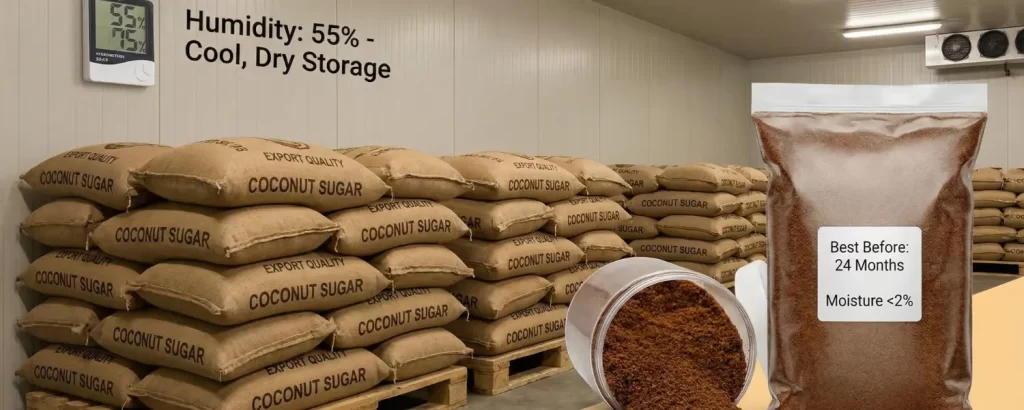
For international importers, private label brands, and food manufacturers, buying export quality coconut sugar is an investment. You are paying for a premium, unrefined natural sweetener with a specific texture, flavor profile, and nutrient content. Protecting that investment requires understanding the science of storage.   Unlike highly refined white sugar, which is stripped of nutrients and essentially inert, natural coconut sugar is a “living” product. It retains natural moisture, minerals, and amino acids. This makes it more sensitive to its environment but also far more valuable. As a specialist exporter from India, Exim Internationals ensures that every batch leaves our facility in peak condition. This guide explains how we maintain that quality during transit and how you can preserve it in your warehouse to ensure maximum shelf life and profitability. 1. The Golden Rule: Moisture Content < 2% The single biggest enemy of coconut sugar is moisture. Coconut sugar is hygroscopic, meaning it naturally attracts and holds water molecules from the surrounding air. The Risk: If the moisture content rises above 2-3%, the sugar granules will begin to stick together. This leads to clumping, hardening into “bricks,” and eventually, fermentation or mold growth. Our Export Standard: We process our export quality coconut sugar to a strict moisture content of less than 2%. This low baseline is critical. It ensures the product remains free-flowing and granular, even during the temperature fluctuations of international shipping. 2. Expected Shelf Life: What Buyers Can Count On When stored correctly, premium coconut sugar is a highly stable product. Unopened Bulk Packs: In our standard 25kg export bags, stored in a cool, dry warehouse, you can expect a shelf life of 18 to 24 months from the date of manufacture. Retail Packs: Once repacked into retail pouches (e.g., 500g stand-up pouches with zippers), the product maintains its quality for the same 24-month period, provided the seal is airtight. Note: While the product remains safe to consume beyond this period, the flavor profile may slowly change, losing some of its distinct caramel notes. Import products for your Needs Ready to Import 3. Export Packaging: The First Line of Defense Maintaining shelf life starts with the right packaging. We do not use standard woven sacks for coconut sugar; they are too porous. For bulk exports, we use a specialized Triple-Layer System: Inner Liner: A high-density polyethylene (HDPE) liner that acts as a primary moisture barrier. Barrier Layer: Often an aluminum or metallized layer to reflect heat and block UV light, which can degrade nutrients. Outer Shell: A tough Kraft paper or woven polypropylene sack for physical protection during handling. 4. Warehouse Best Practices for Importers Once the shipment arrives at your facility (whether in the UAE, Europe, or the US), maintaining the “Export Quality” status is in your hands. Temperature Control: Store in a cool environment, ideally between 20°C to 25°C (68°F – 77°F). Avoid areas near ovens, heaters, or direct sunlight. Humidity Control: This is critical. Keep relative humidity (RH) in your storage area below 60%. If you are in a humid climate (like tropical regions or coastal cities), climate-controlled warehousing is highly recommended to prevent clumping. Pallet Management: Always store bags on pallets, off the floor and away from walls, to prevent condensation transfer and allow for airflow. 5. Troubleshooting: Why Clumping Happens If you notice clumping in your inventory, it is almost always a sign of moisture ingress. Soft Clumps: Usually harmless and can be broken up easily. This suggests a minor humidity fluctuation. Hard Bricks: Indicates significant moisture absorption. The product may still be safe but is difficult to use and repackage. The Solution: Prevention is the only cure. Ensure your supplier provides a Certificate of Analysis (COA) verifying the initial low moisture content (<2%) before it ships. Import products for your Needs Ready to Import Quality Preservation is a Partnership Maintaining the value of export quality coconut sugar is a partnership. We guarantee the specs at the source—low moisture, perfect granulation, and barrier packing—and you maintain the environment at the destination. Together, we ensure the end consumer receives the premium, free-flowing natural sweetener they expect.   Looking for a supplier who understands the science of shelf life? Contact Exim Internationals today to discuss your bulk coconut sugar requirements. Frequently Asked Questions (FAQs) 1. What is the ideal moisture content for export quality coconut sugar? For export, the industry standard for premium quality is a moisture content of less than 2%. This ensures the sugar remains free-flowing and does not clump during transit or storage. 2. Does coconut sugar expire? Like honey or maple syrup, coconut sugar is very stable and doesn’t “spoil” quickly. However, it has a “Best Before” date of typically 24 months. After this, it may lose flavor intensity or texture but is usually still safe to consume. 3. How do you prevent “container rain” (condensation) during shipping? For sea freight shipments crossing different climate zones, we use desiccants (moisture-absorbing packs) inside the container and ensure high-quality, moisture-proof packaging liners to protect the cargo from condensation. 4. Can I store bulk coconut sugar in a standard warehouse? Yes, provided the warehouse is cool, dry, and pest-free. If your warehouse is in a high-humidity area, you must take extra precautions to keep the humidity levels below 60%. 5. Why is your coconut sugar darker/lighter than the last batch? Natural variation is a hallmark of an unrefined product. The color depends on the coconut species, the harvest season, and the caramelization temperature during processing. However, “Export Quality” ensures that within a single batch, the color is uniform. 6. Is clumping a sign of bad quality? Not necessarily. Minor clumping is natural for unrefined sugars without anti-caking agents. However, severe hardening indicates that the product was exposed to high moisture, either during production or improper storage. 7. Do you offer vacuum packing for bulk orders? Yes, for clients in extremely humid regions or those requiring extended storage, we can offer vacuum-sealed bulk bags upon request to provide maximum protection. 8. What packaging do

Shelf Life and Storage: Maintaining the Value of Export Quality Coconut Sugar Read Post »

turmeric for medical uses
Export Import Fruits Spices Vegetables

Sourcing Turmeric for Medical Uses: Why High-Curcumin Lakadong is the Pharma Choice

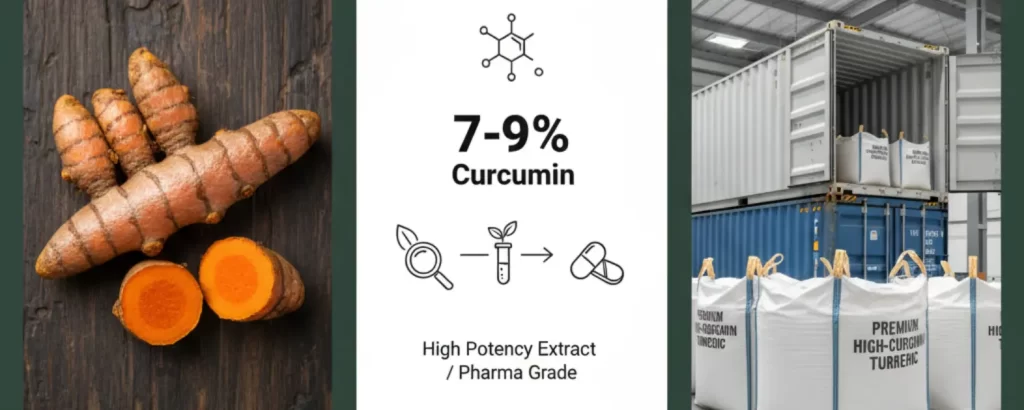
The global shift towards natural medicine has transformed turmeric from a kitchen staple into a pharmaceutical powerhouse. However, for procurement managers in the pharmaceutical and nutraceutical industries, not all yellow powder is created equal. When sourcing turmeric for medical uses, the critical metric is not color or flavor—it is Curcuminoid potency.   While standard culinary turmeric hovers around 2-3% curcumin content, the medical sector demands significantly higher efficacy. This demand has turned the spotlight onto a specific, potent variety from India: Lakadong Turmeric.   Here is why global pharma brands are switching their supply chains to high-curcumin Indian varieties and what you need to know before placing your next bulk order. The Science of Potency: It’s All About the Curcuminoids To understand sourcing turmeric for medical uses, one must look at the molecular level. The anti-inflammatory and antioxidant properties attributed to turmeric come from a group of compounds called Curcuminoids (primarily Curcumin, Demethoxycurcumin, and Bisdemethoxycurcumin). For a pharmaceutical extraction company, yield is everything. Standard Turmeric (Salem/Erode): 2% to 3% Curcumin. Medical Grade Target: 5% Curcumin and above. Sourcing low-potency turmeric for medical extraction is economically inefficient. It requires processing nearly triple the volume of raw material to achieve the same yield of active compound compared to premium varieties. Why Lakadong is the “Gold Standard” for Medicine Grown in the pristine, hilly terrain of the Jaintia Hills in Meghalaya, India, Lakadong turmeric is often regarded as the world’s finest variety for medicinal applications. 1. Superior Curcumin Content Lakadong turmeric consistently tests with a curcumin content between 7% and 9%, with some harvests reaching as high as 12%. This is significantly higher than the global average. For supplement manufacturers creating high-potency curcumin capsules, Lakadong offers the highest natural concentration available. 2. Low Heavy Metal Profile Because it is grown in a region that largely practices traditional, organic farming methods, Lakadong turmeric typically carries a much lower risk of heavy metal contamination (Lead, Arsenic, Cadmium)—a critical safety parameter for turmeric for medical uses. 3. High Oleoresin Yield Beyond the powder, Lakadong is preferred for oleoresin extraction (used in soft gels and liquid formulations) due to its rich volatile oil profile. Import products for your Needs Ready to Import Critical Quality Specs for Medical Buyers When issuing a Request for Quote (RFQ) for medical-grade turmeric, your specification sheet must go beyond basic hygiene. Here are the parameters Exim Internationals prioritizes: Heavy Metal Analysis The pharmaceutical industry has zero tolerance for toxicity. Ensure your supplier provides a Certificate of Analysis (COA) verifying that lead and mercury levels are well below international safety limits (often <1ppm). Microbial Load & Sterilization Raw turmeric acts as a root in the soil, making it susceptible to microbial activity. For medical applications, Steam Sterilization is the preferred method over ETO (Ethylene Oxide) treatment. Steam sterilization ensures the product is safe for direct consumption in capsules without leaving chemical residues that could interact with other pharmaceutical ingredients. Mesh Size and Solubility Depending on your final application (tablet, capsule, or liquid extract), the mesh size of the powder matters. A finer mesh (60-80 mesh) allows for better solubility and extraction efficiency. The Logistics of Potency: Protecting the Cargo High-curcumin turmeric is sensitive. The active compounds can degrade if exposed to excessive heat, light, or moisture during transit. When exporting turmeric for medical uses, we utilize: High-Barrier Packaging: Multi-layer aluminum liners or vacuum packing to prevent oxidation. Desiccants: To control moisture within the container and prevent aflatoxin growth. Temperature Monitoring: Ensuring the cargo doesn’t suffer “heat shock” during ocean freight. Verify Before You Buy The market for turmeric for medical uses is flooded with adulterated products reinforced with synthetic curcumin or dyes like Metanil Yellow. The only way to secure your supply chain is through rigorous testing and transparent sourcing.   At Exim Internationals, we specialize in sourcing high-curcumin varieties like Lakadong and Alleppey Finger Turmeric specifically for the medical and extraction industries. We provide full traceability and third-party lab reports with every shipment. Ready to upgrade your raw material quality? Contact Exim Internationals today for a quote on high-curcumin, medical-grade turmeric. Frequently Asked Questions (FAQs) 1. What is the minimum curcumin content required for medical-grade turmeric? While there is no single global standard, the pharmaceutical industry typically demands turmeric with a curcumin content of 5% or higher. Varieties like Lakadong (7-9%) are preferred for their superior extraction efficiency. 2. Why is Lakadong turmeric better than regular turmeric for supplements? Lakadong turmeric naturally contains 3x to 4x more curcumin than standard culinary turmeric. This means a consumer (or a capsule) gets a much higher dose of the active anti-inflammatory compound per gram. 3. Can you export organic turmeric for medical uses? Yes. We can source certified organic high-curcumin turmeric. Organic certification is increasingly important in the medical sector to ensure the absence of pesticide residues. 4. How do you ensure the turmeric doesn’t contain heavy metals? We conduct rigorous testing via accredited third-party laboratories. Every batch destined for medical use is tested for Lead, Arsenic, Cadmium, and Mercury to ensure it meets USP (United States Pharmacopeia) and EU standards. 5. What is the difference between “Steam Sterilized” and “ETO Treated” turmeric? Steam sterilization uses heat and water to kill bacteria, which is a natural and safe process. ETO (Ethylene Oxide) is a chemical treatment. For turmeric for medical uses, steam sterilization is preferred as it leaves no chemical residue. 6. Do you provide a Certificate of Analysis (COA)? Absolutely. We never ship medical-grade products without a COA that verifies curcumin percentage, moisture content, ash content, and microbial analysis. 7. Is Alleppey Turmeric also good for medical use? Yes. Alleppey Finger Turmeric (from Kerala) is another high-quality variety, typically ranging from 5-6.5% curcumin. It is an excellent alternative if Lakadong volumes are limited. 8. How does mesh size affect turmeric for medical extraction? A consistent mesh size ensures uniform extraction. If the powder is too coarse, solvent extraction is inefficient. If it’s too fine, it may clump. We can customize the grind size

Sourcing Turmeric for Medical Uses: Why High-Curcumin Lakadong is the Pharma Choice Read Post »

Kashmiri Red Chilli
Vegetables Export Import Fruits Spices

The Colour Advantage: Why Global Food Manufacturers Demand Kashmiri Red Chilli

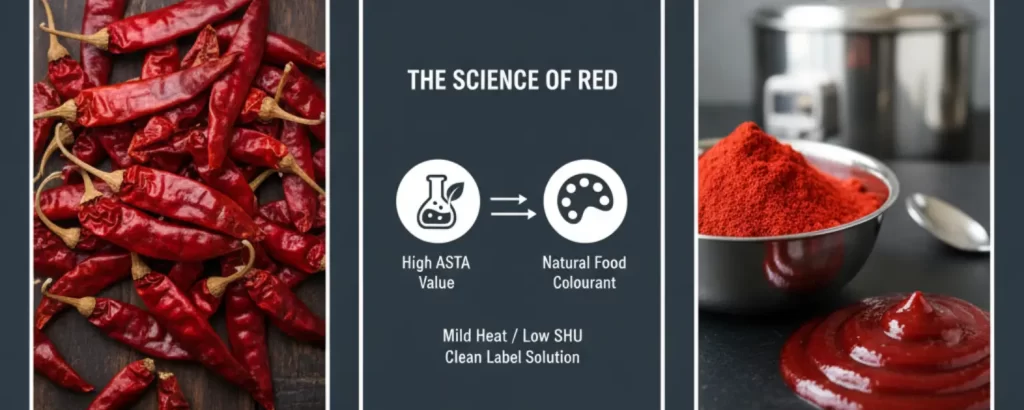
In the competitive world of food manufacturing, the old adage holds true: “We eat with our eyes first.” The visual appeal of a curry paste, a barbecue marinade, or a spice blend is often the deciding factor for a consumer standing in a supermarket aisle. For global food brands, achieving that perfect, deep, appetite-inducing red without resorting to artificial additives is a critical challenge. The solution lies in one of India’s most prized agricultural exports: the Kashmiri Red Chilli.   While standard chillies are sourced for heat, the Kashmiri Red Chilli is sourced for its “Colour Advantage.” As a specialist exporter based in Pune, India, we understand why this specific variety commands a premium and why it is an indispensable ingredient for quality-conscious food processors. 1. High ASTA Value: The Science of Deep Red The primary commercial value of Kashmiri chilli lies in its pigmentation. In the spice trade, colour is measured by ASTA colour value (American Spice Trade Association). The Metric: Standard commercial chillies might have an ASTA value of 60-80. Premium Kashmiri Red Chilli typically boasts an ASTA value of 100-160. The Result: This high extractable colour means that food manufacturers can use a smaller quantity of the spice to achieve a rich, vibrant crimson hue in their final product. It provides a natural, stable red that artificial dyes struggle to replicate. 2. Mild Heat for Mass Market Appeal Global palates are changing, but not everyone wants extreme heat. A major challenge for food formulators is adding colour without making the product too spicy for the average consumer. Low Pungency: Unlike the fiery Guntur chilli (which ranges from 40,000 to 90,000 SHU), Kashmiri Red Chilli is remarkably mild, typically ranging between 1,000 to 2,000 SHU (Scoville Heat Units). The Benefit: This allows chefs and food technologists to be generous with the chilli powder to maximize colour and flavour depth, without blowing out the heat tolerance of the dish. It is the perfect “family-friendly” spice. 3. The “Clean Label” Solution Modern consumers are scrutiny-obsessed. They are moving away from artificial food colourings (like Red 40) and looking for “clean labels” with recognizable, natural ingredients. Kashmiri Red Chilli acts as a dual-purpose ingredient: it is both a flavour enhancer and a natural food colourant. By listing it on the label, manufacturers can claim “No Artificial Colours” while still delivering a visually stunning product. This is a massive advantage in the European and North American markets. Import products for your Needs Ready to Import 4. Authenticity: The Sourcing Challenge The high demand for Kashmiri chilli has led to a market flooded with substitutes, often the similar-looking but different Byadgi chilli. While Byadgi is excellent, true Kashmiri chilli has a specific broad shape and a distinct, fruity aroma. As we approach the 2026 procurement season (with harvest preparations beginning in late 2025), ensuring authenticity is paramount. Our Approach: At Exim Internationals, we source directly from established grower networks. We verify authenticity not just by visual inspection (the broad, wrinkled skin), but by lab-testing for the specific capsaicin and capsanthin profile that defines the true Kashmiri variety. Elevate Your Product with the Right Red For a food manufacturer, Kashmiri Red Chilli is an investment in brand perception. It turns a brown curry red; it makes a tandoori marinade pop; it gives hot sauce a vibrant glow—all while adding a mild, aromatic flavour that consumers love. Don’t compromise on the visual appeal of your products.   Ready to secure authentic, high-ASTA Kashmiri Red Chilli for your 2026 production? Contact Exim Internationals today for a sample and a detailed quote. Frequently Asked Questions (FAQs) 1. What is the main difference between Kashmiri Chilli and regular chilli powder? The main difference is the balance of colour and heat. Regular chilli powder is usually hot and pungent with a lighter orange-red colour. Kashmiri Red Chilli powder is very mild in heat but provides a vibrant, deep crimson colour. 2. What is a good ASTA colour value for Kashmiri Red Chilli? For export-quality Kashmiri chilli, you should look for an ASTA colour value between 100 and 160. The higher the number, the deeper and more intense the red colour. 3. Is Kashmiri Red Chilli the same as Byadgi Chilli? No, though they are often confused. Byadgi (from Karnataka) is also high-colour and mild, but it is long and heavily wrinkled. True Kashmiri chilli is broader, shorter, and has a distinct fruity aroma. Both are premium, but they are distinct varieties. 4. Can Kashmiri Chilli be used as a natural food colouring? Yes, absolutely. Because of its high pigment content and low heat, it is widely used by food manufacturers as a natural alternative to artificial red dyes in sauces, soups, and meats. 5. How do you pack Kashmiri Red Chilli for export? We pack it in new, clean jute or PP bags (typically 25kg) or in cartons. For the stemless variety, we ensure meticulous sorting to remove all stalks. We can also provide vacuum packing to preserve the colour and ASTA value during transit. 6. What forms of Kashmiri Chilli do you export? We export Whole Dried Kashmiri Chilli (both with stem and stemless) and Kashmiri Chilli Powder. We can grind to your specific mesh size requirements. 7. Do you provide a Certificate of Analysis (COA)? Yes. Every shipment is accompanied by a COA from an accredited lab, verifying the SHU (heat), ASTA (colour), moisture content, and confirming the product is free from Sudan dyes and aflatoxins. 8. What is the minimum order quantity (MOQ) for Kashmiri Chilli? For sea freight, the standard MOQ is a 20-foot container (approx. 6-7 MT for whole chilli, or 14-15 MT for powder). We can discuss smaller trial orders via LCL or air freight depending on your needs. About us Exim Internationals is a premier export company dedicated to delivering the finest products from India to international markets. Our mission is to establish India as a global export powerhouse, contributing to economic growth and showcasing the richness of Indian goods worldwide.

The Colour Advantage: Why Global Food Manufacturers Demand Kashmiri Red Chilli Read Post »

semi husked coconuts
Export Import Fruits Spices Vegetables

Why Semi-Husked is King: A Coconut Supplier’s Guide to Profitability for the UAE Market

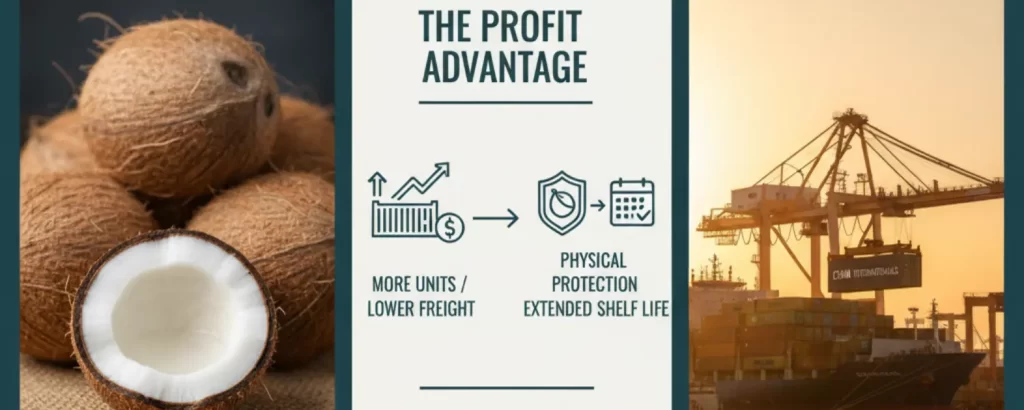
For any international importer, profitability is the end goal. In the fresh produce trade, your profit margin is not just made at the point of sale; it’s secured in your sourcing decisions. When it comes to importing coconuts, the most critical decision you’ll make is choosing the form of the product. You have two main choices: the traditional fully-husked nut (the hard brown shell only) or the Semi-Husked Coconut. As a specialist coconut exporter from India, we’ve seen the most successful importers in the UAE and globally make a clear choice. The semi-husked format is not just a preference; it is a strategic business decision that directly boosts your profitability. This guide is your profitability analysis, breaking down exactly why semi-husked is the gold standard for quality coconuts in the export market. 1. The Freight Analysis: Lower Cost Per Unit The single biggest drain on your profit margin is freight. The heavy, fibrous outer husk of a coconut is mostly weight and volume that has no retail value. The Problem: You pay for shipping by the container. A container filled with heavier, bulkier, fully-husked nuts holds fewer sellable units. The Semi-Husked Solution: The semi-husking process skillfully removes 25-30% of the coconut’s total weight. This optimization is a game-changer for logistics. A 40ft Container of Fully-Husked Coconuts ≈ 20,000 units A 40ft Container of Semi-Husked Coconuts ≈ 25,000 units By fitting 5,000 more units into the exact same container, you have drastically lowered your “landed cost per nut.” That saving is pure, direct profit. 2. The Risk Analysis: Superior Protection & Shelf Life The second threat to your profit is spoilage. A container of fresh coconuts can spend 7-10 days at sea even on a fast route like India to Jebel Ali. The Problem: Fully-husked coconuts, with their shells fully exposed, are brittle. During loading, transit, and unloading, they can easily knock against each other, causing hairline cracks. These tiny, invisible cracks are the #1 entry point for mould and bacteria, leading to spoiled, unsellable inventory. The Semi-Husked Solution: The remaining husk on a semi-husked nut is not just for show; it is a natural shock absorber. This protective fibrous layer cushions the coconut, dramatically reducing the risk of impact damage and cracking. A coconut that arrives intact is a coconut that stays fresh. This expert preparation is a key component of quality coconuts and directly translates to a lower spoilage rate and a longer, more stable shelf life in your warehouse. Import products for your Needs Ready to Import 3. The Quality Analysis: Sourcing from the Best Profitability also depends on the desirability of your product. A smart importer sources a product that their customers (retailers, HORECA sector) will love. The Problem: Sourcing “generic” coconuts can result in inconsistent quality, small nuts, or thin, undesirable flesh. The Semi-Husked Solution: A professional exporter sources from prime growing regions. As a Pune-based company, we are strategically located to source premium coconuts from India’s “Coconut Capital,” Pollachi. The Pollachi Advantage: These nuts are globally renowned for their sweet water and thick, fleshy kernels. The “Export Quality” Standard: The semi-husking process is, in itself, a form of quality control. It’s a value-added step where the nut is individually handled and assessed, ensuring that only the best-looking, mature, and undamaged coconuts are packed for your order. The Most Profitable Choice The verdict is clear. The semi-husked format is not just a different product; it is the correct product for any serious importer. It is a superior logistical solution that lowers your freight costs and a superior quality-assurance method that reduces your spoilage. As you plan your procurement for 2026, choosing Semi-Husked Coconuts is the first and most important step to a more profitable year.   Ready to maximize your profitability? Contact Exim Internationals today for a detailed quote on a 40ft container of premium, Pollachi-sourced Semi-Husked Coconuts delivered to your port. Frequently Asked Questions (FAQs) 1. How many Semi-Husked Coconuts fit in a 40ft container? A 40ft reefer (refrigerated) container typically holds approximately 25,000 coconuts, packed in 25-nut PP bags. 2. What is the average weight of a single semi-husked coconut? We grade our quality coconuts for export to be between 500 grams and 650 grams per nut. 3. What is the shelf life of semi-husked coconuts when they arrive? With proper packing and transport, our coconuts have an excellent shelf life. When stored in a cool, dry place, they can last for over 60 days after arriving at your port. 4. Why source coconuts from Pollachi, India? The Pollachi region in Tamil Nadu is world-famous for its coconut groves. The coconuts from this region are prized for having sweeter water and thicker, meatier flesh than most other varieties. 5. How does the semi-husked form prevent cracking? The remaining fibrous husk acts as a natural, built-in cushion or “shock absorber” that protects the brittle inner shell from impacts during handling and sea transit. 6. What is the transit time from India to the UAE? The India-to-UAE trade route is one of the most efficient. Sea transit from Nhava Sheva Port (near us in Pune) to Jebel Ali Port (Dubai) is typically only 7 to 10 days. 7. What is a Phytosanitary Certificate? This is a mandatory document for all fresh produce exports. It is issued by the Indian agricultural authorities to certify that the coconuts have been inspected and are free from pests and plant diseases, as required by UAE customs. 8. How do I start the ordering process for a 2026 supply? Simply contact us with your company details, your required quantity (e.g., 1 x 40′ container per month), and your destination port. Our team will provide a detailed quote and guide you through the simple contracting process for the upcoming year. About us Exim Internationals is a premier export company dedicated to delivering the finest products from India to international markets. Our mission is to establish India as a global export powerhouse, contributing to economic growth and showcasing the richness of Indian

Why Semi-Husked is King: A Coconut Supplier’s Guide to Profitability for the UAE Market Read Post »

cucumber lemon water
Export Import Fruits Spices Vegetables

How the “Infused Water” Trend is Driving Bulk Exports of Lemons

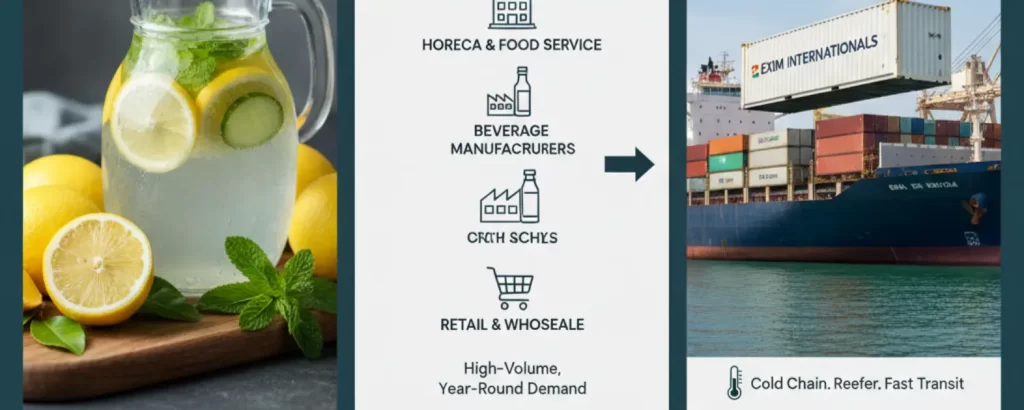
Walk into any high-end hotel lobby, modern spa, or trendy café, and you’re guaranteed to see them: elegant glass dispensers filled with water, ice, and slices of fresh fruit. “Infused water”—especially the classic cucumber lemon water—has become a global symbol of health, hydration, and hospitality. For most people, this is a simple wellness trend. But for savvy importers, HORECA suppliers, and beverage companies, this trend represents something far more significant: a massive and rapidly growing commercial opportunity. This consumer-driven demand has created a new, year-round engine for the bulk export of lemons. As a leading Indian exporter of fresh produce, we at Exim Internationals are on the front lines of this market shift. Here’s how this trend translates into a B2B goldmine. The Commercial Markets Cashing In on the Trend The demand for “infused water” has created three distinct B2B markets, all of which require a reliable, large-volume supply of fresh lemons. The HORECA Sector (Hotels, Restaurants, Catering) This is the most visible market. For a hotel, offering complimentary infused water is no longer an amenity; it’s an expectation. This sector requires a consistent, year-round supply of visually perfect, fresh lemons to keep their dispensers full. They are not buying a few kilos; they are contracting for pallets and container loads to service their entire chain. The RTD (Ready-to-Drink) Beverage Manufacturers Why make it when you can buy it? The “functional beverage” aisle in supermarkets is exploding. Companies are bottling and selling “detox waters,” “wellness shots,” and “natural lemon-infused beverages.” These manufacturers require a massive, industrial-scale bulk export of lemons to use as a primary ingredient for juicing and flavoring. The Retail Supply Chain Finally, the trend inspires consumers to “do-it-yourself.” This drives a steady, reliable demand for fresh lemons at the supermarket. Retail importers and wholesalers must ensure their shelves are constantly stocked, and they rely on bulk shipments from exporters to meet that demand. Why Source from India? The Logistical Solution For a B2B buyer in the Middle East, Europe, or Southeast Asia, India is the strategic choice for sourcing lemons. Year-Round Availability: India’s diverse agro-climatic zones allow for multiple harvest cycles, enabling a skilled exporter to provide a nearly year-round supply. Proximity: For key markets like the UAE, the short sea transit time from India (7-10 days) is a massive advantage. It means a fresher product, a more responsive supply chain, and lower freight costs. Variety: We can supply the specific varieties you need, from the juicy, thin-skinned Kagzi lime (popular in the Middle East) to classic Eureka lemons. Import products for your Needs Ready to Import The Critical Hurdle: Sourcing a Perishable in Bulk This entire business opportunity hinges on one critical factor: logistics. Lemons are perishable. Sourcing them in bulk is not a matter of “if” they will spoil, but “how” you will prevent it. This is where your choice of exporter is everything. A professional bulk export of lemons is a masterpiece of logistics: The Cold Chain: The process starts immediately. Lemons are pre-cooled after harvest to remove field heat, stopping the ripening process in its tracks. Expert Packing: They are packed in ventilated cartons, often sorted by size, to allow air to circulate and prevent bruising. Reefer Containers: For large-volume sea freight, the lemons are shipped in reefer containers—refrigerated units that maintain a constant, optimal temperature (around 8-10°C) for the entire journey. Flawless Documentation: Every shipment is accompanied by a mandatory Phytosanitary Certificate to guarantee compliance with your country’s biosecurity laws, ensuring a smooth customs clearance. Turn a Trend into a Business The “infused water” trend is a clear signal of where the market is heading. Consumers want fresh, healthy, and natural products. This has opened a reliable, high-volume B2B channel for a classic commodity. As you plan your 2026 inventory, don’t just see a lemon. See the raw material for a global wellness boom. Ready to capitalize on this trend? Contact Exim Internationals today for a detailed quote on a bulk, cold-chain-managed shipment of fresh lemons to your port Frequently Asked Questions (FAQs) 1. What are the main B2B opportunities for the “infused water” trend? The three main opportunities are: 1) Supplying the HORECA sector (hotels, restaurants, cafes), 2) Supplying beverage manufacturers for bottled RTD (Ready-to-Drink) products, and 3) Supplying retail wholesalers for in-store supermarket sales. 2. What is a “cold chain” and why is it essential for the bulk export of lemons? A cold chain is an unbroken, temperature-controlled supply line. It’s essential for lemons to slow their respiration and ripening, prevent spoilage, and ensure they arrive fresh with a long shelf life after a multi-week sea journey. 3. What is a “reefer container”? A reefer container is a refrigerated shipping container. It allows us to set and maintain a precise temperature (e.g., 8-10°C) for the entire transit, which is non-negotiable for perishable goods like lemons. 4. What is the minimum order quantity (MOQ) for a bulk lemon shipment? To be cost-effective with sea freight, the standard MOQ is a 20-foot or 40-foot reefer container. A 40-foot container holds approximately 24-25 metric tons of lemons. 5. What is a Phytosanitary Certificate? This is a mandatory document issued by the Indian agricultural authorities. It certifies that the fresh lemons have been inspected and are free from pests and plant diseases, as required by your country’s customs. 6. What are the key quality specifications for a bulk export of lemons? Key specs include the grade (size/count per carton), juice content (%), Brix level (sweetness), and skin quality (firm, blemish-free). 7. How does India’s proximity help UAE importers? For importers in the UAE, sourcing from India means a sea transit time of only 7-10 days. This is significantly faster than sourcing from Europe or South America, resulting in a fresher product and a more responsive supply chain. 8. Can you supply cucumbers and other ingredients for infused water? Yes. As a full-service fresh produce exporter, we can create a consolidated shipment for you, including fresh lemons, cucumbers, ginger, and mint, to service the

How the “Infused Water” Trend is Driving Bulk Exports of Lemons Read Post »

ginger from india
Vegetables Export Import Fruits Spices

Price, Specs & MOQ: Your 2026 Guide to Sourcing Ginger from India

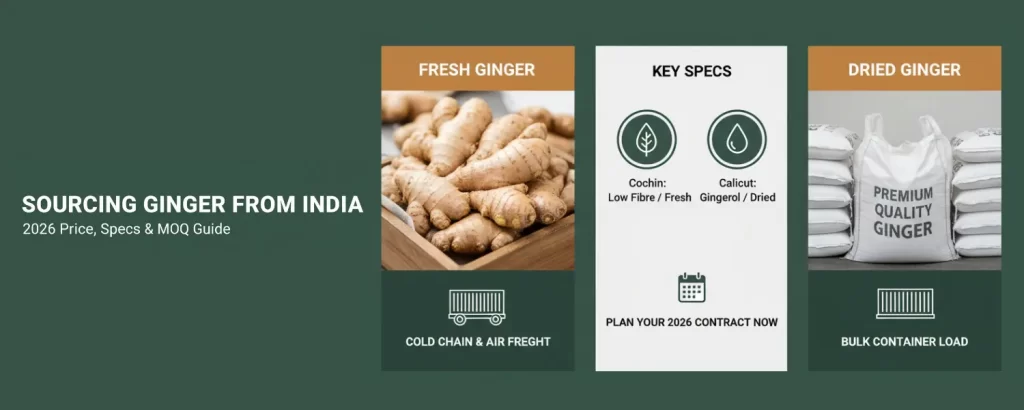
For international importers, spice blenders, and nutraceutical brands, sourcing high-quality Ginger from India is a cornerstone of a successful business. India is the world’s largest producer, offering a rich diversity of varieties, unmatched flavour, and scalable supply.   However, a successful import operation is built on a clear, strategic plan. As we are now in November 2025, the critical planning and contracting window for the upcoming 2026 harvest (Jan-Mar 2026) is wide open.   As a leading APEDA-certified exporter based in Pune, India, we’ve crafted this guide to demystify the three most critical components of your 2026 procurement: Price, Specifications, and MOQ. 1. Price: Decoding Your 2026 Landed Cost The “price” of ginger is not a single number. It’s a combination of the product’s cost (FOB), its form, and the freight. Market Price (FOB): The base price is dynamic and set by the upcoming harvest’s outlook. Based on a favorable 2025 monsoon and a healthy sowing season, we are forecasting a stable, healthy crop for 2026. However, strong global demand will keep prices firm. We strongly advise contracting now to hedge against potential price volatility as the harvest begins. Fresh vs. Dried Logistics: The product’s form is the biggest variable. Fresh Ginger: Requires a cold chain. This means it must be shipped in a refrigerated “reefer container” set at an optimal temperature (12-14°C) to prevent sprouting and spoilage. This is a more expensive, high-value supply chain. Dried Ginger: Is shelf-stable and ships in a standard dry container. This is a more cost-effective and common option for bulk shipments intended for grinding or extraction. 2. Specs: Sourcing the Right Ginger for Your Needs Not all Ginger from India is the same. The “spec” you need depends entirely on your end-use. A professional exporter will guide you to the right choice. Category A: Fresh Ginger Best For: Fresh retail in supermarkets, HORECA sector, and culinary use. Key Specs: Plump, firm rhizomes, low fibre, high moisture, and a zesty aroma. Go-To Variety: Cochin Ginger. This variety is globally renowned for its low fibre content, making it pleasant to eat fresh. Category B: Dried Ginger Best For: Spice blenders (powder), food manufacturers, and the high-value nutraceutical industry. Key Specs: A low, uniform moisture content (<12%) is essential. But the most important metric is gingerol content. The Gingerol Factor: Gingerol is the bioactive compound responsible for ginger’s pungency and health benefits. For health supplements, a high gingerol content (e.g., 2% or higher) is a non-negotiable specification. Go-To Variety: Calicut Ginger is often preferred for its higher gingerol content, making it ideal for extraction and supplements. The Proof: A reputable exporter must provide a Certificate of Analysis (COA) from a third-party lab to verify these specs. Import products for your Needs Ready to Import 3. MOQ (Minimum Order Quantity): Planning Your Bulk Shipment For international trade, “bulk” means a full container load (FCL). This is the only way to make sea freight cost-effective. Standard MOQ: 1 x 20-foot or 1 x 40-foot container. Container Weight (Approximate): Dried Ginger: A 20ft container holds 14-16 Metric Tons. A 40ft container holds 26-28 Metric Tons. Fresh Ginger: A 40ft Reefer container holds 24-26 Metric Tons (it is heavier due to moisture). Choosing a 40-foot container, while a larger investment, significantly reduces your per-kilogram freight cost, making your product more competitive in your home market. Your Strategic Partner for the 2026 Season A successful strategy for sourcing Ginger from India is built on these three pillars. By understanding the pricing dynamics, being specific about your required quality (fresh vs. dried), and planning your logistics in container load volumes, you can build a resilient and profitable supply chain. The time to plan for the 2026 season is now.   Ready to build your 2026 procurement plan? Contact Exim Internationals today for the latest 2026 harvest forecast and a detailed quote for your specific requirements. Frequently Asked Questions (FAQs) 1. When is the 2026 Indian ginger harvest? The main harvest for the ginger crop being contracted now will be from January to March 2026. The best time to plan and secure your contracts is now, in Q4 2025.   2. What is the difference between Cochin Ginger and Calicut Ginger? Generally, Cochin Ginger is preferred for fresh culinary use as it is less fibrous. Calicut Ginger is often preferred for drying and extraction as it typically has a higher gingerol (potency) content.   3. What is a “reefer container” and is it always needed for ginger? A “reefer container” is a refrigerated container. It is absolutely essential for exporting fresh ginger to maintain the cold chain and prevent spoilage. It is not required for dried ginger.   4. What is ‘gingerol’ and why does it matter? Gingerol is the primary bioactive compound in ginger. If you are a nutraceutical company or supplement brand, a high, verified gingerol content is your most important quality metric for efficacy.   5. What is a Certificate of Analysis (COA)? A COA is a lab report from an independent testing agency. It is your proof that the Ginger from India you purchased meets the specifications for gingerol, moisture, purity, etc.   6. What is the standard packing for bulk dried ginger? The standard packing is in new 50 kg (or 25 kg) Jute bags or PP bags. This ensures the product is protected and handled efficiently.   7. What is a Phytosanitary Certificate? This is a mandatory document for customs clearance issued by the Indian government’s agricultural authority. It certifies that the ginger has been inspected and is free from pests and plant diseases.   8. How do I get a quote for a 2026 container of ginger? Simply contact us with your company details, your required product (Fresh or Dried), the quantity (e.g., 1 x 40′ FCL), and your destination port. Our team will provide a comprehensive quote based on the upcoming 2026 harvest. About us Exim Internationals is a premier export company dedicated to delivering the finest products from India to international markets. Our

Price, Specs & MOQ: Your 2026 Guide to Sourcing Ginger from India Read Post »

drumsticks vegetable exporter
Export Import Fruits Spices Vegetables

A Drumsticks Vegetable Exporter’s Guide to Quality Grades

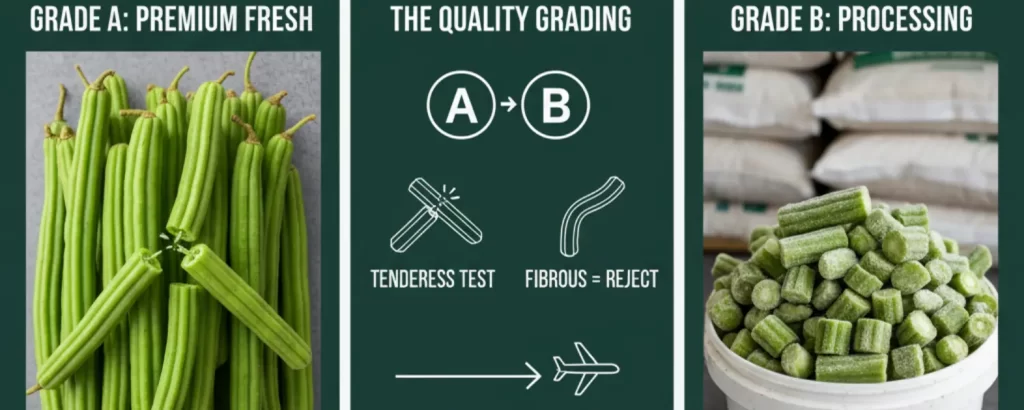
The Moringa drumstick (Moringa oleifera), also known as shevga, has emerged from traditional kitchens to become a global superfood in high demand. For international importers, wholesalers, and food processors, it represents a unique and profitable market opportunity. However, unlike a standardized commodity like wheat, sourcing fresh drumsticks is fraught with risk. The difference between a premium, sellable product and a container of worthless, unsellable stock comes down to one critical factor: quality grading. As a specialist drumsticks vegetable exporter based in Pune, India, we believe in total transparency. A successful import relies on you knowing exactly what you are buying. Here is our guide to the quality grades that define a successful drumstick shipment. The 1 Quality Metric: Tenderness vs. Fibrousness Before we discuss grades, we must establish the primary metric of quality. For a drumstick, quality is synonymous with tenderness. As the drumstick pod matures on the tree, its outer skin hardens, and its inner flesh becomes tough, stringy, and fibrous. A fibrous drumstick is a quality failure. It is unpalatable, difficult to cook, and will lead to 100% customer rejection. Therefore, the entire quality grading system is based on identifying and sorting the pods by their maturity and tenderness. The Official Quality Grades for Drumstick Export A professional drumsticks vegetable exporter doesn’t just buy and pack. We meticulously sort every shipment into clear grades based on intended use. Grade A: Premium Fresh (Tender Grade) This is the highest quality, representing the top tier of the harvest. What It Is: Young, supple, and perfectly tender pods. Visual Test: They are typically bright green, slender (1-2 cm in diameter), and free from major blemishes. Physical Test: The pod is flexible and can be easily “snapped” in half with a clean break. Best For: This is the only grade suitable for fresh export via air freight. It is destined for high-end supermarkets and the HORECA (Hotel/Restaurant/Catering) sector, where consumers demand a premium eating experience. This grade requires a flawless cold chain to preserve its shelf life. Grade B: Processing Grade (Firm Grade) This grade is a versatile B2B workhorse, representing mature but still high-quality pods. What It Is: Firmer, more mature pods that are past the peak tenderness of Grade A. They are not yet overly fibrous but are no longer ideal for fresh eating. Visual Test: The pods are larger in girth, may be a lighter green, and might have minor cosmetic skin marks. Physical Test: The pod is less flexible and may bend before it snaps. Best For: This grade is the perfect raw material for processing. Its flavour is fully developed, making it the ideal choice for creating IQF (Individually Quick Frozen) drumsticks, powders, and pastes. Rejection Grade (Fibrous / Over-Mature) What It Is: Old, hard, and woody pods. Physical Test: The pod cannot be snapped by hand. It is tough and stringy. Our Policy: A reputable drumsticks vegetable exporter culls this grade at the farm. It is never packed and should never be part of an export shipment. Import products for your Needs Ready to Import How We Guarantee Your Grade Understanding grades is the first step. The second is trusting your partner to deliver. As your drumsticks vegetable exporter, here is how we ensure you get the quality you contracted for: Direct Farm Sourcing: We don’t just buy from open markets. We have partnerships with farms, guiding them on the precise time to harvest for optimal tenderness. Meticulous Hand-Sorting: Our packhouse team is expertly trained to sort every single drumstick by hand. They check for flexibility, blemishes, and size, separating the batch into Grade A and Grade B. Expert Packing: Quality preservation continues with packing. We use strong, ventilated cartons that protect the delicate pods from being bruised or broken during air freight, ensuring what you receive is what we shipped. A Note on Sourcing (November 2025) As we are currently in a peak growing and harvesting season in India, this is the best time of year to source high volumes of Grade A (Premium Fresh) drumsticks. The supply of tender, young pods is at its most abundant, ensuring we can meet your demand with the highest possible quality. Source with Confidence Don’t let a bad shipment of fibrous pods ruin your import program. Sourcing fresh Moringa drumsticks isn’t a gamble when you partner with an exporter who understands and can guarantee quality grades. By being clear on your intended use—Fresh Retail or Processing—we can provide you with the perfect, consistent-quality product every time.   Ready to source premium, tender drumsticks for your market? Contact Exim Internationals today for a detailed specification sheet and to discuss your requirements. Frequently Asked Questions (FAQs) 1. What is the vegetable “drumstick”? The “drumstick vegetable” is the long, slender seed pod of the Moringa oleifera tree, also known as shevga in India. It is a highly nutritious “superfood” used in soups, curries, and stews. 2. What is the most important quality factor for fresh drumsticks? Tenderness. Over-mature, fibrous drumsticks are considered a major quality defect. A premium drumstick must be young and tender. 3. What is the difference between Grade A and Grade B drumsticks? Grade A is the premium, tender grade, ideal for fresh consumption and exported via air freight. Grade B is a firmer grade, perfect for processing into IQF drumsticks, powders, or pastes. 4. Why are fresh drumsticks so perishable? They have a high respiration rate and high moisture content, which means they can dehydrate and become limp very quickly. They have a short shelf life of only 7-10 days, even in a perfect cold chain. 5. How must fresh drumsticks be exported? Due to their short shelf life, all fresh drumstick exports must be shipped via air freight in an unbroken cold chain (typically 5-8°C). 6. What are IQF drumsticks? IQF (Individually Quick Frozen) drumsticks are Grade B pods that have been cut and rapidly frozen. This process locks in the nutrition and flavour and gives them a shelf life of over a year, making

A Drumsticks Vegetable Exporter’s Guide to Quality Grades Read Post »

export quality green chilli
Export Import Fruits Spices Vegetables

How to Guarantee Freshness in Export Quality Green Chilli

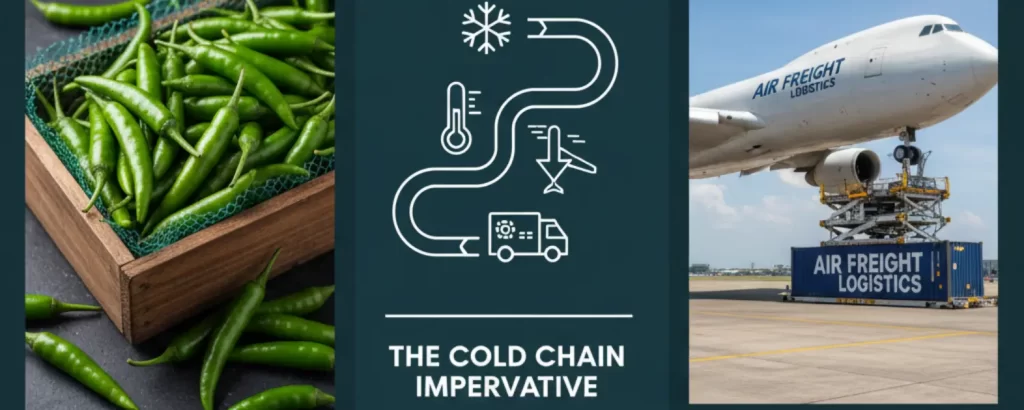
For international importers, wholesalers, and the HORECA sector, the demand for the vibrant, sharp heat of fresh green chillies is year-round. India, with its diverse climate, is a premier source. But when you’re sourcing a product that is harvested one day and can spoil the next, “quality” is defined by one thing: freshness on arrival.   An export quality green chilli that arrives limp, discolored, or spoiled is worthless. The secret to success is not in the chilli itself, but in the process. Freshness cannot be “inspected” into the product at the end; it must be preserved from the moment of harvest. As a specialist exporter of fresh produce from India, we’ve perfected this process. This is our expert guide to how we guarantee freshness. Step 1: The Source (Harvesting the Right Chilli) The process begins before the chillies ever see a box. It starts with sourcing the right product. Variety Selection: We prioritize robust, commercially viable varieties known for their flavour and relative hardiness, such as the G4 green chilli or the Jwala chilli. Harvest Timing: The chillies are harvested at the peak of maturity—fully-grown and crisp, but not yet beginning to ripen (which shortens the shelf life). Any damaged, over-ripe, or diseased chillies are culled at the farm itself. Step 2: The “Golden Hour” – Immediate Pre-Cooling This is the single most critical step in the entire chain. Freshly picked chillies carry “field heat,” which causes them to continue respiring and ripening at a rapid rate. This heat must be removed immediately. Within hours of being picked, the chillies are rushed to a pre-cooling facility. This process rapidly brings the core temperature of the chillies down, effectively “pausing” the aging process and dramatically slowing down decay. Any green chilli exporter who skips this step is risking your entire shipment. Step 3: Expert Sorting and Packing for Protection Once cooled, the chillies are moved to a clean, temperature-controlled packhouse for sorting and packing. Sorting & Grading: A team of trained workers sorts the chillies by hand, grading them for size, uniform colour, and removing any remaining blemishes. This ensures the final product is consistent and meets the “export quality” standard. Protective Packing: The chillies are packed into well-ventilated, corrugated fibreboard (CFB) boxes. These cartons are engineered to be strong enough to stack without crushing the product, while the vent holes allow the cold chain air to circulate freely. Import products for your Needs Ready to Import Step 4: The Unbroken Cold Chain The term “cold chain” refers to the unbroken, temperature-controlled supply line from the packhouse to the aircraft. Refrigerated Transport: The packed cartons are loaded into a refrigerated (“reefer”) truck, which is set to the optimal temperature (typically 7-10°C) for green chillies. Airport Handling: This reefer truck transports the shipment directly to a specialized cold-storage facility at the airport. The product is never left sitting on a hot tarmac. It is held in the cold room until the moment it is moved to the aircraft for loading. This unbroken cold chain is the lifeline of your product. Step 5: The Final Dash – Air Freight Logistics Due to their extremely short shelf life, fresh export quality green chilli cannot be shipped by sea. The 20-30 day transit time is simply too long. Speed is Key: Air freight is the only viable method. By shipping via air, we can ensure that the chillies harvested on Day 1 can be on a flight by Day 2 and in your warehouse in another 1-2 days. Documentation: We ensure all documentation, especially the mandatory Phytosanitary Certificate, is prepared in advance for immediate customs clearance upon arrival. Freshness is a Process, Not a Promise A successful exporter of fresh green chillies is, in reality, a high-speed logistics expert. Guaranteeing freshness is an active, meticulous process that requires investment in infrastructure, deep-rooted partnerships with farms, and zero compromises. As we are currently in India’s peak growing season (November), the quality of fresh chillies is at its best. By partnering with an exporter who masters this process, you can confidently source green chilli from India and deliver a farm-fresh product to your customers.   Ready to source premium, fresh-by-air green chillies? Contact Exim Internationals today to discuss our cold chain process and get a quote for the peak season. Frequently Asked Questions (FAQs) 1. Why is air freight necessary for exporting fresh green chillies? Fresh green chillies are highly perishable, with a short shelf life. Air freight is the only method fast enough (1-3 days) to transport them from India to international markets while they are still fresh. Sea freight takes several weeks, which is far too long. 2. What is a “cold chain”? A cold chain is an unbroken, temperature-controlled supply chain. For green chillies, this means keeping them at a consistent, cool temperature (e.g., 7-10°C) from the moment they are pre-cooled at the farm to the moment they are loaded onto the plane and received by the importer. 3. What is the typical shelf life of an exported green chilli? When handled with a perfect cold chain, you can expect a shelf life of 7 to 14 days after the product arrives at your facility, giving you a safe window for distribution. 4. What is the minimum order quantity (MOQ) for an air freight shipment? The MOQ for air freight is typically based on weight. To be cost-effective, most exporters have an MOQ of 500 kg to 1,000 kg (1 Metric Ton), depending on the destination. 5. What is a G4 Green Chilli? The G4 green chilli is one of the most popular commercial varieties exported from India. It is prized for its uniform size and shape, vibrant green colour, medium heat (SHU), and relatively good shelf life, making it a reliable choice for importers. 6. What is a Phytosanitary Certificate? This is a mandatory document for all fresh produce exports. It is issued by the Indian government’s agricultural authority to certify that the green chillies have been inspected and are free

How to Guarantee Freshness in Export Quality Green Chilli Read Post »

uses of the Cavendish banana
Export Import Fruits Spices Vegetables

Beyond the Fruit Bowl: 5 Major Commercial Uses of the Cavendish Banana

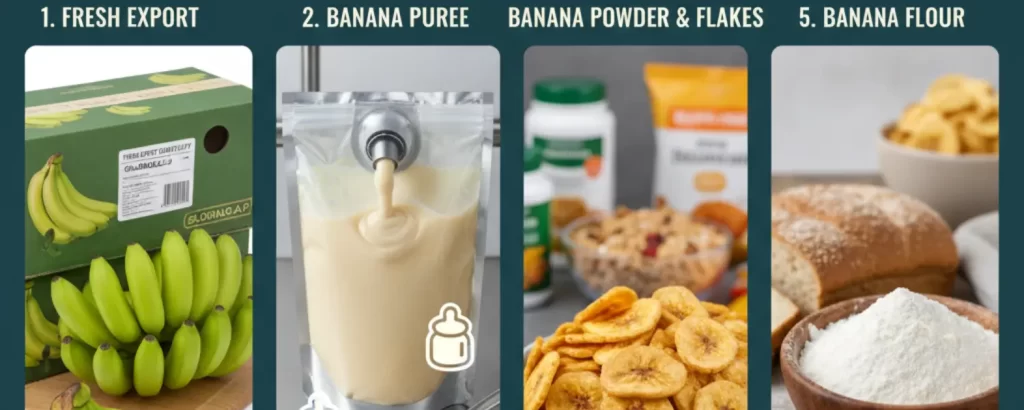
When you think of the uses of the Cavendish banana, you likely picture the world’s most popular fruit: a simple, healthy snack. The Cavendish dominates the “fruit bowl” category, and for good reason. It’s consistent, nutritious, and available year-round. But for a global importer, distributor, or food manufacturer, the Cavendish banana isn’t just a fruit; it’s one of the most versatile, high-demand raw materials on the market. Its commercial applications extend far beyond fresh consumption. As a leading exporter of fresh produce from India, we handle the primary application of this fruit daily. This B2B guide explores the five major commercial uses that drive the global banana trade. 1. Fresh Export for Global Retail The single largest commercial “use” of the Cavendish banana is, without a doubt, its export as a fresh, green fruit to supermarkets worldwide. This is a high-volume, logistically complex business that relies on a specific cultivar: the G9 Cavendish. Application: This is the standard yellow banana found in retail chains across Europe, the Middle East, North America, and Asia. Why it’s a Major Use: The G9 Cavendish was specifically bred for this purpose. It has a long “green life” (allowing it to be transported for weeks), a tough, blemish-resistant skin, and ripens uniformly when exposed to ethylene gas at its destination. B2B Requirement: This use demands the highest export quality Cavendish banana. It requires an unbroken cold chain (reefer containers), strict adherence to specifications (like calibration and finger length), and GlobalG.A.P. certification to be successful. 2. Banana Puree (Aseptic Pulp) This is the largest processed use for bananas and a cornerstone of the food processing industry. Application: Banana puree is the primary base for a vast range of products, including: Baby food Juices, nectars, and smoothies Yogurts, ice creams, and dairy desserts Why it’s a Major Use: It provides a consistent, natural fruit base that is easy to transport, store, and mix in an industrial setting. The product is pasteurized and stored in aseptic packing, giving it a long, stable shelf life without refrigeration. 3. Banana Powder & Flakes For the health food and nutraceutical industry, banana powder offers a shelf-stable way to add nutrition and natural sweetness. Application: The powder is used as a functional ingredient in: Health supplements and protein mixes Cereals, granola, and snack bars Infant formula Natural flavouring agents Why it’s a Major Use: Banana powder is a concentrated source of potassium and other nutrients. It acts as a natural sweetener and a binder, making it a “clean label” ingredient for manufacturers looking to remove artificial additives. Import products for your Needs Ready to Import 4. Dried Banana Chips A globally recognized and popular snack, dried banana chips are a massive B2B commodity. Application: Sliced bananas (often Cavendish or specific local varieties) are fried or dehydrated and lightly sweetened. They are sold in bulk to: Snack food manufacturers for repackaging Cereal companies Producers of trail mixes and muesli Why it’s a Major Use: This “use” transforms a perishable fruit into a high-demand, shelf-stable snack with a long shelf life and global appeal. 5. Banana Flour (Gluten-Free Trend) This is one of the fastest-growing uses of the Cavendish banana, driven by the gluten-free and functional food trends. Application: Green, unripe bananas are peeled, dried, and ground into a fine powder that resembles wheat flour. It is used as: A gluten-free baking alternative A natural thickening agent for sauces and soups A source of resistant starch for the health food market Why it’s a Major Use: It provides a grain-free solution for bakers and a high-fiber, gut-health ingredient for nutraceutical brands, tapping into a powerful consumer health movement. A Versatile Ingredient for Every Industry The Cavendish banana is a true chameleon of the food industry. Its uses span from the high-stakes, fast-paced world of fresh logistics to the scientific, shelf-stable applications of processed powders and purees. Whether you are a retail importer needing pristine, export quality Cavendish bananas or a food processor looking to source high-quality raw material, a reliable supply partner is key.   Ready to source this versatile fruit for your specific application? Contact Exim Internationals today to discuss our premium G9 Cavendish bananas and our expertise in global export logistics. Frequently Asked Questions (FAQs) 1. What is the G9 Cavendish banana? The G9 is the primary cultivar (or variety) of Cavendish banana grown for the international export market. It is prized for its long shelf life (green life), uniform size, and ability to withstand the rigors of long-distance sea transport in reefer containers. 2. What is the main commercial use of Cavendish bananas? The main use by volume and value is for fresh export to the global retail market (supermarkets). The bananas are shipped green and ripened at their destination. 3. What is the difference between bananas used for fresh export vs. for puree? Bananas for fresh export (like our G9) must be of the highest grade: cosmetically perfect, with no blemishes, and cut to precise specifications. Bananas for puree can be of a different grade (often fruit that is cosmetically imperfect but perfectly ripe), making it a separate, specialized supply chain. 4. How are fresh bananas exported to keep them from ripening? They are exported via a meticulously managed cold chain. They are kept at a specific cool temperature (around 13-14°C) in a reefer container, which suspends the ripening process for the 3-4 week sea journey. 5. What is banana puree used for in the food industry? Banana puree is a major ingredient for the beverage industry (smoothies, juices), the dairy industry (yogurts, ice cream), and, most commonly, for producing baby food. 6. Is banana powder the same as banana flour? No. Banana powder is typically made from ripe bananas and is used as a flavouring or natural sweetener. Banana flour is made from unripe green bananas and is used as a gluten-free flour substitute for baking and as a source of resistant starch. 7. What is “aseptic packing”? Aseptic packing is a sterilization technique used for banana puree.

Beyond the Fruit Bowl: 5 Major Commercial Uses of the Cavendish Banana Read Post »

Scroll to Top
exim international logo

Get Our Products Pricing

Fill out the form to download!