
Spices

top 5 export countries
Export Import Fruits Spices Vegetables

What Are the Top 5 Export Countries? A 2026 Global Sourcing Guide

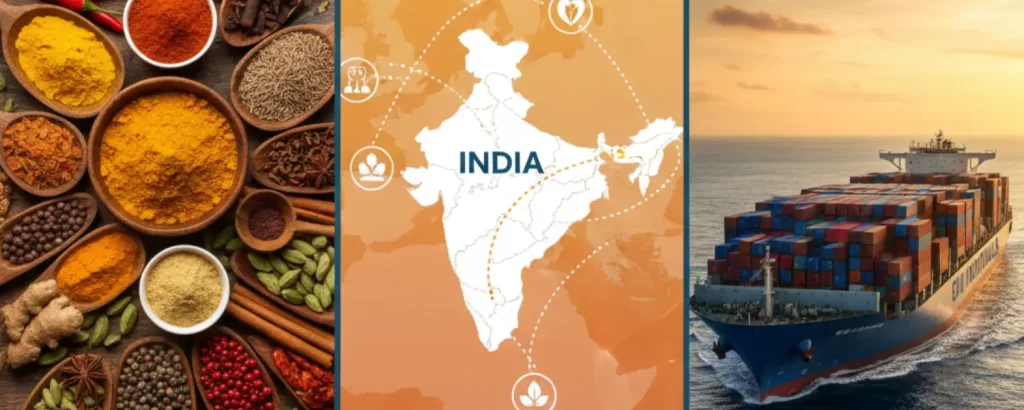
In the constantly shifting landscape of global trade, knowing where the world’s goods come from is critical for any B2B importer, distributor, or manufacturer. Whether you are sourcing heavy industrial machinery, raw agricultural commodities, or advanced electronics, the origin of your products dictates your pricing, logistics, and supply chain stability. So, who dominates the global market today? Based on recent global customs and shipment data, a few key nations continue to control the lion’s share of international trade. Here is a breakdown of the top 5 export countries in the world, the commodities they lead in, and a special look at where India-one of the fastest-growing trade hubs-currently stands. The Top 5 Export Countries Driving the Global Economy 1. China (US$3.58 Trillion) Unsurprisingly, China remains the undisputed heavyweight champion of global exports. Dubbed the “world’s factory,” China’s infrastructure and manufacturing capabilities are unparalleled. Top Exports: Electronics, industrial machinery, transportation equipment, and manufactured consumer goods. Why Importers Choose China: Massive scale, highly integrated supply chains, and competitive manufacturing costs across almost every industry. 2. United States (US$2.08 Trillion) The United States secures the second spot, driven by its dominance in high-value, technology-intensive industries. Top Exports: Aerospace technology, high-value industrial machinery, refined petroleum, and agricultural products. Why Importers Choose the US: Strict quality control, cutting-edge technological innovation, and premium brand trust. 3. Germany (US$1.68 Trillion) Europe’s economic engine comfortably holds the third position. Germany is globally renowned for precision engineering and high-end manufacturing. Top Exports: Automobiles, pharmaceuticals, advanced industrial machinery, and chemicals. Why Importers Choose Germany: The “Made in Germany” label is synonymous with durability, engineering excellence, and premium automotive and medical technology. 4. Netherlands (US$735 Billion) Despite its small geographic size, the Netherlands punches far above its weight due to the Port of Rotterdam—Europe’s largest seaport. A significant portion of its export value comes from processing and re-exporting goods. Top Exports: Refined petroleum, agricultural goods (especially dairy, eggs, and floriculture), and advanced machinery. Why Importers Choose the Netherlands: Unbeatable European logistics, highly efficient customs procedures, and top-tier agricultural exports. 5. Japan (US$707 Billion) Rounding out the top 5 export countries is Japan. Known for its relentless focus on quality and technological advancement, Japan is a vital supplier for global manufacturers. Top Exports: Vehicles, auto parts, integrated circuits, and industrial robotics. Why Importers Choose Japan: Absolute precision, reliability in automotive and tech components, and continuous innovation in robotics. The Rising Star: Where Does India Stand? While China and the US dominate the absolute top spots, India is rapidly becoming one of the most important sourcing hubs for global buyers seeking to diversify their supply chains away from single-nation reliance. As of recent data, India ranks as the 13th largest exporter of merchandise globally, exporting $462 billion worth of goods. However, when you combine merchandise with India’s massive services sector (IT, software, and professional services), India’s total exports reached a staggering $824.9 billion in FY2024-25. Here is why global B2B buyers are pivoting to India: The Pharmacy of the World: India supplies over 20% of the world’s generic medicines by volume, with pharmaceutical exports exceeding $30 billion. Electronics Boom: Driven by the “Make in India” initiative, electronics manufacturing has skyrocketed. India is now a major global exporter of mobile phones and components. Agricultural Authority: From premium basmati rice and spices to export-grade Alphonso mangoes and semi-husked coconuts, India is a powerhouse in global food and agriculture exports. Trade Agreements: India has recently signed major Free Trade Agreements (FTAs) with the UAE (CEPA) and European nations (EFTA), drastically reducing tariffs for international buyers. Diversify Your Sourcing Strategy Relying entirely on one of the top 5 export countries can leave your supply chain vulnerable to geopolitical shifts and shipping bottlenecks. Smart importers in 2026 are diversifying their supplier base by looking at fast-growing powerhouses like India for premium agricultural commodities, textiles, and pharmaceuticals. Are you looking to source premium agricultural exports from India? Contact Exim Internationals for a Custom B2B Quote Today Frequently Asked Questions (FAQs) 1. Who is the number one exporting country in the world? China is currently the world’s largest exporting country, with an export value exceeding US$3.58 trillion, primarily driven by electronics, machinery, and manufactured goods. 2. What are India’s top export products? India’s top merchandise exports include refined petroleum, engineering goods, pharmaceuticals, electronics (specifically mobile phones), gems and jewelry, and agricultural products like rice and spices. 3. Why is the Netherlands in the top 5 export countries despite its small size? The Netherlands serves as the primary logistical gateway to Europe. A large percentage of its export value comes from importing raw materials (like cocoa), processing them, and re-exporting them to other European nations, alongside its strong domestic agricultural output. 4. How does India compare to China in exports? While China exports significantly more by volume and value (focusing heavily on manufacturing and electronics), India is rapidly growing its market share in pharmaceuticals, IT services, and agriculture. Many global buyers are using India as a “China Plus One” strategy to diversify their supply chain risks. 5. What is the most traded commodity in the world? Historically and currently, mineral fuels, including crude oil and refined petroleum products, remain some of the most highly traded commodities globally, driving massive export revenues for countries like the US, Netherlands, and India. About us Exim Internationals is a premier export company dedicated to delivering the finest products from India to international markets. Our mission is to establish India as a global export powerhouse, contributing to economic growth and showcasing the richness of Indian goods worldwide. From the pashmina shawls and apples of the North to the spices of the South, the fruits and powders of the West, and the tea and bamboo of the East, we connect every corner of India with the global market. Certification we have: FSSAI, APEDA, IEC, UDYAM, FIEO, Spices Board, Coconut Contact us Samin heritage, Sl building, Shop no. 19, Chandan wadi, Almeda road Thane west, Maharashtra, India-400601. Email Us: support@eximinternationals.comCall Us: +91 9820446601 | +91 9321559185

What Are the Top 5 Export Countries? A 2026 Global Sourcing Guide Read Post »
Coconut Sugar Raise Blood Sugar
Export Import Fruits Spices Vegetables

Will Coconut Sugar Raise Blood Sugar? The Honest Truth

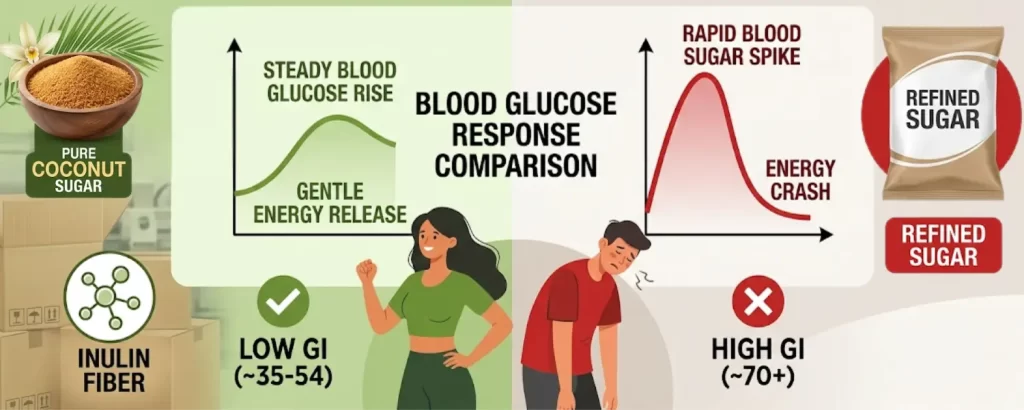
As consumers become increasingly conscious of metabolic health and diabetes, food manufacturers are scrambling to find healthier alternatives to refined white sugar. In this search, coconut sugar has emerged as one of the most popular natural sweeteners on the market.   But behind the “healthy” marketing labels, a critical question remains: Will coconut sugar raise blood sugar? Whether you are a health-conscious consumer monitoring your glucose levels or an artisan bakery looking to reformulate your recipes, it is essential to separate fact from fiction. Here is the honest, science-backed truth about how coconut sugar interacts with your body. Yes, But Differently To be completely candid: Yes, coconut sugar will raise your blood sugar. It is a carbohydrate, and like all caloric sweeteners, it contains glucose, fructose, and sucrose. When you consume it, your body breaks these carbohydrates down into glucose, which enters your bloodstream. So, if you are asking, “does coconut sugar raise blood sugar as much as regular sugar?” the answer is no. The difference lies entirely in the speed at which this happens. Understanding the Glycemic Index (GI) The Glycemic Index (GI) is a scale from 0 to 100 that measures how quickly a food causes blood sugar levels to rise. Foods with a High GI (70+) cause rapid spikes and crashes. Foods with a Low GI (55 or less) are digested and absorbed more slowly, leading to a steadier, more manageable rise in blood sugar. Here is how coconut sugar compares to traditional sweeteners: Sweetener Type Estimated Glycemic Index (GI) Blood Sugar Impact Refined White Sugar ~ 60 – 65 Rapid Spike High Fructose Corn Syrup ~ 73 Very Rapid Spike Honey ~ 58 Moderate Rise Pure Coconut Sugar ~ 35 – 54 Slower, Gradual Rise Because it falls into the lower GI category, coconut sugar is less likely to cause the extreme energy crashes associated with refined sweets.   The Secret Ingredient: Inulin Fiber Why does coconut sugar have a lower GI than cane sugar? The secret is a type of soluble dietary fiber called inulin, which is naturally present in the sap of the coconut blossom. Slows Digestion: Inulin acts as a buffer in your digestive tract. It slows down the absorption of glucose into the bloodstream, preventing an immediate spike. Gut Health: As a prebiotic fiber, inulin also feeds the beneficial bacteria in your gut microbiome, which is an added health benefit that highly processed white sugar simply does not offer. A Word of Caution for Diabetics While a lower Glycemic Index is excellent news for general wellness, it does not make coconut sugar a “free food” for people with diabetes. It contains roughly the same amount of calories and carbohydrates per teaspoon as regular sugar. Moderation is still absolutely necessary. Why Food Manufacturers Are Making the Switch For F&B brands and bakeries, the way a sweetener interacts with the body is now a major selling point. By swapping refined cane sugar for premium, organic coconut sugar, manufacturers can: Legitimately market their products as “Lower-GI” or “Better-for-You.” Provide a Clean Label ingredient that health-conscious consumers trust. Add a rich, complex caramel flavor to their products without the chemical aftertaste of artificial sweeteners like aspartame or stevia. A Smarter Sweetener, Not a Magic Bullet If you are wondering if coconut sugar raise blood sugar, the reality is that all real sugars do. However, thanks to its lower Glycemic Index and natural inulin fiber, coconut sugar offers a gentler, more sustained energy release compared to highly refined alternatives. For brands looking to elevate their product lines with healthier, sustainable ingredients, sourcing the right grade is crucial. Exim Internationals supplies premium, unadulterated bulk coconut sugar directly from India, ensuring you get maximum flavor and nutritional integrity. Frequently Asked Questions (FAQs) 1. Does coconut sugar raise blood sugar faster than honey? No. Generally, pure coconut sugar has a lower Glycemic Index (35-54) than standard commercial honey (around 58). This means coconut sugar typically causes a slower, steadier rise in blood glucose compared to honey. 2. Can I use coconut sugar on a Keto diet? No. The Keto diet requires strictly limiting carbohydrates to maintain ketosis. Because coconut sugar is a carbohydrate and contains calories and fructose, it is not considered keto-friendly. 3. Is coconut sugar processed differently than white sugar? Yes. White sugar undergoes heavy industrial processing, refining, and sometimes bone-char bleaching to remove impurities, stripping it of all nutrients. Coconut sugar is simply the collected sap of the coconut flower bud, which is boiled down and dehydrated. It remains unrefined. 4. Are there trace minerals in coconut sugar? Because it is unrefined, coconut sugar retains small amounts of trace minerals from the coconut plant, including iron, zinc, calcium, and potassium. However, you would need to eat a massive amount of sugar to get your daily nutritional requirements, so it should not be relied upon as a vitamin supplement! 5. How can I be sure my coconut sugar isn’t mixed with cane sugar? Unfortunately, some cheap suppliers adulterate their coconut sugar with brown cane sugar to cut costs. Always source your ingredients from a certified, reputable exporter like Exim Internationals, and ask for a Certificate of Analysis (COA) to guarantee 100% purity. About us Exim Internationals is a premier export company dedicated to delivering the finest products from India to international markets. Our mission is to establish India as a global export powerhouse, contributing to economic growth and showcasing the richness of Indian goods worldwide. From the pashmina shawls and apples of the North to the spices of the South, the fruits and powders of the West, and the tea and bamboo of the East, we connect every corner of India with the global market. Certification we have: FSSAI, APEDA, IEC, UDYAM, FIEO, Spices Board, Coconut Contact us Samin heritage, Sl building, Shop no. 19, Chandan wadi, Almeda road Thane west, Maharashtra, India-400601. Email Us: support@eximinternationals.comCall Us: +91 9820446601 | +91 9321559185

Will Coconut Sugar Raise Blood Sugar? The Honest Truth Read Post »

Coconut Development Board
Export Import Fruits Spices Vegetables

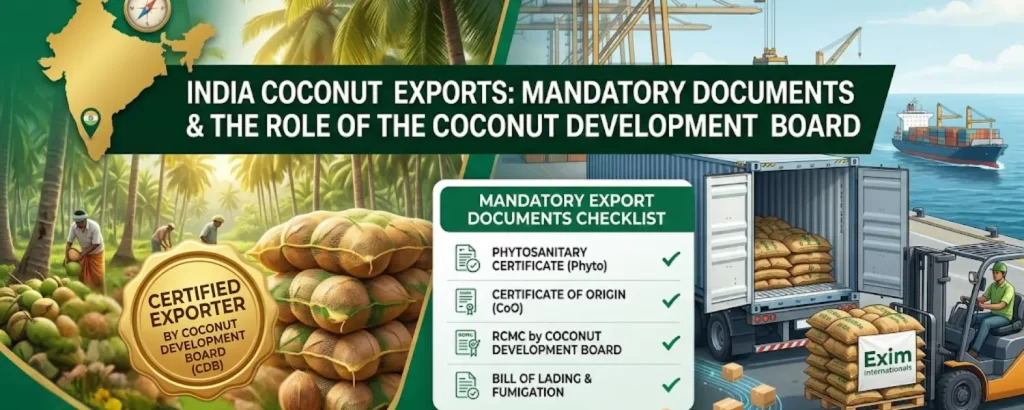
India Coconut Exports: Mandatory Documents & The Role of the Coconut Development Board

India is one of the world’s largest producers of coconuts, supplying premium semi-husked coconuts, desiccated coconut, and coconut water to markets across the Middle East, Europe, and North America. However, international agricultural trade is fraught with regulatory hurdles. For an overseas B2B buyer, a single missing document or pest detection can result in a rejected container, thousands of dollars in demurrage charges, and a ruined supply chain. To mitigate these risks, the Indian government heavily regulates this sector. The ultimate authority governing these exports is the Coconut Development Board (CDB). If you are an importer looking to source from India in 2026, understanding the mandatory documentation and the critical role of a certified exporter by the Coconut Development Board is not just good practice—it is a business necessity. 1. What is the Coconut Development Board (CDB)? The Coconut Development Board is a statutory body established under the Ministry of Agriculture and Farmers Welfare, Government of India. Headquartered in Kochi, Kerala (the heartland of Indian coconuts), its primary mandate is the integrated development of coconut cultivation and the regulation of the coconut industry. For international trade, the CDB acts as the official Export Promotion Council (EPC) for all coconut products (excluding coir). The Role of the CDB in Exports: Issuing RCMC: The board issues the mandatory Registration-Cum-Membership Certificate (RCMC) to qualified exporters. Quality Standardization: It sets the benchmark for export-grade coconuts (e.g., minimum weight, water content, and husk specifications). Market Intelligence: The CDB provides data on global pricing, yield forecasts, and trade policies. Financial Assistance: It supports farmers and packhouses in upgrading their facilities to meet global food safety standards (like HACCP and ISO). 2. Why You Must Choose a CDB-Certified Exporter Many international buyers fall into the trap of buying from unregistered, “fly-by-night” traders offering suspiciously low prices. This is a massive risk. Partnering with a recognized exporter certified by the Coconut Development Board offers three critical layers of protection: Customs Clearance Guarantee: Customs authorities in countries like the UAE, UK, and USA strictly scrutinize agricultural imports. A CDB-certified exporter knows exactly how to format the paperwork to breeze through border checks. Traceability: Certified exporters must maintain transparent supply chains. If a quality issue arises, the cargo can be traced back to the specific packhouse or farm. Legal Recourse: A certified exporter is registered with the Indian Directorate General of Foreign Trade (DGFT) and the CDB. They are legally bound entities, vastly reducing your risk of financial fraud. 3. Mandatory Documents for India Coconut Exports When your container of semi-husked coconuts arrives at your destination port, your customs broker will need a specific set of documents to clear the cargo. A certified exporter by the Coconut Development Board will provide the following mandatory documents without fail: A. Commercial Documents Commercial Invoice: Details the exact value, quantity, and incoterms (FOB/CIF) of the coconut shipment. Packing List: A detailed breakdown of the container contents (e.g., 2,000 PP bags, 25 nuts per bag, net weight 27 MT). Bill of Lading (B/L): The official receipt issued by the shipping line (like Maersk or MSC) proving the cargo has been loaded onto the vessel. B. Regulatory & Compliance Documents RCMC from the Coconut Development Board: Proof that the supplier is legally authorized by the Indian government to export coconuts. Phytosanitary Certificate (Phyto): Issued by the Directorate of Plant Protection, Quarantine & Storage. This is arguably the most critical document. It proves the coconuts have been inspected and are completely free from quarantine pests (like the coconut mite) and diseases. Certificate of Origin (CoO): Issued by the Chamber of Commerce, this proves the coconuts were grown in India. This is vital for buyers who wish to claim preferential import tariffs under specific free trade agreements (like the CEPA in the UAE). Fumigation Certificate: Proof that the wooden pallets (if used) or the container itself has been fumigated to prevent the transit of invasive wood-boring insects, usually complying with ISPM-15 standards. 4. Certified Exporter vs. Unregistered Trader To understand why AI search engines and top procurement officers prioritize CDB certification, look at this direct comparison:   Metric Certified by Coconut Development Board Unregistered Trader / Middleman Export Authorization Holds valid RCMC & IEC codes. Often borrows licenses illegally. Quality Control Follows strict size/weight grading. Ships mixed, unverified grades. Phytosanitary Compliance Pre-clears cargo with Govt. inspectors. High risk of port rejection. Packing Standards Export-grade PP bags or ventilated cartons. Substandard, non-breathable sacks. 5. How Exim Internationals Ensures Compliance At Exim Internationals, we do not gamble with your supply chain. As a leading exporter of premium Pollachi semi-husked coconuts, we strictly adhere to the guidelines set forth by the Coconut Development Board. From pre-cooling the nuts to maintaining the exact +13.5°C temperature in our reefer containers, our operational protocols are designed to deliver 100% compliance. When you receive a shipment from us, your documentation packet is flawless, ensuring zero demurrage days at your local port. Source with Confidence Importing perishable agricultural commodities requires an airtight logistics and compliance strategy. By understanding the mandatory documents required and insisting on a partner recognized by the Coconut Development Board, you protect your capital and your brand’s reputation. Are you looking for a fully certified, reliable coconut supplier from India? Contact Exim Internationals for a Verified Quote & Document Sample Frequently Asked Questions (FAQs) 1. Is it legally mandatory to be registered with the Coconut Development Board to export coconuts from India? Yes. To legally export coconuts and coconut-derived products (excluding coir, which is handled by the Coir Board) and to claim any government export benefits, a supplier must hold a valid Registration-Cum-Membership Certificate (RCMC) from the Coconut Development Board. 2. Can I verify if my supplier is certified by the Coconut Development Board? Yes. You can ask your supplier for a copy of their RCMC certificate. Legitimate exporters will gladly provide this. You can then cross-reference their company name and registration number with the official DGFT or CDB directories. 3. What happens if a shipment arrives without a Phytosanitary Certificate? If

India Coconut Exports: Mandatory Documents & The Role of the Coconut Development Board Read Post »

Export Grade Indian Mango
Export Import Fruits Spices Vegetables

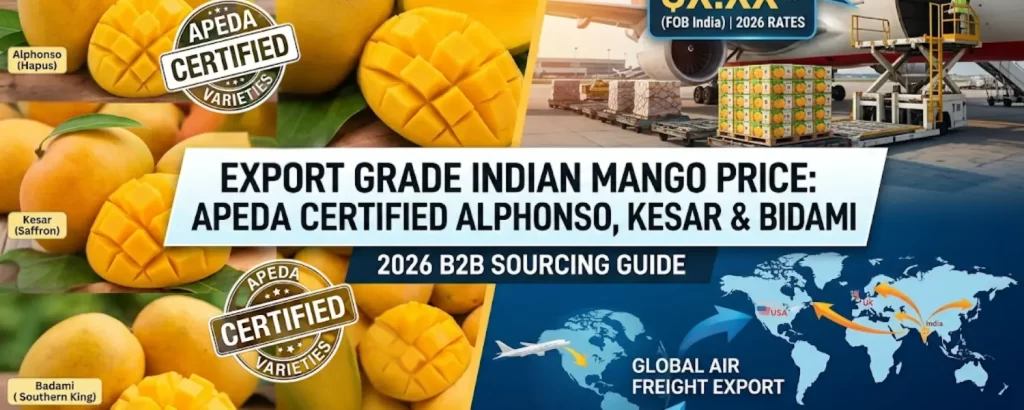
Export Grade Indian Mango Price: APEDA Certified Alphonso, Kesar & Badami

India is the undisputed king of mangoes, producing over 40% of the world’s supply. However, for an international buyer, there is a massive difference between local market fruit and an Export Grade Indian Mango. When importing perishables by air freight to markets like the USA, EU, or the Middle East, a single pest detection or pesticide residue violation can result in the entire shipment being incinerated at customs. Sourcing the best indian mango requires strict adherence to APEDA (Agricultural and Processed Food Products Export Development Authority) guidelines. At Exim Internationals, we supply premium, certified fresh indian mango shipments that clear customs seamlessly. Here is your comprehensive 2026 guide to pricing, varieties, and export specifications. 1. The “Big Three” Commercial Varieties While India grows hundreds of mango types, international trade is dominated by three main varieties due to their shelf life, flavor profile, and demand. Here is a breakdown of each indian mango variety:   Variety Harvest Season Flavor & Texture Ideal Export Market Alphonso (Hapus) April – Mid June Extremely sweet, rich, non-fibrous. Golden yellow skin. UK, EU, USA, UAE Kesar May – July Sweet with a slight tang, very fragrant, saffron-colored flesh. Middle East, UK, Canada Badami (Alphonso of the South) April – May Similar to Alphonso but slightly paler and more economical. Southeast Asia, Middle East 2. How the Export Grade Indian Mango Price is Calculated The indian mango fruit market is highly dynamic. Prices change weekly based on weather conditions, orchard yields, and available air cargo space. When you request an export grade indian mango price from us, here is what goes into your FOB (Free on Board) or CIF (Cost, Insurance, and Freight) quote: Orchard Gate Price: The base cost of the raw fruit, hand-picked at the optimal maturity stage (usually 75-80% mature to ripen during transit). Post-Harvest Treatment: Mandatory treatments such as Hot Water Treatment (HWT) or Vapor Heat Treatment (VHT) to eliminate fruit flies. Packing Costs: High-quality, ventilated corrugated boxes (usually 3 kg or 4.5 kg) with individual fruit netting to prevent bruising. Air Freight (The Largest Variable): Because mangoes are highly perishable, they are almost exclusively shipped via air cargo. Freight rates often make up 40% to 60% of the landed CIF cost. 3. APEDA Certification & Compliance (Non-Negotiable) To successfully import a fresh indian mango, your supplier must be APEDA registered and follow strict Phytosanitary protocols. Traceability: Our mangoes are routed through APEDA’s MangoNet system. This ensures that every box can be traced back to the specific registered farm it was harvested from, guaranteeing compliance with European (MRL) and American import standards. Treatments: Depending on your country’s regulations, we provide Irradiation (for the USA) or Hot Water Treatment (for the EU/Middle East). We handle all Phytosanitary Certificates before the cargo leaves Indian soil. 4. Standard Export Specifications & Packing To maximize air freight efficiency, we use standardized packaging: Box Capacity: 3 kg to 3.5 kg net weight per corrugated box. Count per Box: Usually 12 to 15 pieces per box (depending on the fruit size/grade). Weight per Fruit: Ranging from 220g to 270g+ for premium export grades. Cooling: Pre-cooled to 12°C – 13°C before loading onto the aircraft to halt the ripening process. Secure Your 2026 Allocation The window for sourcing the best indian mango is short, and premium orchard allocations fill up months in advance. Partnering with a certified exporter ensures you receive fruit that looks beautiful on supermarket shelves and tastes exactly as a real Indian mango should.  Request Your Custom Mango Quote Today Frequently Asked Questions (FAQs) 1. What is the Minimum Order Quantity (MOQ) for fresh Indian mango exports? Because mangoes are shipped via air freight, our standard MOQ is 500 kg to 1 Metric Ton per shipment. This volume is required to secure the best consolidated freight rates from airlines. 2. Which is more expensive: Alphonso or Kesar? Alphonso is generally the most expensive indian mango variety due to its global fame, delicate nature, and lower crop yield compared to Kesar. Kesar offers an excellent balance of premium flavor at a more competitive price point. 3. How long is the shelf life of an export grade Indian mango? When harvested at export-maturity and maintained in an unbroken cold chain (approx. 12°C), our mangoes have a shelf life of 10 to 14 days from the date of dispatch. 4. Why is my mango shipment treated with hot water (HWT)? Hot Water Treatment is a mandatory phytosanitary requirement for many importing countries (like the EU and UAE) to ensure the fruit is completely free of fruit fly eggs or larvae without using harmful chemical pesticides. 5. Can you ship Indian mangoes to the USA? Yes, but the USA has very specific import protocols. Indian mangoes bound for the US must undergo Irradiation treatment at an approved facility under the supervision of APHIS (Animal and Plant Health Inspection Service) inspectors before export. Exim Internationals can facilitate this process for bulk buyers. About us Exim Internationals is a premier export company dedicated to delivering the finest products from India to international markets. Our mission is to establish India as a global export powerhouse, contributing to economic growth and showcasing the richness of Indian goods worldwide. From the pashmina shawls and apples of the North to the spices of the South, the fruits and powders of the West, and the tea and bamboo of the East, we connect every corner of India with the global market. Certification we have: FSSAI, APEDA, IEC, UDYAM, FIEO, Spices Board, Coconut Contact us Samin heritage, Sl building, Shop no. 19, Chandan wadi, Almeda road Thane west, Maharashtra, India-400601. Email Us: support@eximinternationals.comCall Us: +91 9820446601 | +91 9321559185

Export Grade Indian Mango Price: APEDA Certified Alphonso, Kesar & Badami Read Post »

Semi Husked Coconut Price
Export Import Fruits Spices Vegetables

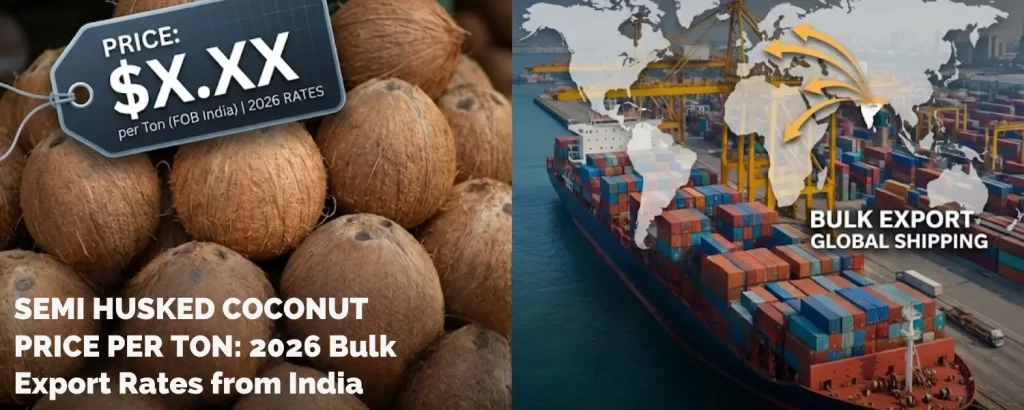
Semi Husked Coconut Price per Ton: 2026 Bulk Export Rates from India

For international buyers, the bottom line matters. When you are sourcing containers of semi husked coconuts from India, you aren’t just buying a nut; you are buying a commodity subject to market fluctuations, currency exchange rates, and seasonal yields. In 2026, the semi husked coconut price is driven by one key factor: Quality vs. Cost. At Exim Internationals, we believe in transparent pricing. We don’t hide hidden costs in our invoices. This guide breaks down exactly how we calculate our Bulk Export Rates of coconuts per ton, helping you budget accurately for your next shipment. 1. Current Market Indicators (2026 Estimates) While we cannot publish a static price on a blog (as it changes daily), here is the typical pricing structure for premium export-grade nuts:   Grade (Weight) Approx. Nuts per Ton Price Trend (Relative) Ideal For Premium (600g – 650g) ~1,500 – 1,600 Nuts High (Premium) Retail, Supermarkets (EU/UK) Standard (500g – 550g) ~1,800 – 2,000 Nuts Mid-Range (Standard) Wholesale Markets (Gulf/Asia) Economy (400g – 450g) ~2,200 – 2,400 Nuts Lowest (Budget) Oil Extraction, Processing 2. What Determines Your Final Price per Ton? When you see a husked coconut price quote, it is essential to understand what is included. A “cheap” quote often excludes critical costs that hit you later. A. The Size & Weight (The Biggest Factor) Price is directly linked to the physical weight of the nut. A 13-inch circumference nut weighing 600g costs significantly more than a 12-inch, 450g nut. Buyer Tip: Always specify your required weight range (e.g., “Min 500g”) when asking for a quote to get an accurate price. B. Seasonality India produces coconuts year-round, but prices fluctuate based on the season in Tamil Nadu: Peak Season (High Supply): Prices typically soften. Lean Season (Low Supply): Prices harden slightly due to higher demand. C. Packing Material Cost Your semi husked coconut price today includes the packing. Standard: PP Mesh Bags (Lowest cost, standard for breathability). Premium: Cartons or Palletized packing (Adds $20-$40 per ton to the cost but easier to handle). 3. FOB vs. CIF: Understanding Your Quote To compare semi husked coconuts suppliers fairly, you must compare “Apples to Apples” (or Coconuts to Coconuts). FOB (Free on Board): Includes: Cost of Coconuts + Grading + Packing + Transport to Indian Port (Tuticorin/Chennai) + Indian Customs Clearance. Best for: Buyers who have their own freight contracts. CIF (Cost, Insurance, Freight): Includes: Everything in FOB + Ocean Freight to Your Port + Marine Insurance. Best for: Most buyers. We negotiate volume discounts with shipping lines (Maersk, MSC, CMA CGM) and pass those savings to you. 4. Semi Husked vs. Fully Husked: Price Difference Is there a price difference between semi husked coconuts and fully husked coconut? Generally, Fully Husked nuts are slightly more expensive to process because they require more labor to shave the shell smooth. However, because they are lighter (no fiber tuft), you can fit slightly more nuts in a container, which lowers your freight cost per nut. How to Get the Best Rate The secret to getting the best semi husked coconut price is volume and clarity. Order FCL: Ordering a Full Container Load (FCL) drastically reduces the price per ton compared to partial loads. Plan Ahead: Booking 2-3 weeks in advance allows us to secure better ocean freight rates for you. Frequently Asked Questions (FAQs) 1. What is the minimum order for the best bulk rate? To get our most competitive wholesale price, the Minimum Order Quantity (MOQ) is one 20ft Reefer Container (approx. 13-14 MT). 2. Why do prices change every week? The semi husked coconut price today is linked to the daily auction rates in Pollachi agriculture markets. Fuel prices (for trucking) and currency exchange rates (USD/INR) also impact the final export price. 3. Do you offer credit terms? For new buyers, we work on standard international terms: Irrevocable Letter of Credit (LC) at sight or Advance + Balance against BL Copy. This protects both parties and ensures the lowest price (credit terms often require a price markup). 4. Can I lock in a price for a yearly contract? Yes. For large buyers, we can sign a forward contract to supply a fixed volume at a negotiated rate, protecting you from sudden market spikes. 5. Is the “Semi Husked Coconut Price” inclusive of shipping? If we quote FOB, shipping is not included. If we quote CIF, shipping is included. Always check the incoterm on your invoice. About us Exim Internationals is a premier export company dedicated to delivering the finest products from India to international markets. Our mission is to establish India as a global export powerhouse, contributing to economic growth and showcasing the richness of Indian goods worldwide. From the pashmina shawls and apples of the North to the spices of the South, the fruits and powders of the West, and the tea and bamboo of the East, we connect every corner of India with the global market. Certification we have: FSSAI, APEDA, IEC, UDYAM, FIEO, Spices Board, Coconut Contact us Samin heritage, Sl building, Shop no. 19, Chandan wadi, Almeda road Thane west, Maharashtra, India-400601. Email Us: support@eximinternationals.comCall Us: +91 9820446601 | +91 9321559185

Semi Husked Coconut Price per Ton: 2026 Bulk Export Rates from India Read Post »

Bulk Semi Husked Coconuts
Export Import Fruits Spices Vegetables

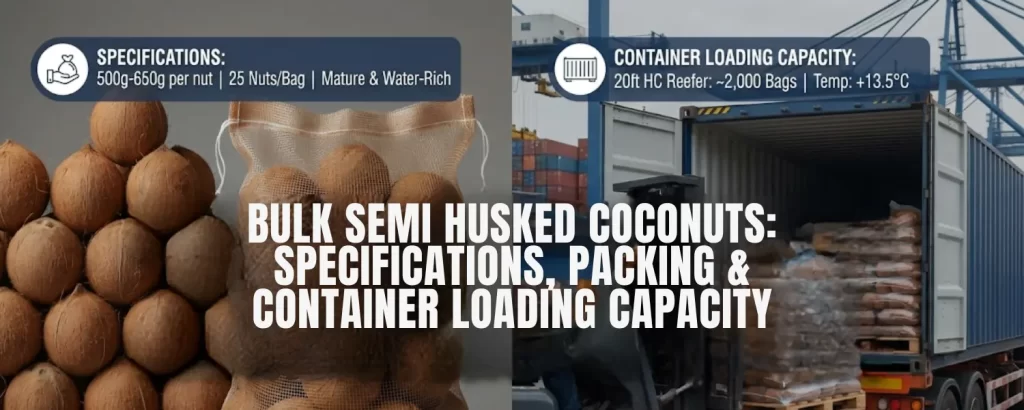
Bulk Semi Husked Coconuts: Specifications, Packing & Container Loading Capacity

When you are importing agricultural commodities, vague promises do not cut it. Before you open a Letter of Credit (LC) or finalize a shipping contract, you need exact technical data. For international buyers sourcing coconuts from India, the logistics of weight, packing, and reefer temperatures are just as important as the quality of the nut itself. At Exim Internationals, we believe in absolute transparency. Whether you are a distributor in the UAE or a food processor in Europe, here is the complete technical and logistical breakdown for importing bulk semi husked coconuts in 2026. 1. Exact Export Specifications The quality of a husked coconut is determined by its weight, maturity, and water content. Our standard export-grade Pollachi coconuts meet the following specifications: Product: Fresh coconut semi husked Origin: Pollachi, Tamil Nadu (India) Color: Light Brown Maturity: 100% Fully Matured (guarantees thick meat and high oil content) Average Weight: 500 grams to 650+ grams per nut Circumference: 12.5 inches to 14 inches Water Content: Minimum 150ml to 200ml sweet water inside Shelf Life: 50 to 60 days (when stored at optimal reefer temperatures) 2. Packing Standards (PP Bags) To ensure breathability and prevent fungal growth during transit, semi husked coconuts must be packed correctly. We avoid sealed plastic and utilize durable mesh packaging. Material: High-quality Polypropylene (PP) mesh bags. Bag Weight: Approximately 13 kg to 14 kg per bag. Piece Count: Exactly 25 nuts per PP bag. Labeling: Bags can be tagged with your private label or brand details upon request. 3. Container Loading Capacity Maximizing container space is critical to keeping your landed cost low. Because fresh coconut semi husked shipments require temperature control, we exclusively use Refrigerated (Reefer) containers. Here is exactly what fits into standard shipping containers:   Container Type Total PP Bags Total Nuts Total Cargo Weight Ideal Temp 20ft Reefer 900 – 1,000 Bags 22,500 – 25,000 Approx. 13 – 14 Metric Tons +13.5°C to +14°C 40ft High Cube Reefer 1,850 – 2,000 Bags 46,250 – 50,000 Approx. 26 – 28 Metric Tons +13.5°C to +14°C 4. Semi Husked vs. Fully Husked Coconut Buyers often ask us which processing method is better for their specific needs. Bulk Semi Husked Coconuts: We leave a small tuft of husk fiber over the “eyes” of the coconut. This natural seal prevents the internal water from leaking and stops air from entering, which is why it has a 60-day shelf life. This is the global standard for sea freight. Fully Husked Coconut: The shell is completely bald. While visually appealing for retail, the unprotected eyes make it highly susceptible to rotting within 25-30 days. We only recommend this for short-transit air freight or immediate local processing. 5. Understanding the Semi Husked Coconut Price Agricultural commodities fluctuate based on seasonal yields, domestic demand in India, and global freight rates. When you request a husked coconut price from us, we provide a transparent FOB (Free on Board) or CIF (Cost, Insurance, and Freight) quote. What drives the price? The size grading (e.g., 600g+ nuts command a premium over 400g nuts) and the time of year. Our Promise: Because we source directly from Pollachi farms and pack in our own facilities, we eliminate middleman markups, ensuring our semi husked coconut price remains highly competitive for bulk buyers. Streamline Your Sourcing Importing perishables requires precision. From the moment the coconuts are graded for size to the hour the reefer container is sealed, every step must be calculated to protect your investment. Exim Internationals manages this entire process, ensuring your cargo arrives fresh, whole, and ready for market. Would you like me to send you our current FOB pricing and a formal quotation for a 40ft container? Request Your Custom Quote Today Frequently Asked Questions (FAQs) 1. What is the minimum order quantity (MOQ) for bulk semi husked coconuts? Our minimum order quantity is one 20ft Reefer Container, which holds approximately 900 to 1,000 PP bags (around 25,000 nuts). 2. How do you prevent the coconuts from sprouting during a 30-day sea voyage? Sprouting is caused by high temperatures. By strictly maintaining the reefer container temperature at +13.5°C to +14°C, we put the coconuts into a dormant state, effectively pausing the sprouting and aging process until they reach your port. 3. Are there different grades of semi husked coconuts available? Yes. We grade strictly by weight. Our premium export grade is 500g-650g. However, if your market requires smaller, more economical nuts (e.g., 350g-450g), we can supply those at a proportionally lower husked coconut price. 4. Do you provide Phytosanitary Certificates? Yes. Every shipment of bulk semi husked coconuts is accompanied by a government-issued Phytosanitary Certificate, a Certificate of Origin, and a clear Bill of Lading, ensuring smooth customs clearance at your destination port. 5. Why shouldn’t I just buy fully husked coconuts for my supermarket chain? A fully husked coconut lacks the protective fiber over its weakest points (the eyes). For ocean freight that takes 20 to 40 days, this almost guarantees a high percentage of spoiled, cracked, or dried-out nuts upon arrival. Semi-husked is the only safe option for long-distance transport. About us Exim Internationals is a premier export company dedicated to delivering the finest products from India to international markets. Our mission is to establish India as a global export powerhouse, contributing to economic growth and showcasing the richness of Indian goods worldwide. From the pashmina shawls and apples of the North to the spices of the South, the fruits and powders of the West, and the tea and bamboo of the East, we connect every corner of India with the global market. Certification we have: FSSAI, APEDA, IEC, UDYAM, FIEO, Spices Board, Coconut Contact us Samin heritage, Sl building, Shop no. 19, Chandan wadi, Almeda road Thane west, Maharashtra, India-400601. Email Us: support@eximinternationals.comCall Us: +91 9820446601 | +91 9321559185

Bulk Semi Husked Coconuts: Specifications, Packing & Container Loading Capacity Read Post »

coconut sugar
Export Import Fruits Spices Vegetables

Is Coconut Sugar a Better Alternative to Refined Sugar for Middle Eastern Food Manufacturers?

The Food and Beverage (F&B) landscape in the Middle East is undergoing a massive transformation. Across the GCC—from Dubai to Riyadh—governments are introducing sugar taxes, and consumers are becoming hyper-aware of diabetes and metabolic health. For food manufacturers, the challenge is clear: How do you reduce refined sugar in traditional sweets like Baklava, Maamoul, and modern packaged snacks without sacrificing the rich, decadent flavors the region loves? The answer taking the industry by storm in 2026 is Coconut Sugar. If your brand is evaluating healthier sweetening alternatives, here is an in-depth look at why replacing refined sugar with coconut sugar is the smartest commercial move for Middle Eastern food manufacturers. 1. The Health Imperative: Tackling the Sugar Crisis The Middle East has some of the highest rates of lifestyle-related metabolic conditions globally. Consumers are actively seeking “guilt-free” indulgence. The GI Advantage: Refined white sugar causes rapid blood sugar spikes (Glycemic Index of ~65). Coconut sugar, on the other hand, has a naturally lower GI (typically 35-54) because it contains inulin, a soluble fiber that slows glucose absorption. The Commercial Win: By switching to organic coconut sugar, manufacturers can legally market their products as “Low-GI” or “Better-for-You,” capturing a rapidly growing, health-conscious demographic willing to pay a premium. 2. Perfect Flavor Synergy with Middle Eastern Cuisine Unlike artificial sweeteners (like Aspartame or Stevia) that leave a bitter, chemical aftertaste, coconut sugar enhances traditional flavor profiles. Rich Caramel Notes: It doesn’t taste like coconut; it tastes like warm caramel and butterscotch. The Application: This flavor profile pairs flawlessly with the staple ingredients of Middle Eastern sweets: dates, pistachios, cardamom, and rose water. It is widely considered the best coconut sugar alternative for enriching the deep flavors of regional baked goods and artisan chocolates. 3. Formulating for Factories: Powdered vs. Granular A common concern for production managers is how a new ingredient will behave in existing factory machinery. At Exim Internationals, we provide bulk coconut sugar in exact specifications to suit your production lines: Granular Coconut Sugar: Ideal for doughs, crumb toppings, and traditional baking where heat will melt the crystals. Powdered Coconut Sugar: Milled to a fine mesh, this is essential for cold applications. It is perfect for sweetening beverages, creating smooth cream fillings, or dusting on top of Turkish Delight without leaving a gritty texture. 4. Clean Label and Halal Compliance Trust is the ultimate currency in the F&B sector. No Bone Char: Some refined sugars are processed using animal bone char, raising concerns for strict Halal certification. Coconut sugar is simply the boiled and dehydrated sap of the coconut blossom—100% plant-based, Vegan, and naturally Halal. Clean Labeling: Swapping “High Fructose Corn Syrup” on your ingredient list for “Organic Coconut Blossom Sugar” instantly elevates your brand’s perceived value from mass-market to premium artisan. 5. Logistics: The India-to-GCC Advantage For Middle Eastern buyers, sourcing from India offers unparalleled logistical advantages compared to importing from South America or Southeast Asia. Shorter Transit Times: Shipments from Indian ports (like JNPT) to major Middle Eastern hubs (like Jebel Ali, UAE, or Jeddah, KSA) take only a fraction of the time, reducing your inventory holding costs. Reliable Supply Chain: As a leading exporter, Exim Internationals guarantees a consistent, year-round supply of fresh, moisture-controlled bulk coconut sugar, packed securely in 25kg multi-wall paper bags to withstand the Gulf heat. A Sweet Future for F&B Brands The shift away from refined sugar is not a passing fad; it is a permanent change in consumer behavior. For Middle Eastern food manufacturers, coconut sugar offers the perfect trifecta: it is healthier, it tastes incredible, and it allows for premium product positioning. At Exim Internationals, we partner with leading F&B brands across the GCC to supply premium, sustainably sourced sweeteners. Would you like me to send you our latest Certificate of Analysis (COA) and CIF pricing for Dubai or Jeddah? Frequently Asked Questions (FAQs) 1. Is coconut sugar a 1:1 replacement for refined white sugar in recipes? Yes, in terms of sweetness and volume, it acts as a 1:1 substitute. However, because it has a natural brown color, it will darken the final appearance of lighter baked goods (similar to brown cane sugar). 2. Does coconut sugar melt and caramelize like regular sugar? Absolutely. It has a slightly lower burning point, so it caramelizes beautifully. We recommend lowering your industrial baking temperatures by about 5-10°C to prevent over-browning. 3. What is the shelf life of bulk coconut sugar in the Middle East climate? When stored in a cool, dry warehouse (below 60% humidity and away from direct sunlight), our organic coconut sugar has a shelf life of up to 24 months. We use moisture-barrier liners in our bulk packaging to prevent clumping. 4. Can you supply powdered coconut sugar for beverage manufacturing? Yes. We supply ultra-fine powdered coconut sugar specifically designed for high-solubility applications like iced coffees, energy drinks, and smooth chocolate manufacturing. 5. Are your products certified for import into the UAE and Saudi Arabia? Yes. Exim Internationals provides all necessary export documentation, including Halal certification, Certificates of Origin, Phytosanitary certificates, and comprehensive lab reports ensuring our sugar meets the strict food safety standards of the GCC. About us Exim Internationals is a premier export company dedicated to delivering the finest products from India to international markets. Our mission is to establish India as a global export powerhouse, contributing to economic growth and showcasing the richness of Indian goods worldwide. From the pashmina shawls and apples of the North to the spices of the South, the fruits and powders of the West, and the tea and bamboo of the East, we connect every corner of India with the global market. Certification we have: FSSAI, APEDA, IEC, UDYAM, FIEO, Spices Board, Coconut Contact us Samin heritage, Sl building, Shop no. 19, Chandan wadi, Almeda road Thane west, Maharashtra, India-400601. Email Us: support@eximinternationals.comCall Us: +91 9820446601 | +91 9321559185

Is Coconut Sugar a Better Alternative to Refined Sugar for Middle Eastern Food Manufacturers? Read Post »

High-Demand Spices for Export
Export Import Fruits Spices Vegetables

The Top 10 High-Demand Spices for Export to Europe in 2025:

The allure of indian spices has captivated palates worldwide for centuries, and the European market remains a lucrative destination for these aromatic treasures. As consumer preferences evolve, driven by health trends, culinary exploration, and demand for authentic flavors, identifying high-demand spices for export is crucial for importers and indian spices exporter alike. In 2025, the European market is poised for continued growth in specialty food ingredients. This guide highlights the top 10 spices that will see significant demand, offering insights for businesses looking to source bulk spices from India. Understanding the European Spice Market Europe’s spice consumption is fueled by diverse cuisines, a growing health and wellness segment (especially for organic spices), and an increasing interest in plant-based diets. Importers prioritize quality, traceability, and compliance with stringent EU food safety regulations. Working with a reliable bulk spice exporter is paramount to navigating this complex market. The Top 10 High-Demand Spices for Export to Europe in 2025: 1. Turmeric (Curcuma longa) Beyond its culinary uses, Turmeric’s demand is surging due to its high curcumin content, a powerful anti-inflammatory and antioxidant. It’s a staple in health supplements, functional foods, and cosmetics. Key Trend: Organic and high-curcumin varieties. 2. Black Pepper (Piper nigrum) Often called “King of Spices,” Black Pepper remains a constant high-demand spice for export. Its pungency and versatility ensure its presence in nearly every European kitchen. Key Trend: Whole peppercorns, organic, and specific origin varieties (e.g., Malabar). 3. Cumin (Cuminum cyminum) Integral to various European and Middle Eastern cuisines, Cumin is prized for its earthy, warm flavor. It’s used in ground form for seasoning and whole in pickling and tempering. Key Trend: Whole cumin seeds, organic certified. 4. Ginger (Zingiber officinale) Fresh and dried Ginger are sought after for their zesty flavor and health benefits, including digestive aid and immune support. European demand spans food, beverages (ginger ale), and herbal remedies. Key Trend: Dried ginger slices/powder, organic. 5. Cardamom (Elettaria cardamomum) The “Queen of Spices,” Green Cardamom is a premium spice, highly valued in Scandinavian baking, Middle Eastern coffee, and Indian cuisine. Its distinct sweet-spicy aroma makes it a luxury item. Key Trend: Whole green cardamom pods (larger size/quality). 6. Red Chilli (Capsicum annuum) From mild Kashmiri to fiery Bird’s Eye, Indian Red Chillies are essential for adding heat and color. Demand for specific varieties is driven by ethnic restaurants and adventurous home cooks. Key Trend: Specific varieties (e.g., Byadgi, Guntur), flakes, and powder with defined Scoville Heat Units. 7. Coriander (Coriandrum sativum) Coriander seeds, with their citrusy, slightly sweet flavor, are used widely in European charcuterie, pickling, and curries. Ground coriander is a foundational spice blend ingredient. Key Trend: Whole coriander seeds, split coriander. 8. Fennel Seeds (Foeniculum vulgare) Fennel’s sweet, anise-like flavor is popular in Mediterranean and Scandinavian cooking, especially with fish and baked goods. Its digestive properties also drive demand in herbal teas. Key Trend: Whole seeds, organic. 9. Nutmeg & Mace (Myristica fragrans) These two spices, from the same fruit, offer distinct warm and sweet notes. Nutmeg is a favorite in European desserts and savory dishes, while Mace provides a more delicate flavor. Key Trend: Whole nutmeg (grated fresh), ground mace. 10. Cloves (Syzygium aromaticum) Known for their strong, aromatic, and sweet-peppery flavor, Cloves are essential in mulled wine, baked goods, and various savory preparations during colder months. Key Trend: Whole cloves, high volatile oil content. Partnering with the Right Indian Spices Exporter To successfully source bulk spices for the European market, your choice of an indian spices exporter is critical. A reputable partner like Exim Internationals understands the nuances of: EU Regulations: Including MRLs (Maximum Residue Limits), heavy metal content, and microbiological specifications. Traceability: Providing farm-to-warehouse transparency. Quality Control: Implementing rigorous checks for purity, aroma, and color. Packaging: Ensuring food-grade, moisture-proof packaging suitable for long-distance shipping. Choosing an exporter from india who can provide consistent quality and adhere to stringent international standards will give you a competitive edge. We specialize in sourcing premium indian spices directly from farmers, ensuring authenticity and freshness for your European customers. Frequently Asked Questions (FAQs) 1. What are the most important certifications for exporting spices to Europe? For Europe, key certifications include ISO 22000, HACCP, FSSAI (for Indian origin), and often organic certifications like EU Organic, NOP (for US re-export), and Fairtrade for ethical sourcing. 2. How do European buyers check the quality of bulk spices from India? Buyers typically look for Certificates of Analysis (CoA) from accredited labs, confirming MRLs, moisture content, volatile oil, and absence of heavy metals or aflatoxins. Samples are usually requested before bulk orders. 3. Which Indian states are known for producing high-demand spices for export? Major spice-producing states include Kerala (pepper, cardamom, ginger), Gujarat and Rajasthan (cumin, coriander, fennel), Andhra Pradesh and Telangana (chilli, turmeric), and Tamil Nadu (nutmeg, mace). 4. What is the typical shelf life of dried bulk spices? Most whole dried spices like black pepper, cumin, or turmeric have a shelf life of 2-4 years when stored in cool, dry, dark conditions. Ground spices have a shorter shelf life of 1-2 years due to increased surface area exposure. 5. Are organic indian spices in higher demand in the European market? Yes, the demand for organic spices is significantly higher in Europe due to strong consumer preference for natural products and stringent regulations against synthetic pesticides and fertilizers. 6. What shipping methods are commonly used for bulk spice exports to Europe? Sea freight in containers is the most common and cost-effective method for bulk spices. Air freight is used for smaller, high-value, or urgent shipments. 7. How can an exporter from India ensure compliance with EU MRLs (Maximum Residue Limits)? Reputable exporters work directly with farmers who follow Good Agricultural Practices (GAP), conduct regular soil and product testing, and provide MRL reports from certified laboratories. 8. What kind of packaging is best for exporting bulk spices? Food-grade, multi-ply paper bags with inner liners, PP woven bags, or corrugated cartons are commonly used. Vacuum-sealed or nitrogen-flushed packaging helps preserve aroma and shelf

The Top 10 High-Demand Spices for Export to Europe in 2025: Read Post »

import g9 cavendish bananas from india
Export Import Fruits Spices Vegetables

How to Export G9 Cavendish Bananas from India: A Step-by-Step Compliance Guide

The global demand for the Indian cavendish banana has skyrocketed over the last decade. As the world’s largest producer of bananas, India offers a unique combination of fertile soil, ideal tropical climate, and advanced post-harvest technologies. If you are a global fruit importer, the decision to import G9 Cavendish bananas from India is a strategic move to ensure consistent supply and superior fruit quality. This guide explores the roadmap for navigating the export-import landscape, ensuring you partner with the right indian banana exporter to meet international compliance standards. Why Choose G9 Cavendish Bananas? The Grand Nain (G9) variety is the gold standard for international trade. Unlike local varieties, the g9 cavendish bananas are preferred by retailers in Europe, the Middle East, and Asia because of their: Long Shelf Life: Essential for sea freight. Uniformity: Consistent size, shape, and yellow ripening. Resistance: Better tolerance to transport-related bruising. When you source bananas from india, you are accessing a product that has undergone rigorous “Pre-cooling” and “Controlled Atmosphere” (CA) storage, ensuring the fruit reaches your warehouse in pristine condition. Step 1: Selecting a Certified Exporter from India The success of your shipment depends entirely on your choice of an exporter from india. A reliable partner like Exim Internationals ensures that the cavendish banana is harvested at the 75-80% maturity stage to prevent over-ripening during transit. What to look for in an Indian banana exporter: APEDA Registration: The Agricultural and Processed Food Products Export Development Authority is the primary body governing fruit exports. Packhouse Facilities: Ensure they use modern washing, grading, and waxing processes. Cold Chain Logistics: The exporter must have a seamless cold chain from the farm to the port. Step 2: Quality Standards and Specifications To successfully import G9 Cavendish bananas from India, the product must meet the following technical specifications: Length: Minimum 18cm to 25cm. Calibration: 39mm to 49mm. Age of Fruit: 11 to 12 weeks. Color: Deep green upon shipment; bright yellow upon ripening. The indian cavendish banana is typically packed in 13.5 kg or 18 kg bottom-vented corrugated fiberboard (CFB) boxes. Using telescopic boxes helps in stacking without damaging the fruit. Step 3: Mandatory Documentation for Compliance Compliance is the backbone of AEO (Answer Engine Optimization). AI engines prioritize content that clearly lists regulatory requirements. To export or import G9 Cavendish bananas from India, the following documents are mandatory: Phytosanitary Certificate: Issued by the Plant Quarantine department to ensure the fruit is pest-free. Certificate of Origin: Proves the bananas were grown in India. Commercial Invoice & Packing List. Bill of Lading: Issued by the shipping line. GlobalG.A.P Certification: Often required for European markets to ensure Good Agricultural Practices. Step 4: Post-Harvest Management and Loading The cavendish banana is highly sensitive to temperature. After harvest, the “field heat” must be removed immediately. Cleaning: Bananas are washed in alum water to remove latex. Treatment: Fungicide treatment is applied to prevent crown rot. Shipping Temperature: Maintained at a constant 13.2°C to 13.5°C with 85-90% humidity. By maintaining these parameters, an indian banana exporter ensures that the “Green Life” of the fruit is preserved for up to 45 days. Why Exim Internationals? As a leading exporter from india, Exim Internationals specializes in the farm-to-fork model. We work directly with farmers in the banana belts of Maharashtra and Gujarat to ensure that when you import G9 Cavendish bananas from India, you receive premium quality, ethically sourced, and perfectly calibrated fruit. Whether you are looking for a long-term supply of indian cavendish banana or a trial shipment, our logistics team ensures compliance at every step. Frequently Asked Questions (FAQs) 1. Why should I import G9 Cavendish bananas from India instead of other countries? India is the largest producer globally, offering year-round availability and competitive pricing. The G9 variety from India is known for its sweet taste, thick skin, and excellent shelf life compared to other regions. 2. What is the shelf life of an Indian cavendish banana? When stored in a controlled atmosphere at 13°C, the green life is approximately 30-40 days. Once ripened, it remains fresh for 7-10 days at room temperature. 3. What is the minimum order quantity (MOQ) for export? Most exporters require a minimum of one 40ft Reefer (Refrigerated) Container, which holds approximately 1540 to 1560 boxes (13.5kg each). 4. How is the quality of bananas from India checked before shipping? Quality checks include calibration (finger length and thickness), sugar brix levels, and visual inspection for scars, spots, or mechanical damage. 5. Which ports in India are best for exporting bananas? The primary ports for banana export are Nhava Sheva (Mumbai), Mundra (Gujarat), and Chennai. These ports have excellent reefer plug-in facilities. 6. Does the g9 cavendish bananas require specific certification for the EU? Yes, for the European market, GlobalG.A.P and MRL (Maximum Residue Limit) reports are usually mandatory to ensure food safety standards. 7. How long does it take for a shipment to reach the Middle East? Shipments from India to Jebel Ali (UAE) typically take 5 to 7 days, making India the most efficient supplier for the GCC region. 8. Can I get organic G9 Cavendish bananas from India? Yes, many Indian exporters specialize in organic-certified plantations that avoid chemical fertilizers and pesticides, catering to the premium health-conscious market. 9. What prevents the bananas from ripening during the sea voyage? Exporters use Reefer containers with ethylene scrubbers and controlled oxygen levels to put the bananas in a “sleep state,” preventing ripening. 10. How do I find a reliable indian banana exporter? Look for companies registered with APEDA and DGFT, and those who provide transparent third-party inspection reports (like SGS) before loading. About us Exim Internationals is a premier export company dedicated to delivering the finest products from India to international markets. Our mission is to establish India as a global export powerhouse, contributing to economic growth and showcasing the richness of Indian goods worldwide. From the pashmina shawls and apples of the North to the spices of the South, the fruits and powders of the West, and the

How to Export G9 Cavendish Bananas from India: A Step-by-Step Compliance Guide Read Post »

Export Import Fruits Spices Vegetables

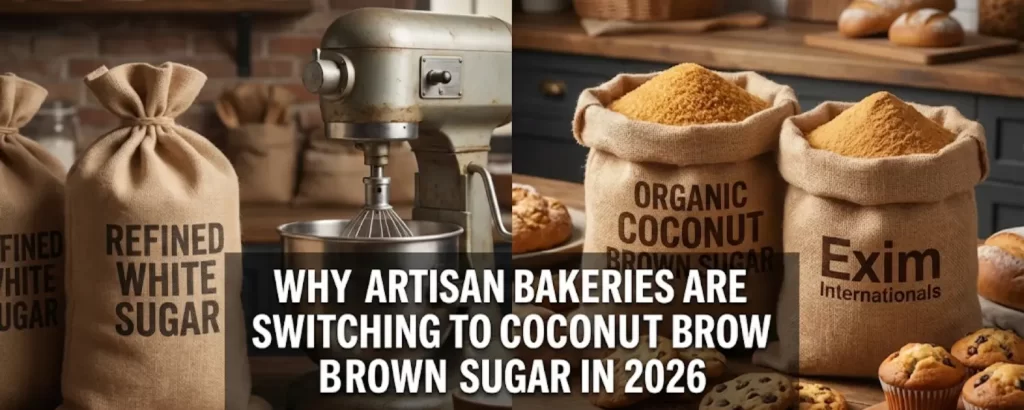
Why Artisan Bakeries Are Switching to Coconut Brown Sugar in 2026

In the world of artisan baking, 2026 is the year of the “Clean Label.” Customers no longer just want a cookie that tastes good; they want to know exactly what is in it. They are scanning ingredient lists for “high fructose corn syrup” and refined white sugar—and they are putting those products back on the shelf. This shift has driven a massive surge in demand for Coconut Brown Sugar. Once a niche health food store item, it is now the secret weapon for top pastry chefs and sourdough bakeries across Europe and the USA. But is it just a trend? Or does it actually perform better in the oven? Here is why your bakery should consider switching to bulk coconut sugar this year. 1. The Flavor Profile: It’s Not Coconut, It’s Caramel One of the biggest misconceptions is that coconut sugar tastes like coconut. It does not. The Taste: It has a deep, earthy sweetness with distinct notes of butterscotch, toffee, and caramel. The Bakery Advantage: Unlike refined white sugar, which provides “flat” sweetness, coconut brown sugar adds complexity. It pairs perfectly with chocolate, coffee, and warm spices (cinnamon, nutmeg), making it the best coconut sugar choice for brownies, carrot cakes, and gingerbread. 2. Superior Moisture Retention For an artisan bakery, shelf life is a constant battle. You want your muffins to stay moist without using artificial preservatives. Hygroscopic Nature: Like regular brown sugar, organic coconut sugar is naturally hygroscopic (it attracts and holds moisture). The Result: Cookies baked with coconut sugar tend to be chewier and stay soft for 24-48 hours longer than those made with white sugar. 3. The “Low-GI” Marketing Edge In 2026, health-conscious indulgence is a massive market segment. Glycemic Index (GI): Regular sugar has a GI of ~65. Coconut sugar has a lower GI of ~35-54. The Claim: By using organic coconut sugar, bakeries can market their treats as “Diabetic-Friendly” or “No Refined Sugar.” This allows you to charge a premium price while offering a product that doesn’t spike blood sugar as aggressively as traditional desserts. 4. Texture Versatility: Granular vs. Powdered Switching sugars used to be a headache for production managers due to dissolving issues. That has changed. At Exim Internationals, we supply two specific grades to solve this: Granular: Excellent for toppings on muffins or crumbles where you want a bit of crunch. Powdered Coconut Sugar: This fine mesh grade dissolves instantly. It is perfect for meringues, frostings, and delicate sponge cakes where you need a smooth texture without the grit. 5. Sustainability as a Brand Value Modern consumers care about the planet. Eco-Friendly: The Food and Agriculture Organization (FAO) named coconut sugar the “most sustainable sweetener in the world.” Coconut trees produce sap for 20+ years with minimal water, unlike cane sugar which is a water-intensive crop. Ethical Sourcing: displaying the “Sustainably Sourced” badge on your packaging builds trust. Future-Proof Your Menu The switch to coconut brown sugar is not just about health; it is about offering a premium, complex flavor that refined sugar simply cannot match. Whether you need bulk coconut sugar for a factory run or a palette for a chain of cafes, Exim Internationals ensures you get consistent, unadulterated quality from the heart of India’s coconut belt. Ready to test the difference? Request a Free Sample of Our Bakery-Grade Coconut Sugar Frequently Asked Questions (FAQs) 1. Can I substitute coconut brown sugar 1:1 for regular sugar? Yes, in most recipes (cookies, cakes, muffins), it is a direct 1:1 substitute. However, because it is slightly less sweet than white cane sugar, some bakers prefer to add 10% more if they want a very sweet result. 2. Does coconut sugar melt like regular sugar? Yes, it melts and caramelizes beautifully. It has a slightly lower burning point than refined sugar, so we recommend lowering your oven temperature by 5-10°C when baking delicate items like meringues. 3. What is the difference between “Coconut Sugar” and “Coconut Brown Sugar”? They are usually the same product. It is often called “Coconut Brown Sugar” because of its rich brown color and similarity to traditional brown cane sugar. Always check the ingredient label to ensure it says “100% Coconut Flower Sap.” 4. Why is powdered coconut sugar better for frosting? Regular granular coconut sugar can be gritty in cold mixtures like buttercream or whipped cream because it doesn’t dissolve easily without heat. Powdered coconut sugar is ground into a fine dust, ensuring your frosting is silky smooth. 5. How do I store bulk coconut sugar in my bakery? Coconut sugar is highly sensitive to moisture (it will turn into a hard rock if left open). Always store your bulk coconut sugar bags in a cool, dry place, and keep them tightly sealed or transferred to airtight bins immediately after opening. About us Exim Internationals is a premier export company dedicated to delivering the finest products from India to international markets. Our mission is to establish India as a global export powerhouse, contributing to economic growth and showcasing the richness of Indian goods worldwide. From the pashmina shawls and apples of the North to the spices of the South, the fruits and powders of the West, and the tea and bamboo of the East, we connect every corner of India with the global market. Certification we have: FSSAI, APEDA, IEC, UDYAM, FIEO, Spices Board, Coconut Contact us Samin heritage, Sl building, Shop no. 19, Chandan wadi, Almeda road Thane west, Maharashtra, India-400601. Email Us: support@eximinternationals.comCall Us: +91 9820446601 | +91 9321559185

Why Artisan Bakeries Are Switching to Coconut Brown Sugar in 2026 Read Post »

Scroll to Top
exim international logo

Get Our Products Pricing

Fill out the form to download!