Spices

fresh ginger
Fruits Export Import Spices Vegetables

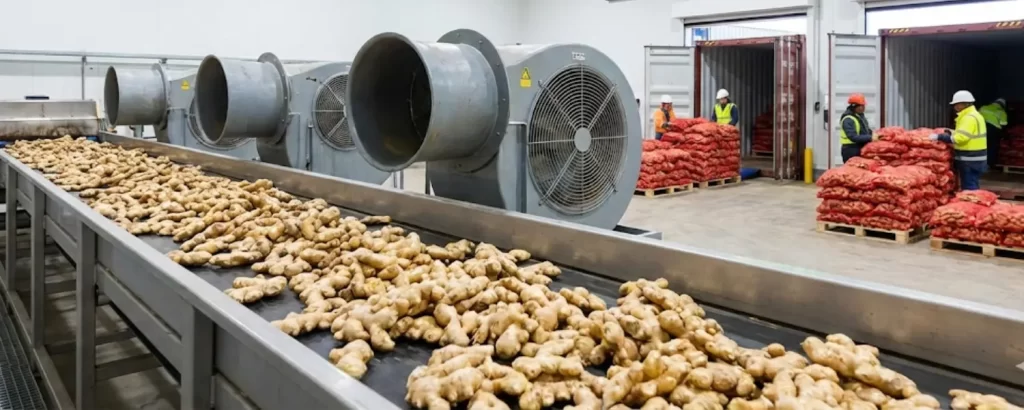
The Drying Factor: How We Control Moisture in Fresh Ginger Shipments

For an importer of fresh produce, fresh ginger is a high-risk, high-reward commodity. It is one of the most difficult rhizomes to transport over long distances. The reason isn’t price or availability; it is biology. Fresh ginger is roughly 80-85% water. This makes it a living, breathing product that is constantly releasing moisture. Too much moisture remaining on the skin? You get Blue Mold (Penicillium) or Soft Rot (Pythium) inside the container within days. Too dry? The rhizomes shrivel, lose weight (shrinkage), and look fibrous and unappealing to the consumer. The art of successful export lies in the “Goldilocks Zone”—maintaining just enough internal moisture for freshness while keeping the surface bone-dry to prevent fungus. At Exim Internationals, we have mastered this balance. Here is the technical breakdown of how we control the “Drying Factor” to protect your investment. 1. The Pre-Export Phase: Curing the Skin Moisture control starts on the farm. We do not pack ginger immediately after harvest. Freshly dug ginger has a very thin, delicate skin that scrapes easily (skinning), which becomes an entry point for bacteria. Our Protocol: We subject the rhizomes to a short curing period. By allowing the ginger to air-dry in the shade for a few days, the skin toughens and heals over minor harvest nicks. This natural barrier is the first line of defense against moisture loss and pathogen entry during the sea voyage. 2. The Washing & Drying Cycle For markets like the UAE and Europe that demand “Washed Ginger,” we use high-pressure water jets to remove soil. However, washing adds surface water-the enemy of long-term storage. The Critical Step: We do not rely on passive drying. After washing, the ginger is passed through Air Blowers and allowed to dry on raised mesh beds in a covered, well-ventilated facility. The Goal: To ensure the surface is dry to the touch, specifically in the “fingers” (the crevices between the nodes) where water tends to get trapped and start fungal colonies. 3. Packaging for Airflow: Mesh vs. Carton If you seal fresh ginger in a plastic bag or a closed box, it will “sweat” its own moisture, creating a greenhouse for mold. Ventilation is non-negotiable. Mesh Bags (25kg / 50kg): This is the preferred packing for the Middle East and Asian markets. The open mesh allows for maximum airflow throughout the pallet stack, ensuring that any respiration moisture escapes rather than settling on the skin. Corrugated Boxes (Cartons): For premium retail markets (like the UK), we use strong 5-ply boxes. Crucially, these boxes are engineered with side ventilation holes aligned to match the pallet stacking pattern, creating a “chimney effect” that pulls cool air through the cargo. Import products for your Needs Ready to Import 4. The Reefer Environment: Controlling Humidity Once the container doors close, the ginger relies on the Reefer (Refrigerated) Unit to manage the atmosphere. Temperature: We typically ship at 12°C to 13°C. Going lower (below 10°C) causes “Chilling Injury,” where the ginger turns grey and watery internally. Humidity Management: We set fresh air exchange vents (typically 15-20 CFM) to flush out the ethylene and excess humidity generated by the ginger, replacing it with fresh, dry cool air. 5. Anti-Fungal Treatment For long transits (20+ days) or specific buyer requests, we can treat the ginger with a food-safe, permissible fungicide dip prior to drying. This provides an chemical shield against surface mold spores that may be present in the air. Note: This is strictly per buyer specifications and import regulations of the destination country. No More “Fuzzy” Surprises Receiving a container of moldy ginger is a financial disaster. It happens when exporters skip the drying phase or use the wrong packaging to save money. At Exim Internationals, we treat moisture control as a science. From curing the skin to ventilating the box, every step is designed to ensure that when you open the container in Dubai or Rotterdam, you see clean, firm, and market-ready fresh ginger. Stop gambling with spoilage. Contact Exim Internationals today for a quote on moisture-controlled, export-quality fresh ginger. Frequently Asked Questions (FAQs) 1. What is the difference between “Washed” and “Unwashed” ginger? Washed Ginger is cleaned of all soil, making it ready for retail shelves but more sensitive to moisture. Unwashed (Muddy) Ginger retains a layer of dried soil, which acts as a natural preservative, extending shelf life. It is often preferred by wholesalers who wash it at the destination. 2. What is the ideal temperature for shipping fresh ginger? The standard protocol is 12°C to 14°C. Temperatures below this range can cause chilling injury, leading to internal rotting and discoloration. 3. How much weight loss (shrinkage) should I expect? Due to moisture evaporation, fresh ginger can lose 3% to 5% of its weight during a typical sea voyage. We account for this by overpacking our bags slightly to ensure you receive the net weight you paid for. 4. Why does my ginger arrive with blue mold? Blue mold usually occurs because the ginger was packed while still damp (surface moisture) or because there was insufficient airflow inside the container, allowing humidity to build up to 100%. 5. Which Indian ginger variety is best for export? Cochin Ginger (from Kerala) and Shimoga/Coorg Ginger (from Karnataka) are famous for export due to their low fiber content, high pungency (oleoresin), and bold size. 6. Can you ship ginger to Europe? Yes. For the EU market, we ensure strict compliance with pesticide residue norms and use premium ventilated carton packaging to meet retail standards. 7. What is the minimum order quantity (MOQ)? Our MOQ is one 20ft or 40ft Reefer Container. A 40ft container typically holds around 24-26 Metric Tons of ginger packed in mesh bags. 8. Is Indian ginger available year-round? The main harvest season (New Crop) starts in December/January. However, we can supply dried or stored fresh ginger year-round, though the “new crop” months offer the best freshness and pricing. About us Exim Internationals is a premier export company dedicated to delivering the finest products from India

The Drying Factor: How We Control Moisture in Fresh Ginger Shipments Read Post »
Drumstick from India to Global
Export Import Fruits Spices Vegetables

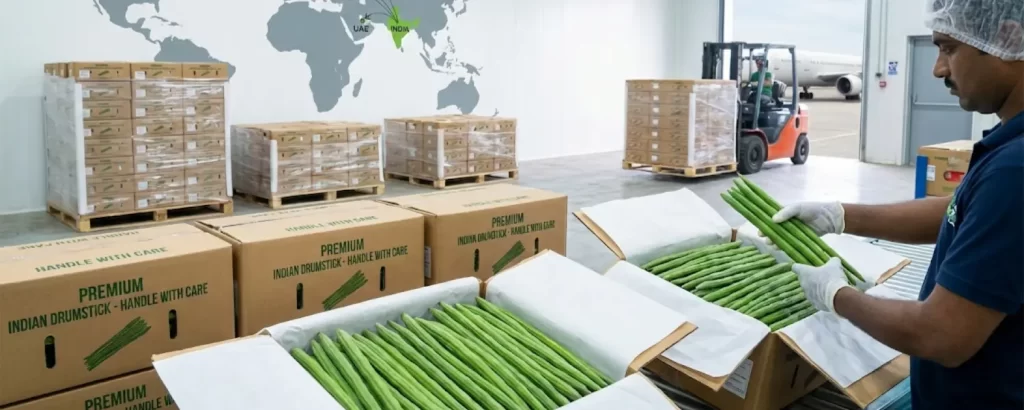
Packaging for Perfection: Ensuring Intact Drumstick from India to Global Buyers

For international importers, sourcing fresh drumstick from India to global markets like the UAE, UK, and USA comes with a specific anxiety: Will it arrive fresh?   Drumstick (Moringa Oleifera) is notoriously fragile. It loses moisture rapidly (shriveling) and snaps easily if mishandled. A shipment that leaves Mumbai green and firm can arrive in Dubai yellow and limp if the cold chain or packaging fails.   At Exim Internationals, we don’t just export vegetables; we export freshness engineering. We understand that for a procurement manager, the value isn’t just in the product—it’s in the condition of arrival. Here is how we ensure every pod arrives shelf-ready. 1. The Variety Advantage: Why ODC is the Exporter’s Choice Before packaging even begins, the choice of variety is critical. While India grows many types, the ODC (Oddanchatram) variety is the gold standard for export. Longer Shelf Life: ODC drumsticks have a naturally thicker skin compared to other local varieties, helping them retain moisture for 2-3 days longer during transit. Flesh-to-Seed Ratio: They are fleshier and tastier, making them the preferred choice for discerning customers in global supermarkets. Uniformity: ODC pods are consistently long and straight, allowing for tighter, safer packing with less breakage. 2. The Pre-Packing Protocol: Pre-Cooling The biggest enemy of freshness is “Field Heat.” If you pack a warm drumstick into a box, it will sweat, leading to fungal growth and rotting within 24 hours. Our Process: Immediately after harvesting, our drumsticks are rushed to a Pre-Cooling Chamber. We rapidly bring the core temperature down to 5°C – 8°C. This puts the vegetable to “sleep,” slowing down its respiration rate and locking in the green color and crunch. 3. The 5-Ply Fortress: Our Packaging Standard We do not use standard local market boxes. For drumstick export, we use specialized 5-Ply Corrugated Fibreboard (CFB) Boxes. Crush Resistance: These boxes are engineered to withstand the weight of stacking in air cargo pallets without crushing the bottom layer. Ventilation: Each box features precision-cut ventilation holes. This allows cold air to circulate freely during the flight, preventing heat buildup while maintaining the necessary humidity. Standard Size: We typically pack in 5kg or 10kg net weight boxes, which are easy for retailers to handle directly. Import products for your Needs Ready to Import 4. Moisture Management: The Secret to “Green” Arrival Air freight is dry. The low humidity at high altitudes can suck the moisture right out of a vegetable. To combat this, we use a dual-layer protection system: Paper Lining: We wrap the bunches in food-grade paper. This absorbs any excess condensation that might form, keeping the skin dry and preventing rot. Moisture Retention: The paper also acts as a humidity buffer, creating a micro-environment inside the box that prevents the pods from drying out and shriveling. 5. Compliance & Documentation Getting the product to the airport is only half the battle. Clearing customs in strict markets like the EU or UAE requires flawless paperwork. Phytosanitary Certificate: Every shipment is inspected and certified pest-free by Indian quarantine authorities. Residue-Free: For our EU and UK clients, we source from GAP-certified farms and provide lab reports proving the product is free from banned pesticide residues. Your Reliable Partner in Freshness When you import drumstick from India to global destinations, you need more than a farmer; you need a logistics partner. By combining the right variety (ODC) with scientific pre-cooling and robust 5-ply packaging, Exim Internationals guarantees that the product you receive is as fresh as the moment it was harvested. Ready to upgrade your fresh vegetable supply chain? Contact Exim Internationals today for a quote on air-freighted, export-quality drumsticks. Frequently Asked Questions (FAQs) 1. What is the shelf life of exported drumsticks? With proper pre-cooling and packaging, our ODC drumsticks have a shelf life of 7 to 10 days from the time of packing, provided they are kept in a cold chain environment (5-8°C). 2. Why do you recommend the ODC variety for export? ODC drumsticks are preferred for export because they are fleshier, tastier, and have a thicker skin that retains moisture better than other varieties, ensuring they stay fresh during air transit. 3. What is the standard box size for drumstick export? We primarily use 5kg Net Weight corrugated boxes. This size is ideal because it minimizes the pressure on the bottom layer of vegetables, preventing breakage and bruising. 4. How do you prevent drumsticks from snapping during transit? We trim the drumsticks to a uniform length (typically 20-24 inches) to fit perfectly inside the box without bending. We also pack them snugly to prevent movement and vibration damage during the flight. 5. Do you ship drumsticks by sea or air? For global markets like Europe and the USA, Air Freight is mandatory due to transit time. For nearby markets like the Maldives or Sri Lanka, sea shipments may be possible, but air is always recommended for premium quality. 6. Is your packaging eco-friendly? Yes, our corrugated boxes are 100% recyclable and biodegradable. We are also moving towards reducing plastic usage by using paper-based liners where regulations permit. 7. Can you supply organic drumsticks? Yes, we have a network of organic certified farms. Please specify your requirement for “Organic” in your inquiry so we can provide the relevant NPOP/USDA certificates. 8. What is the minimum order quantity (MOQ)? For air shipments, our standard MOQ is 500 kg to 1000 kg (1 Ton) to ensure you get the best freight rates. We can mix this with other vegetables like okra or green chili to fill the pallet. About us Exim Internationals is a premier export company dedicated to delivering the finest products from India to international markets. Our mission is to establish India as a global export powerhouse, contributing to economic growth and showcasing the richness of Indian goods worldwide. From the pashmina shawls and apples of the North to the spices of the South, the fruits and powders of the West, and the tea and bamboo of the East, we connect every corner of

Packaging for Perfection: Ensuring Intact Drumstick from India to Global Buyers Read Post »

coconut sugar for food industries
Fruits Export Import Spices Vegetables

Price vs. Purity: How to Detect Adulterated Coconut Sugar in Bulk Shipments

For the global food industry, coconut sugar has graduated from a niche health ingredient to a formulation necessity. From low-GI beverages to paleo-friendly chocolates, manufacturers are scrambling to secure supply. However, this surge in demand has created a dark underbelly in the supply chain: Adulteration.   The math is simple. Coconut sugar is labor-intensive to produce (manual tapping of trees), while cane sugar is industrially farmed and cheap. Unscrupulous suppliers often blend 30-50% cane sugar into bulk coconut sugar to slash costs. For a procurement manager, the risk isn’t just financial—it is legal. If your label claims “Low GI” or “100% Coconut Sugar,” and your product tests positive for cane sucrose, you face recalls and lawsuits.   At Exim Internationals, we believe transparency is the only currency that matters. Here is a technical guide on how to detect adulteration and ensure the integrity of your coconut sugar for food industries. 1. Dark Green Chillies (The “G4” Variety) The most sophisticated (and reliable) way to detect adulteration is looking at the atomic level. The Difference: Coconut trees are C3 plants, meaning they use a specific photosynthetic pathway. Sugarcane and corn are C4 plants. The Test: A Carbon Isotope Ratio Analysis (SIRA) measures the ratio of Carbon-13 to Carbon-12 isotopes. Pure Coconut Sugar: Will show a C3 carbon signature (typically -25‰ to -27‰). Adulterated Sugar: Even a 10% addition of cane sugar shifts the isotopic signature toward the C4 range (-10‰ to -12‰). Procurement Tip: When issuing a Purchase Order (PO), explicitly state: “Must pass C13 Carbon Isotope Analysis for C4 sugar detection.” This clause alone scares off dishonest suppliers. 2. Field Tests: Quick Sensory Checks Before you even send samples to the lab, your Quality Control (QC) team can perform these rapid sensory tests on pre-shipment samples. The “Sweetness” Benchmark Pure Coconut Sugar: Has a complex flavor profile—notes of caramel, butterscotch, and a slight hint of saltiness (minerals). It is less sweet than table sugar. Adulterated Sugar: Tastes aggressively sweet. If the sweetness hits your tongue sharply and immediately (like white sugar), it is likely cut with cane sucrose. The “Solubility” Test Pure: Dissolves slowly in cold water. Because it is unrefined, it often leaves a tiny amount of natural sediment (minerals/fiber) at the bottom of the beaker. Adulterated: If mixed with dyed cane sugar, you might see “color streaks” separating as the dye washes off the white crystals. If it dissolves instantly and perfectly clear, be suspicious. Import products for your Needs Ready to Import 3. Operational Risks: Why Purity Matters for Manufacturing Adulteration isn’t just a label issue; it’s a production nightmare. Melting Point Variances: Pure coconut sugar has a different melting point and hygroscopicity (moisture absorption) compared to cane sugar. In chocolate manufacturing, using an adulterated batch can ruin the tempering process, leading to “blooming” or poor texture. Moisture & Clumping: Export-quality coconut sugar is dried to <2% moisture. Adulterated batches often have higher moisture content or inconsistent granule sizes, leading to massive clumping in industrial hoppers and mixers. 4. The “Color” Myth Do not judge purity by color alone. Natural Variation: Pure coconut sugar varies from light golden to dark brown depending on the harvest season and how long the sap was boiled (caramelization). The Red Flag: Be wary of sugar that is perfectly uniform in color across tons of product. Nature is rarely perfect; industrial blending is. 5. Your Verification Checklist To secure genuine coconut sugar for food industries, implement this 3-step verification protocol: Request the COA (Certificate of Analysis): Ensure it covers SIRA / Carbon Isotope testing, not just basic microbial checks. Check the “Ash” Content: Pure coconut sugar is high in minerals (Potassium, Magnesium, Zinc). It typically has an ash content of 2-3%. Refined cane sugar has <0.5%. A low ash reading is a dead giveaway of dilution. Audit the Supply Chain: Does the exporter have direct farm relationships? Adulteration usually happens at the aggregation level (middlemen), not the farm level. Import products for your Needs Ready to Import Sourcing with Confidence In the high-stakes world of food manufacturing, “cheap” coconut sugar is the most expensive ingredient you can buy. It costs you your reputation. At Exim Internationals, we strictly monitor our supply chain from the tapping of the flower to the sealing of the bulk bag. We provide full transparency, including Isotope Analysis reports, so you can formulate with confidence. Don’t gamble with your ingredients. Contact Exim Internationals today for a quote on 100% pure, lab-verified coconut sugar. Frequently Asked Questions (FAQs) 1. What is the most reliable test for coconut sugar adulteration? The Carbon Isotope Ratio Analysis (SIRA), specifically checking for C4 sugars, is the gold standard. It can detect even small amounts of cane or corn syrup added to the coconut sugar. 2. Why is cane sugar used as an adulterant? It is primarily about cost. Cane sugar is significantly cheaper to produce than coconut sugar. It also mimics the crystalline structure, making it easy to blend visually. 3. Does pure coconut sugar taste like coconut? No. Pure coconut sugar is made from the sap of the flower bud, not the nut. It tastes like a rich, earthy caramel or butterscotch, similar to brown sugar but with more depth. 4. What mesh size should I order for beverage manufacturing? For beverages, we recommend a fine mesh (60-80 mesh). Standard granule sizes may not dissolve quickly enough in cold liquids, leaving residue. We can customize the grind size for your application. 5. Is your coconut sugar FSSAI and FDA compliant? Yes. Our export facilities are compliant with FSSAI (India), FDA (USA), and EU food safety standards. We provide full traceability documents with every container. 6. What is the standard bulk packaging for food industries? We supply 25kg Multi-Wall Paper Bags with an inner HDPE liner to protect against moisture. This is the industry standard for easy handling in factories. 7. Can you supply Organic Certified coconut sugar? Yes. We offer NPOP/NOP Certified Organic coconut sugar for brands that require clean label

Price vs. Purity: How to Detect Adulterated Coconut Sugar in Bulk Shipments Read Post »

green chillies
Export Import Fruits Spices Vegetables

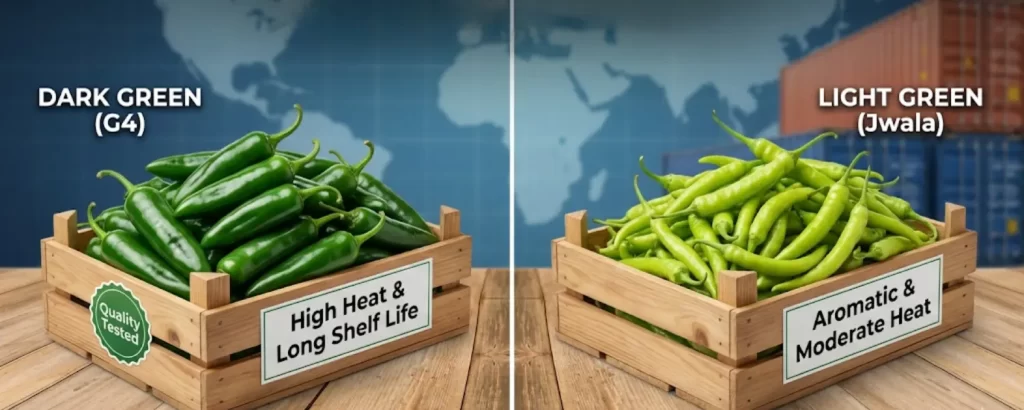
Sourcing Dark Green vs. Light Green Chillies: Which is Right for Your Market?

In the international fresh produce trade, a “green chilli” is never just a green chilli. For an importer in Dubai, London, or Singapore, the difference between a successful shipment and a rejected container often comes down to one specific specification: Variety.   Indian green chillies are broadly categorized into two commercial powerhouses: the Dark Green (G4) and the Light Green (Jwala). While they may look similar to the untrained eye, they are distinct products with different heat levels (pungency), shelf lives, and culinary uses. Choosing the wrong one for your target demographic can be a costly mistake.   As a leading exporter based in Pune, Exim Internationals helps you decode the market demand to ensure you import the right spice for your customers. 1. Dark Green Chillies (The “G4” Variety) If you walk into a supermarket in the UAE or Europe, the chilli you see is most likely the G4 variety. Appearance: Deep, glossy dark green color with a smooth, thick skin. They typically range from 3 to 5 inches in length. Heat Profile (Pungency): High. These are spicy chillies, prized for their ability to add significant heat without needing a large quantity. Shelf Life: Excellent. This is the primary reason importers prefer G4. The thicker skin makes them more resilient to moisture loss and physical handling during transit. They hold up exceptionally well in cold storage (reefer containers). Best Market: Ideal for the Middle East (UAE, Saudi Arabia, Qatar) and markets that demand “hot” chillies for curries and spicy pastes. 2. Light Green Chillies (The “Jwala” Variety) Often called the “finger chilli,” the Jwala (which means “Volcano” in Hindi) is the traditional favorite of the Indian domestic market and the diaspora. Appearance: Pale, light green color. The key visual differentiator is the skin—it is slightly wrinkled and thinner than the G4. They are often longer and slender. Heat Profile (Pungency): Moderate to High, but with a unique aromatic profile. It offers a pungent flavor that is distinct from the sharp bite of the dark green variety. Shelf Life: Moderate. Due to the thinner skin, light green chillies are more sensitive to temperature changes and have a shorter shelf life than G4. They require precise air freight logistics or highly controlled sea shipments. Best Market: High demand in the UK, USA, and Canada, specifically among the South Asian diaspora who prefer the specific aroma of Jwala for traditional cooking, pickles, and consumption as a raw side dish. Import products for your Needs Ready to Import Quick Comparison: G4 vs. Jwala Feature Dark Green (G4) Light Green (Jwala) Color Deep, Glossy Green Pale, Light Green Skin Texture Smooth, Thick Wrinkled, Thin Heat Level Very Hot (High Pungency) Hot + Aromatic Shelf Life Long (10-14 Days) Medium (7-10 Days) Top Logistics Sea & Air Freight Mostly Air Freight 3. The “Dual-Purpose” Strategy Many successful wholesalers do not choose just one. They stock both to cater to different segments: Restaurant/HORECA Clients: Usually prefer Dark Green (G4) because it is easier to store, slice, and provides consistent heat for commercial cooking. Retail/Grocery Clients: Often prefer Light Green (Jwala) for the fresh produce aisle, catering to home cooks who value the specific aroma. 4. Our Cold Chain Guarantee Regardless of the color, the enemy of fresh green chillies is heat. Field heat causes rapid ripening (turning the chilli red) and rotting. At Exim Internationals, we follow a strict protocol for both varieties: Pre-Cooling: Harvested chillies are immediately pre-cooled to 4°C to remove field heat. Sorting: We manually sort to remove any “red tips” or damaged pieces. Ventilated Packing: We use 5-ply ventilated boxes (Net Weight 3.8kg – 4kg) that allow cold air to circulate during the flight or sea voyage, preventing “sweating” inside the box. Know Your Customer Before you place your order, ask yourself: Who is the end consumer? If they want durability and high heat, go Dark Green. If they want traditional aroma and culinary authenticity, go Light Green.   Not sure which variety fits your supply chain? Contact Exim Internationals today for samples and a quote on fresh G4 and Jwala Green Chillies. Frequently Asked Questions (FAQs) 1. Which green chilli variety is best for export to the UAE? The Dark Green (G4) variety is the most popular for the UAE market. Its thick skin allows it to survive sea transit perfectly, and its high heat matches the local palate. 2. What is the shelf life of exported green chillies? With proper pre-cooling and cold chain management (at 4-6°C), Dark Green (G4) chillies can last 12-15 days, making them suitable for sea shipments to nearby ports. Light Green (Jwala) varieties typically last 8-10 days and are often sent via air freight. 3. What is the standard packing size for green chilli exports? The international standard is a Net Weight 3.8kg to 4.5kg corrugated box. We use ventilated boxes to ensure airflow, which is critical to prevent the chillies from rotting. 4. Why do green chillies turn red during shipping? This happens if the “field heat” was not removed before packing, or if the reefer container temperature fluctuated. Chillies continue to ripen (turn red) if kept warm. We solve this by strictly pre-cooling all stock. 5. Can you mix Dark and Light green chillies in one shipment? Yes. For air freight shipments, we frequently send mixed pallets of G4 and Jwala to help importers test the demand for both varieties in their local market. 6. Do you supply pesticide-free green chillies for the EU/UK? Yes. For the European market, we source from specific GAP-certified farms and test for Maximum Residue Limits (MRL) to ensure compliance with strict EU import norms. 7. What is the Scoville unit (SHU) of G4 chillies? G4 Green Chillies typically range from 70,000 to 100,000 SHU, putting them in the “hot” category, similar to Thai Bird’s Eye chillies but with more flesh. About us Exim Internationals is a premier export company dedicated to delivering the finest products from India to international markets. Our mission is to establish India

Sourcing Dark Green vs. Light Green Chillies: Which is Right for Your Market? Read Post »

Cavendish Bananas to uae
Export Import Fruits Spices Vegetables

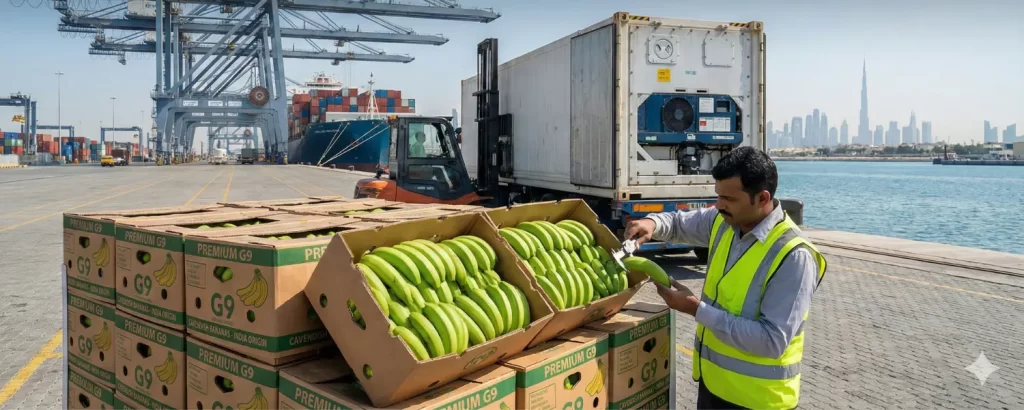
How to Secure a Container of Premium Cavendish Bananas for Jebel Ali Port

For fruit importers in Dubai and the wider UAE, the “green gold” of the fresh produce trade is the Cavendish banana. It is a high-volume, high-demand staple. But sourcing a container that arrives at Jebel Ali Port perfectly green, blemish-free, and ready for ripening is not a matter of luck—it’s a matter of specs and logistics. While the Philippines and Ecuador are traditional giants, Indian G9 Cavendish bananas have become the preferred choice for the UAE market due to a massive geographical advantage: Speed. As a specialized exporter from India, we handle the intricacies of this trade daily. This guide will walk you through exactly how to secure a premium container load, ensuring you get the quality your customers demand. Step 1: Define Your “Premium” Specs (The G9 Standard) To secure a premium container, you must first define what “premium” means in your Purchase Order (PO). For the UAE market, the standard for high-quality G9 Cavendish is very specific. Don’t just ask for “bananas.” Specify the following: Variety: G9 Cavendish (Grand Naine) – prized for its long shelf life. Calibration (Thickness): Premium Grade A fruit typically requires a calibration of 39mm to 47mm. Anything thinner is considered Grade B. Finger Length: Minimum 18 cm from pulp to tip. Hands per Carton: 4, 5, or 6 hands. (Fewer hands usually indicate larger fruit sizes, which fetch a premium). Appearance: The fruit must be 100% green, hard, and free from “sugar spots” (which indicate ripening has already started). Step 2: Choose the Right Packing (7kg vs. 13kg) For Cavendish bananas to UAE, packaging isn’t just about holding the fruit; it’s about your end buyer. We offer two standard options, and choosing the right one affects your bottom line. 13kg / 13.5kg Cartons: Best For: Wholesalers, re-exporters, and large supermarkets. The Advantage: This is the industry standard “Net Weight” box. It offers the best value on freight since you fit more weight per container (approx. 1,540 boxes per 40ft container). 7kg Cartons: Best For: Premium retail, convenience stores, and the HORECA sector. The Advantage: These smaller boxes protect the fruit better (less compression weight) and are easier for smaller retailers to handle directly without repacking. Import products for your Needs Ready to Import Step 3: The Logistics Advantage (India to Jebel Ali) This is why UAE buyers are switching to India. The transit time from Nhava Sheva (Mumbai) to Jebel Ali is incredibly short—typically 5 to 7 days. Compare this to the 25+ days from South America or the Philippines. Fresher Arrival: The fruit spends less time at sea, meaning it arrives with more “green life” remaining. Cash Flow: A shorter transit time means your capital isn’t tied up on the water for a month. You can turn your inventory over faster. Step 4: Ensuring Compliance (The Documentation) A container stuck at customs is a disaster for fresh fruit. To clear Jebel Ali customs smoothly, your Indian exporter must provide a flawless documentation packet. Ensure your contract includes: Phytosanitary Certificate: Issued by Indian authorities certifying the fruit is free from pests. Certificate of Origin: Crucial for trade agreements. Bill of Lading: Your title to the goods. Temperature Logs: Data from the reefer container proving the fruit was kept at the critical 13.5°C throughout the voyage. Buying Strategy, Not Just Fruit Securing a container of premium Cavendish bananas is about partnering with an exporter who understands the Jebel Ali trade lane. By specifying Grade A specs, choosing the right carton size for your customers, and leveraging India’s short transit time, you ensure that every container you open is profitable. Ready to book your next 40ft reefer to Dubai? Contact Exim Internationals today for our current FOB rates on premium G9 Cavendish. Frequently Asked Questions (FAQs) 1. What is the minimum order quantity (MOQ) for exporting bananas to the UAE? The standard MOQ is one 40-foot High Cube Reefer Container. This holds approximately 1,540 boxes (of 13kg) or 20 Metric Tons. Shipping less than a full container is not recommended due to high freight costs and temperature control risks. 2. Why is the 13.5°C temperature so important? Bananas are highly sensitive. If the temperature drops below 13°C, they suffer “chilling injury” and turn grey. If it rises above 14°C, they begin to ripen during transit. We maintain a strict 13.5°C protocol to keep them in a “sleeping” green state. 3. Can you ship mixed containers of 7kg and 13kg boxes? Yes, it is possible to load a mix of carton sizes in a single container, provided the stacking pattern allows for proper airflow. This is great for importers who serve both wholesale and retail clients. 4. How do I ripen the bananas once they arrive in Jebel Ali? The bananas arrive green and hard. You will need to move them to a ripening chamber in the UAE where they are treated with ethylene gas and controlled temperatures to turn them the perfect golden yellow before sale. 5. What is “calibration” in banana exports? Calibration refers to the thickness (diameter) of the banana finger. For the UAE market, a 39mm to 47mm calibration is the standard for premium grade fruit. 6. Do you handle customs clearance in Dubai? As exporters (FOB/CNF terms), we handle all export clearance in India. For import clearance in Jebel Ali, we provide you with all necessary documents (Phyto, Invoice, BL), but you will need a local clearing agent in the UAE. About us Exim Internationals is a premier export company dedicated to delivering the finest products from India to international markets. Our mission is to establish India as a global export powerhouse, contributing to economic growth and showcasing the richness of Indian goods worldwide. From the pashmina shawls and apples of the North to the spices of the South, the fruits and powders of the West, and the tea and bamboo of the East, we connect every corner of India with the global market. Certification we have: FSSAI, APEDA, IEC, UDYAM, FIEO, Spices Board, Coconut Contact us Samin heritage, Sl building,

How to Secure a Container of Premium Cavendish Bananas for Jebel Ali Port Read Post »

indian mangoes
Fruits Export Import Spices Vegetables

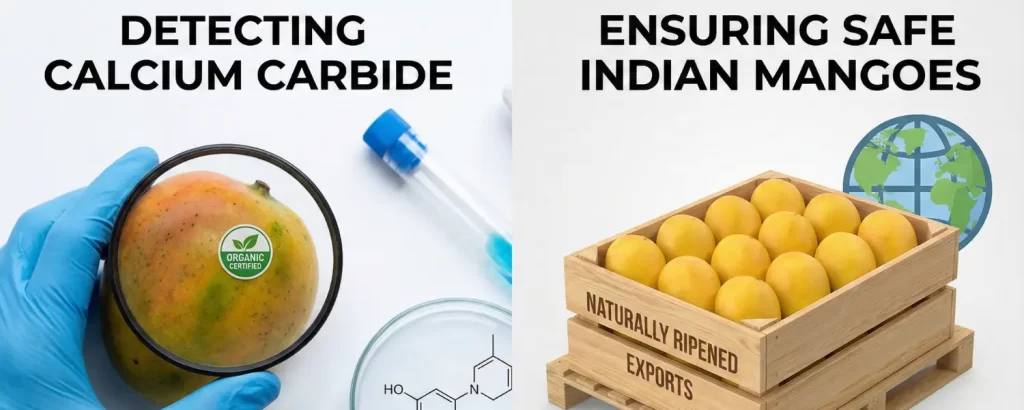
Detecting Calcium Carbide: How We Ensure Naturally Ripened Mango Exports

For international buyers of Indian mangoes-especially premium varieties like Alphonso, Kesar, and Banganapalli—flavor is everything. But in recent years, a shadow has fallen over the fruit trade: Calcium Carbide. This banned chemical ripening agent not only ruins the authentic taste of the mango but poses serious health risks, including potential carcinogenicity. For importers in the EU, USA, and UK, sourcing mangoes that are guaranteed naturally ripened is not just a preference; it is a strict regulatory requirement. At Exim Internationals, we believe transparency is the only way to build trust. This guide explains exactly why Calcium Carbide is dangerous, how we use safe Ethylene Ripening instead, and the rigorous testing protocols we use to prove it. The Hidden Danger: What is Calcium Carbide? Calcium Carbide (CaC2), often called “masala” in local markets, is an industrial chemical used in welding. When it comes into contact with moisture, it releases acetylene gas, which mimics the natural ripening hormone ethylene. While it speeds up the color change of the fruit (turning it yellow overnight), it fails to ripen the fruit internally. The result is a mango that looks ripe on the outside but is sour, hard, and flavorless on the inside.   Why It Is Banned Globally Arsenic & Phosphorus Traces: Commercial-grade calcium carbide contains toxic impurities like arsenic and phosphorus hydride, which remain on the fruit skin. Health Risks: Consumption can lead to neurological issues, gastric irritation, and long-term carcinogenic risks. Flavor Destruction: It forces the peel to change color without breaking down the starches into sugars, destroying the mango’s natural sweetness and aroma. The Safe Alternative: Our Ethylene Ripening Process We do not leave ripening to chance. To ensure our mangoes arrive with perfect brix levels (sweetness) and uniform color, we use Ethylene Ripening Chambers. Ethylene is a natural plant hormone produced by the fruit itself. Our process simply helps the fruit do what it does naturally, but in a controlled environment.   The 4-Step Natural Ripening Workflow Harvesting at Maturity: We only harvest mangoes that have reached full physiological maturity (not ripeness). This ensures the fruit has enough natural starch to convert into sugar. Pre-Cooling & Cleaning: Fruits are washed and pre-cooled to remove field heat. For markets like the USA, they undergo Hot Water Treatment (HWT) at this stage to eliminate pests. Ethylene Exposure: The mangoes are placed in airtight chambers where safe, food-grade ethylene gas is introduced at controlled concentrations (typically 100 ppm) for 24 hours. Controlled Temperature: The chamber is maintained at a specific temperature (18°C–22°C) to allow the enzymes to break down starches into sugars naturally. The Result: A mango that is uniformly yellow, soft to the touch, and bursting with natural sweetness and aroma. Import products for your Needs Ready to Import How We Verify & Detect: The “Carbide-Free” Guarantee As an importer, you cannot rely on visual inspection alone. We provide scientific proof that our shipments are free from artificial chemical agents. 1. The Certificate of Analysis (COA) Every export batch is tested by an APEDA-recognized laboratory. We provide a COA that specifically tests for: Heavy Metals: Arsenic and Phosphorus residues (the tell-tale signs of calcium carbide usage). Acetylene Residue: Confirming zero traces of industrial gas exposure. 2. Traceability (Farm-to-Packhouse) We source directly from Global GAP certified farms and process in APEDA-approved packhouses. Our supply chain is closed, meaning no third-party traders can inject artificially ripened stock into your consignment. 3. Physical Inspection Indicators While lab tests are definitive, you can often spot naturally ripened mangoes by: Aroma: Naturally ripened mangoes have a strong, sweet aroma. Carbide mangoes often have no smell or a slight garlic-like chemical odor. Appearance: Naturally ripened fruit often has uneven color (hints of green are normal). Carbide fruit is often an unnatural, uniform bright yellow while remaining hard. Floating Test: In some cases, naturally ripened mangoes (which are denser with sugar) will sink in water, while artificially ripened ones (high in starch/air) may float. Purity is Our Promise Sourcing Indian mangoes should be a celebration of flavor, not a safety risk. By strictly adhering to Ethylene Ripening protocols and providing transparent lab reports, Exim Internationals ensures that the mangoes you receive are as safe as they are delicious. Don’t compromise on safety. Contact Exim Internationals today to pre-book your 2026 harvest of naturally ripened, lab-certified Alphonso and Kesar mangoes. Frequently Asked Questions (FAQs) 1. Is Ethylene ripening safe? Yes. Ethylene is a natural plant hormone found in all fruits (bananas, apples, mangoes). Using it in a controlled chamber is the global standard for safe ripening and is approved by the FDA and FSSAI. 2. Why do some mangoes look yellow but taste sour? This is a classic sign of Calcium Carbide treatment. The chemical forces the skin to turn yellow before the starches inside have had time to convert into sugar, resulting in a sour taste. 3. Does Hot Water Treatment (HWT) ripen the mangoes? No. HWT is a phytosanitary process used to kill fruit fly larvae (required for the USA/EU). Ripening happens after HWT in separate ethylene chambers or during transit. 4. Can you provide a lab report proving no calcium carbide was used? Yes. We provide a Certificate of Analysis (COA) with every shipment, which includes testing for arsenic and phosphorus residues, ensuring the fruit is carbide-free. 5. How long does natural ripening take compared to chemical ripening? Natural ethylene ripening takes 4-5 days to achieve full sweetness. Chemical ripening can turn a fruit yellow in 12-24 hours, but without the flavor development. 6. Do you export mangoes to the USA? Yes. We strictly follow the USDA-APHIS pre-clearance program, which includes irradiation and strict packing protocols to ensure compliance with US import standards. 7. What varieties do you export? We specialize in Alphonso (Maharashtra), Kesar (Gujarat), Banganapalli (Andhra Pradesh), and Totapuri varieties. 8. When should I book my order for the 2026 season? To secure naturally ripened stock from the first harvest, we recommend booking your contracts by January or February 2026. About us Exim Internationals

Detecting Calcium Carbide: How We Ensure Naturally Ripened Mango Exports Read Post »

coconuts
Export Import Fruits Spices Vegetables

The HORECA Guide: Sourcing Fresh Coconuts for Hotels & Resorts

In the competitive world of hospitality, the difference between a 4-star and a 5-star experience often comes down to the freshness of the ingredients. For beach resorts, wellness retreats, and luxury hotels, the fresh coconut is more than just a fruit; it is a symbol of tropical luxury and natural health. Whether served as a welcome drink in the lobby, grated fresh for a signature South Indian curry, or used in a spa treatment, the quality of the coconut reflects directly on your brand. For F&B Managers and Executive Chefs, sourcing consistent, high-quality fresh coconuts in bulk is a unique challenge. This guide is designed to help HORECA professionals navigate the supply chain, ensuring that every coconut served is as impressive as the property itself. 1. The Chef’s Choice: Why Origin Matters In fine dining, origin is everything. Just as you source sparkling wine from Champagne, the discerning choice for coconuts is Pollachi, India. Known as the “Coconut Capital of India,” Pollachi’s unique geographical position—rich red soil and high water table—produces a coconut variety that is superior for two key reasons: Sweetest Water: Pollachi tender coconuts are renowned for water that is naturally sweeter and more flavourful, reducing the need for added sugar in mocktails and beverages. Thick, White Meat: For culinary applications, the meat of a mature Pollachi coconut is thicker, whiter, and richer in oil. This translates to creamier coconut milk for curries and stews, a non-negotiable for authentic regional cuisine. Marketing Tip: Don’t just serve “fresh coconut water.” List “Fresh Pollachi Coconut Water” on your menu. It signals a commitment to sourcing the best ingredients available. 2. Sourcing Checklist for F&B Managers When receiving a bulk shipment at your loading dock, your team needs a quick, reliable way to verify quality. Here is a checklist for your receiving clerk: The Shake Test: A mature coconut must feel heavy for its size. When shaken, you should hear a distinct “sloshing” sound. If there is no sound, the water has dried up; if it sounds too “hollow,” the nut may be over-mature. The Eye Exam: Check the three “eyes” at the base. They should be dry and firm. Any moisture or mold here is an immediate red flag for internal spoilage. Size Uniformity: For resort beverage service, presentation is key. Demand a supplier who grades by size (e.g., 12-13 inch circumference) so every guest receives a uniform experience. Shell Integrity: Ensure there are no hairline cracks. Even a microscopic crack can lead to fermentation and sour water within days. Import products for your Needs Ready to Import 3. Storage & Inventory Management in Hotels Managing perishable inventory in a busy hotel requires precision. Coconuts are robust, but they are not invincible. Temperature Control: Ideally, fresh coconuts should be stored between 32°F – 40°F (0°C – 4°C). For tender coconuts served as drinks, keeping them chilled is essential not just for taste, but to slow down the maturation process. Humidity: Maintain 80-85% relative humidity. Low humidity will cause the water to evaporate through the shell, shrinking the meat. Rotation: Implement a strict FIFO (First-In, First-Out) system. A fresh coconut typically has a shelf life of 30-60 days depending on storage, but in a premium setting, you want to serve them within 1-2 weeks of arrival for peak freshness. Packaging: Move away from rough gunny sacks which can harbour pests and dirt. Request clean, stackable plastic crates or mesh bags for easier handling and hygiene in the kitchen store. 4. Beyond the Menu: Diverse Applications in Resorts A high-quality fresh coconut is a versatile asset for a resort property. The “Instagrammable” Welcome: Nothing sets the vacation mood faster than a chilled, fresh tender coconut served whole upon arrival. Zero-Waste Kitchen: Use the water for the bar, the meat for the kitchen, and the shell for eco-friendly serving bowls or charcoal for the BBQ grill. Wellness & Spa: Freshly grated coconut is an excellent base for organic body scrubs. Coconut milk baths are a premium luxury treatment. Using fresh ingredients from your own kitchen adds an “organic/farm-to-spa” appeal. 5. Partnering with the Right Exporter For a hotel chain, supply chain reliability is as important as quality. You cannot afford to run out of coconuts during peak wedding season or a corporate retreat. At Exim Internationals, we understand the HORECA sector’s demands. We don’t just supply coconuts; we supply consistency. Graded Supply: We sort specifically for the hospitality industry, ensuring uniform size and weight. Freshness Guarantee: Our efficient logistics from Pollachi ensure minimum transit time, so the shelf life is spent in your hotel, not on a truck. Volume Capablity: From a pallet for a boutique hotel to container loads for a resort chain, we scale with your needs. Elevate your guest experience with the finest fresh coconuts. Contact Exim Internationals today for a quote tailored to your hotel’s volume and seasonal requirements. Frequently Asked Questions (FAQs) 1. How long can fresh coconuts be stored in a hotel walk-in cooler? Fresh coconuts can last 1-2 months if stored at 32°F-40°F with proper humidity. However, for the best guest experience (sweetest water), we recommend consuming them within 2 weeks of delivery. 2. Why are Pollachi coconuts preferred for hotel kitchens? Pollachi coconuts are preferred for their superior meat thickness and oil content, which yields richer, creamier coconut milk—essential for high-quality curries and desserts. 3. What is the best way to open tender coconuts safely in a high-volume bar? Invest in specialized “coconut opener” tools rather than traditional machetes. These tools drill a clean hole for a straw or pour, ensuring safety for staff and a neat presentation for guests. 4. Can you supply semi-husked coconuts to reduce waste disposal at the resort? Yes. Semi-husked coconuts are ideal for hotels as they have reduced bulk/waste while the remaining husk tuft protects the eyes, ensuring shelf life is maintained during transit. 5. Do you offer organic certified fresh coconuts for wellness resorts? Yes, we can source organic certified coconuts from specific partner farms in Pollachi

The HORECA Guide: Sourcing Fresh Coconuts for Hotels & Resorts Read Post »

fennel for foods
Vegetables Export Import Fruits Spices

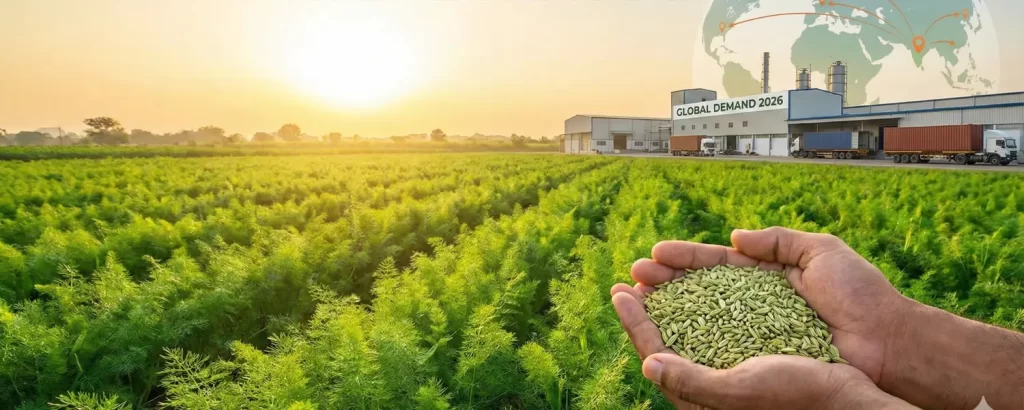
The Global Palate: The Rising Demand for Indian Fennel for Foods in 2026

In the dynamic world of global food manufacturing, taste profiles are constantly evolving. As we approach 2026, one trend is unmistakable: the “Global Palate” is shifting towards authentic, complex, and functional ingredients. At the center of this shift is a humble seed with a powerful profile: Indian Fennel. While fennel has always been a staple in South Asian cuisine, its role is rapidly expanding. From artisan bakeries in Europe to meat processors in the Americas, the demand for high-quality Indian fennel for foods is surging. As a leading exporter of Indian spices, Exim Internationals is witnessing this transformation firsthand. Here is why food manufacturers worldwide are turning to Indian fennel as a key ingredient for their 2026 product lines. 1. The “Clean Label” Revolution & Natural Flavoring The modern consumer demands transparency. They want “clean labels” free from artificial flavors and preservatives. This is where Indian fennel shines. The Anethole Advantage: Indian fennel, particularly varieties like Lucknow Fennel, has a naturally high content of anethole. This compound provides a potent, sweet, liquorice-like flavor that is 13 times sweeter than sugar. Application: Manufacturers are using fennel for foods—specifically in confectionery, chewing gums, and breath mints—as a natural flavoring agent that allows them to reduce artificial sweeteners while maintaining a premium taste profile. 2. The Bakery & Confectionery Boom The bakery sector is perhaps the largest driver of this new demand. The traditional use of fennel in rye breads is expanding into premium cookies, digestive biscuits, and even artisanal chocolates. Texture and Aroma: The Indian variety is prized for its smaller, greener seeds which offer a superior crunch and a more delicate aroma compared to coarser varieties from other origins. Global Fusion: We are seeing a rise in fusion products, such as fennel-infused biscotti and spiced pastries, where the sweet-savory note of fennel provides a sophisticated edge. Import products for your Needs Ready to Import 3. Meat Processing and Savory Snacks In the savory sector, fennel for foods is becoming indispensable for its ability to cut through rich fats. Italian Sausage & Cured Meats: The authentic flavor of Italian sausage relies heavily on fennel. As global demand for premium charcuterie grows, so does the need for high-quality, clean fennel seeds that are free from foreign matter. Plant-Based Meats: Interestingly, the plant-based meat industry is a growing buyer. Fennel is used to mask “beany” off-notes in soy and pea protein, creating a more meat-like savory profile in vegan sausages and patties. 4. Functional Foods: Digestion as a Selling Point In 2026, “functional foods”—products that offer health benefits beyond basic nutrition—will dominate the shelves. Fennel is historically renowned for its digestive properties. Digestive Teas & Biscuits: Brands are explicitly marketing products containing fennel as “digestive aids.” Sourcing high-quality Indian fennel allows these manufacturers to make credible claims about the functional benefits of their products. 5. Why Indian Origin? The Quality Factor Why are global buyers specifically requesting Indian fennel? Two Harvests: India is one of the few countries with two fennel crops a year (Rabi and Kharif), ensuring a fresh, year-round supply that stabilizes prices for large-scale manufacturers. Food Safety Standards: With the rise of strict EU and FDA regulations, Indian exporters have adapted. At Exim Internationals, we supply Steam Sterilized fennel that meets the strictest microbial limits, ensuring it is safe for ready-to-eat (RTE) applications without the use of chemical ETO sterilization. A Strategic Ingredient for 2026 For food product developers and procurement managers, Indian fennel is no longer just a spice; it is a strategic ingredient. It offers natural sweetness, functional health benefits, and a premium flavor profile that aligns perfectly with the 2026 consumer trends. As you plan your ingredient sourcing for the coming year, ensure your supply chain is ready. Developing a new product line? Contact Exim Internationals today for samples of our premium, steam-sterilized Indian fennel suitable for all food applications. Frequently Asked Questions (FAQs) 1. Why is Indian fennel preferred for food manufacturing over other origins? Indian fennel is preferred due to its higher anethole content, which gives it a sweeter, more potent aroma. It also has a brighter green color and a cleaner appearance, which is visually appealing in bakery and confectionery applications. 2. What food safety standards apply when sourcing fennel for foods? For global food manufacturing, safety is paramount. Key standards include Steam Sterilization to control microbial load (Salmonella/E. coli), purity levels (typically 99% or 99.5%), and compliance with maximum residue limits (MRLs) for pesticides, especially for EU and US markets. 3. Can fennel seeds be used as a natural preservative? Yes. Fennel seeds contain antioxidant compounds that can help extend the shelf life of certain food products by preventing the oxidation of fats, making them a valuable ingredient for “clean label” preservation strategies. 4. What forms of fennel are available for food manufacturers? We supply fennel for foods in various forms: Whole Seeds: For bakery toppings and pickling. Cracked/Coarse Grind: For sausages and spice rubs. Fine Powder: For sauces, beverages, and confectionery. 5. Is Indian fennel suitable for the beverage industry? Absolutely. It is widely used in the production of herbal teas, digestive infusions, and even in the distillation of spirits like gin and absinthe, where its aromatic profile is essential. 6. What is the harvest season for Indian fennel? The main crop (Rabi) is sown in October-November and harvested in February-March. This is the best time for food manufacturers to contract for the freshest, most aromatic crop for the year ahead. 7. How does steam sterilization differ from ETO for food ingredients? Steam sterilization uses only heat and water to kill bacteria, leaving no chemical residue. This is safe and accepted globally. ETO (Ethylene Oxide) is a chemical treatment that is banned or restricted in many countries (like the EU) due to health risks. We recommend steam sterilization for all food applications. 8. How can I get a sample of Indian fennel for my R&D team? Simply contact us with your specific application (e.g., bakery, meat, beverage). We can provide samples of

The Global Palate: The Rising Demand for Indian Fennel for Foods in 2026 Read Post »

benefits of organic black pepper
Export Import Fruits Spices Vegetables

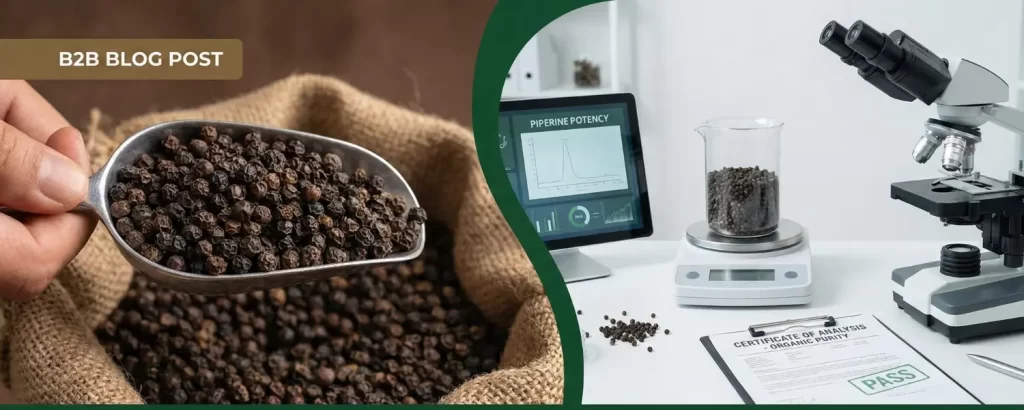
Sourcing for Health: How to Verify the Purity Benefits of Organic Black Pepper

In the booming global wellness market, “Organic” is no longer just a buzzword—it is a baseline requirement for premium brands. Consumers are increasingly aware that the medicinal benefits of organic black pepper from enhanced digestion to potent anti-inflammatory properties—rely entirely on the purity of the spice. For supplement manufacturers, organic food brands, and cosmetic formulators, the challenge isn’t just finding black pepper; it is finding clean black pepper. Conventional pepper is often subjected to irradiation, chemical sterilization, and pesticide use, all of which can compromise the very health benefits your customers are paying for. As a leading exporter of Indian spices, Exim Internationals understands the rigorous standards required for organic sourcing. Here is how procurement managers can verify purity and ensure their products deliver the maximum therapeutic value. Why “Organic” Matters for Bioavailability The primary active compound in black pepper is Piperine. It is the engine behind the spice’s thermogenic and bio-enhancing properties (most notably, boosting Curcumin absorption by 2000%). However, the benefits of organic black pepper go beyond just piperine content. Organic farming ensures that the peppercorn is free from synthetic pesticides and fertilizers. This is critical because: Chemical Residues: Pesticides can mimic estrogen and disrupt hormonal balance, negating the wellness goals of the final product. Solvent Extraction: In the nutraceutical industry, when pepper is extracted for oleoresins, using organic raw material ensures no concentration of farming chemicals in the final extract. Step 1: Verify the Certification Chain The first step in validating the benefits of organic black pepper is paperwork. A claim of “organic” on an invoice is insufficient. You need a traceable paper trail. NPOP / NOP Standards: Since India is a primary source, look for certification under the National Programme for Organic Production (NPOP), which is recognized by the European Commission and the USDA (NOP). Transaction Certificates (TC): For every shipment, ask your exporter for a Transaction Certificate. This document tracks the specific lot of pepper from the certified farm to your container, ensuring no conventional pepper was mixed in during processing. Import products for your Needs Ready to Import Step 2: The Lab Test – Purity Beyond the Label To truly guarantee the health benefits of organic black pepper, you must look at the chemistry. A Certificate of Analysis (COA) from a third-party lab is non-negotiable. What to Look for in the COA: Piperine Content: High-quality organic Tellicherry or Malabar pepper should typically have a piperine content between 4% and 6%. Low numbers indicate old stock or poor harvesting methods. Heavy Metal Analysis: Organic soil management generally leads to lower heavy metal uptake. Ensure Lead, Arsenic, Cadmium, and Mercury are well below the strict limits set by the EU and FDA (often <1ppm). Pesticide Screen: A full screen for organophosphates and pyrethroids must come back “Not Detected” (ND) to classify as true organic. Step 3: Sterilization – The Safety Factor One of the hidden risks in the spice trade is microbial contamination (Salmonella, E. coli). Conventional pepper is often treated with Ethylene Oxide (ETO), a known carcinogen, or Irradiation, which can damage the volatile oils responsible for aroma and therapeutic benefit. To preserve the benefits of organic black pepper, demand Steam Sterilization. Steam Sterilization: Uses only heat and water. The Result: It effectively kills pathogens while maintaining the organic status and preserving the delicate essential oils and piperine structure. Sourcing from India: The Quality Advantage India is the home of Piper nigrum. Regions like the Western Ghats (Kerala and Karnataka) offer ideal growing conditions for high-potency organic pepper. By sourcing directly from Indian exporters who manage the supply chain from farm gate to port, you ensure that the “organic” premium you pay for translates into actual product quality. At Exim Internationals, we specialize in sourcing steam-sterilized, lab-tested organic black pepper that meets the stringent requirements of the European and American markets. Your brand’s reputation rests on the quality of your ingredients. To deliver the full health benefits of organic black pepper to your customers, you need a sourcing partner who prioritizes transparency, testing, and safety. Don’t settle for a label; insist on the lab report. Ready to secure a clean, high-potency supply of organic black pepper? Contact Exim Internationals today for a quote and a sample Certificate of Analysis. Frequently Asked Questions (FAQs) 1. What are the main health benefits of organic black pepper for supplement manufacturers? The primary benefit is bioavailability enhancement. The piperine in organic black pepper significantly increases the absorption of nutrients like Curcumin (turmeric), Selenium, and Vitamin B12. It also aids in digestion and has thermogenic (metabolism-boosting) properties. 2. Why is organic black pepper better than conventional pepper? Organic black pepper is grown without synthetic pesticides, herbicides, or GMOs. This ensures that the final product is free from chemical residues, which is crucial for health-conscious consumers. It is also processed without radiation or ETO sterilization. 3. How can I tell if the black pepper is genuinely organic? Always ask for a valid Transaction Certificate (TC) issued by an accredited certification body (like Control Union or Lacon) for that specific shipment. Additionally, order a lab test to screen for pesticide residues. 4. Does organic black pepper have higher piperine content? Not necessarily by default, but organic farming often focuses on soil health, which can lead to robust plants. Premium Indian varieties like Tellicherry Garbled Extra Bold (TGEB), often grown organically, are renowned for high piperine and volatile oil content. 5. Is steam sterilization required for organic black pepper? Yes, for food safety. Since chemical sterilization (ETO) and irradiation are generally prohibited in organic standards, steam sterilization is the only approved method to ensure the pepper is free from pathogens like Salmonella while retaining its organic status. 6. Can Exim Internationals supply bulk organic black pepper with lab reports? Yes. We provide complete documentation, including Organic Certificates, Transaction Certificates, and a batch-specific Certificate of Analysis (COA) verifying piperine levels and microbial purity with every shipment. 7. What is the shelf life of bulk organic black pepper? When stored in a cool, dry

Sourcing for Health: How to Verify the Purity Benefits of Organic Black Pepper Read Post »

mustard export to uae
Export Import Fruits Spices Vegetables

The Oil Content Factor: Why UAE Oil Millers Prefer Indian Mustard Seeds

In the bustling industrial zones of Dubai and Sharjah, the hum of oil crushing machines tells a story of trade that spans centuries. The UAE is not just a consumer of spices; it is a major processing hub for edible oils. For oil millers in the region, the profitability of their entire operation hinges on one crucial metric: Oil Content. When it comes to sourcing raw material, the preference is clear. The demand for mustard export to UAE is dominated by Indian origin seeds. But why? It’s not just proximity; it’s biology. Indian mustard seeds, particularly those from the arid belts of Rajasthan, offer a yield advantage that competitors struggle to match. As a leading exporter of Indian oilseeds, Exim Internationals breaks down the “Oil Content Factor” and why it makes Indian mustard the undisputed choice for UAE millers. 1. The Yield Advantage: 40% to 42% Oil Content For an oil miller, every percentage point matters. A seed with 38% oil content versus one with 42% represents a massive difference in output per container. Indian Standard: Premium Indian mustard seeds (Brassica juncea), specifically the “Bold” varieties, consistently test with an oil content between 40% and 42%. The Profit Calculation: On a standard 20-foot container carrying roughly 24 Metric Tons of seeds, a 2% increase in oil recovery can yield hundreds of additional liters of oil. This efficiency directly boosts the miller’s bottom line. 2. The Pungency Factor: That “Kick” the Market Craves The UAE market, with its diverse expatriate population from South Asia, demands mustard oil with a specific sensory profile: a sharp, pungent aroma and a rich, dark golden color. This pungency comes from a compound called Allyl Isothiocyanate. Indian mustard seeds are naturally rich in this compound. When crushed, they release that signature “kick” that consumers in Abu Dhabi and Dubai associate with high-quality, authentic mustard oil. Seeds from other origins often result in a bland oil that requires artificial fortification, adding cost and reducing quality perception. Import products for your Needs Ready to Import 3. Low Moisture, High Stability The journey from an Indian port like Nhava Sheva or Mundra to Jebel Ali is relatively short (typically 5-7 days). However, the intense heat of the UAE requires raw materials that are stable. Indian mustard seeds are harvested during the hot, dry spring season (Rabi crop). They are naturally dried to a moisture content of below 8-9%. This low moisture level is critical for two reasons: Prevents Fungal Growth: High moisture can lead to aflatoxin development during storage in hot UAE warehouses. Better Crushing: Dry seeds crush more efficiently, releasing oil more easily without creating excess sludge or cake. 4. Consistent Sizing for Efficient Milling UAE oil mills use sophisticated expeller presses that require uniform seed size for optimal operation. Indian exporters categorize mustard into specific grades: Micro: Small seeds, often used for cheaper blends. Bold: Large, uniform seeds preferred by premium oil millers for their higher oil-to-husk ratio. By sourcing graded Bold Black Mustard from India, UAE millers ensure their machinery runs smoothly with less wear and tear. The Smart Choice for UAE Millers For the UAE’s oil milling industry, sourcing is not just about buying seeds; it’s about buying yield, flavor, and stability. Indian mustard seeds deliver on all three fronts. They offer the highest natural oil content, the authentic pungency the market demands, and the low-moisture stability required for the desert climate. As we approach the 2026 harvest (February-March), now is the time for UAE millers to secure their contracts. Are you an oil miller in the UAE looking to maximize your yield? Contact Exim Internationals today for a quote on high-oil-content Bold Black Mustard seeds, shipped directly to Jebel Ali. Frequently Asked Questions (FAQs) 1. What is the typical oil content of Indian mustard seeds exported to the UAE? Premium Indian mustard seeds (Bold variety) typically have an oil content ranging from 40% to 42%. This high yield is the primary reason they are preferred by oil millers in the UAE. 2. Which port in the UAE do you ship mustard seeds to? We primarily ship to Jebel Ali Port in Dubai, which serves as the main logistics hub for the entire region. We can also arrange shipments to Khalifa Port (Abu Dhabi) or Sharjah upon request. 3. What is the difference between “Bold” and “Micro” mustard seeds? “Bold” refers to larger, fully mature seeds which typically have a higher oil-to-shell ratio, making them ideal for oil extraction. “Micro” seeds are smaller and are often used for lower-cost spice blends or powder, rather than oil crushing. 4. How do you ensure the mustard seeds stay dry during shipping to the UAE? We ensure the seeds are dried to a moisture level below 9% before packing. We use high-quality PP (Polypropylene) or Jute bags and inspect containers for leaks or dampness to prevent “container rain” during the sea voyage. 5. Do you provide a Certificate of Analysis (COA) confirming the oil content? Yes. Every shipment of mustard export to UAE is accompanied by a COA from an accredited third-party laboratory. This document verifies the oil content, purity, and moisture levels, giving you complete peace of mind. 6. What is the transit time from India to Jebel Ali for a mustard shipment? The sea transit time from India’s west coast ports (Mundra or Nhava Sheva) to Jebel Ali is very short, typically between 5 to 8 days. 7. Can you supply yellow mustard seeds to the UAE as well? Yes, while black/brown mustard is preferred for oil, we also export Yellow Mustard seeds (often used for American-style mustard paste and pickling) to food manufacturers in the UAE. 8. What is the minimum order quantity (MOQ) for mustard seeds? Our standard MOQ is one 20-foot container, which holds approximately 24 to 25 Metric Tons of mustard seeds packed in 25kg or 50kg bags. About us Exim Internationals is a premier export company dedicated to delivering the finest products from India to international markets. Our mission is

The Oil Content Factor: Why UAE Oil Millers Prefer Indian Mustard Seeds Read Post »

Scroll to Top
exim international logo

Get Our Products Pricing

Fill out the form to download!