
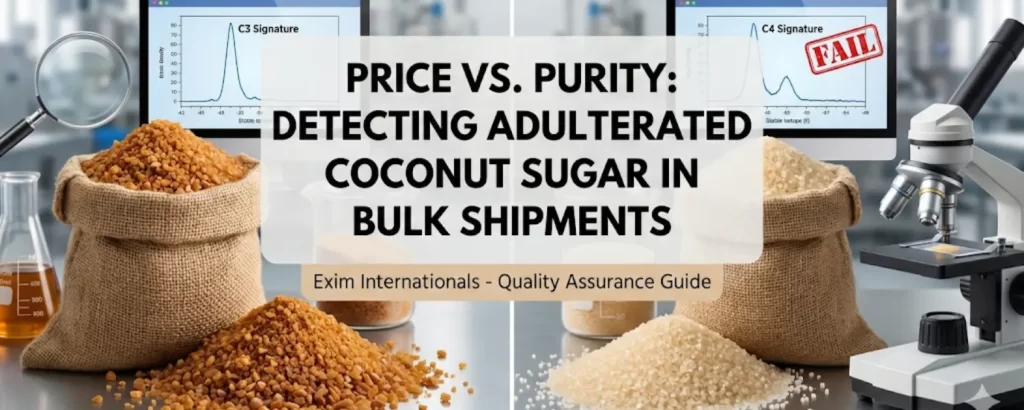
For the global food industry, coconut sugar has graduated from a niche health ingredient to a formulation necessity. From low-GI beverages to paleo-friendly chocolates, manufacturers are scrambling to secure supply. However, this surge in demand has created a dark underbelly in the supply chain: Adulteration.
The math is simple. Coconut sugar is labor-intensive to produce (manual tapping of trees), while cane sugar is industrially farmed and cheap. Unscrupulous suppliers often blend 30-50% cane sugar into bulk coconut sugar to slash costs.
For a procurement manager, the risk isn’t just financial—it is legal. If your label claims “Low GI” or “100% Coconut Sugar,” and your product tests positive for cane sucrose, you face recalls and lawsuits.
At Exim Internationals, we believe transparency is the only currency that matters. Here is a technical guide on how to detect adulteration and ensure the integrity of your coconut sugar for food industries.
1. Dark Green Chillies (The "G4" Variety)
The most sophisticated (and reliable) way to detect adulteration is looking at the atomic level.
The Difference: Coconut trees are C3 plants, meaning they use a specific photosynthetic pathway. Sugarcane and corn are C4 plants.
The Test: A Carbon Isotope Ratio Analysis (SIRA) measures the ratio of Carbon-13 to Carbon-12 isotopes.
Pure Coconut Sugar: Will show a C3 carbon signature (typically -25‰ to -27‰).
Adulterated Sugar: Even a 10% addition of cane sugar shifts the isotopic signature toward the C4 range (-10‰ to -12‰).
Procurement Tip: When issuing a Purchase Order (PO), explicitly state: “Must pass C13 Carbon Isotope Analysis for C4 sugar detection.” This clause alone scares off dishonest suppliers.
2. Field Tests: Quick Sensory Checks
Before you even send samples to the lab, your Quality Control (QC) team can perform these rapid sensory tests on pre-shipment samples.
The “Sweetness” Benchmark
Pure Coconut Sugar: Has a complex flavor profile—notes of caramel, butterscotch, and a slight hint of saltiness (minerals). It is less sweet than table sugar.
Adulterated Sugar: Tastes aggressively sweet. If the sweetness hits your tongue sharply and immediately (like white sugar), it is likely cut with cane sucrose.
The “Solubility” Test
Pure: Dissolves slowly in cold water. Because it is unrefined, it often leaves a tiny amount of natural sediment (minerals/fiber) at the bottom of the beaker.
Adulterated: If mixed with dyed cane sugar, you might see “color streaks” separating as the dye washes off the white crystals. If it dissolves instantly and perfectly clear, be suspicious.
Import products for your Needs

3. Operational Risks: Why Purity Matters for Manufacturing
Adulteration isn’t just a label issue; it’s a production nightmare.
Melting Point Variances: Pure coconut sugar has a different melting point and hygroscopicity (moisture absorption) compared to cane sugar. In chocolate manufacturing, using an adulterated batch can ruin the tempering process, leading to “blooming” or poor texture.
Moisture & Clumping: Export-quality coconut sugar is dried to <2% moisture. Adulterated batches often have higher moisture content or inconsistent granule sizes, leading to massive clumping in industrial hoppers and mixers.
4. The "Color" Myth
Do not judge purity by color alone.
Natural Variation: Pure coconut sugar varies from light golden to dark brown depending on the harvest season and how long the sap was boiled (caramelization).
The Red Flag: Be wary of sugar that is perfectly uniform in color across tons of product. Nature is rarely perfect; industrial blending is.
5. Your Verification Checklist
To secure genuine coconut sugar for food industries, implement this 3-step verification protocol:
Request the COA (Certificate of Analysis): Ensure it covers SIRA / Carbon Isotope testing, not just basic microbial checks.
Check the “Ash” Content: Pure coconut sugar is high in minerals (Potassium, Magnesium, Zinc). It typically has an ash content of 2-3%. Refined cane sugar has <0.5%. A low ash reading is a dead giveaway of dilution.
Audit the Supply Chain: Does the exporter have direct farm relationships? Adulteration usually happens at the aggregation level (middlemen), not the farm level.
Import products for your Needs
Sourcing with Confidence
In the high-stakes world of food manufacturing, “cheap” coconut sugar is the most expensive ingredient you can buy. It costs you your reputation.
At Exim Internationals, we strictly monitor our supply chain from the tapping of the flower to the sealing of the bulk bag. We provide full transparency, including Isotope Analysis reports, so you can formulate with confidence.
Don’t gamble with your ingredients. Contact Exim Internationals today for a quote on 100% pure, lab-verified coconut sugar.
Frequently Asked Questions (FAQs)
1. What is the most reliable test for coconut sugar adulteration?
The Carbon Isotope Ratio Analysis (SIRA), specifically checking for C4 sugars, is the gold standard. It can detect even small amounts of cane or corn syrup added to the coconut sugar.
2. Why is cane sugar used as an adulterant?
It is primarily about cost. Cane sugar is significantly cheaper to produce than coconut sugar. It also mimics the crystalline structure, making it easy to blend visually.
3. Does pure coconut sugar taste like coconut?
No. Pure coconut sugar is made from the sap of the flower bud, not the nut. It tastes like a rich, earthy caramel or butterscotch, similar to brown sugar but with more depth.
4. What mesh size should I order for beverage manufacturing?
For beverages, we recommend a fine mesh (60-80 mesh). Standard granule sizes may not dissolve quickly enough in cold liquids, leaving residue. We can customize the grind size for your application.
5. Is your coconut sugar FSSAI and FDA compliant?
Yes. Our export facilities are compliant with FSSAI (India), FDA (USA), and EU food safety standards. We provide full traceability documents with every container.
6. What is the standard bulk packaging for food industries?
We supply 25kg Multi-Wall Paper Bags with an inner HDPE liner to protect against moisture. This is the industry standard for easy handling in factories.
7. Can you supply Organic Certified coconut sugar?
Yes. We offer NPOP/NOP Certified Organic coconut sugar for brands that require clean label certification.
8. Why does my coconut sugar batch have small clumps?
Small, soft clumps are natural in unrefined sugars because they lack chemical anti-caking agents. However, hard “bricks” indicate high moisture content (>3%) or improper storage, which is a quality defect.
About us
Exim Internationals is a premier export company dedicated to delivering the finest products from India to international markets. Our mission is to establish India as a global export powerhouse, contributing to economic growth and showcasing the richness of Indian goods worldwide.
From the pashmina shawls and apples of the North to the spices of the South, the fruits and powders of the West, and the tea and bamboo of the East, we connect every corner of India with the global market.
Certification we have: FSSAI, APEDA, IEC, UDYAM, FIEO, Spices Board, Coconut
Contact us
Samin heritage, Sl building, Shop no. 19, Chandan wadi, Almeda road Thane west, Maharashtra, India-400601.
Email Us:support@eximinternationals.com
Call Us: +91 9820446601 | +91 9321559185