
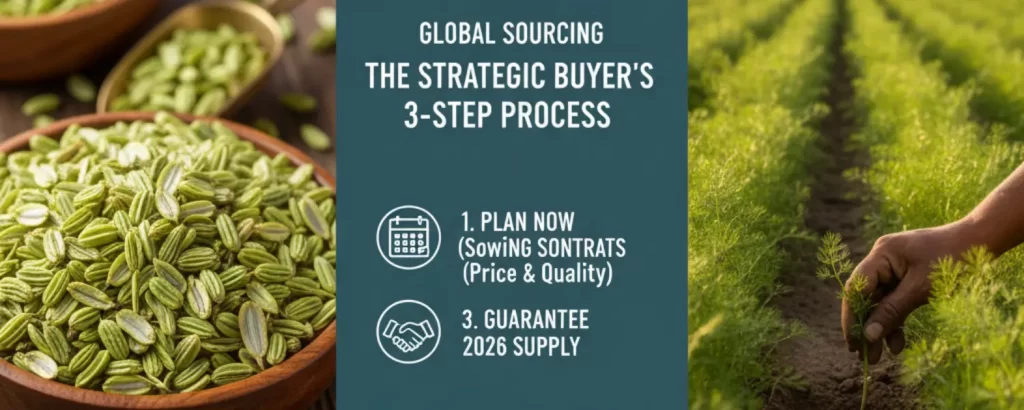
For international importers, gin distillers, and herbal tea blenders, the global demand for high-quality Indian fennel seed is robust. Its unique, sweet, and aromatic profile is an essential ingredient. However, many buyers make a critical mistake: they wait until the harvest begins (February-March) to start sourcing.
By then, the best quality lots are often already spoken for.
As we are currently in November 2025, the peak sowing season for India’s Rabi crop is underway. The decisions being made by farmers right now will determine the quality and quantity of the 2026 harvest. This is the single most important time for strategic buyers to plan.
As a leading Indian exporter based in Maharashtra, we’ve created this buyer’s guide to help you navigate the procurement process and secure your supply of premium fennel seed for 2026.
Why Contract for 2026 Fennel Seed Now? The Sowing Season Advantage
Contracting with an export partner during the Q4 2025 sowing season is the most strategic move a bulk buyer can make. Here’s why:
Secure Premium Quality: The most sought-after varieties, like the highly aromatic Lucknow fennel prized by gin botanicals suppliers and herbal infusion brands, are in high demand. By contracting early, you get “first pick” of the new crop, ensuring you secure lots with the highest volatile oil and anethole content.
Achieve Price Stability: The spot market during the harvest (Feb-Mar) can be volatile. Early contracting allows you to lock in a more stable pricing structure based on long-term forecasts, protecting your budget from sudden spikes.
Guarantee Your Supply: A reliable exporter uses this pre-season period to forecast demand and plan their sourcing. By giving them your volume commitment now, you guarantee that your container load (or multi-container load) will be allocated and ready, even if the overall market is tight.
A Sowing Season Forecast: What We're Seeing for 2026
Our teams on the ground in key growing regions are monitoring the 2025 sowing season closely. Here’s what we see:
Positive Farmer Sentiment: Following a favorable monsoon, soil moisture is good in key fennel-growing states like Gujarat and Rajasthan.
Acreage Trends: With firm prices for fennel seed in the previous season, farmer sentiment is positive. We anticipate a stable to slightly increased acreage being sown, which bodes well for a healthy 2026 supply.
The Quality Outlook: Good sowing conditions often correlate to a high-quality crop with well-developed seeds and strong aromatic profiles.
Import products for your Needs

A Buyer's Checklist: What to Define in Your 2026 Contract
A “contract” is simply an agreement on quality and expectations. A professional exporter will work with you to define these key specifications:
1. The Variety & Grade:
Lucknow Fennel: Are you a tea blender or distiller? You need this variety, prized for its sweetness and high anethole content.
Gujarati Fennel: A robust, high-quality all-rounder perfect for culinary use and spice blends.
Purity Grade: Do you need “Europe Grade” (99.5% purity) or “Singapore Grade” (99% purity)?
2. The Key Quality Metrics:
For Aroma (Tea/Gin): Specify a minimum Volatile Oil Content. This is the scientific measure of the seed’s aroma.
For All Buyers: Specify a maximum Moisture Content (typically <12%) to ensure stability and prevent mould during transit.
3. The Logistics:
Packing: Confirm packing in 25kg or 50kg new PP or jute bags.
Container Size: Define your volume in terms of 20ft or 40ft container loads.
Documentation: Ensure your contract includes all required documents: Phytosanitary Certificate, Certificate of Analysis (COA), Certificate of Origin, etc.
Don't Buy in a Rush, Buy with a Strategy
The 2026 fennel seed harvest may seem far away, but the window for smart, strategic sourcing is open right now. By planning your procurement during the sowing season, you move from being a reactive buyer to a proactive partner. You secure not just a commodity, but the exact quality your brand depends on, with price stability and a guaranteed supply.
Ready to plan your 2026 fennel seed procurement? Contact Exim Internationals today for the latest insights from the sowing season and to discuss your bulk contract requirements.
Frequently Asked Questions (FAQs)
1. Why should I contract for the 2026 fennel seed harvest now, in late 2025?
Contracting during the sowing season (Oct-Nov 2025) allows you to secure the best quality lots, achieve better price stability, and guarantee your volume before the market rush begins at harvest time (Feb-Mar 2026).
2. When is the actual 2026 Indian fennel seed harvest?
The crop that is being sown now (a Rabi crop) will be harvested from February to March 2026.
3. What is the difference between Lucknow fennel and Gujarati fennel?
Lucknow fennel is generally considered a premium variety, known for its smaller, greener seeds and a sweeter, more aromatic flavour (higher anethole). It’s a top choice for herbal infusions and gin botanicals. Gujarati fennel is a robust and high-quality all-purpose variety.
4. What is “volatile oil content” and why is it important for my contract?
Volatile oil is the scientific measure of the essential oils within the seed, which create its aroma and flavour. If you are in the tea, gin, or aromatherapy industry, specifying a minimum volatile oil content in your contract is essential to guarantee a potent, high-quality product.
5. What is the difference between “Singapore Grade” and “Europe Grade” fennel seed?
This refers to purity. “Singapore Grade” is a standard high-quality grade, typically 99% pure. “Europe Grade” is a higher specification, 99.5% pure or even 99.9% (Sortex clean), and is required for markets with stricter import regulations.
6. What is the minimum order quantity (MOQ) for a bulk fennel seed contract?
The standard MOQ for a cost-effective export is a 20-foot container load, which holds approximately 13-14 metric tons of fennel seed.
7. What key documents are required when importing fennel seeds from India?
The essential documents include the Bill of Lading, Commercial Invoice, Packing List, Certificate of Origin, and a mandatory Phytosanitary Certificate (certifying the seeds are pest-free).
8. How do I get started with a 2026 contract for fennel seed?
Simply contact us with your company details, your estimated annual or seasonal volume, and your quality specifications (e.g., “Lucknow fennel for gin, 1 FCL”). Our team will provide a detailed quote and walk you through the simple contracting process.
About us
Exim Internationals is a premier export company dedicated to delivering the finest products from India to international markets. Our mission is to establish India as a global export powerhouse, contributing to economic growth and showcasing the richness of Indian goods worldwide.
From the pashmina shawls and apples of the North to the spices of the South, the fruits and powders of the West, and the tea and bamboo of the East, we connect every corner of India with the global market.
Certification we have: FSSAI, APEDA, IEC, UDYAM, FIEO, Spices Board, Coconut
Contact us
Samin heritage, Sl building, Shop no. 19, Chandan wadi, Almeda road Thane west, Maharashtra, India-400601.
Email Us:support@eximinternationals.com
Call Us: +91 9820446601 | +91 9321559185