For international importers, wholesalers, and the HORECA sector, the demand for the vibrant, sharp heat of fresh green chillies is year-round. India, with its diverse climate, is a premier source. But when you’re sourcing a product that is harvested one day and can spoil the next, “quality” is defined by one thing: freshness on arrival.
An export quality green chilli that arrives limp, discolored, or spoiled is worthless.
The secret to success is not in the chilli itself, but in the process. Freshness cannot be “inspected” into the product at the end; it must be preserved from the moment of harvest. As a specialist exporter of fresh produce from India, we’ve perfected this process. This is our expert guide to how we guarantee freshness.
Step 1: The Source (Harvesting the Right Chilli)
The process begins before the chillies ever see a box. It starts with sourcing the right product.
Variety Selection: We prioritize robust, commercially viable varieties known for their flavour and relative hardiness, such as the G4 green chilli or the Jwala chilli.
Harvest Timing: The chillies are harvested at the peak of maturity—fully-grown and crisp, but not yet beginning to ripen (which shortens the shelf life). Any damaged, over-ripe, or diseased chillies are culled at the farm itself.
Step 2: The "Golden Hour" – Immediate Pre-Cooling
This is the single most critical step in the entire chain. Freshly picked chillies carry “field heat,” which causes them to continue respiring and ripening at a rapid rate. This heat must be removed immediately.
Within hours of being picked, the chillies are rushed to a pre-cooling facility. This process rapidly brings the core temperature of the chillies down, effectively “pausing” the aging process and dramatically slowing down decay. Any green chilli exporter who skips this step is risking your entire shipment.
Step 3: Expert Sorting and Packing for Protection
Once cooled, the chillies are moved to a clean, temperature-controlled packhouse for sorting and packing.
Sorting & Grading: A team of trained workers sorts the chillies by hand, grading them for size, uniform colour, and removing any remaining blemishes. This ensures the final product is consistent and meets the “export quality” standard.
Protective Packing: The chillies are packed into well-ventilated, corrugated fibreboard (CFB) boxes. These cartons are engineered to be strong enough to stack without crushing the product, while the vent holes allow the cold chain air to circulate freely.
Import products for your Needs

Step 4: The Unbroken Cold Chain
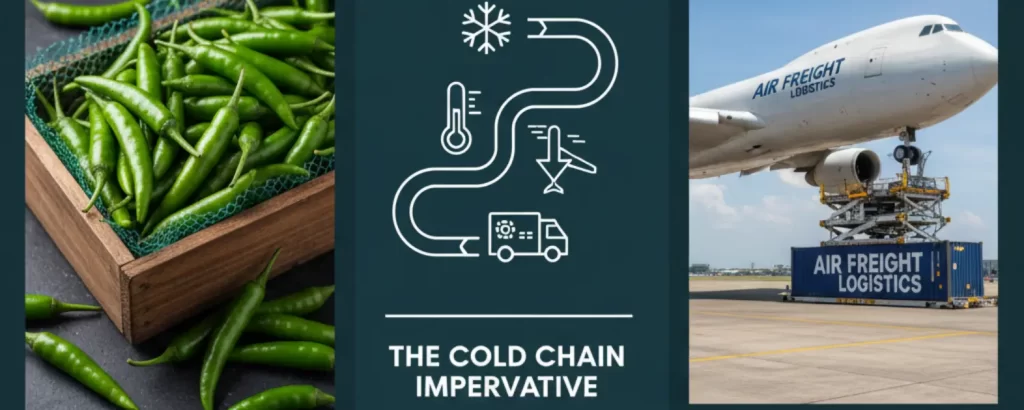
The term “cold chain” refers to the unbroken, temperature-controlled supply line from the packhouse to the aircraft.
Refrigerated Transport: The packed cartons are loaded into a refrigerated (“reefer”) truck, which is set to the optimal temperature (typically 7-10°C) for green chillies.
Airport Handling: This reefer truck transports the shipment directly to a specialized cold-storage facility at the airport. The product is never left sitting on a hot tarmac. It is held in the cold room until the moment it is moved to the aircraft for loading.
This unbroken cold chain is the lifeline of your product.
Step 5: The Final Dash – Air Freight Logistics
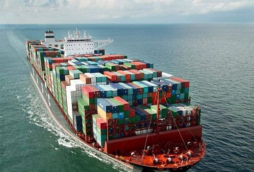
Due to their extremely short shelf life, fresh export quality green chilli cannot be shipped by sea. The 20-30 day transit time is simply too long.
Speed is Key: Air freight is the only viable method. By shipping via air, we can ensure that the chillies harvested on Day 1 can be on a flight by Day 2 and in your warehouse in another 1-2 days.
Documentation: We ensure all documentation, especially the mandatory Phytosanitary Certificate, is prepared in advance for immediate customs clearance upon arrival.
Freshness is a Process, Not a Promise
A successful exporter of fresh green chillies is, in reality, a high-speed logistics expert. Guaranteeing freshness is an active, meticulous process that requires investment in infrastructure, deep-rooted partnerships with farms, and zero compromises.
As we are currently in India’s peak growing season (November), the quality of fresh chillies is at its best. By partnering with an exporter who masters this process, you can confidently source green chilli from India and deliver a farm-fresh product to your customers.
Ready to source premium, fresh-by-air green chillies? Contact Exim Internationals today to discuss our cold chain process and get a quote for the peak season.
Frequently Asked Questions (FAQs)
1. Why is air freight necessary for exporting fresh green chillies?
Fresh green chillies are highly perishable, with a short shelf life. Air freight is the only method fast enough (1-3 days) to transport them from India to international markets while they are still fresh. Sea freight takes several weeks, which is far too long.
2. What is a “cold chain”?
A cold chain is an unbroken, temperature-controlled supply chain. For green chillies, this means keeping them at a consistent, cool temperature (e.g., 7-10°C) from the moment they are pre-cooled at the farm to the moment they are loaded onto the plane and received by the importer.
3. What is the typical shelf life of an exported green chilli?
When handled with a perfect cold chain, you can expect a shelf life of 7 to 14 days after the product arrives at your facility, giving you a safe window for distribution.
4. What is the minimum order quantity (MOQ) for an air freight shipment?
The MOQ for air freight is typically based on weight. To be cost-effective, most exporters have an MOQ of 500 kg to 1,000 kg (1 Metric Ton), depending on the destination.
5. What is a G4 Green Chilli?
The G4 green chilli is one of the most popular commercial varieties exported from India. It is prized for its uniform size and shape, vibrant green colour, medium heat (SHU), and relatively good shelf life, making it a reliable choice for importers.
6. What is a Phytosanitary Certificate?
This is a mandatory document for all fresh produce exports. It is issued by the Indian government’s agricultural authority to certify that the green chillies have been inspected and are free from pests and plant diseases, as required by your country’s customs.
7. How are export quality green chillies packed?
They are typically packed in 3-4 kg ventilated corrugated fibreboard (CFB) boxes. This protects them from being crushed, while the ventilation holes are essential for allowing the cold air to circulate.
8. What is the ideal temperature to store and transport fresh green chillies?
The ideal temperature is between 7°C and 10°C (45°F – 50°F). Storing them any colder can cause chilling injuries, while warmer temperatures will accelerate ripening and decay.
About us
Exim Internationals is a premier export company dedicated to delivering the finest products from India to international markets. Our mission is to establish India as a global export powerhouse, contributing to economic growth and showcasing the richness of Indian goods worldwide.
From the pashmina shawls and apples of the North to the spices of the South, the fruits and powders of the West, and the tea and bamboo of the East, we connect every corner of India with the global market.
Certification we have: FSSAI, APEDA, IEC, UDYAM, FIEO, Spices Board, Coconut
Contact us
Samin heritage, Sl building, Shop no. 19, Chandan wadi, Almeda road Thane west, Maharashtra, India-400601.
Email Us:support@eximinternationals.com
Call Us: +91 9820446601 | +91 9321559185