
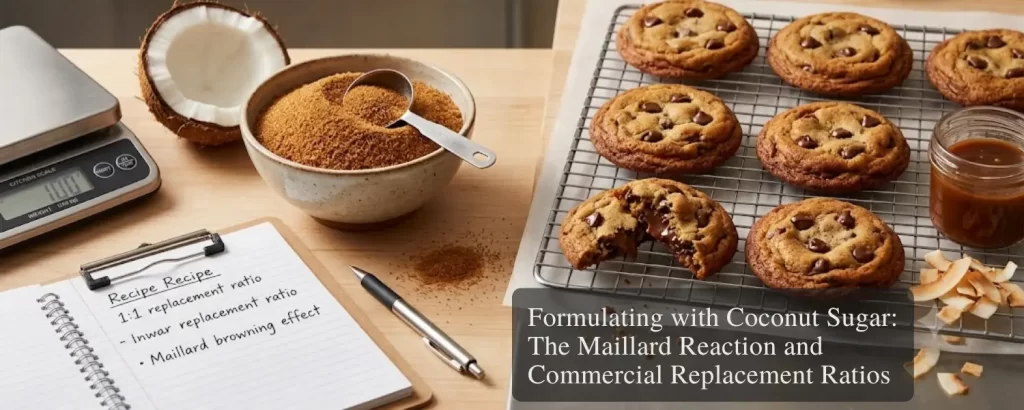
As consumer demand for refined-sugar-free and low-glycemic products surges, commercial food and beverage R&D departments are rapidly reformulating their product lines. Wholesale coconut sugar is often the preferred natural alternative due to its robust caramel flavor profile and distinct mineral content.
However, formulating with coconut sugar in an industrial setting is not as simple as swapping out white cane sugar. Due to its unique chemical composition, coconut sugar behaves differently under heat, moisture, and mixing friction.
For R&D food scientists, commercial bakers, and product formulators, understanding the exact commercial replacement ratios and managing the accelerated Maillard reaction are critical steps to scaling up production without compromising product stability.
1. Commercial Replacement Ratios: Baseline Formulations
The most common question formulators ask when transitioning a recipe is: What is the volumetric and mass replacement ratio for coconut sugar versus cane sugar?
As a general baseline, coconut sugar can be used as a 1:1 replacement by volume or weight for granulated white or brown cane sugar. However, this is only the starting point. Depending on the application, you must account for its distinct granular structure and moisture retention.
Adjusting for Density and Granulation
Export-grade wholesale coconut sugar is typically milled to a 16-18 mesh size. This fine granulation ensures high solubility in commercial beverage manufacturing, but in dry baking mixes or doughs, it packs differently than crystalline sucrose.
Because coconut sugar is unrefined, it retains trace amounts of natural moisture (typically kept strictly below 2% for export). This slight hygroscopic nature means it can pull moisture from other ingredients in your formulation.
Dry Mixes: If your formulation relies on high-speed industrial mixing, the 1:1 ratio holds, but you may need to slightly increase your liquid inputs (water, milk, or liquid fats) by 1-2% to prevent a crumbly texture in the final baked good.
Beverage Syrups: For liquid applications, coconut sugar dissolves readily but yields a slightly darker, more viscous solution than refined white sugar. A 1:1 replacement works perfectly for viscosity, but flavor profiling may require a 0.8:1 reduction if the caramel notes clash with delicate flavorings.
2. Managing the Maillard Reaction in Commercial Baking
The most significant technical hurdle when formulating with coconut sugar is its behavior under heat—specifically, its impact on the Maillard reaction.
The Maillard reaction is a chemical reaction between amino acids and reducing sugars that gives browned food its distinctive flavor (think toasted bread, roasted coffee, or baked cookies).
Why Coconut Sugar Accelerates Browning
Refined white cane sugar is almost 100% sucrose (a non-reducing sugar). Coconut sugar, conversely, contains roughly 70-79% sucrose, alongside notable amounts of glucose and fructose (reducing sugars). Furthermore, it is rich in natural amino acids inherited from the coconut palm sap.
Because it brings both the necessary reducing sugars and amino acids to the table, coconut sugar accelerates the Maillard reaction significantly.

Technical Adjustments for Production Lines
If you run a product formulated with coconut sugar through an industrial tunnel oven using the exact time and temperature parameters established for cane sugar, the product will over-brown or burn.
To mitigate this, R&D teams must adjust thermal processing parameters:
Reduce Oven Temperature: Drop the standard baking temperature by 25°F (15°C) to slow the Maillard reaction, allowing the interior of the product to bake fully before the exterior over-caramelizes.
Extend Bake Time: Compensate for the lower temperature by extending the bake time by approximately 10-15%.
Monitor pH Levels: The Maillard reaction occurs faster in alkaline environments. Because coconut sugar can sometimes lower the overall pH of a dough (making it slightly more acidic), it generally balances out its own accelerated browning, but formulators relying heavily on chemical leaveners (like baking soda) should monitor batch pH closely.
Explore how altering your sugar replacement ratios impacts moisture balance and browning intensity in real-time with this formulation calculator:
2. Managing the Maillard Reaction in Commercial Baking
| Formulation Parameter | Value | Note |
|---|---|---|
| Original Cane Sugar Mass | 500 g | Base Formulation |
| Coconut Sugar Replacement | 50 % | Target Ratio |
| Required Coconut Sugar | 250 g | 1:1 Substitution |
| Remaining Cane Sugar | 250 g | Balance |
| Target Baking Temperature | 350 °F | Thermal Setting |
| Maillard Reaction Score | 0.50 | Normal |
3. Storage and Hygroscopic Behavior in the Facility
In an industrial setting, ingredient storage is just as critical as the formulation itself. Coconut sugar is highly hygroscopic—it aggressively absorbs moisture from the air.
If bags are left open in a humid commercial bakery or production floor, the sugar will quickly clump, causing blockages in automated dispensing hoppers and inconsistent batch weights.
Sourcing Specifications: Ensure your B2B supplier ships in 25-kilogram 3-ply kraft paper bags with heavy-duty inner poly-liners.
Facility Requirements: Once opened, the sugar must be stored in climate-controlled environments with relative humidity (RH) kept strictly under 60%.
Sourcing for Consistency
Formulating with coconut sugar allows brands to capture the lucrative clean-label market. However, success on the production line requires predictable raw materials. Variability in moisture content, mesh size, or processing hygiene from your supplier will lead to endless reformulations and wasted batches.
When establishing your supply chain, prioritize B2B exporters who can provide consistent lab analytics (Certificates of Analysis) for moisture content and granulation sizing, ensuring your R&D team is working with a stabilized ingredient from the pilot plant to full-scale commercialization.
Frequently Asked Questions (FAQs)
What is the standard commercial replacement ratio for coconut sugar to cane sugar?
For most dry applications (baking, dry mixes), a 1:1 replacement by volume or weight is the standard baseline. However, liquid adjustments may be necessary depending on the specific dough matrix.
Why does coconut sugar burn faster than white sugar in commercial ovens?
Coconut sugar is unrefined and contains natural amino acids along with reducing sugars (glucose and fructose). This composition accelerates the Maillard reaction, causing products to brown and caramelize much faster under heat than products made with refined sucrose.
How should wholesale coconut sugar be stored in a production facility?
Because it is highly hygroscopic, it must be stored in a cool, dry environment with relative humidity below 60%. It should remain sealed in poly-lined kraft bags until immediately before use to prevent clumping in automated dispensers.
