
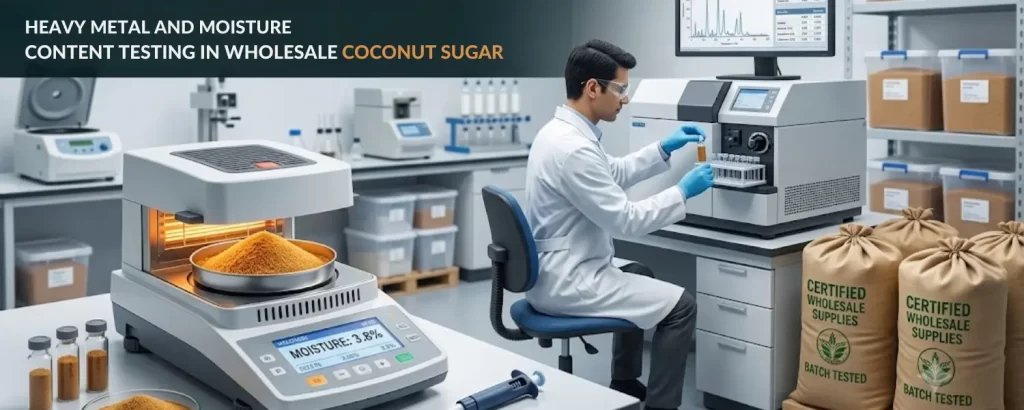
For commercial food and beverage manufacturers, introducing a new raw material into the supply chain carries inherent regulatory risks. When substituting refined cane sugar with natural alternatives, heavy metal and moisture content testing in wholesale coconut sugar becomes the primary hurdle for QA/QC and compliance officers.
Unlike highly refined sucrose—which is stripped of nearly all minerals during processing—coconut sugar is unrefined. It retains the natural mineral profile of the palm sap, including potassium, magnesium, and zinc. However, this unrefined nature also means it can absorb naturally occurring heavy metals from the soil and groundwater.
If your procurement team is sourcing bulk coconut sugar without demanding strict laboratory analytics, you risk severe FDA or EFSA (European Food Safety Authority) compliance violations. In this guide, we break down the critical testing thresholds your supplier must meet before the product ever hits your production floor.
The Danger of Heavy Metals in Unrefined Sugars
Heavy metals—specifically Lead (Pb), Arsenic (As), Cadmium (Cd), and Mercury (Hg)—are naturally present in the earth’s crust. Agricultural crops absorb these elements through their root systems. Because coconut sugar is produced by boiling down the raw sap of the coconut palm blossom without chemical refinement, any heavy metals present in the palm tree’s environment can concentrate in the final granulated product.
Regulatory bodies worldwide have drastically tightened their tolerances for heavy metals in food ingredients, particularly in products frequently consumed by children (such as baked goods and snacks).
Standard PPM (Parts Per Million) Thresholds
When reviewing a supplier’s Certificate of Analysis (CoA), compliance officers must ensure the heavy metal concentrations fall well below these recognized international limits:
Lead (Pb): Must be strictly
< 1.0 ppm(Many strict buyers and EU regulations demand< 0.5 ppm).Arsenic (As): Must be
< 1.0 ppm.Cadmium (Cd): Must be
< 0.5 ppm.Mercury (Hg): Must be
< 0.1 ppm

Moisture Content: The Catalyst for Spoilage
While heavy metals represent a regulatory risk, moisture content represents an immediate operational hazard.
Coconut sugar is extremely hygroscopic, meaning it acts like a sponge, aggressively pulling moisture from the surrounding air. In a commercial baking or industrial blending facility, excess moisture in dry ingredients leads to catastrophic machinery clumping, inaccurate batch weights, and accelerated microbial growth.
The 2% Rule for Export-Grade Coconut Sugar
To be classified as export-grade, wholesale coconut sugar must be dried to a strict moisture content of less than 2.0% (with premium grades often hitting < 1.5%).
If a supplier ships product with a moisture content of 3% or 4%, you will encounter the following issues during ocean transit and warehouse storage:
Caking and Hardening: The 25kg bags will arrive as solid bricks, requiring manual labor to smash the product before it can be fed into automated hoppers.
Yeast and Mold Proliferation: Moisture provides the breeding ground for yeast and mold. High moisture content significantly raises the Aerobic Plate Count (APC), leading to potential product recalls.
Maillard Instability: Moisture variance throws off commercial baking formulations, causing inconsistent browning and unpredictable shelf-life in the final retail product.
Securing the Moisture Barrier
Laboratory testing before shipment is only half the battle. To maintain that < 2.0% moisture level during high-humidity maritime transit, the packaging must be hermetically secure.
Always stipulate in your RFQs that the bulk coconut sugar must be packed in 25-kilogram 3-ply kraft paper bags fitted with thick, heat-sealed inner poly-liners. A standard woven sack without a liner will completely invalidate the origin lab results by the time the cargo reaches your facility.
Why Verifiable Lab Analytics Drive B2B Trust
As a B2B procurement director, you cannot rely on a supplier’s marketing claims of “100% Organic” or “Premium Quality.” In the food manufacturing sector, quality is defined exclusively by data.
When you partner with a verified exporter, you should expect a comprehensive Certificate of Analysis (CoA) for every single batch shipped. This document is your shield against regulatory fines, recalled retail products, and production line downtime.
By demanding rigorous heavy metal and moisture content testing in wholesale coconut sugar, you protect your brand’s integrity and streamline your supply chain from the origin packhouse to the final consumer.
Frequently Asked Questions (FAQs)
Why is heavy metal and moisture content testing in wholesale coconut sugar mandatory?
Testing is mandatory to ensure the unrefined sugar does not exceed FDA and EFSA legal limits for toxic elements (Lead, Arsenic, Cadmium, Mercury). Moisture testing ensures the product remains below 2% to prevent microbial growth and industrial machinery clumping.
What is the maximum acceptable moisture content for export-grade coconut sugar?
Export-grade coconut sugar must have a moisture content strictly below 2.0%. High-quality B2B suppliers typically dry their product to between 1.2% and 1.8% to ensure free-flowing granulation.
How do heavy metals get into coconut sugar?
Because coconut sugar is minimally processed, it retains the mineral profile of the palm sap. If the palm trees are grown in soil or exposed to groundwater contaminated with heavy metals, those elements can be absorbed by the tree and concentrated during the sap-boiling process.
What documentation should I request from my coconut sugar supplier?
Always request a batch-specific Certificate of Analysis (CoA) from an accredited third-party laboratory. This CoA must detail exact PPM metrics for heavy metals, exact moisture percentage, mesh size, and microbiological counts (Salmonella, E. coli, Yeast, and Mold).