
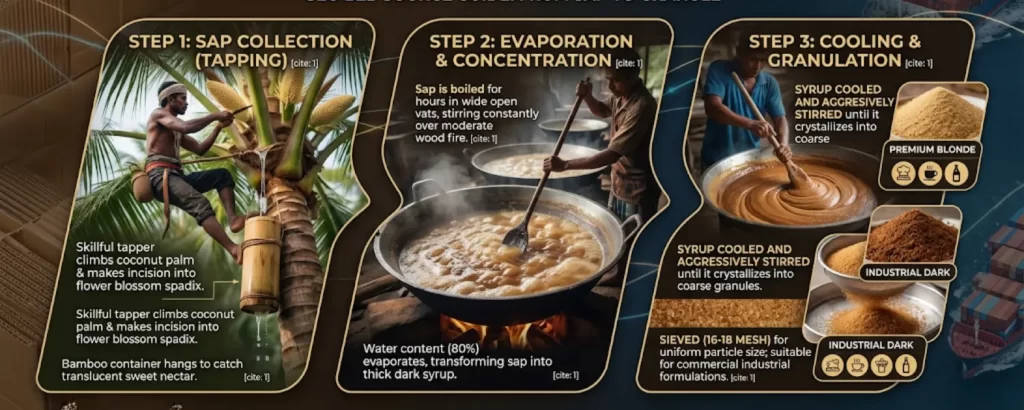
The Extraction Process
If you need a fast answer on how this natural sweetener is produced, here is the three-step TL;DR:
Tapping: Farmers climb the coconut palm and make a cut in the flower blossom (not the fruit) to collect the sweet nectar (sap).
Boiling: The collected sap is immediately boiled in large, open vats over a wood fire to evaporate the high water content.
Granulation: As the liquid thickens into a dense syrup, it is continuously stirred until it cools and crystallizes into unrefined sugar granules.
Step 1: Tapping the Blossom (Not the Coconut)
One of the most common misconceptions is that coconut sugar comes from the coconut fruit itself. It does not.
The process begins high up in the canopy of the coconut palm tree (Cocos nucifera). Before a coconut can grow, the tree produces a flower blossom (spadix). Skilled farmers, known as “tappers,” physically climb the tree—often up to 50 feet high—and make a precise incision into the stem of this unopened flower bud.
They tie a bamboo container or plastic bucket securely beneath the cut to catch the slow, steady drip of the translucent, sweet sap (nectar).
Step 2: Harvesting and Immediate Processing
Because the raw sap is about 80% water and highly rich in natural sugars, it is extremely susceptible to fermentation. If left out too long, it will naturally ferment into coconut vinegar or palm wine.
To prevent this, the tappers must collect the sap twice a day (morning and evening) and transport it immediately to the processing facility or village boiling station. This urgency is a primary reason why genuine organic coconut sugar production cannot be fully industrialized.
Lorem ipsum dolor sit amet, consectetur adipiscing elit. Ut elit tellus, luctus nec ullamcorper mattis, pulvinar dapibus leo.
Step 3: The Artisanal Boiling Process
Once collected, the sap is poured into massive, wide-mouthed woks or vats.
The sap is brought to a rolling boil over a moderate wood-fired or gas stove.
It requires constant, manual stirring for several hours to ensure it does not burn.
As the water evaporates, the thin, translucent sap transforms into a thick, dark, bubbling syrup.
At this stage, the syrup develops its signature rich, caramel-like flavor and brown color—a natural result of the Maillard reaction (the browning of amino acids and sugars under heat).

Step 4: Crystallization and Sieving
Once the syrup reaches the precise density, the heat is turned off. The artisan makers continue to aggressively stir and aerate the thick paste as it cools.
This rapid cooling and stirring cause the syrup to break down and crystallize into coarse granules. Finally, to meet commercial B2B standards, the granules are passed through industrial sieves (typically 16 to 18 mesh) to ensure a uniform particle size that will easily dissolve in commercial baking and beverage formulations.
The Difference: Coconut Sugar vs. Refined Cane Sugar
Understanding this process highlights why coconut sugar is considered a premium, clean-label ingredient.
| Processing Feature | Organic Coconut Sugar | Refined White Cane Sugar |
| Source Material | Coconut flower blossom sap | Sugarcane stalks |
| Extraction Method | Manual tree tapping | Heavy machinery and crushing |
| Refining Process | Unrefined: Simply boiled and evaporated | Highly Refined: Bleached, chemically treated, and filtered |
| Nutritional Profile | Retains trace minerals (Iron, Zinc) and Inulin | Empty calories, zero trace minerals |
Source Authentic Sugar with Exim Internationals
When consumers ask, “how is organic coconut sugar made?”, they are looking for reassurance that the product is natural, sustainable, and free from heavy chemical processing. As a food manufacturer, you must source an ingredient that honors this artisanal process while meeting strict commercial quality standards.
At Exim Internationals, we supply premium, unadulterated bulk organic coconut sugar directly from verified origins. We ensure our sugar is 100% pure sap, perfectly sieved for industrial use, and completely free from cheap cane sugar additives.
Would you like me to send you our latest Certificate of Analysis (COA) and a wholesale quote for your manufacturing needs?
Frequently Asked Questions (FAQs)
1. How is organic coconut sugar made?
It is made through a simple, two-step artisanal process: first, the sweet sap from the coconut tree’s flower blossom is collected, and second, that sap is boiled for several hours until the water evaporates and it crystallizes into unrefined sugar granules.
2. People often ask about coconut sugar how is it made compared to white sugar?
Unlike white cane sugar, which undergoes extensive chemical bleaching and refining in massive factories, coconut sugar is completely unrefined. It is simply the dehydrated sap of the coconut blossom, meaning it retains its natural brown color and trace minerals.
3. Does coconut sugar taste like coconuts?
No. Because it is made from the tree’s flower nectar and not the actual coconut meat or coconut water, it does not have a tropical coconut flavor. Instead, it boasts a rich, earthy, caramel-like taste similar to brown sugar.
4. Why is the production of organic coconut sugar considered sustainable?
Coconut palms produce sap for decades and require very little water compared to sugarcane fields. Furthermore, tapping the blossoms for sap provides a stable, year-round income for local farming communities without requiring the destructive clear-cutting of land often associated with commercial cane sugar.
5. How do I know if my bulk coconut sugar is 100% pure?
Always request a Certificate of Analysis (COA) from your supplier. Because pure coconut sugar is expensive to produce, some suppliers may adulterate it by mixing in cheaper brown cane sugar. A COA will verify the exact moisture content, mesh size, and ingredient purity.
About us
Exim Internationals is a premier export company dedicated to delivering the finest products from India to international markets. Our mission is to establish India as a global export powerhouse, contributing to economic growth and showcasing the richness of Indian goods worldwide.
From the pashmina shawls and apples of the North to the spices of the South, the fruits and powders of the West, and the tea and bamboo of the East, we connect every corner of India with the global market.
Certification we have: FSSAI, APEDA, IEC, UDYAM, FIEO, Spices Board, Coconut
Contact us
Samin heritage, Sl building, Shop no. 19, Chandan wadi, Almeda road Thane west, Maharashtra, India-400601.
Email Us: support@eximinternationals.com
Call Us: +91 9820446601 | +91 9321559185
