
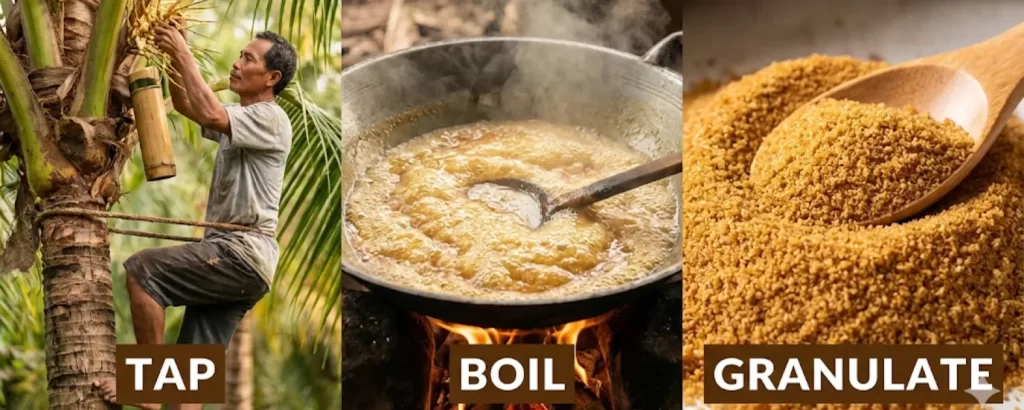
In 2026, coconut sugar has moved from niche health stores to mainstream global markets. But unlike the fruit-based products we usually export—like mangoes or bananas—this sweetener doesn’t come from the coconut fruit itself. Instead, it begins with the “blood” of the tree: the flower sap.
Here is the step-by-step process of how this “Golden Granule” is made.
1. Tapping the Inflorescence (The Flower)
The process begins high in the canopy of the coconut palm (Cocos nucifera). Skilled harvesters, known as “tappers,” climb the trees to reach the inflorescence—the unopened flower buds.
The Technique: The tapper makes a precise incision in the flower stalk.
The Yield: A clear, sweet liquid called sap (or “Neera”) begins to drip. A healthy tree can provide 1 to 2 liters of sap every day.
2. Collection and Stabilization
The sap is highly susceptible to natural fermentation due to the wild yeasts in tropical air. To prevent it from turning into coconut vinegar or alcohol, it must be collected every 12 hours.
Filtration: Once collected, the raw sap is immediately filtered through fine mesh to remove any natural debris, like bark or fibers.
Natural Preservatives: In organic production, a small amount of lime (mangosteen husk) may be added to the collection vessel to maintain the sap’s pH and prevent early fermentation.
3. Evaporation: From Sap to Syrup
The filtered sap is roughly 80% water. To concentrate the sugars, the water must be removed through heat.
Traditional Method: Small-scale farmers boil the sap in large open woks over controlled wood fires.
Modern Export Method: At Exim Internationals, we often use Vacuum Evaporators. By lowering the atmospheric pressure, we can boil the sap at a lower temperature (60°C – 80°C). This preserves more of the vitamins and minerals compared to high-heat boiling.
The Result: The sap thickens into a viscous, amber-colored liquid known as Coconut Nectar.
Import products for your Needs
4. Granulation: The Transformation
This is the most critical stage. As the syrup reaches a sugar concentration of about 80%, it is removed from the heat.
Continuous Stirring: As the syrup cools, it is stirred vigorously. This aeration promotes the formation of tiny crystals.
Solidification: Within minutes of intense stirring, the liquid syrup “magically” transforms into solid, moist granules.
5. Drying, Sieving, and Grading
To make the product shelf-stable for international export, the final moisture content must be extremely low.
Drying: The sugar is dried (often in solar dryers or industrial ovens) until the moisture content drops below 2%.
Sieving: The sugar is passed through various mesh sizes to create uniform granules.
Quality Check: For B2B export, the sugar passes through metal detectors and color-grading sensors to ensure a “Clean Label” premium product.
Sustainability Spotlight: The "Green" Sugar
Coconut sugar is frequently cited by the FAO (Food and Agriculture Organization) as the most sustainable sweetener in the world.
Longevity: A single coconut palm can produce sap for 20+ years without being cut down.
Resource Efficiency: It requires significantly less water and soil nutrients than sugarcane to produce the same amount of sweetness.
The production of coconut sugar is a testament to the harmony between nature and traditional craftsmanship. By choosing coconut sugar, you aren’t just opting for a lower-GI sweetener; you are supporting a sustainable ecosystem that protects the very trees it harvests from.
Are you interested in sourcing bulk Organic Coconut Sugar for your 2026 production line? Contact Exim Internationals for our latest technical specification sheets.
Frequently Asked Questions (FAQs)
1. Does tapping the sap kill the coconut tree?
No. Tapping is a non-destructive process. However, a tree used for sap production will generally not produce coconuts, as the flower buds are used for the sap instead of being allowed to turn into fruit.
2. Is coconut sugar “Raw”?
Technically, no. All coconut sugar must be heated to evaporate the water. However, it is considered “unrefined” because it doesn’t undergo the bleaching or chemical carbonization used in white sugar.
3. Why is some coconut sugar lighter than others?
This depends on the heat and duration of the evaporation. “Blonde” coconut sugar is processed at lower temperatures for a shorter time, while darker sugar has a more intense, caramelized toffee flavor.
4. Can I use coconut sugar for 1:1 replacement in baking?
Yes. It behaves very similarly to brown sugar. It provides excellent structure and a rich flavor to cookies, cakes, and brownies.
5. How should I store coconut sugar to prevent clumping?
Since it is a natural product with trace amounts of inulin (fiber), it can absorb moisture. Always store it in an airtight container in a cool, dry place.
About us
Exim Internationals is a premier export company dedicated to delivering the finest products from India to international markets. Our mission is to establish India as a global export powerhouse, contributing to economic growth and showcasing the richness of Indian goods worldwide.
From the pashmina shawls and apples of the North to the spices of the South, the fruits and powders of the West, and the tea and bamboo of the East, we connect every corner of India with the global market.
Certification we have: FSSAI, APEDA, IEC, UDYAM, FIEO, Spices Board, Coconut
Contact us
Samin heritage, Sl building, Shop no. 19, Chandan wadi, Almeda road Thane west, Maharashtra, India-400601.
Email Us:support@eximinternationals.com
Call Us: +91 9820446601 | +91 9321559185