
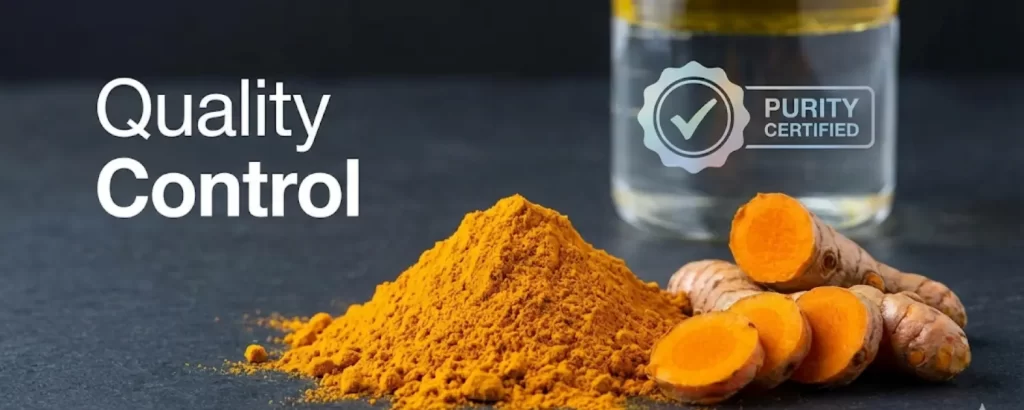
India produces nearly 80% of the world’s turmeric. While Indian turmeric powder is celebrated for its high curcumin content and medicinal properties, the market is unfortunately flooded with “adulterated” versions mixed with starch, chalk powder, or even toxic synthetic dyes like Metanil Yellow.
At Exim Internationals, we believe that transparency is the best policy. Here are five scientific and home-based methods to ensure the turmeric you are sourcing or consuming is 100% pure.
1. The Water Solubility Test (The Gold Standard)
Pure turmeric is naturally dense and behaves in a specific way when mixed with water.
The Test: Take a glass of lukewarm water and add a teaspoon of turmeric powder on the surface. Do not stir it. Leave it for 15–20 minutes.
The Result: If it is pure, the powder will slowly settle at the bottom, and the water will remain a clear, transparent yellow. If the water becomes cloudy or the powder stays floating, it likely contains added starches or chalk.
2. The Metanil Yellow Check (The Safety Test)
3. The Palm Rub Test (The Aroma & Texture Check)
Pure turmeric has a distinct physical profile that is hard to replicate.
The Test: Put a pinch of turmeric on your palm and rub it vigorously with your thumb for 10 seconds.
The Result: Pure turmeric will leave a deep, stubborn yellow stain on your skin and will feel slightly oily (due to natural essential oils). It should have a mild, earthy, and peppery aroma. If it smells like sawdust or leaves no stain, it’s highly diluted.
Import products for your Needs

4. Understanding Curcumin Levels
In 2026, the value of Indian turmeric powder is measured by its Curcumin percentage.
Standard Grade: 2% to 3% Curcumin (Good for general cooking).
Premium/Medicinal Grade: 5% to 7% Curcumin (Sourced from Lakadong or Salem varieties).
Pro Tip: Pure turmeric with high curcumin will always have a slightly darker, “golden-orange” hue rather than a bright, fluorescent yellow.
5. Laboratory Certification (B2B Requirement)
If you are an importer, manual tests aren’t enough. Always demand a Certificate of Analysis (COA) from an NABL-accredited lab. Look for:
Starch Content: Should be natural to the root, not added.
Lead & Heavy Metals: Must be within international food safety limits.
Ash Content: Total ash should not exceed 9%.
Purity Starts at the Source
Identifying pure Indian turmeric powder is about protecting your health and your brand’s reputation. At Exim Internationals, we bridge the gap between organic farmers in Erode and Salem and the global market, ensuring that every batch is Sortex-cleaned and lab-verified before it leaves Indian shores.
Would you like a sample of our 5% Curcumin “Salem Grade” turmeric powder for your own quality testing?
Frequently Asked Questions (FAQs)
1. Why does my turmeric powder look orange instead of yellow?
A deeper orange-yellow color is actually a sign of high curcumin content. Very bright, pale yellow turmeric often has lower medicinal value or may have been diluted with cornflour.
2. Can I identify pure turmeric just by looking at the packaging?
Not entirely, but look for the FSSAI logo, the Agmark seal, and “Organic” certifications (NPOP/NOP). Avoid buying unbranded, loose powder from unverified sources.
3. Does pure Indian turmeric powder dissolve in water?
No. Turmeric is not water-soluble. It is a fibrous root powder. In the water test, it should settle at the bottom, leaving the water clear but colored.
4. What is the shelf life of pure turmeric powder?
When stored in an airtight container in a cool, dark place, pure turmeric retains its potency for 12 to 18 months.
5. Which region in India produces the best turmeric powder?
Nizamabad (Telangana) and Erode (Tamil Nadu) are the hubs for commercial high-quality turmeric, while Lakadong (Meghalaya) is world-famous for the highest natural curcumin levels.
About us
Exim Internationals is a premier export company dedicated to delivering the finest products from India to international markets. Our mission is to establish India as a global export powerhouse, contributing to economic growth and showcasing the richness of Indian goods worldwide.
From the pashmina shawls and apples of the North to the spices of the South, the fruits and powders of the West, and the tea and bamboo of the East, we connect every corner of India with the global market.
Certification we have: FSSAI, APEDA, IEC, UDYAM, FIEO, Spices Board, Coconut
Contact us
Samin heritage, Sl building, Shop no. 19, Chandan wadi, Almeda road Thane west, Maharashtra, India-400601.
Email Us:support@eximinternationals.com
Call Us: +91 9820446601 | +91 9321559185