
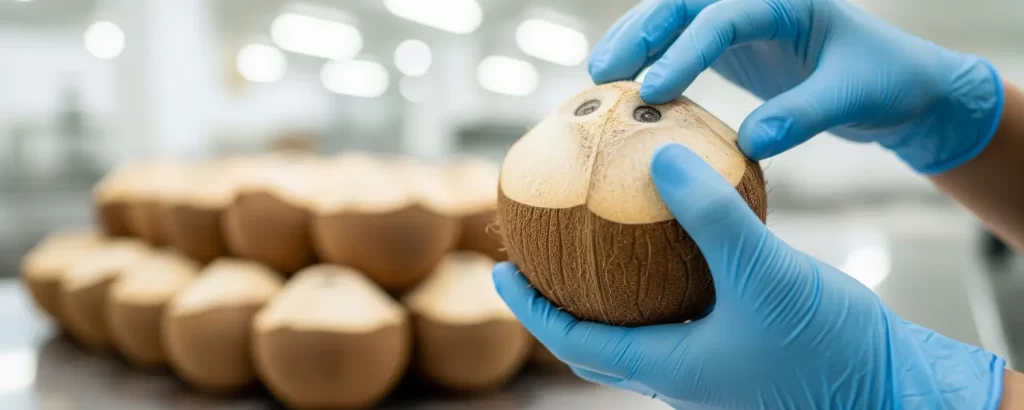
For international buyers looking to source semi husked coconut in bulk, especially from prime growing regions like India, visual inspection is a crucial first step in ensuring you’re investing in a premium product. Unlike processed goods, the quality of fresh produce like coconuts can be readily assessed by a trained eye.
As a trusted exporter of semi husked coconuts from India, with strong sourcing networks in key regions like Pollachi and Kerala, Exim Internationals understands the importance of quality. This visual guide will equip importers with the knowledge to identify high-grade semi husked coconuts, minimizing risks and ensuring customer satisfaction.
Why Visual Inspection Matters for Semi Husked Coconuts
Before delving into laboratory tests or internal checks, a thorough visual assessment can provide valuable insights into the overall health, maturity, and handling of the coconuts. This initial evaluation helps importers:
Identify Freshness: Visual cues can indicate how recently the coconut was harvested.
Detect Damage: Cracks, bruises, or signs of pest infestation are often visible externally.
Assess Maturity: The size and shape can give clues about the coconut’s maturity level.
Gauge Handling: Cleanliness and proper trimming suggest good post-harvest practices.
Key Visual Indicators of High-Quality Semi Husked Coconuts
When inspecting a batch of semi husked coconuts, pay close attention to these key visual characteristics:
1. The Husk (Semi-Husked Condition):
Cleanliness: The remaining husk should be relatively clean, free from excessive dirt, mud, or fungal growth. A clean husk indicates good handling practices.
Trim: The cut should be neat and even. Ragged or uneven cuts might suggest rushed or careless processing. The “eye” area should be clearly visible and undamaged.
Absence of Damage: Look for any signs of cuts, bruises, or cracks in the remaining husk that could compromise the integrity of the shell.
2. The Shell:
Intactness: The shell beneath the husk should be hard, smooth, and without any visible cracks or holes. Even small cracks can allow bacteria and pests to enter, reducing shelf life.
Color: The color of the shell should be uniform and typical for the variety and maturity stage. Avoid nuts with significant discoloration or dark spots.
3. The “Eyes” (Germination Pores):
Intact and Undamaged: The three “eyes” at one end of the coconut should be intact and free from any damage, punctures, or signs of germination (sprouting). Sprouting indicates the coconut is older and the water and meat quality may be compromised.
Absence of Mold: Check carefully for any mold or fungal growth around the eyes, which can be a sign of poor storage conditions.
4. Size and Shape:
Uniformity: A batch of high-quality coconuts should ideally exhibit a degree of uniformity in size and shape, indicating consistent maturity and growing conditions.
Weight (Heft): While not strictly visual, holding the coconut can give an indication of its water content. A good quality semi husked coconut should feel heavy for its size, suggesting a good amount of water inside.
5. Absence of Infestation Signs:
Holes or Sawdust: Look for small holes or sawdust-like residue on the husk or shell, which could indicate insect infestation.
Movement or Sounds: While not visual, any noticeable movement or sounds from within the coconut are clear signs of infestation.
6. Cleanliness of the Cutting Area:
No Discoloration or Mold: The area where the husk has been removed should be clean and free from any unusual discoloration or mold growth.
Import products for your Needs

The Importance of Origin and Variety
While visual inspection provides a crucial initial assessment, understanding the origin and variety of the semi husked coconut is also essential. For example, coconuts sourced from Pollachi in Tamil Nadu are often prized for their size and sweet water, while those from certain regions in Kerala might be favoured for their thicker meat. Knowing the typical visual characteristics of the specific variety you are sourcing will enhance your inspection process.
Your Eye on Quality from India
Mastering the art of visually identifying high-quality semi husked coconuts is a valuable skill for any importer. By paying close attention to the husk, shell, eyes, size, and any signs of damage or infestation, you can make more confident sourcing decisions.
At Exim Internationals, based in Pune, Maharashtra, India, we work closely with trusted coconut farmers in key regions to ensure that the semi husked coconuts we export meet the highest standards of quality. We encourage our partners to utilize these visual cues, alongside our rigorous quality control processes, to guarantee a premium product for their markets.
Looking to source high-quality semi husked coconuts from India? Contact Exim Internationals today to discuss your requirements and learn more about our quality assurance measures.
Frequently Asked Questions (FAQs)
1. What is the difference between a fully husked and a semi husked coconut?
A fully husked coconut has its entire fibrous outer layer (husk) removed, leaving only the hard shell. A semi husked coconut has a portion of the husk removed, typically around the top and bottom, making it lighter for shipping while still providing some protection.
2. Why is semi husked coconut preferred for export?
Semi husked coconuts are lighter and take up less space than fully husked coconuts, leading to lower shipping costs per unit. The remaining husk also offers some protection against damage during transit and helps extend shelf life compared to fully husked nuts.
3. What does it mean if a semi husked coconut has sprouts coming from the “eyes”?
Sprouting from the “eyes” indicates that the coconut is germinating. During germination, the coconut water and meat undergo changes, which can affect their taste and texture, making the coconut less desirable for consumption.
4. How can the weight of a semi husked coconut indicate its quality?
A good quality, fresh semi husked coconut should feel heavy for its size, indicating a high water content. A lighter weight might suggest that the coconut is older and has lost some of its water.
5. What are some common signs of damage or infestation to look for during visual inspection?
Look for cracks, bruises, soft spots on the husk or shell, small holes or sawdust-like residue indicating insect infestation, and any signs of mold or fungal growth, especially around the “eyes.”
6. Does the color of the semi husked coconut husk or shell indicate its quality?
While color can vary slightly depending on the variety and maturity, significant discoloration, very dark spots, or an unnatural appearance can be signs of spoilage or poor handling.
7. What is the significance of the “eyes” on a semi husked coconut for quality assessment?
The “eyes” are the germination pores. They should be intact and undamaged. Any signs of damage, sprouting, or mold around the eyes can indicate that the coconut is past its prime or has been stored improperly.
8. Besides visual inspection, what other quality checks are important for imported semi husked coconuts?
Besides visual inspection, other important checks include assessing the taste and smell of the coconut water and meat, testing for sugar content (Brix level) in the water, and ensuring the coconuts meet any agreed-upon size and weight specifications. Importers should also request a Phytosanitary Certificate to ensure the coconuts are free from pests and diseases.
About us
Exim Internationals is a premier export company dedicated to delivering the finest products from India to international markets. Our mission is to establish India as a global export powerhouse, contributing to economic growth and showcasing the richness of Indian goods worldwide.
From the pashmina shawls and apples of the North to the spices of the South, the fruits and powders of the West, and the tea and bamboo of the East, we connect every corner of India with the global market.
Certification we have: FSSAI, APEDA, IEC, UDYAM, FIEO, Spices Board, Coconut
Contact us
Samin heritage, Sl building, Shop no. 19, Chandan wadi, Almeda road Thane west, Maharashtra, India-400601.
Email Us:support@eximinternationals.com
Call Us: +91 9820446601 | +91 9321559185