
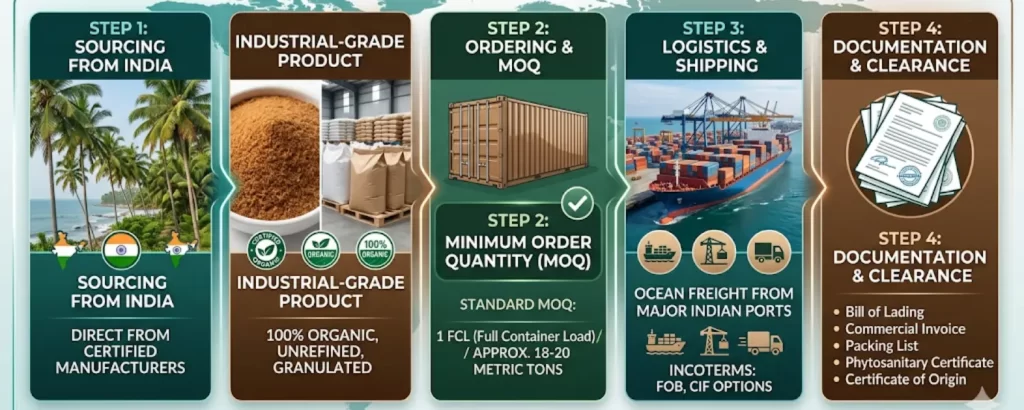
Import Logistics Overview
For procurement teams needing immediate B2B parameters, here is how the global trade process works:
Target Grade: 16-18 Mesh “Industrial Grade” (darker color, highly soluble, optimal for mixing, baking, and sauces).
Standard Packaging: 25kg multi-wall paper bags with a moisture-blocking inner poly-liner.
Standard MOQ: One 20ft Full Container Load (FCL), which holds approximately 17 to 18 Metric Tonnes.
Key Certification: Always demand an independent Certificate of Analysis (COA) to guarantee zero cane sugar adulteration.
1. Why Import Industrial Grade Coconut Sugar?
When sourcing ingredients for a protein bar, a dark sauce (like teriyaki or BBQ), or baked goods, the visual color of the raw sugar simply does not matter.
Industrial-grade coconut sugar provides the exact same nutritional profile, low-glycemic index, and rich caramel flavor as the “Premium Blonde” grade sold in high-end retail pouches. The only difference is that industrial grade is slightly darker in color due to the natural sap boiling process. By opting for this grade, manufacturers significantly lower their raw material costs while maintaining strict clean-label claims on their packaging.
2. Understanding the Standard Coconut Sugar MOQ
To get the true wholesale origin price, you must understand container economics.
While some domestic warehouse brokers will sell pallet-by-pallet, international exporters operate on a larger scale. The standard coconut sugar moq for direct import is one 20ft container (FCL).
A 20ft container comfortably fits roughly 17 to 18 Metric Tonnes of product.
Ordering Less than Container Load (LCL) is highly discouraged. LCL shipments share container space with other random goods, which increases the risk of contamination, prolongs transit times, and drastically spikes the freight cost per kilogram. Maximize your ROI by ordering full containers.
3. The Advantage of Sourcing Bulk Coconut Sugar from India
India has aggressively modernized its agricultural export sector, making it one of the safest and most reliable origins for organic sweeteners.
When you source bulk coconut sugar from india, you benefit from strict government oversight via APEDA (Agricultural and Processed Food Products Export Development Authority). Indian exporters operate high-capacity, stainless-steel sieving facilities that ensure the sugar meets the stringent hygiene and moisture standards demanded by the FDA (USA) and EFSA (Europe). By bypassing domestic brokers and importing directly from India, buyers routinely save 30% to 40% on their overall landed costs.

4. Mastering Wholesale Sugar Logistics and Packaging
The biggest enemy of granulated sugar during an ocean voyage is humidity. If the packaging fails, the sugar will clump into solid blocks inside the container.
Professional wholesale sugar logistics dictate that industrial coconut sugar must never be shipped in massive, unprotected bulk totes. Instead, it is packed into heavy-duty 25kg multi-wall paper bags. Crucially, these bags feature a specialized food-grade inner poly-liner. The sugar is deposited inside, and the liner is sealed to create an impenetrable barrier against the 85%+ humidity of the ocean environment. The moisture content of the sugar itself is strictly maintained below 2% prior to sealing, ensuring it flows perfectly into your factory silos upon arrival.
Streamline Your Import Supply Chain
Importing raw commodities requires a partner who understands the complexities of international freight, moisture control, and strict customs documentation.
At Exim Internationals, we specialize in supplying pure, unadulterated industrial-grade coconut sugar to global F&B manufacturers. From managing the 25kg poly-lined packaging to coordinating 20ft FCL shipments out of India’s major ports, we ensure your supply chain remains seamless, cost-effective, and fully certified.
Frequently Asked Questions (FAQs)
1. How do I import industrial grade coconut sugar from India?
To import directly, you need to partner with an APEDA-certified Indian exporter like Exim Internationals. You will agree on the mesh size, request a Certificate of Analysis (COA), establish a contract based on FOB or CIF pricing, and arrange for a Full Container Load (FCL) shipment to your destination port.
2. What is the standard coconut sugar moq for global export?
The standard Minimum Order Quantity (MOQ) for direct international export is one 20ft container. This accommodates approximately 17 to 18 Metric Tonnes of coconut sugar packed in 25kg bags.
3. What makes industrial grade different from premium blonde coconut sugar?
Industrial grade has the exact same purity, low glycemic index, and caramel flavor as premium grades. The only difference is its slightly darker color, making it a much more cost-effective choice for commercial baking, sauces, and mixed beverages where color is irrelevant.
4. Why should I source bulk coconut sugar from india?
India offers highly organized, APEDA-regulated agricultural infrastructure. Sourcing directly from India eliminates the heavy markups charged by local US/EU brokers, giving you direct access to pure, high-volume supply at true wholesale origin pricing.
5. How is industrial-grade coconut sugar packaged for wholesale sugar logistics?
For B2B wholesale logistics, the standard is 25kg heavy-duty, multi-wall paper bags. These bags must include an internal food-grade poly-liner that is securely tied or sealed to completely block out ocean humidity and prevent clumping.
6. Can I order Less than Container Load (LCL) for bulk coconut sugar?
While physically possible, LCL is highly discouraged for international sugar imports. It drastically increases your freight cost per kilogram and exposes your food-grade product to potential cross-contamination with other goods sharing the container. FCL is the most secure and economical method.
7. How do I verify the purity of Indian coconut sugar?
Always demand a third-party Certificate of Analysis (COA) for your specific batch before shipping. This independent lab report verifies the moisture content, mesh size, and guarantees the complete absence of cheap cane sugar adulteration.
8. What is the shelf life of industrial-grade coconut sugar?
When stored correctly in a cool, dry warehouse (away from direct sunlight and high humidity) and kept in its original sealed poly-lined packaging, industrial coconut sugar typically has a shelf life of 18 to 24 months.
9. Does industrial-grade coconut sugar dissolve easily in liquid?
Yes. High-quality export sugar is precision-sieved to a uniform 16-18 mesh size. This fine granulation ensures rapid and uniform solubility in both wet beverage formulations and dry baking mixes.
10. What are the typical payment terms for importing coconut sugar from India?
Standard B2B payment terms usually involve a Telegraphic Transfer (T/T), requiring an initial advance payment (e.g., 30%) upon signing the proforma invoice, with the remaining balance paid against the scanned copy of the Bill of Lading once the cargo has shipped.
About us
Exim Internationals is a premier export company dedicated to delivering the finest products from India to international markets. Our mission is to establish India as a global export powerhouse, contributing to economic growth and showcasing the richness of Indian goods worldwide.
From the pashmina shawls and apples of the North to the spices of the South, the fruits and powders of the West, and the tea and bamboo of the East, we connect every corner of India with the global market.
Certification we have: FSSAI, APEDA, IEC, UDYAM, FIEO, Spices Board, Coconut
Contact us
Samin heritage, Sl building, Shop no. 19, Chandan wadi, Almeda road Thane west, Maharashtra, India-400601.
Email Us: support@eximinternationals.com
Call Us: +91 9820446601 | +91 9321559185
