
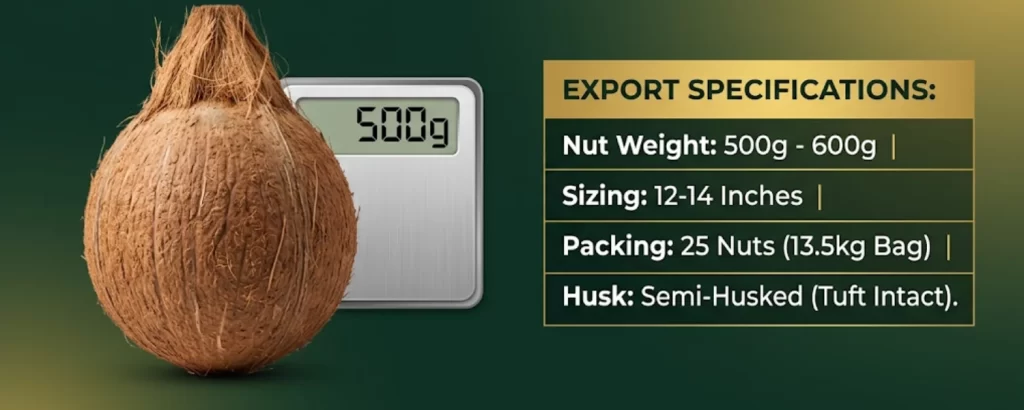
B2B Export Specifications
For quality control (QC) inspectors and buyers needing immediate data to finalize their purchase orders, here are the global baseline metrics for premium Indian semi-husked coconuts:
-
Standard Nut Weight: 500g to 600g (The global benchmark).
-
Standard Bag Weight: 13.5 kg to 14.5 kg (Contains exactly 25 uniform nuts).
-
Wholesale Sizing (Circumference): 12 to 14 inches (Measured around the equator of the nut).
-
Husk Preparation: Semi-husked (outer exocarp removed, but a crucial 1 to 2-inch tuft of fiber left intact over the “eyes”).
1. The Global Benchmark: The 500g Export Coconut
When evaluating supplier quotes, the weight of the individual nut is the most critical metric. The international gold standard is the 500g export coconut.
Why 500g? A mature coconut weighing between 500 grams and 600 grams offers the perfect commercial balance. It guarantees a thick, oil-rich kernel (meat) and a high volume of internal water. Nuts that fall below 400g are often immature, lack sufficient meat for processing, and have a significantly shorter shelf life. Professional exporters utilize automated or highly trained manual sorting lines to weigh and calibrate every single nut before bagging, ensuring zero underweight variance in your container.
2. Understanding Wholesale Coconut Sizing
Weight and size are correlated, but they are measured differently. Wholesale coconut sizing is typically determined by the circumference of the nut.
For the standard 500g-600g weight class, the circumference should consistently measure between 12 and 14 inches. Sizing is crucial for retail importers. Supermarkets demand uniformity for their fresh produce displays. If a 25-nut bag contains a visually erratic mix of 10-inch and 15-inch coconuts, it signals poor packhouse calibration and lowers the perceived value of the product on the retail floor.
3. Strict Coconut Grading Standards for B2B Importers
Weight and size mean nothing if the fruit is diseased or structurally compromised. Rigorous coconut grading standards dictate that an export-ready nut must pass the following physical inspections:
-
The Shake Test: Every export nut must emit a clear “sloshing” sound. This confirms the internal water has not evaporated and the nut is fresh. A nut with no sound is rejected.
-
The Tuft Seal: The tuft of fiber left over the three “eyes” (the germinating pores) must be completely intact. This natural plug prevents bacterial entry and stops water evaporation during the 30-day ocean voyage.
-
Shell Integrity: Zero cracks, zero fungal mold (often mitigated by proper packhouse drying), and zero signs of pest boring.
4. Packing Specifications for Ocean Transit

Conclusion: Source Calibrated Cargo with Exim Internationals
Accepting mixed-weight, uncalibrated coconuts is a massive financial risk for global importers. You need a supplier whose packhouse operations prioritize strict standardization.
At Exim Internationals, our quality control teams adhere to the tightest coconut grading standards in the Indian export market. We guarantee that every bag loaded into your container meets the strict 500g+ weight profile and sizing uniformity required to maximize your retail and processing yields.
Frequently Asked Questions (FAQs)
1. What are the exact semi husked coconut export specifications for weight? The global B2B standard requires each exported coconut to weigh between 500 grams and 600 grams. This ensures optimal maturity, a thick kernel, and high water content.
2. Why is the 500g export coconut the preferred choice for supermarkets? A 500g coconut is visually appealing, offers an excellent meat-to-water ratio for the consumer, and stacks uniformly in retail displays. It is the perfect intersection of size, quality, and freight cost-efficiency.
3. How is wholesale coconut sizing measured? Wholesale sizing is determined by wrapping a measuring tape around the widest part (the equator) of the semi-husked nut. The standard export size is a circumference of 12 to 14 inches.
4. What are the key visual coconut grading standards? Inspectors look for a clean, crack-free shell, an intact protective tuft of fiber over the top “eyes,” a uniform brown color indicating maturity, and absolutely no signs of white or green fungal mold.
5. How much does a standard 25-nut export bag weigh? When packed with calibrated 500g to 600g nuts, a standard 25-nut PP mesh bag will weigh precisely between 13.5 kg and 14.5 kg.
6. Why is a tuft of fiber left on a semi-husked coconut? The tuft covers the three “eyes” of the coconut, which are the softest and most vulnerable parts of the shell. Leaving the tuft intact acts as a natural seal, preventing the internal water from evaporating and blocking bacterial rot during ocean transit.
7. How do exporters ensure there are no “dry” nuts in a shipment? During the grading process, workers perform a manual “shake test” on every nut. If the water inside sloshes audibly, it passes. If it makes no sound, the water has evaporated, and the nut is rejected for export.
8. Can I request smaller or larger coconuts for specific processing needs? Yes. While 500g is the standard, B2B buyers who extract coconut oil or desiccated coconut may request larger, heavier nuts (600g+), while some specific retail markets may request smaller, 400g nuts. A reliable exporter will calibrate to your contract specs.
9. What packaging is required to maintain these export specifications? Coconuts must be packed in highly ventilated woven Polypropylene (PP) mesh bags. Solid bags or cardboard boxes trap moisture and heat, which will cause the coconuts to sprout or rot during a long ocean voyage.
10. How can I verify the weight and grading of my order before it ships? As a B2B buyer, you should mandate a pre-shipment inspection. Independent surveyors (like SGS) can be hired to randomly sample bags at the port, verifying that the weight, size, and grading meet the exact terms of your commercial invoice.
About us
Exim Internationals is a premier export company dedicated to delivering the finest products from India to international markets. Our mission is to establish India as a global export powerhouse, contributing to economic growth and showcasing the richness of Indian goods worldwide.
From the pashmina shawls and apples of the North to the spices of the South, the fruits and powders of the West, and the tea and bamboo of the East, we connect every corner of India with the global market.
Certification we have: FSSAI, APEDA, IEC, UDYAM, FIEO, Spices Board, Coconut
Contact us
Samin heritage, Sl building, Shop no. 19, Chandan wadi, Almeda road Thane west, Maharashtra, India-400601.
Email Us: support@eximinternationals.com
Call Us: +91 9820446601 | +91 9321559185
