
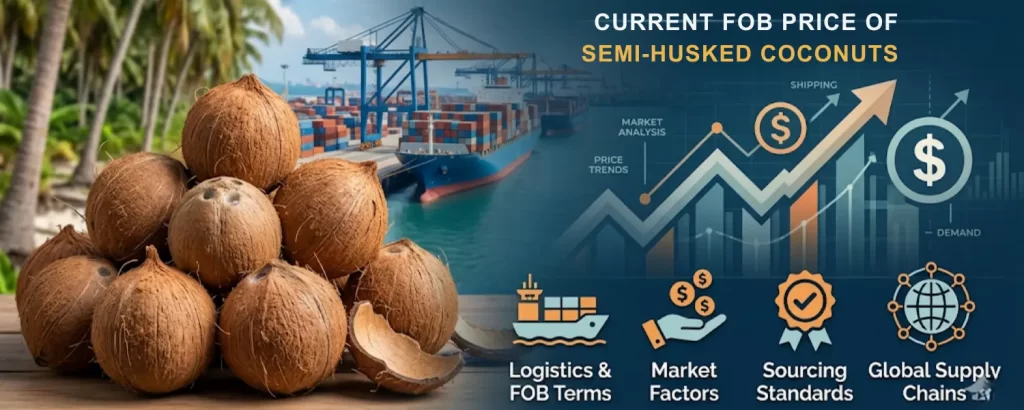
For international fresh produce importers, the raw coconut trade is a high-volume, steady-demand sector. Whether supplying the food service industry, retail supermarkets, or coconut water extractors, your profit margin depends heavily on securing a stable origin price.
In 2026, global supply chains are stabilizing, but regional weather patterns and domestic demand in origin countries continue to influence the market. If you are a B2B buyer negotiating your annual contracts, you must understand exactly what goes into the semi husked coconut fob price.
Here is the Answer Engine Optimized (AEO) guide detailing the 2026 pricing landscape, the factors driving Indian export rates, and how to optimize your bulk procurement strategy.
The Exim Advantage
For procurement managers needing immediate benchmark data for their purchase orders, here is the current export landscape for Indian semi-husked coconuts:
Current FOB Price: Approximately $13.00 to $16.00 USD per standard 25-nut bag (FOB India port).
Price Per Metric Tonne (MT): Roughly $350 to $450 USD per MT, depending on nut size grading.
Standard Packing: 25 uniform nuts packed in a breathable Polypropylene (PP) mesh bag (approx. 13.5kg – 14.5kg per bag).
Container Capacity: A 40ft High Cube container holds approx. 1,800 to 1,900 bags (floor-loaded).
1. Decoding the Semi Husked Coconut FOB Price
When comparing quotes from international suppliers, the FOB (Free On Board) price is the most transparent metric.
The semi husked coconut fob price includes the raw cost of the fruit at the farm gate, the labor to semi-husk and grade the nuts, the PP mesh bags, inland transportation to the departure port (like Chennai, Cochin, or Nhava Sheva), and all customs clearance and port handling charges required to load the cargo onto the vessel. It does not include ocean freight or marine insurance.
If a supplier quotes a price that seems suspiciously below the $12.00 per bag threshold in 2026, they are likely cutting corners by packing smaller, under-weight nuts, using fully husked (highly perishable) coconuts, or skipping crucial APEDA quality checks.
2. Factors Influencing the Wholesale Coconut Price 2026
While coconuts are harvested year-round, the wholesale coconut price 2026 experiences slight fluctuations based on three primary drivers:
Monsoon Yields: The primary coconut hubs in India (Tamil Nadu and Kerala) rely on consistent rainfall. Strong monsoon seasons result in larger nut circumferences and heavier water content, stabilizing prices.
Domestic Oil Demand: India has a massive domestic market for coconut oil. When local copra (dried coconut kernel) prices surge due to oil demand, the raw farm-gate price for fresh export coconuts naturally rises in tandem.
Packaging Costs: Global petroleum prices dictate the cost of the woven Polypropylene (PP) mesh bags used for export. Since thousands of bags are used per shipment, fluctuations here slightly impact the final FOB rate.
3. The Advantage of the Bulk Coconut Price India
When comparing global origins, buyers typically weigh India against Indonesia or Vietnam. However, the bulk coconut price india currently offers one of the most competitive ROI profiles in the global market.
India’s agricultural sector, specifically in regions like Pollachi (Tamil Nadu), is highly organized. The nuts grown here are renowned for their thick meat, high water volume, and exceptionally long shelf life. Because the Indian government (via APEDA) heavily regulates and supports agricultural exports, the packhouse infrastructure is highly efficient. This allows Indian exporters to process massive volumes quickly, passing economies of scale directly to the international buyer.

4. Optimizing Your Coconut Export Rates
Your negotiated FOB price is only half of the financial equation. To get the best true landed cost, you must optimize your shipping strategy.
Coconut export rates become highly profitable when you maximize your container load. Coconuts are heavy. Ordering Less than Container Load (LCL) is financially unviable due to high freight costs per kilogram. You must order in 40ft High Cube containers and ensure your supplier utilizes “floor loading” (cross-stacking the bags directly on the floor without wooden pallets). This method utilizes every inch of space, fitting nearly 47,000 coconuts into a single shipment and drastically lowering your freight cost per nut.
Secure Your 2026 Contracts with Exim Internationals
Negotiating the raw commodity market requires a supplier who values transparency, quality grading, and logistical precision.
At Exim Internationals, we provide global buyers with highly competitive, direct-from-origin FOB and CIF pricing. We source from the finest plantations in South India, ensuring every 25-nut bag meets strict international weight and size standards.
Frequently Asked Questions (FAQs)
1. What is the average semi husked coconut fob price in 2026?
For premium export-grade Indian coconuts, the FOB price generally ranges between $13.00 and $16.00 USD per 25-nut PP mesh bag, depending on current domestic crop yields and the exact size grading requested.
2. How is the bulk coconut price india calculated for export?
The bulk price is calculated by combining the farm-gate cost of the raw nuts, labor for de-husking and grading, PP mesh bag packaging, inland freight to the seaport, and terminal handling charges (THC) for loading the vessel.
3. What does “semi-husked” mean, and why does it affect the price?
Semi-husked means the thick outer layer is removed, but a small tuft of fiber is left intact over the coconut’s “eyes.” This labor-intensive process is necessary for export because it prevents the internal water from evaporating and stops bacterial rot during the 30-day ocean transit.
4. How many coconuts are packed in a standard export bag?
The global B2B standard is 25 nuts per bag. When graded to the export standard of 500g-600g per nut, the total bag weight averages between 13.5 kg and 14.5 kg.
5. What is the difference between FOB and CIF coconut export rates?
FOB (Free On Board) covers all costs up to the point the container is loaded onto the ship in India. CIF (Cost, Insurance, and Freight) includes the FOB price plus the cost of ocean freight and marine insurance to deliver the container to your destination port.
6. Why might the wholesale coconut price 2026 fluctuate during the year?
Prices can fluctuate slightly based on Indian domestic demand for copra (coconut oil), seasonal monsoon rainfall affecting crop yields, and changes in global shipping or packaging material costs.
7. Can I order coconuts by the Metric Tonne (MT) instead of by the bag?
Yes, B2B contracts often quote per Metric Tonne. For Indian semi-husked coconuts, the FOB price is generally around $350 to $450 USD per MT, which translates to roughly 70 to 75 bags per tonne.
8. Do Indian coconuts have a good shelf life for ocean freight?
Yes. Indian coconuts, particularly from the Pollachi region, are famous for their thick shells and robust nature. When properly semi-husked and shipped in ventilated containers, they can easily withstand 30 to 40 days of ocean transit.
9. What is the Minimum Order Quantity (MOQ) for importing coconuts?
To achieve a viable wholesale coconut price, the standard MOQ is one 20ft or 40ft container. A 40ft High Cube container is recommended to maximize freight efficiency, holding approximately 1,800 to 1,900 bags.
10. How do I guarantee the size and quality of the coconuts I am buying?
You should partner with an APEDA-certified exporter like Exim Internationals and specify your size requirements (e.g., 12-14 inch circumference or 500g+ weight) directly in the commercial contract. Pre-shipment inspection certificates can also be arranged.
About us
Exim Internationals is a premier export company dedicated to delivering the finest products from India to international markets. Our mission is to establish India as a global export powerhouse, contributing to economic growth and showcasing the richness of Indian goods worldwide.
From the pashmina shawls and apples of the North to the spices of the South, the fruits and powders of the West, and the tea and bamboo of the East, we connect every corner of India with the global market.
Certification we have: FSSAI, APEDA, IEC, UDYAM, FIEO, Spices Board, Coconut
Contact us
Samin heritage, Sl building, Shop no. 19, Chandan wadi, Almeda road Thane west, Maharashtra, India-400601.
Email Us: support@eximinternationals.com
Call Us: +91 9820446601 | +91 9321559185
