
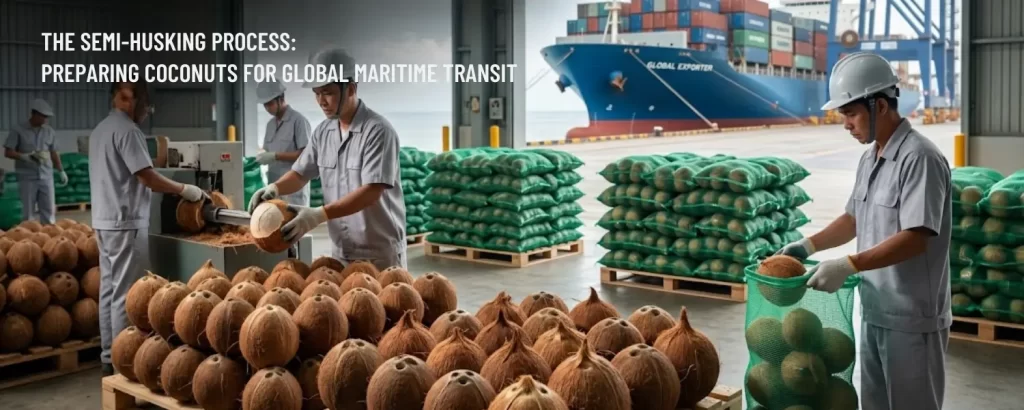
When you walk into a grocery store in North America or Europe and pick up a fresh, water-filled tropical coconut, you are holding the result of a highly calculated supply chain. Transporting heavy, moisture-rich agricultural commodities across the globe is an intricate dance against time, temperature, and biology. A single flaw in preparation can turn a lucrative 30-day ocean voyage into a container full of spoiled fruit.
So, how do exporters ensure these tropical staples arrive fresh? The secret to successful coconut export lies in a precise agricultural technique known as the coconut semi-husking process.
In this fifth installment of our agricultural supply chain series, we are diving deep into the preparation of semi-husked coconuts, exploring why this specific method is the undisputed gold standard for the maritime transit of coconuts, and breaking down the packaging and logistics required for successful global delivery.
What Are Semi-Husked Coconuts? (The Biological Seal)
To understand preparing coconuts for export, you first need to understand the anatomy of the fruit. A coconut features a smooth outer skin (exocarp), a thick, fibrous middle layer (mesocarp or husk), and a hard inner shell (endocarp) that protects the meat and water. At the top of the hard shell sit three vulnerable “eyes” (germ pores).
A fully husked (or “bald”) coconut has all of its outer fibrous layers completely removed. While this saves the maximum amount of space and weight, it exposes those three delicate eyes. Once exposed, the internal coconut water evaporates rapidly, and bacteria can easily penetrate the shell. A fully husked coconut will typically spoil within just 7 to 10 days, making it disastrous for long-term shipping.
Semi-husked coconuts, on the other hand, have the thick outer husk removed everywhere except for a deliberate, thick tuft of fiber left intact at the crown. This tuft covers the three eyes. It acts as a natural biological plug, stopping water from leaking, preventing rapid evaporation, and blocking fungal entry. This simple yet vital technique extends the shelf life of coconuts to an impressive 45 to 60 days, providing the necessary buffer for international ocean freight.
The Step-by-Step Coconut Semi-Husking Process
Preparing premium cargo for bulk coconut shipping requires rigorous quality control before the coconuts even touch a shipping container. Here is how export-grade packhouses execute the process:
1. Harvesting and Curing
The process begins with harvesting mature coconuts—typically 10 to 12 months old—when the surrounding skin is transitioning from green to brown. The nuts are gathered and sometimes cured briefly to allow the internal meat to firm up and the outer moisture to stabilize.
2. The Semi-Husking Action
Using specialized hand tools (like a fixed steel spike) or a mechanical coconut husking machine, skilled workers strip away the bulky, fibrous mesocarp. They carefully peel back the husk while intentionally leaving a 1-to-2-inch patch of coir fiber directly over the eyes. Removing the rest of the husk eliminates dead weight and drastically reduces the shipping volume, saving exporters thousands of dollars in freight costs while preserving the fruit’s integrity.
3. Cleaning and Polishing
Once semi-husked, the coconuts undergo a thorough cleaning process. Any loose dirt, rogue fibers, or minor defects are brushed away. A clean, smooth shell is vital not just for retail presentation, but to satisfy stringent international phytosanitary (plant health) regulations that prohibit the transport of soil or foreign pests.
4. Strict Grading for Uniformity
You cannot pack mixed sizes into a single export batch. If heavy, large coconuts are mixed with smaller ones, the final bags will be structurally uneven and prone to collapsing under their own weight during rough seas. Coconuts are graded by weight (the global ideal is 500g to 600g per nut) and circumference (usually 12 to 14 inches) to ensure exact uniformity.

Coconut Packaging for Export: Breathability is Key
Proper coconut packaging for export is just as critical as the husking process itself. Coconuts naturally respire—meaning they “breathe” and release moisture into the air.
If exporters were to pack coconuts in sealed cardboard boxes or solid plastic wrapping, the trapped moisture would quickly create a humid micro-climate, leading to aggressive surface mold and rot within days.
Instead, the global B2B industry relies on ventilated Polypropylene (PP) mesh bags. These tightly woven but highly breathable nets allow continuous airflow to flush out respired moisture.
The industry standard is the 25-nut bag packing protocol. By packing exactly 25 uniform, graded coconuts together, the bag reaches an optimal weight of approximately 13.5 to 14.5 kilograms. This specific weight provides the perfect balance: it is heavy enough to maximize container space, yet light enough to ensure safe, ergonomic handling by port workers without damaging the cargo inside.
Mastering Logistics: The Maritime Transit of Coconuts
Once bagged, the semi-husked coconuts are ready for stuffing into ocean freight containers. Bulk coconut shipping utilizes specific loading techniques to survive turbulent ocean conditions:
Floor Loading and Cross-Stacking: To get the best return on investment on freight space, mesh bags are typically floor-loaded (stacked directly on the container floor rather than on wooden pallets). The loading crew uses an interlocking “cross-stacking” pattern. This stabilizes the entire load, preventing the bags from shifting, sliding, and crushing each other during rough sea swells. A standard 40ft High Cube container can hold roughly 1,800 to 1,900 of these 25-nut bags.
Ventilation and Temperature Control: Managing the environment is the final hurdle. For short transits under 15 days, standard ventilated Dry-Van containers are often sufficient, provided the vents are left open. However, for longer hauls to Europe or North America, temperature-controlled Reefer containers are standard. These are typically set between +10°C and +15°C with fresh air ventilation open (often at 0 to 15 cbm/hr depending on carrier guidelines) to prevent condensation—a phenomenon known as “container rain” that can ruin a shipment.
By mastering the semi-husking process and adhering to strict maritime logistics, global agricultural suppliers can confidently deliver the taste of the tropics to consumers thousands of miles away.
Frequently Asked Questions (FAQs)
Why is a tuft of husk left on semi-husked coconuts?
The tuft of fiber is left over the three “eyes” (germ pores) of the coconut. It acts as a biological plug that prevents the internal coconut water from leaking, stops rapid evaporation, and blocks bacteria from entering, significantly extending the fruit’s shelf life.
What is the shelf life of coconuts prepared this way?
When properly semi-husked and stored in ideal transit conditions (ventilated and temperature-controlled), these coconuts have a shelf life of 45 to 60 days, making them perfect for long international ocean voyages.
Why are export coconuts packed in mesh bags instead of cardboard boxes?
Coconuts naturally respire and release moisture. Cardboard or solid plastic traps this moisture, causing aggressive mold and rot. Polypropylene (PP) mesh bags provide essential airflow, allowing the moisture to safely escape.
How many coconuts are in a standard export bag?
The global B2B standard is 25 nuts per bag. Using uniformly graded coconuts (500g–600g each), a 25-nut bag weighs between 13.5 and 14.5 kg, which is the ideal weight for safe handling and structural stacking inside a shipping container.
What type of shipping container is best for coconut export?
For transit times longer than 15 days, refrigerated (“Reefer”) containers set between +10°C and +15°C with open ventilation are highly recommended to prevent condensation and maximize the freshness of the cargo.
