For fruit importers and wholesalers in the UAE, the demand for fresh coconuts remains consistently strong. Sourcing directly from India, a major global producer, is a strategic move to ensure quality and competitive pricing. However, for a profitable import business, understanding the key commercial details is crucial.
This 2025 guide provides a transparent breakdown of the three most important factors for sourcing Semi-Husked Coconuts from India for the UAE market: Price, Minimum Order Quantity (MOQ), and Packing.
Decoding the Price of Semi-Husked Coconuts (2025 Trends)
The final price of a coconut shipment is more than just the cost per nut. It’s a combination of the product cost, freight, and quality grade.
Factor 1: FOB Price from India
The base price of the coconut itself (FOB – Free On Board) fluctuates based on seasonal factors, harvest volumes in key growing regions like Pollachi, Tamil Nadu, and domestic market demand. A reliable exporter will provide you with current, transparent pricing based on the prevailing market conditions.
Factor 2: Ocean Freight Costs
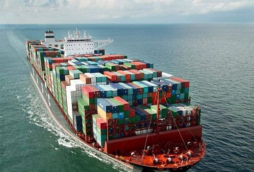
A major component of your landed cost is the ocean freight from a major Indian port like Nhava Sheva (Mumbai) to your destination, such as Jebel Ali. This is where Semi-Husked Coconuts offer a significant advantage. Because they are lighter and slightly more compact than fully husked coconuts, we can load more units per container, drastically reducing the per-unit shipping cost.
2025 Market Outlook
For the latter half of 2025, we anticipate stable pricing with robust demand from the UAE market, especially leading into the cooler months and the festive season. Engaging with a supplier now is the best way to secure favorable rates for your upcoming shipments.
Minimum Order Quantity (MOQ) for UAE Shipments
We offer flexible MOQs to suit your business needs, whether you’re placing a trial order or scaling up your supply.
Trial Orders: 20-Foot Container
We understand the need to verify quality and build trust. For new partners in the UAE, we are happy to accommodate a trial MOQ of one 20-foot container.
Approximate Load: 13–15 Metric Tons
Standard Orders: 40-Foot Container
For maximum cost-efficiency and the lowest possible freight cost per unit, our standard MOQ is one 40-foot container. This is the preferred option for our regular partners.
Approximate Load: 23–27 Metric Tons
Import products for your Needs

Expert Packing for Optimal Freshness & Shelf Life
The journey from India to the UAE requires packing that is optimized for protection, ventilation, and freshness. Our process is designed to ensure your Semi-Husked Coconuts arrive in perfect, sellable condition.
The Bagging Process: Each shipment consists of mature, graded coconuts (typically 500-650g). We pack 25 coconuts into a new, durable PP (polypropylene) woven bag. The average weight of a packed bag is between 12.5 kg and 13.5 kg.
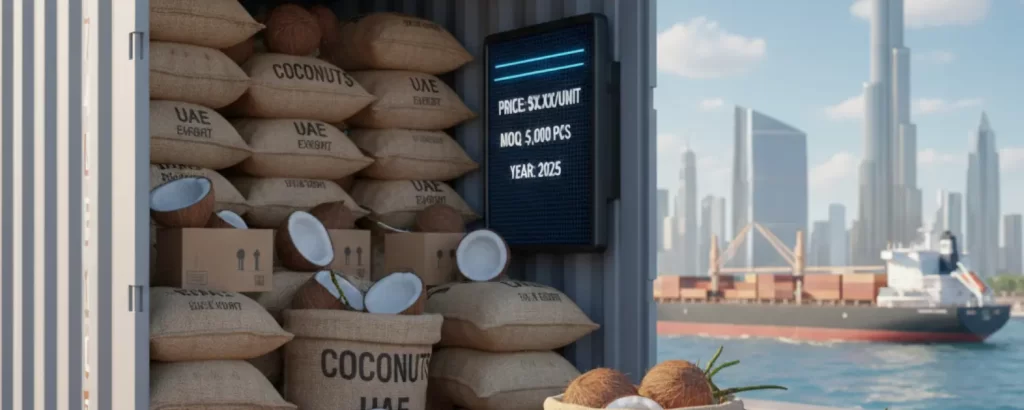
Container Stuffing: Our experienced team meticulously loads (stuffs) the bags into the container. They are stacked to ensure stability and allow for proper air circulation, which is crucial for preventing spoilage and extending shelf life during the sea voyage.
This expert packing method is our commitment to quality, ensuring the product that leaves our shores is the same high-quality product that arrives at your warehouse in the UAE.
Your Sourcing Partner for the UAE Market
Understanding the nuances of price, MOQ, and packing is the foundation of a profitable import strategy. By partnering with Exim Internationals, you are choosing a supplier that provides not only high-quality Semi-Husked Coconuts but also transparency and expertise in every shipment.
Ready to source your next container? Contact us today for a detailed, all-inclusive quote to Jebel Ali or other UAE ports.
Frequently Asked Questions (FAQs)
1. How is the final price for a shipment to Jebel Ali calculated?
The final price (often quoted as CNF or CIF) includes the FOB cost of the coconuts, ocean freight charges, and any other agreed-upon charges like insurance or inspection fees. We provide a fully transparent breakdown in our quotes.
2. Why is a 40-foot container more cost-effective for importing coconuts?
While the total cost is higher, a 40-foot container holds significantly more coconuts than a 20-foot container. This drastically reduces the shipping cost per individual coconut, making your landed cost per unit lower and your potential profit margin higher.
3. What documents are provided with the shipment for UAE customs?
Every shipment includes a standard set of export documents: the Bill of Lading, Commercial Invoice, Packing List, Certificate of Origin, and a Phytosanitary Certificate, which is mandatory for customs clearance of agricultural products in the UAE.
4. What is the typical shelf life of your semi-husked coconuts upon arrival?
Thanks to our careful selection and packing methods, our Semi-Husked Coconuts have an excellent shelf life. When stored in a cool, dry place, they can remain in good condition for over 60 days after arrival.
5. Do you ship to other ports in the UAE besides Jebel Ali?
Yes. While Jebel Ali (Dubai) is the most common destination, we can arrange shipments to other major UAE ports, including Abu Dhabi and Sharjah.
6. Where in India are your coconuts sourced from?
We source our premium export-grade coconuts from Pollachi in Tamil Nadu, which is widely regarded as India’s “Coconut Capital,” famous for producing coconuts with sweet water and thick flesh.
7. What is the approximate transit time from Nhava Sheva, India to Jebel Ali, UAE?
The sea transit time for a container vessel from Nhava Sheva Port to Jebel Ali is typically between 7 to 10 days, making it a quick and efficient route.
8. How do I get a precise quote for my company?
Simply use the “Get Container Quote” button on our page or contact us via WhatsApp. Provide your company details, desired quantity (e.g., 1 x 40′ container), and destination port. Our team will respond with a detailed quote within 24 hours.