
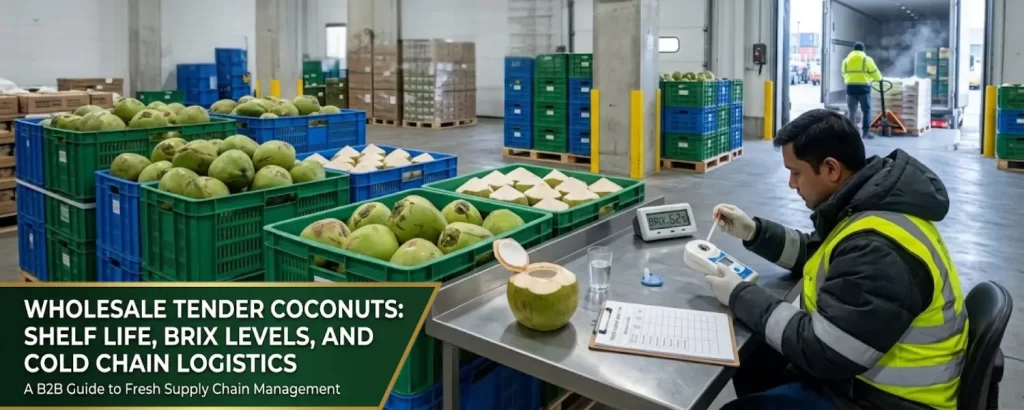
The global beverage market is experiencing a massive shift toward natural hydration, positioning wholesale tender coconuts as one of the fastest-growing premium export commodities. However, unlike fully mature, semi-husked coconuts that boast a durable shelf life, tender coconuts are highly perishable. They are living, breathing agricultural products that require clinical precision to export successfully.
For supermarket retail buyers and B2B beverage manufacturers, the challenge isn’t finding coconuts; it’s finding a supplier who can guarantee that a 40ft High Cube container of green tender coconuts won’t arrive at the destination port fermented or covered in mold.
In this technical guide, we break down the exact harvest metrics, sweetness indicators (Brix levels), and cold chain logistics required to successfully import wholesale tender coconuts with a maximized shelf life.
The Anatomy of an Export-Grade Tender Coconut
Unlike mature coconuts harvested for their thick copra (meat) and oil content, a tender coconut is harvested exclusively for its nutrient-rich water. Timing the harvest is the single most critical variable in the supply chain.
Harvest Timing and Nut Weight
To qualify for export, tender coconuts must be harvested at exactly 7 to 8 months of maturity.
Too early (under 7 months): The water will taste astringent and sour due to high phenolic compounds, and the volume will be insufficient.
Too late (over 8 months): The natural sugars begin converting into copra (jelly-like meat). The water volume drops, and the taste becomes slightly salty and flat.
An export-grade tender coconut typically weighs between 1.5 kg to 2.5 kg and guarantees a minimum water volume of 350ml to 450ml per nut.
Brix Levels: Measuring Sweetness
In the B2B beverage industry, sweetness is not subjective—it is measured scientifically using a refractometer to determine the Brix level (the percentage of dissolved sucrose in the water).
Top-tier Indian export varieties (like the Pollachi Green Dwarf) are prized because they consistently test at a Brix level of 5.5% to 7.0%. If you are a procurement director establishing SLAs (Service Level Agreements) with an exporter, stipulating a minimum Brix level of 5.5% ensures you are receiving a premium, naturally sweet product that requires no artificial additives.
Processing and Packaging for Extended Shelf Life
If you simply cut a green coconut from the tree and place it in a shipping container, it will begin rotting within 7 days. To achieve the 30-to-40-day shelf life required for international maritime transit, the coconut must be meticulously processed.
The Diamond Cut and Shrink-Wrapping Protocol
Whole green coconuts are incredibly heavy and bulky, making them inefficient to ship. Exporters solve this through the “diamond cut” process:
Trimming: The outer green exocarp and much of the fibrous husk are trimmed away using specialized blades, shaping the top of the nut into a diamond or cone shape. This removes excess transit weight and creates a flat base so the nut can stand upright on retail shelves.
Anti-Fungal Treatment: The freshly cut husk is highly susceptible to mold. The coconuts are briefly dipped in an organic, food-safe anti-fungal solution (often hydrogen peroxide or permitted food-grade coatings) to seal the exposed fibers.
Food-Grade Shrink Wrapping: Immediately after trimming and treating, each individual coconut is vacuum-shrink-wrapped in food-grade POF (Polyolefin) film. This hermetic seal serves a dual purpose: it traps the natural moisture inside the nut to prevent dehydration and acts as an absolute barrier against airborne fungal spores during transit.

Cold Chain Logistics: The Lifeblood of Tender Coconut Exports
Even with perfect harvesting and shrink-wrapping, wholesale tender coconuts will ferment if exposed to ambient heat. Once the coconut water ferments, the internal pressure will cause the nut to burst, ruining the surrounding cargo.
Maintaining an unbroken cold chain from the APEDA-certified packhouse to the destination port is non-negotiable.
Reefer Container Settings
Tender coconuts must be loaded into pre-cooled refrigerated (reefer) containers. The setpoints are much colder than those used for mature coconuts or bananas:
Optimal Temperature: 4°C to 5°C (39°F to 41°F)
Ventilation: Closed (0 CBM/hour). Because the nuts are individually shrink-wrapped, they are largely dormant and do not require fresh air exchange. In fact, introducing outside air can introduce unwanted humidity fluctuations.
The Impact of Cold Chain Breaks
If the temperature spikes above 8°C during inland transport or due to a reefer malfunction on the vessel, the enzymatic breakdown of the coconut water accelerates exponentially. The sugars will ferment into alcohol, altering the pH and destroying the commercial viability of the shipment.
Sourcing with Confidence
Sourcing wholesale tender coconuts requires far more logistical oversight than dry agricultural goods. B2B buyers must partner with origin-verified exporters who control the entire process—from timing the harvest for optimal Brix levels to managing the delicate shrink-wrapping and pre-cooling protocols.
By demanding strict adherence to these temperature and packaging standards in your purchasing contracts, you can confidently import premium tender coconuts that command top-tier retail pricing, without the crippling cost of transit spoilage.
Frequently Asked Questions (FAQs)
What is the standard shelf life of an exported tender coconut?
When properly diamond-cut, shrink-wrapped, and maintained in an unbroken cold chain at 4°C to 5°C, export-grade tender coconuts have a viable shelf life of 30 to 40 days.
What is a Brix level, and why does it matter for tender coconuts?
Brix is a scientific measurement of the dissolved sugar content (sweetness) in a liquid. For tender coconuts, a Brix level of 5.5% to 7.0% guarantees the naturally sweet flavor profile demanded by premium retail and beverage markets.
Why are exported tender coconuts shrink-wrapped in plastic?
Shrink-wrapping is critical for two reasons: it locks in the nut’s natural moisture to prevent it from drying out and cracking, and it acts as a hermetic barrier against airborne mold and fungal spores during ocean transit.
What temperature should a reefer container be set to for tender coconuts?
The reefer container must be strictly maintained between 4°C and 5°C (39°F to 41°F). Temperatures below 2°C risk freezing and expanding the water (cracking the nut), while temperatures above 8°C will cause the water to rapidly ferment.
How much water is inside an export-grade tender coconut?
properly harvested export-grade tender coconut (weighing 1.5kg to 2.5kg) typically yields between 350ml and 450ml of premium coconut water.
