
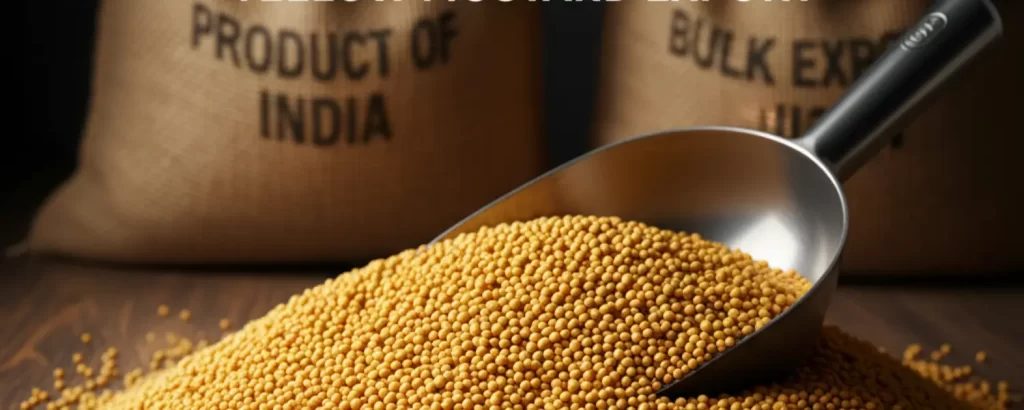
For global condiment manufacturers, the key to a perfect American-style mustard or a mild, flavourful pickling spice is a consistent supply of high-quality Yellow Mustard seeds (Sinapis alba). As a buyer, navigating the international market to secure this essential ingredient requires a clear understanding of three core commercial factors: Price, Specifications, and Minimum Order Quantity (MOQ).
As we are now in the middle of the sowing season (October 2025) for the next Indian crop, this is the perfect time to plan your procurement. This 2026 buyer’s guide provides the transparent, expert insights you need to make smart sourcing decisions for the upcoming harvest.
Part 1: Price - Decoding the 2026 Market for Yellow Mustard
The final landed cost of your bulk yellow mustard shipment is determined by several key factors.
Harvest Outlook: The 2025 monsoon season has been favourable across India’s primary mustard-growing regions. This has created excellent soil moisture for the current sowing season, leading to an optimistic forecast for a healthy crop in the 2026 harvest (Feb-Mar). A stable supply generally leads to a more stable market price.
Grade & Quality: Higher purity grades (e.g., 99.5%) will command a premium over standard grades (99%).
Freight Costs: The cost of a container load from a major Indian port like Nhava Sheva to your destination is a significant component. We provide transparent CNF (Cost and Freight) pricing so you can calculate your final cost with confidence.
2026 Price Forecast: We anticipate a stable market for the 2026 season, supported by strong demand from the global food processing industry. The smartest strategy for buyers is to engage with suppliers now to discuss volume requirements and secure contracts before the post-harvest rush.
Part 2: Specs - Defining Export-Quality Yellow Mustard
“Export quality” is a standard defined by measurable data. When you source yellow mustard, these are the specifications that matter:
| Specification | Details |
| Product | Yellow Mustard Seeds (Sinapis alba) |
| Purity | Standard: 99% / Premium: 99.5% (Machine Cleaned) |
| Moisture Content | < 10-12% (Crucial for preventing mould and ensuring shelf life) |
| Colour | Uniform, bright golden yellow |
| Condition | Whole, clean seeds free from admixture and insect damage |
A reputable exporter will always provide a Certificate of Analysis (COA) from an independent laboratory to scientifically verify these specifications for your shipment.
Import products for your Needs

Part 3: MOQ - Minimum Order Quantity for Bulk Shipments
For cost-effective international trade, we work with standard container sizes.
Standard MOQ: 40-Foot Container This is the most common and cost-effective option for regular importers, holding approximately 25-27 Metric Tons. The larger volume significantly reduces the per-ton shipping cost.
Trial Order: 20-Foot Container We understand the need to verify quality. For new partners, we can accommodate a trial order of one 20-foot container, which holds approximately 13-14 Metric Tons.
Your Strategic Partner for the 2026 Season
A successful import strategy for yellow mustard is built on a clear understanding of market prices, precise quality specifications, and efficient logistics. By planning your procurement now, during the critical sowing season, you can secure a reliable supply chain for the entire year ahead.
Ready to plan your 2026 procurement of high-quality Indian yellow mustard? Contact Exim Internationals today for a detailed quote and the latest insights from the field.
Frequently Asked Questions (FAQs)
1. What is the main difference between yellow mustard and brown mustard?
Yellow mustard (Sinapis alba) is mild and is the primary ingredient for classic American-style yellow mustard. Brown mustard (Brassica juncea) is much more pungent and is used to make Dijon mustard and spicier condiments.
2. What is the primary use of yellow mustard seeds in food manufacturing?
Their primary use is in the production of prepared mustard condiments. They are also widely used whole in pickling brines and as a seasoning in various food products.
3. When is the harvest season for the 2026 yellow mustard crop in India?
The current sowing season is October-November 2025. The crop will be harvested from February to March 2026.
4. What is a Certificate of Analysis (COA)?
A COA is a lab report from a third-party testing agency that scientifically verifies the key quality specifications of the shipment, such as its purity and moisture content. It is your guarantee of quality.
5. What documents are required to import yellow mustard from India?
You will need a Bill of Lading, Commercial Invoice, Packing List, Certificate of Origin, and a mandatory Phytosanitary Certificate to ensure the product is free from pests and diseases.
6. How are bulk yellow mustard seeds packed for export?
They are typically packed in new, clean 25 kg or 50 kg PP (Polypropylene) or jute bags. This ensures the product is protected and easy to handle.
7. Why is a 40-foot container more cost-effective?
While the total freight cost is higher, a 40-foot container holds nearly double the product of a 20-foot container. This significantly reduces your shipping cost per metric ton, making your final landed cost more competitive.
8. How do I get a quote for a container of yellow mustard?
Simply contact us with your required grade (e.g., 99.5% purity), total quantity (e.g., 1 x 40′ container), and your destination port. Our team will provide a detailed quote based on the latest market data for the upcoming season.