
In the world of natural sweeteners, coconut sugar (often called coconut palm sugar) has gained a “halo effect.” It is frequently found in organic bakeries and keto-friendly snack bars. To understand its true value, we need to look past the marketing and examine the nutritional data.
1. The Glycemic Index (GI) Factor
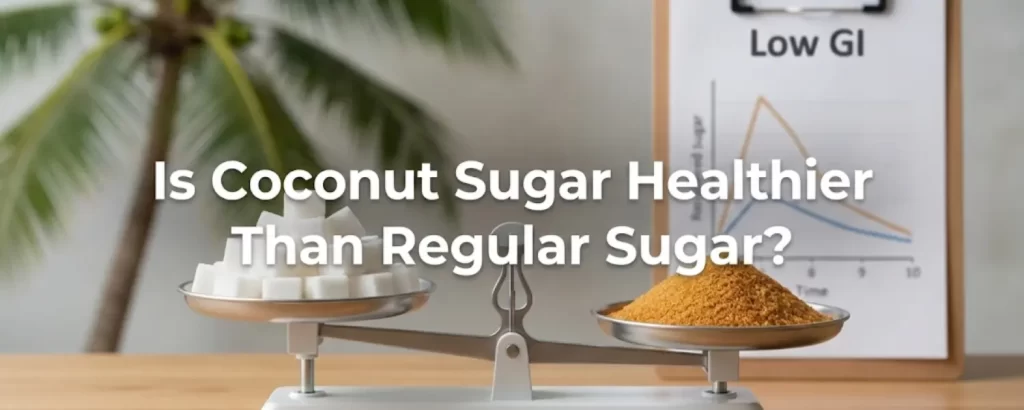
The most significant health claim for coconut sugar is its low Glycemic Index. The GI measures how quickly a food raises your blood sugar levels.
Regular Table Sugar: Has a GI of approximately 60–65.
Coconut Sugar: Typically ranks between 35 and 54.
Why this matters: Because coconut sugar has a lower GI, it causes a slower, more gradual rise in blood sugar rather than the “spike and crash” associated with refined white sugar. This makes it a preferred option for individuals managing insulin sensitivity or those looking to avoid energy slumps.
2. The Secret Weapon: Inulin
Why does coconut sugar have a lower GI despite being mostly sucrose? The answer is Inulin. Inulin is a type of prebiotic fiber found in the coconut sap. It slows down glucose absorption in the gut. While you won’t get your daily fiber intake from a spoonful of sugar, this naturally occurring fiber is the primary reason coconut sugar behaves differently in your body than white sugar.
3. Nutrient Density: More Than Empty Calories
Refined white sugar is often called “empty calories” because the refining process strips away all vitamins and minerals. Coconut sugar, being minimally processed, retains trace amounts of nutrients from the coconut palm:
Iron and Zinc: Essential for immune function.
Potassium: Helps with blood pressure regulation.
Calcium: Vital for bone health.
Antioxidants: Polyphenols that help fight oxidative stress.
Import products for your Needs

4. Side-by-Side Comparison
| Feature | Regular White Sugar | Coconut Sugar |
| Processing | Highly Refined (Bleached) | Minimally Processed (Dehydrated Sap) |
| Glycemic Index | 60 – 65 (High) | 35 – 54 (Low/Medium) |
| Nutrients | None | Trace Minerals & Antioxidants |
| Fiber | None | Contains Inulin (Prebiotic) |
| Flavor Profile | Neutral Sweetness | Deep Toffee/Caramel Notes |
The Honest Truth: It is Still Sugar
While coconut sugar is undeniably better than regular sugar, it is not a “superfood.”
Calories: It contains roughly 16 calories per teaspoon, which is nearly identical to white sugar.
Fructose: It is still roughly 70% to 80% sucrose. Consuming it in excess will have the same metabolic impact as over-consuming any other sugar.
The Verdict: If you are choosing a sweetener for your 2026 wellness routine, coconut sugar is the superior choice because of its lower GI and mineral content. However, moderation remains the key to a healthy lifestyle.
A Win for Clean Labeling
For food manufacturers and home bakers, coconut sugar offers a way to provide sweetness with a “cleaner” label. It provides a rich, caramel-like flavor that enhances coffee, chocolate, and baked goods in a way that plain white sugar cannot.
At Exim Internationals, we source our coconut sugar from sustainable farms that prioritize traditional evaporation methods to preserve every bit of natural goodness.
Would you like to receive our 2026 nutritional analysis report for our bulk organic coconut sugar?
Frequently Asked Questions (FAQs)
1. Is coconut sugar safe for diabetics?
While it has a lower GI, coconut sugar still contains carbohydrates and calories. People with diabetes should consult their doctor and treat it as a sugar source, albeit a slightly better one.
2. Does coconut sugar taste like coconut?
Surprisingly, no! It does not taste like coconut fruit. It has a flavor profile very similar to brown sugar or palm sugar, with deep notes of caramel and butterscotch.
3. Can I substitute coconut sugar 1:1 for white sugar?
Yes. In most recipes, you can replace white or brown sugar with coconut sugar in a 1:1 ratio. Note that since it is brown, it may slightly darken the color of your baked goods.
4. Is coconut sugar “Keto”?
While many people on Paleo or “Clean Eating” diets use it, it is generally not considered strictly Keto because it still contains significant carbohydrates.
5. Why is coconut sugar more expensive than regular sugar?
It is a labor-intensive product. Tappers must climb trees twice a day to collect sap by hand, and the evaporation process is much slower than the industrial milling used for sugarcane.
About us
Exim Internationals is a premier export company dedicated to delivering the finest products from India to international markets. Our mission is to establish India as a global export powerhouse, contributing to economic growth and showcasing the richness of Indian goods worldwide.
From the pashmina shawls and apples of the North to the spices of the South, the fruits and powders of the West, and the tea and bamboo of the East, we connect every corner of India with the global market.
Certification we have: FSSAI, APEDA, IEC, UDYAM, FIEO, Spices Board, Coconut
Contact us
Samin heritage, Sl building, Shop no. 19, Chandan wadi, Almeda road Thane west, Maharashtra, India-400601.
Email Us: support@eximinternationals.com
Call Us: +91 9820446601 | +91 9321559185

