
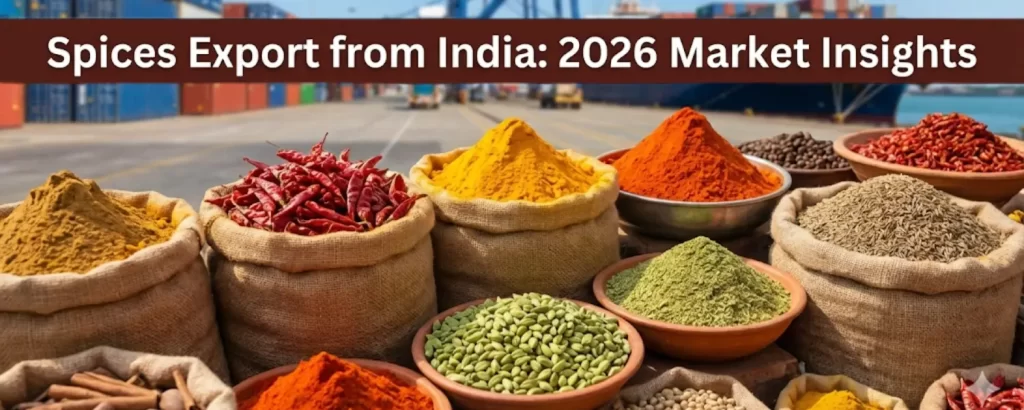
India is not just a producer; it is the global heart of the spice trade. In 2025, Indian spice exports reached an all-time high of $4.72 billion, driven by a surging global demand for wellness-oriented ingredients and a supply gap in competing origins.
For international B2B buyers-whether you are a retail chain in the UAE or a food manufacturer in the USA-understanding the current landscape of spices export from India is the key to securing a high-margin supply chain.
1. Top Spices Driving the 2026 Export Basket
While India exports over 52 different spices, four “heavyweights” dominate the current trade volume:
Chilli (The Volume Leader): India produces over 40% of the world’s chillies. The “Guntur Teja” variety remains the top choice for hot sauce manufacturers due to its intense pungency and vibrant red color.
Cardamom (The 2026 Surge): Due to a major crop failure in Guatemala (India’s primary competitor), Indian cardamom exports nearly doubled in the 2025-2026 season. Buyers are currently locking in Kerala-grown cardamom for its superior green color and higher volatile oil content.
Turmeric (The Wellness King): With the world focusing on immunity, Indian turmeric—specifically the Nizamabad and Erode varieties—is in high demand for its high curcumin content (above 3.5%).
Cumin (The Flavor Anchor): Sourced primarily from Gujarat and Rajasthan, Indian cumin is prized for its high purity levels and earthy aroma, essential for European spice blends.
2. Quality Benchmarks: Meeting Global Standards
In 2026, “cheap” spice is a liability. Global importers now prioritize MRL (Maximum Residue Limits) compliance for pesticides and microbial safety. To ensure your shipment clears customs in the EU or USA, look for these three pillars of quality:
Steam Sterilization: Unlike older chemical methods, steam sterilization is the preferred organic-compliant method to reduce microbial loads without losing flavor.
Sortex Cleaning: This optical sorting technology ensures 99.5% to 99.9% purity, removing stones, stalks, and discolored seeds that can ruin a batch.
Spices Board CRES Certification: All legitimate spices export from India must be backed by the Spices Board’s Certificate of Registration as Exporter of Spices (CRES).
Import products for your Needs

3. Strategic Hubs: Why Dubai and the USA Lead Demand
The UAE, specifically Dubai, acts as the world’s most efficient re-export hub for Indian spices. In 2026, Dubai-based traders are increasingly importing bulk Indian whole spices, value-adding them through high-end packaging, and re-shipping them to Africa and Europe.
Meanwhile, the US market is shifting toward Spice Oils and Oleoresins. Instead of whole pods, US food techs are sourcing concentrated extracts for use in ready-to-eat meals, ensuring flavor consistency across massive production lines.
4. Mandatory Documentation Checklist
If you are beginning your journey in spices export from India, your documentation must be flawless to avoid port delays:
IEC (Importer Exporter Code): Issued by the DGFT.
Phytosanitary Certificate: Confirming the shipment is free from quarantine pests.
Certificate of Analysis (COA): Detailing moisture, oil content, and purity.
FSSAI License: Mandatory for all food-grade products.
Frequently Asked Questions (FAQs)
1. Why has the price of Indian cardamom increased in 2026?
The price surge is primarily due to a supply shortage in Central America (Guatemala), leading to a global dependence on Indian “Small Green” cardamom. Current average auction prices have stayed strong between ₹2,300 and ₹2,600 per kg.
2. What is the difference between “Singapore Quality” and “Europe Quality” cumin?
“Singapore Quality” typically implies 99% purity (machine cleaned), while “Europe Quality” requires 99.5% purity (Sortex cleaned) and stricter testing for pesticide residues to meet EU standards.
3. Can Indian spices be exported in ground form?
Yes, but ground spices have a shorter shelf life. Most B2B buyers prefer importing whole spices and grinding them locally to preserve volatile oils, or sourcing “Milled-to-Order” batches that are ground just days before shipment.
4. How do I find a reliable spice exporter in India?
Always verify their Spices Board CRES registration, check for ISO 22000 or HACCP certifications, and request a lab report from an NABL-accredited laboratory for their current stock.
5. What is the MOQ (Minimum Order Quantity) for spice exports?
For sea freight (FCL/LCL), the MOQ is usually 1 to 5 metric tons. For high-value spices like cardamom or saffron, air freight shipments can start as low as 100 kg.
About us
Exim Internationals is a premier export company dedicated to delivering the finest products from India to international markets. Our mission is to establish India as a global export powerhouse, contributing to economic growth and showcasing the richness of Indian goods worldwide.
From the pashmina shawls and apples of the North to the spices of the South, the fruits and powders of the West, and the tea and bamboo of the East, we connect every corner of India with the global market.
Certification we have: FSSAI, APEDA, IEC, UDYAM, FIEO, Spices Board, Coconut
Contact us
Samin heritage, Sl building, Shop no. 19, Chandan wadi, Almeda road Thane west, Maharashtra, India-400601.
Email Us: support@eximinternationals.com
Call Us: +91 9820446601 | +91 9321559185

