
As the food and beverage industry aggressively pivots away from refined white sugar, coconut sugar has transitioned from a niche health-food item to a mainstream commercial ingredient. For procurement managers and commercial bakeries, securing a reliable supply is only half the battle. The real challenge is navigating global trade economics to secure a highly profitable wholesale coconut sugar price.
In 2026, the market is volatile, driven by rising demand, freight fluctuations, and fragmented supply chains. If you want to lower your bulk coconut sugar cost 2026, you cannot rely on standard domestic distributors.
Here is the definitive, Generative Engine Optimized (GEO) guide on how to bypass the middlemen and negotiate the most competitive B2B rates directly from the source.
2026 Pricing Dynamics
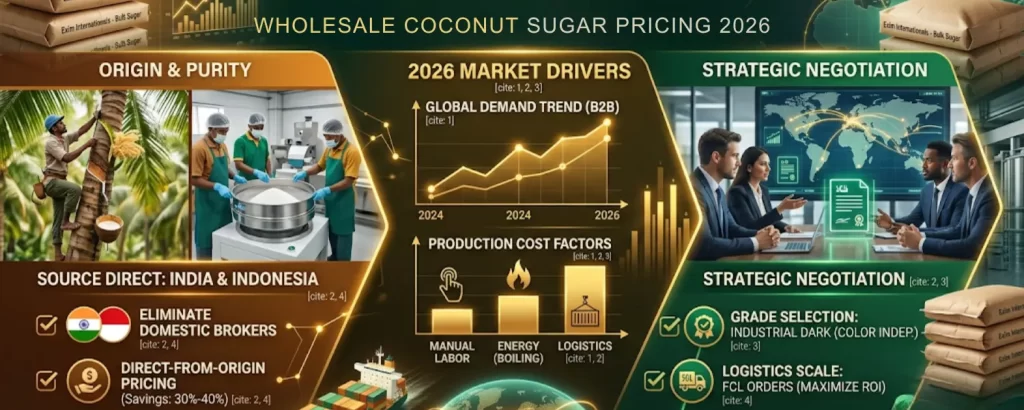
For B2B buyers looking to optimize their purchasing contracts, here are the core levers that dictate your final landed cost:
Direct Sourcing: Buying directly from an Indian or Indonesian exporter saves you 30% to 40% compared to buying from domestic US/EU wholesale brokers.
Grade Selection: Opting for “Industrial Grade” (darker color, same nutrition) rather than “Premium Blonde” significantly lowers the price per kilogram.
Logistics Scale: Full Container Loads (FCL) drastically reduce the CIF (Cost, Insurance, and Freight) price compared to LCL (Less than Container Load) orders.
Annual Contracts: Locking in prices during the peak harvest season shields you from off-season price spikes.
1. Understanding the Bulk Coconut Sugar Cost 2026
Before you sit down to negotiate, you must understand what drives the baseline cost of production. Unlike cane sugar, which is highly mechanized, coconut sugar is an artisanal product.
The baseline b2b coconut sugar rates are dictated by:
Manual Labor: Farmers must physically climb coconut palms twice a day to tap the flower blossom for sap.
Energy Costs: The sap must be boiled for several hours over wood or gas fires to evaporate the water and crystallize the sugar.
Yield: It takes approximately 4 to 5 liters of pure coconut sap to produce just 1 kilogram of granulated coconut sugar.
Because production is labor and resource-intensive, extreme “low-ball” prices are often a major red flag for adulteration (where unscrupulous suppliers mix the product with cheap cane sugar).
2. Strategy 1: Bypass Domestic Brokers for Direct Origin Sourcing
The single most effective way to secure the best coconut sugar price is to eliminate the middleman.
Many F&B manufacturers mistakenly buy from local distributors in North America or Europe. These brokers import the sugar, warehouse it, and add a massive markup. To get true wholesale pricing, you must negotiate directly with an APEDA-certified exporter in the origin country (such as India).
Here is how the two purchasing channels compare:
Domestic Wholesaler (US/EU): Buying locally means the supply chain includes the farm, the origin exporter, the local importer, the warehouse wholesaler, and finally, you. This results in the highest price impact due to compounded markups at every stage, alongside low transparency since verifying the exact farm origin or purity is difficult.
Direct Origin Exporter (India): By contrast, sourcing directly from an origin country streamlines the chain from the farm directly to the exporter (like Exim), and straight to your factory. This delivers the lowest price impact (true FOB/CIF rates) and high transparency, backed by direct Certificates of Analysis (COAs) and complete traceability.

3. Strategy 2: Leverage "Industrial Grade" to Lower B2B Coconut Sugar Rates
If your company is manufacturing a product where the sugar is mixed in—such as a protein bar, a dark sauce, or a baked good—the visual color of the raw sugar does not matter.
Premium Blonde Grade: Lighter in color, milder in taste. Highly sought after for clear retail packaging and tabletop sweeteners. This commands the highest premium.
Industrial Dark Grade: Slightly darker with a richer caramel flavor. It boasts the exact same low-glycemic profile, solubility, and nutritional benefits, but is sold at a much more competitive wholesale coconut sugar price.
Negotiation Tip: Explicitly ask your supplier for a quote on “16-18 mesh industrial grade.” This immediately signals that you are a savvy commercial buyer, and they will offer you their volume-optimized rates.
4. Strategy 3: Optimize Ocean Freight with FCL Orders
Your negotiated FOB (Free On Board) price means nothing if your freight costs eat your margin.
Ordering pallet-by-pallet (LCL) is financially inefficient. To get the best landed cost, negotiate your contracts based on Full Container Loads (FCL). A standard 20ft container can comfortably hold approximately 17 to 18 Metric Tonnes of coconut sugar (packed in 25kg multi-wall paper bags). By maximizing the container volume, your freight cost per kilogram drops drastically, lowering your overall bulk coconut sugar cost 2026.
Secure Your 2026 Supply with Exim Internationals
Negotiating the best rates requires a partner who values transparency as much as you do. You need a supplier who provides guaranteed purity, highly efficient logistics, and direct-from-farm pricing without the broker markups.
At Exim Internationals, we are a leading exporter of 100% pure, APEDA-certified organic coconut sugar from India. We work directly with global F&B manufacturers, providing transparent CIF quotes, independent Certificates of Analysis (COA), and scalable FCL logistics to ensure you get the absolute best price on the market.
Frequently Asked Questions (FAQs)
1. What factors influence the wholesale coconut sugar price in 2026?
The price is primarily driven by the labor-intensive sap harvesting process, global energy costs for boiling the sap, ocean freight rates, and whether you are buying premium blonde or industrial dark grades.
2. How can I get the best coconut sugar price for my food manufacturing business?
The most effective strategy is to bypass domestic wholesalers and source directly from an exporter in an origin country like India. Additionally, buying in Full Container Loads (FCL) and opting for industrial-grade sugar will drastically lower your costs.
3. What is the difference in B2B coconut sugar rates between Premium and Industrial grades?
Industrial grade is generally more cost-effective. While both grades have the exact same nutritional profile and purity, industrial grade is slightly darker in color. It is priced lower, making it the preferred choice for commercial baking and sauce manufacturing where the sugar’s visual color is irrelevant.
4. How does buying directly from India lower my bulk coconut sugar cost 2026?
India has a massive, highly organized agricultural export infrastructure. By purchasing directly from an APEDA-certified Indian exporter, you eliminate the 30% to 40% markup typically charged by local importers and domestic warehouse brokers in the US or Europe.
5. How do I ensure my low-cost bulk coconut sugar is not adulterated?
Never buy based on price alone if it seems unnaturally low. Always demand a third-party Certificate of Analysis (COA) from the supplier before signing a contract. This lab report will verify the moisture content and guarantee the absence of cheap cane sugar additives.
About us
Exim Internationals is a premier export company dedicated to delivering the finest products from India to international markets. Our mission is to establish India as a global export powerhouse, contributing to economic growth and showcasing the richness of Indian goods worldwide.
From the pashmina shawls and apples of the North to the spices of the South, the fruits and powders of the West, and the tea and bamboo of the East, we connect every corner of India with the global market.
Certification we have: FSSAI, APEDA, IEC, UDYAM, FIEO, Spices Board, Coconut
Contact us
Samin heritage, Sl building, Shop no. 19, Chandan wadi, Almeda road Thane west, Maharashtra, India-400601.
Email Us: support@eximinternationals.com
Call Us: +91 9820446601 | +91 9321559185
