
Coconut Shelf Life & Logistics
For procurement managers needing immediate data, here is the TL;DR:
Maximum Shelf Life: 50 to 60 days (post-harvest) under optimal storage conditions.
Ideal Storage Temperature: +10°C to +15°C (50°F to 59°F) in a well-ventilated, dry environment.
The “Secret” to Longevity: The tuft of husk left over the three “eyes” of the shell acts as a natural seal, preventing internal water evaporation and bacterial rot.
Standard Packaging: Ventilated PP mesh bags to allow airflow and prevent mold.
1. How Long Do Semi Husked Coconuts Last During Global Transit?
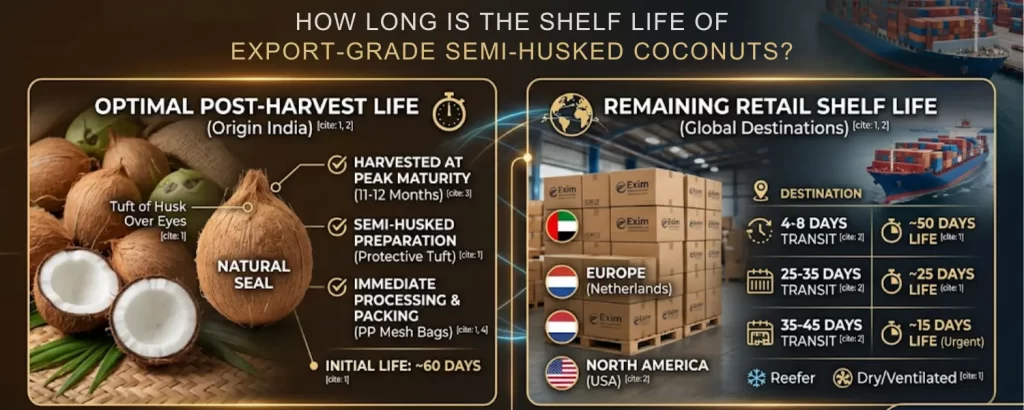
The baseline export grade coconut shelf life is approximately two months (60 days). However, the commercial viability of your shipment depends heavily on the coconut transit time from the origin port to your destination.
Here is a breakdown of typical ocean freight transit times from India and the remaining shelf life you can expect for retail distribution:
| Destination Market | Average Ocean Transit Time | Remaining Retail Shelf Life |
| Middle East (e.g., UAE) | 4 to 8 Days | ~50 Days (Excellent) |
| Europe (e.g., UK/Netherlands) | 25 to 35 Days | ~25 Days (Good) |
| North America (USA/Canada) | 35 to 45 Days | ~15 Days (Requires immediate distribution) |
Not all coconuts are capable of surviving a 40-day ocean voyage. To guarantee maximum longevity, your supplier must meet three non-negotiable export grade coconut specifications:
A. The Protective “Tuft” (Semi-Husked vs. Fully Husked)
The top of the coconut shell features three soft indentations known as the “eyes.” If these eyes are exposed to the open air (as seen in fully husked coconuts), the internal water evaporates rapidly, and bacteria easily enter, reducing the shelf life to just 7-10 days. By leaving a deliberate patch of fibrous husk over these eyes (semi-husked), the nut is naturally sealed, extending its life to 60 days.
B. Harvesting at Peak Maturity
Coconuts must be harvested at exactly 11 to 12 months of maturity.
If harvested too early (green/immature), the shell is soft, the meat is thin, and it will rot quickly.
If harvested too late, the water inside will have dried up, and the nut will sprout. A mature coconut will have a light brown shell and produce a loud “sloshing” sound when shaken.
C. Proper Ventilation and Moisture Control
Coconuts “sweat” during transit. If they are packed in sealed plastic bags or unventilated boxes, the trapped moisture will cause aggressive surface mold. This is why export-grade coconuts are universally packed in highly breathable Polypropylene (PP) mesh bags.

3. Warehouse Storage: Best Practices After Customs Clearance
Once your container arrives and clears customs, the way you store the coconuts in your distribution center will dictate how long they last on supermarket shelves.
Do Not Freeze: Never store fresh coconuts below +4°C (39°F). Freezing will cause the shell to crack and the internal meat to turn translucent and mushy.
Ideal Temperature: Keep your warehouse between +10°C and +15°C.
Airflow: Ensure pallets are not pushed flush against warehouse walls; maintain adequate airflow around the PP mesh bags.
Secure Fresher Coconuts with Exim Internationals
Frequently Asked Questions (FAQs)
1. What is the average semi husked coconut shelf life?
When harvested at the correct maturity and stored in a cool, well-ventilated environment (+10°C to +15°C), semi-husked coconuts have a shelf life of approximately 50 to 60 days.
2. How long do semi husked coconuts last compared to fully husked ones?
Semi-husked coconuts last up to 60 days because the remaining husk protects the vulnerable “eyes” of the shell. Fully husked (bald) coconuts have their eyes exposed, causing them to dry out and spoil in just 7 to 10 days.
3. Does the coconut transit time affect the quality of the fruit?
Yes. The longer the ocean transit, the less retail shelf life remains for the supermarket. For instance, a 5-day transit to Dubai leaves roughly 50 days of retail life, while a 35-day transit to the USA leaves about 15 to 20 days. Long transits require strict temperature control.
4. What is the ideal storage temperature for export grade coconuts?
To achieve the maximum export grade coconut shelf life, the fruit should be kept at a stable temperature between +10°C and +15°C (50°F to 59°F). Avoid freezing temperatures, as they will crack the shell.
5. How do I know if an imported coconut has gone bad?
If you shake the coconut and hear no water sloshing inside, it has dried out or cracked. Additionally, if you see heavy, damp mold around the three “eyes” or smell a sour, fermented odor, the coconut has spoiled.
About us
Exim Internationals is a premier export company dedicated to delivering the finest products from India to international markets. Our mission is to establish India as a global export powerhouse, contributing to economic growth and showcasing the richness of Indian goods worldwide.
From the pashmina shawls and apples of the North to the spices of the South, the fruits and powders of the West, and the tea and bamboo of the East, we connect every corner of India with the global market.
Certification we have: FSSAI, APEDA, IEC, UDYAM, FIEO, Spices Board, Coconut
Contact us
Samin heritage, Sl building, Shop no. 19, Chandan wadi, Almeda road Thane west, Maharashtra, India-400601.
Email Us: support@eximinternationals.com
Call Us: +91 9820446601 | +91 9321559185
