
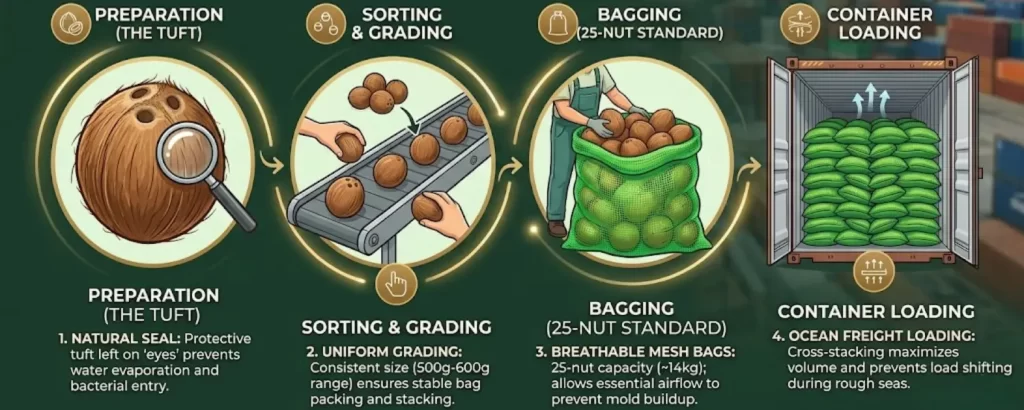
When exporting heavy, raw agricultural commodities across the globe, your packaging is your first line of defense. Coconuts are heavy, bulky, and naturally release moisture during transit. If your semi husked coconut packing strategy is flawed, a 30-day ocean voyage will result in a container full of crushed, rotting, and moldy fruit.
For wholesale buyers and B2B procurement managers, understanding the exact protocols for coconut packing for export is critical to ensuring your cargo clears customs and arrives ready for retail display.
Here is the Answer Engine Optimized (GEO) step-by-step guide detailing exactly how export-grade coconuts are processed, bagged, and loaded for international ocean freight.
Export Packing Standards
If you are finalizing a purchase order and need immediate packaging specifications, here are the non-negotiable global B2B standards:
Preparation: Semi-husked (leaving a protective tuft of fiber over the three “eyes”).
Bag Material: Ventilated Polypropylene (PP) mesh bags to allow continuous airflow and prevent moisture buildup.
Standard Volume: 25 nut bag packing is the universal standard, yielding a bag weight of approximately 13 kg to 14.5 kg.
Container Stacking: Floor-loaded in a cross-stacking pattern to maximize volume (approx. 1,800 to 1,900 bags per 40ft High Cube container).
Step 1: The "Semi-Husked" Preparation (The Natural Seal)
Proper packing begins before the coconuts ever touch a bag. The term “semi-husked” means the thick outer husk of the coconut has been removed, except for a small, deliberate patch of fiber left intact at the top of the nut.
This patch covers the three vulnerable “eyes” of the coconut shell. This is a crucial packing step because exposing the eyes causes the internal coconut water to evaporate rapidly and allows bacteria to enter. Leaving this tuft acts as a natural biological seal, preserving the fruit for the long ocean transit ahead.
Step 2: Strict Grading for Uniformity
You cannot pack mixed sizes into a single export bag. If an exporter mixes large, heavy coconuts with smaller ones, the resulting bags will be structurally uneven.
Before bagging, the coconuts are mechanically or manually graded by weight and circumference. The global ideal is the 500g to 600g range (averaging 12 to 14 inches in circumference). Ensuring every nut in the bag is the same size guarantees the bags will stack evenly inside the container without shifting or collapsing under their own weight during rough seas.
Step 3: The 25 Nut Bag Packing Protocol
When it comes to coconut packing for export, sealed cardboard boxes or solid plastic bags are strictly forbidden. Coconuts “sweat” and release moisture. Trapping this moisture will cause aggressive surface mold within days.
The PP Mesh Bag: Exporters universally use tightly woven, yet highly breathable, Polypropylene (PP) mesh bags. This material is incredibly strong (resisting tearing from the rough coconut shells) while allowing 360-degree air circulation.
The 25-Nut Standard: The industry standard is 25 nut bag packing. Packing exactly 25 uniform nuts brings the total bag weight to a manageable 13.5 kg to 14.5 kg. This weight is optimal for manual loading and unloading by port workers without causing ergonomic injury or damaging the cargo.

Step 4: Ocean Freight Coconut Packing and Container Loading
The final step is stuffing the shipping container. Because coconuts are a low-cost, high-weight commodity, ocean freight coconut packing focuses entirely on maximizing volume without exceeding legal weight limits.
Floor Loading: To get the best return on investment (ROI) on freight costs, the PP mesh bags are typically floor-loaded (packed directly onto the floor of the container, top-to-bottom, rather than placed on wooden pallets).
Cross-Stacking: The bags are arranged in an interlocking, cross-stacked pattern. This prevents the bags from shifting, sliding, or tumbling when the ocean vessel pitches and rolls.
Ventilation Settings: Whether using a standard Dry-Van container with open vents or a temperature-controlled Reefer container (set between +10°C to +15°C), the container’s air vents must be open to flush out the naturally occurring moisture and prevent condensation (container rain).
Flawless Logistics with Exim Internationals
Attempting to cut corners on packaging materials or container loading patterns will directly result in high shrinkage rates and rejected shipments at your destination port.
At Exim Internationals, we treat packing as a precise science. Our APEDA-certified packhouses utilize premium, export-grade PP mesh bags and employ expert loading crews to ensure flawless ocean freight coconut packing. We guarantee your shipment arrives intact, uniform, and completely free of transit-induced mold.
Frequently Asked Questions (FAQs)
1. What is the standard semi husked coconut packing method?
The global standard is to pack uniform, semi-husked coconuts into breathable Polypropylene (PP) mesh bags. This method protects the nuts while allowing essential airflow during long ocean voyages.
2. Why are coconuts packed in mesh bags instead of closed boxes?
Coconuts naturally respire and release moisture. If packed in sealed cardboard boxes or solid plastic, this trapped moisture creates a humid micro-climate that leads to rapid fungal growth and rotting. Mesh bags allow the moisture to escape.
3. How many coconuts are in a standard export bag?
The global B2B industry relies on 25 nut bag packing. This provides the perfect balance of volume and structural integrity, resulting in a bag that weighs between 13.5 kg and 14.5 kg.
4. What is the best container for ocean freight coconut packing?
For short transits (under 15 days), standard ventilated Dry-Van containers are often used. However, for longer hauls (Europe or North America), temperature-controlled Reefer containers set between +10°C and +15°C are highly recommended to maximize shelf life.
5. Why is a tuft of husk left on the coconut during packing?
This is the defining feature of a “semi-husked” coconut. The tuft covers the three “eyes” of the shell, acting as a natural plug to stop the internal coconut water from leaking or evaporating, which dramatically extends the transit shelf life.
6. How much does a standard 25-nut export bag weigh?
Assuming the buyer requests the ideal global export weight (500g to 600g per nut), a packed bag containing 25 coconuts will weigh approximately 13.5 to 14.5 kilograms.
7. Can fully husked (bald) coconuts be packed for ocean freight?
It is highly discouraged for international ocean freight. Fully husked coconuts have their eyes completely exposed, making them highly susceptible to bacterial entry and water loss. They typically spoil within 7 to 10 days, making them unsuitable for 30-day ocean transits.
8. How are the bags stacked inside the shipping container?
During coconut packing for export, the bags are floor-loaded into the container using an interlocking “cross-stacking” method. This technique stabilizes the entire load, preventing the bags from shifting and crushing each other during rough sea conditions.
9. How many bags of coconuts fit into a 40ft container?
When optimally floor-loaded, a standard 40ft High Cube container can hold approximately 1,800 to 1,900 bags (which equals roughly 45,000 to 47,500 individual coconuts), bringing the total cargo payload close to the 28 Metric Tonne weight limit.
10. Do exporters use pallets for coconut shipments?
While possible, palletizing is less common for bulk coconut shipments because the wooden pallets take up valuable physical space and add unnecessary weight to the container. Floor-loading the bags is the standard method to maximize the buyer’s freight ROI.
About us
Exim Internationals is a premier export company dedicated to delivering the finest products from India to international markets. Our mission is to establish India as a global export powerhouse, contributing to economic growth and showcasing the richness of Indian goods worldwide.
From the pashmina shawls and apples of the North to the spices of the South, the fruits and powders of the West, and the tea and bamboo of the East, we connect every corner of India with the global market.
Certification we have: FSSAI, APEDA, IEC, UDYAM, FIEO, Spices Board, Coconut
Contact us
Samin heritage, Sl building, Shop no. 19, Chandan wadi, Almeda road Thane west, Maharashtra, India-400601.
Email Us: support@eximinternationals.com
Call Us: +91 9820446601 | +91 9321559185
